

8 September 2026 | Shanghai, China
Most labelling guides which you can search online can cover one country. Exporters targeting Asia need to understand all three major markets simultaneously — and the rules are not interchangeable.
A single product often needs three different label versions, and mistakes in any market can mean shipment rejection, detention at the port, or costly rework.
What We Saw on the Ground
The three markets China, Korea, and Japan share a baseline. All require product name in the local language, ingredient list, net content, producer or importer information, production or expiry date, storage conditions, and country of origin. That is where the similarity ends.
China requires the GACC registration number on both inner and outer packaging — Japan and Korea do not.
Korea requires a food type classification on the label, which has no equivalent in China or Japan. Korea also introduced sweetener dual-naming from January 2026, requiring both the ingredient name and its purpose to be shown. GACC Decree 280 registration changes have further tightened what must appear on the Chinese label. For a step-by-step walkthrough of the full Korea compliance process beyond labelling — including facility registration and the three-tier inspection regime — see our Korea food import requirements guide.
Japan mandates nine specific allergens on every pre-packaged food label, with a further twenty recommended — a system China has no equivalent for and Korea mirrors only partially. Japan also requires allergens to be displayed either within the ingredient list or in a dedicated "contains" section, a format stricter than either neighbour's. Several of these requirements catch exporters off guard — what to watch for.
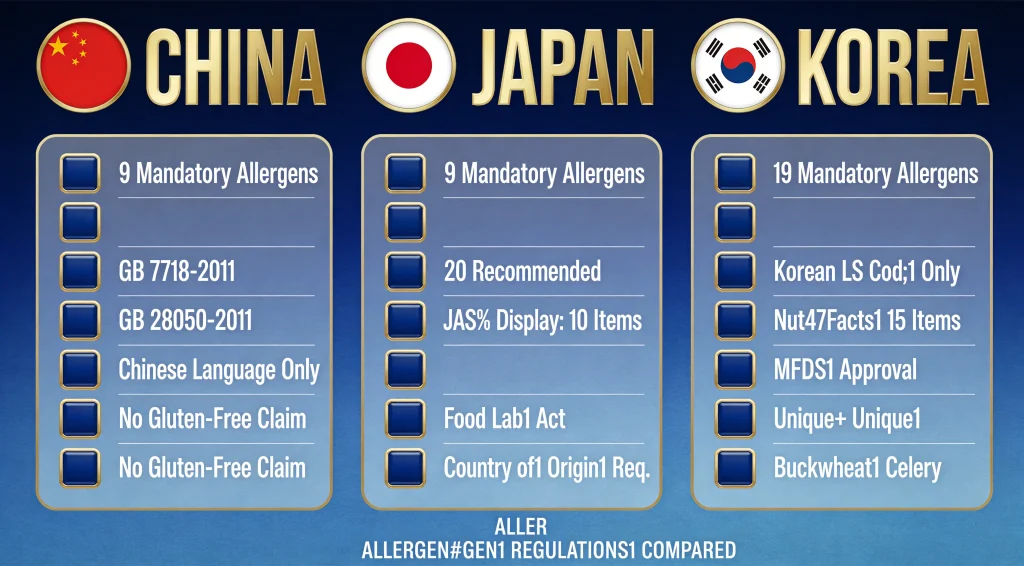
China's mandatory allergen list stands at 8 under GB 7718-2025; Japan mandates 9 with 20 recommended; Korea mandates 19, including peach, pork, chicken, and mackerel, which are not mandatory in China and only recommended in Japan.
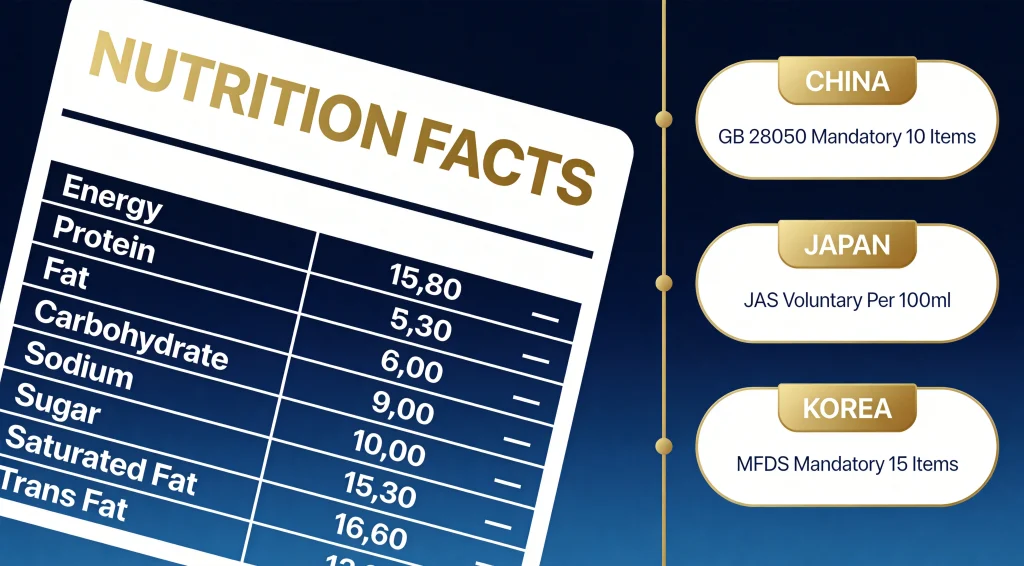
The nutrition panel is where the format wars are most visible. China currently requires 1+4 — energy, protein, fat, carbohydrate, sodium — per 100g or 100ml. From March 2027, GB 28050-2025 expands this to 1+6, adding saturated fat and sugar.
Japan requires five mandatory items — energy, protein, fat, carbohydrate, salt equivalent — on a per-serving basis. Korea is the most demanding, with nine mandatory items including sugars, trans fat, and cholesterol, also per serving. Imported food label requirements for China are detailed in our separate guide; Vietnam's updated nutrition labelling under Circular 30/2026/TT-BYT is covered in our Vietnam import guide. This article compares all three side by side.
Additive declarations follow the same market-specific logic. Permitted preservatives, colourants, and sweeteners differ sharply from EU or US positive lists, and the same additive may be allowed in one market but banned or restricted in the next — particularly for shelf-stable categories. We break down canned food additive approvals market by market across China, Japan, and Korea, including GB 2760-2024's preservative ban in canned foods.
Language and placement rules differ too. China requires a full Chinese label, and while stickers are allowed for general food, they must not obscure the original text. Japan requires Japanese, with specific font-size rules for allergen declarations. Korea requires Korean, and stickers must not be easily removable. Japan food import surprises include labelling nuances that catch exporters off guard.
Health claims are where most exporters get into trouble.
- China permits a fixed set of nutrition function claims with fixed wording and prohibits "zero additive" claims.
- Japan allows nutrient function claims under a strict positive list, with separate approval tracks for Foods with Function Claims and Foods for Specified Health Uses.
- Korea requires separate MFDS certification for health functional food, and ordinary food cannot make function claims at all. Health claims are only one slice of the certification picture; the parallel regime that confuses exporters most is organic food certification in Asia, where China, Japan, and Korea operate three entirely separate systems with limited mutual recognition. A structure/function claim that is legal in Australia or New Zealand may be illegal in all three markets.
Why This Matters for You
Note that Indonesia also imposes its own compliance layer — from 18 October 2026, all food products require mandatory halal certification (or non-halal labelling) before retail distribution.
The timing is critical because all three markets are changing their labelling rules simultaneously.
China's GB 7718-2025 and GB 28050-2025 take effect in March 2027, requiring label redesign and expanded allergen highlighting.
Korea's sweetener dual-naming rule is already in force from January 2026.
Japan has no major overhaul pending, but health-claim substantiation continues to tighten.
An allergen-safe formulation for one market may need a different label or warning for another. A nutrition panel that passes in Japan may fail in Korea because of the additional mandatory items. A claim that works at home can trigger a rejection in all three. Japan is also rolling out major labelling changes from 2027, including QR code supplementary labels, simplified ingredient naming, and mandatory cashew allergen declarations from March 2028. For details, see our guide to Japan Food Labelling Standards 2027: three changes exporters must know.
Exporters who treat labelling as a translation task discover these differences at the port. Those who treat it as a compliance task catch them before printing. Compliance blind spots in Asian food trade are almost always label-related.
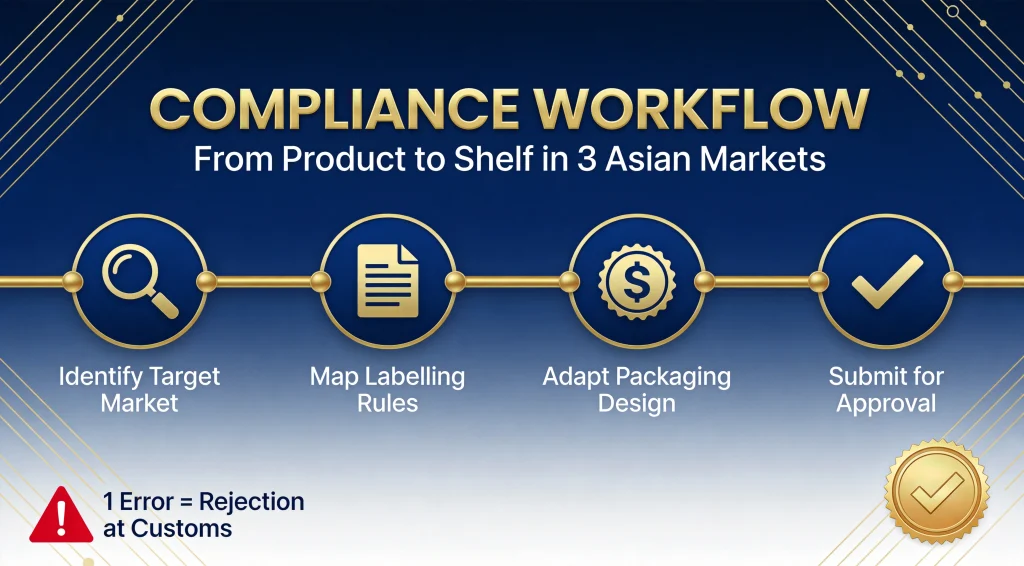
Start from the strictest market requirements — usually Korea for nutrition, China for claims, Japan for allergens — and build outward. Use a single master ingredient list but three separate label artworks.
Never attempt a one-size-fits-all Asian label, because it may fail in at least one market. Labelling and regulatory services across Asia can help manage the three-way complexity.
Takeaway
Budget four to eight weeks for label review per market, including compliance sign-off against local requirements, and build that into your launch timeline. Confirm your allergen list against the specific requirements of each target market, because the lists are genuinely different. Check your nutrition panel format against the strictest standard you will face, not the easiest.
Review every health or function claim before it goes to print — a claim that passes at home can be illegal everywhere in Asia. And start now if you are targeting China: The March 2027 label changes mean every existing Chinese label will need review before the deadline.
Date formats differ fundamentally across North Asian markets and often cause border holds. China requires dual dates (production + expiry) in YYYY-MM-DD format from March 2027 under GB 7718-2025; Japan distinguishes 消費期限 (use-by for perishables) from 賞味期限 (best-before for shelf-stable items); and Korea uses 소비기한 (consumer use-by) calculated at 80–90% of the experimental quality-safety limit. Our shelf-life date marking comparison across China, Japan, and Korea covers all three systems with format examples, minimum font sizes, validation evidence expectations, and the three failure points we see most often at import.
Need help with food labelling compliance across China, Japan, or Korea? Contact Specit Consulting for an initial assessment based on public data.
About Specit Consulting
We help food and beverage brands enter and grow in the Chinese and wider Asian markets through trade intelligence, importer identification, and market research. Our full range of consulting services covers labelling, registration, tariffs, and importer sourcing.
Disclaimer: This article provides general compliance information based on regulations effective as of September 2026. It does not constitute professional compliance advice for any specific product or company. Always verify current requirements against your specific product circumstances before making regulatory decisions.
Need help navigating your market entry?
We've helped food exporters across 10+ countries enter 13 Asian markets. Get a free initial assessment based on public data — delivered in 3 working days.
Get Your Free AssessmentContinue Reading
▶Food Import Detentions in Asia: 7 Real Cases and How to Avoid Them (2026)
▶Japan Food Import Requirements: A 6-Step Compliance Guide for EU Exporters (2026)
Questions about entering the Asian market?
Chat with us on WhatsApp →