


24 September 2026 | Shanghai, China
At Specit Consulting, we work with food exporters targeting Asian markets across 13 countries. Canned and preserved products are consistently treated as one of the "easier" categories by exporters entering the region — shelf-stable, no cold chain, lower phytosanitary barriers than fresh produce, and often lower per-unit logistics costs. But this apparent simplicity masks a more demanding compliance picture than most exporters anticipate.
The risk for canned food is not tariffs. It is the formulation and the label. Additive standards differ sharply across China, Japan, Korea, and Southeast Asia. Date marking rules are in transition in the region's largest market. Shelf-life validation expectations are tightening. BPA and can-coating regulations are advancing at different speeds across markets. And because canned products are often shipped as long-shelf-life staples intended for multi-month distribution, a compliance issue identified at import may not surface until the product is already on retail shelves — triggering costly recalls and importer liability.
For European and other non-Asian exporters, the most common mistake is assuming that a formulation that meets EU additive regulations and carries a compliant EU label can be distributed across Asian markets with only translation changes. It cannot. Reformulation is required more often than not, and the cost of discovering this at the port rather than before shipment is measured in detained containers, destroyed product, and lost distributor relationships.
Asia's Canned Food Market: Where Demand Is Concentrated
Canned food imports into Asia are not a single market. Demand patterns differ sharply between China, Japan, Korea, and Southeast Asia, and the category winners vary by market.
In China, canned product imports show clear segmentation. Prepared or preserved fruit and nuts under HS 2008 (prepared/preserved fruit and nuts not elsewhere specified) is the largest import category among canned products, reaching RMB 66.52 million in July 2026. Canned peaches — a category where China itself is a major exporter — show volatile import flows, reaching RMB 2.70 million in June 2026 against a historical monthly average around RMB 8.69 million, with a low of RMB 0.19 million in February 2025 reflecting seasonal and supply patterns. Canned vegetables and mixtures show steady but lower-volume demand; other prepared/preserved vegetables reached RMB 1.20 million in May 2026, with seasonal peaks above RMB 3.7 million. Canned meat and aquatic products are smaller in volume but face a tighter regulatory pathway, with beef/offal canned products at RMB 1.36 million in June 2026 and pork canned products at RMB 0.57 million in March 2026.[1]
For exporters, the commercial structure matters: fruit and vegetable canned categories see high competition from Chinese domestic producers (China is itself one of the world's largest canned fruit exporters) and therefore lower per-unit margins, while aquatic and meat canned products face higher regulatory barriers — including GACC Decree 280 competent-authority registration requirements — but carry potentially higher margins and less domestic competition. Across all categories, additive and labelling enforcement has tightened since early 2025.
Japan is a mature and sophisticated canned food market with high product-quality expectations and strict additive enforcement. Korea's canned food imports are smaller but growing, with particular demand for imported canned seafood, fruit, and prepared Western-style products. Southeast Asia is both a major canned food exporter (Thailand is one of the world's largest tuna canners) and a growing import market, with additive and Halal requirements creating additional compliance layers.
Additive Standards: The Biggest Hidden Barrier for Canned Products
Food additive regulation is the single most common source of detention and rejection for canned foods across Asian markets, and the rules are not harmonised. There is no "Asian additive standard" equivalent to the EU's unified additive Regulation (EC) No 1333/2008. Each market maintains its own positive list, its own categorisation of food types, and its own enforcement approach.
A canned product formulated to EU specifications can be non-compliant in China, Japan, and Korea simultaneously — but for different reasons in each market.
China: GB 2760-2024 and the ban on preservatives in canned foods
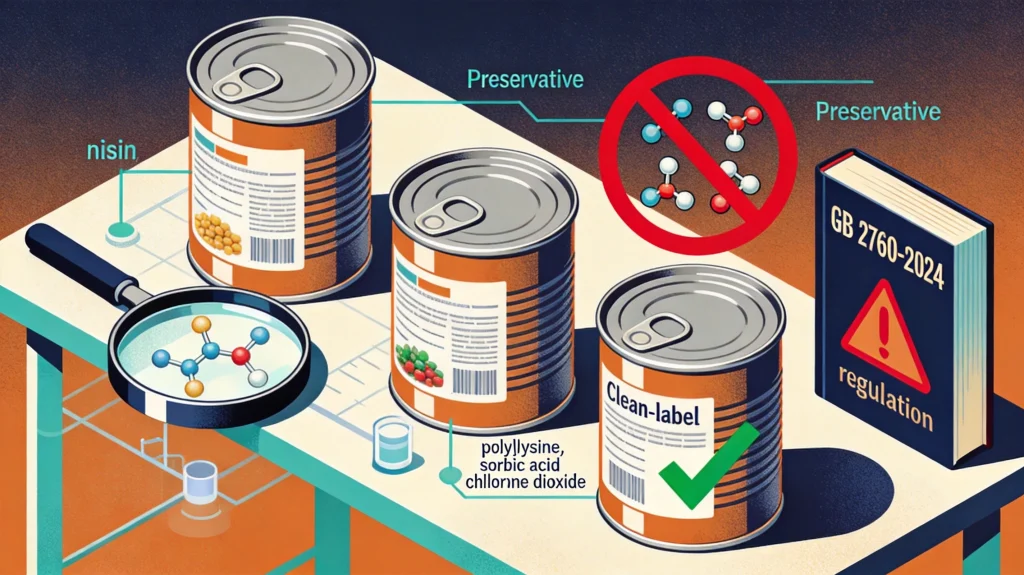
The single most important change for canned food exporters to China in the past two years is GB 2760-2024, the revised National Food Safety Standard for the Use of Food Additives, published in February 2024 and effective from 8 February 2025.[2] The change that most directly affects canned products is the prohibition of preservatives in canned foods.
Under the new standard, preservatives are no longer permitted in the canned food category. This specifically removes permission for:
- ε-polylysine hydrochloride (ε-聚赖氨酸盐酸盐)
- Nisin (乳酸链球菌素, nisin)
- Sorbic acid and potassium sorbate (山梨酸及其钾盐)
- Stabilised chlorine dioxide (稳定态二氧化氯)
The regulatory logic is straightforward: canned foods achieve commercial sterility and preservation through heat treatment (retorting) and hermetic sealing, not through added chemical preservatives. GB 7098-2015 (the National Food Safety Standard for Canned Foods) already requires that sealed semi-finished canned products be sterilised within 2 hours of sealing. Adding chemical preservatives to a properly retorted canned product is redundant — and under GB 2760-2024, it is no longer permitted.[3]
For European and other exporters accustomed to using preservatives (even at very low levels) as an additional hurdle in canned products for other markets, this is a reformulation requirement. It is not a labelling issue; the preservative must be physically removed from the formulation for products bound for China.
Other GB 2760-2024 changes affecting canned and preserved products include:
- Removal of certain colours from approved lists, including beet red (落葵红), mistletoe yellow / buddleja yellow (密蒙黄), and jujube colour (酸枣色) — these colours may no longer be used in any food category in China.[2]
- Prohibition of dehydroacetic acid (脱氢乙酸) in baked goods and prepared meats — relevant for canned meat and preserved prepared-food products.
- Stricter controls on sweetener combinations: when multiple sweeteners are used in combination (e.g., aspartame and acesulfame potassium), the sum of ratios to their respective maximum permitted levels cannot exceed 1 — meaning the combined use is limited more tightly than under the previous standard.
- Removal of azodicarbonamide (ADC, 偶氮甲酰胺) as a flour treatment agent — relevant for canned products containing flour-based ingredients such as sauces or baked components.
Japan: The positive list and "undesignated additive" enforcement
Japan operates one of the strictest additive positive-list systems in the world under the Food Sanitation Act. Only additives that appear on the Ministry of Health, Labour and Welfare (MHLW) published list of designated additives, or on the list of existing food additives, are permitted for use in food sold in Japan. Any additive used legally in the exporting country but not present on these lists is classified as an "undesignated additive" (指定外添加物) and renders the food in violation of Article 12 of the Food Sanitation Act — even if the additive is present in trace amounts.[4]
Enforcement is active, targeted, and well documented. Japanese prefectural public health institutes conduct routine monitoring of imported foods. Import violation statistics published by MHLW consistently identify additive violations as one of the leading categories of import non-compliance. Four additives appear with particular frequency in canned and processed food violations:
- TBHQ (tert-butylhydroquinone): Widely used as an antioxidant in oils and oil-containing foods in many markets (including China, the United States, and parts of the EU under specific conditions), but not designated as a food additive in Japan. Even trace detection (as low as 0.001 g/kg) constitutes a violation. Canned products with added oil components, oil-packed canned fish, and canned products using oil-treated ingredients are particularly at risk.[4]
- Cyclamic acid and its salts (cyclamates, サイクラミン酸): Banned in Japan since 1969 but still permitted as a sweetener in the EU (under Restriction of Use), parts of Asia, and Central/South America. Canned fruit, desserts, and beverages containing cyclamates are routinely flagged.
- Undesignated synthetic colours: Including Orange G, Ponceau R (Ponceau 3R), Azorubine (Carmoisine) at levels above permitted categories, Quinoline Yellow, and Patent Blue V. These may appear in syrups, pickled vegetables, and coloured canned fruit products.
- Sulphur dioxide overuse: Sulphur dioxide is a designated additive in Japan but with strict use limits; canned preserved fruit and vegetable products with excessive residual SO₂ are a recurring violation category.[5]
The practical implication is that an ingredient list review against the Japanese designated additive list is required for every canned product before shipment to Japan. Flowing from EU formulation without this review is high-risk.
Korea: The MFDS Food Additives Code
Korea maintains its own Food Additives Code (식품첨가물의 기준 및 규격) under MFDS, most recently substantively updated by MFDS Notification No. 2025-15 (March 2025) with further amendments through Public Notice No. 2026-50 in July 2026.[6] The Korean system is a positive list with product-category-specific use limits defined in detail.
Key considerations for canned food exporters to Korea:
- Categorisation matters: Korea's food category system for additive purposes does not map one-to-one to HS codes or to EU food categories. A product classified for additive purposes as "canned fruit" in Europe may fall under a different Korean subcategory with different permitted additives and limits.
- Preservative permissions differ from China: Korea permits certain preservatives in specific canned food categories (e.g., sorbic acid in some canned processed foods at defined limits), but the list of permitted preservatives and the maximum use levels do not match EU or CODEX standards, and they differ from the post-GB 2760-2024 Chinese system.
- Additive listings continue to be updated: MFDS issued Public Notice No. 2026-50 on 13 July 2026 expanding the use scope of nutrient fortifiers (zinc citrate and ferrous gluconate) and adjusting other additive provisions, indicating that the additive code remains under active revision.[6]
Southeast Asia: Fragmented systems with Halal overlay
Southeast Asian markets add a compliance layer through the diversity of their additive frameworks and, for Muslim-majority markets (Indonesia, Malaysia, Brunei), mandatory or widely required Halal certification. Indonesia's BPOM registration and Halal certification under Law No. 33 of 2014 (with transition periods completed for major categories from October 2024) require not only additive compliance with Indonesian national standards but also Halal certification of production processes — including additive sourcing (alcohol carriers, pork-derived enzymes, and non-Halal carrier solvents are non-compliant). Thailand's FDA, Vietnam's Ministry of Health/Department of Food Safety, Singapore's SFA, and the Philippines FDA each maintain their own additive lists.
The single most practical point for regional exporters is that there is no ASEAN common additive list that can be relied on for multi-market distribution. Each market must be checked individually.
Date Marking in Transition: China's GB 7718-2025
Date marking rules for pre-packaged food in China are in the middle of a significant transition, and the new standard has direct implications for canned food labelling.
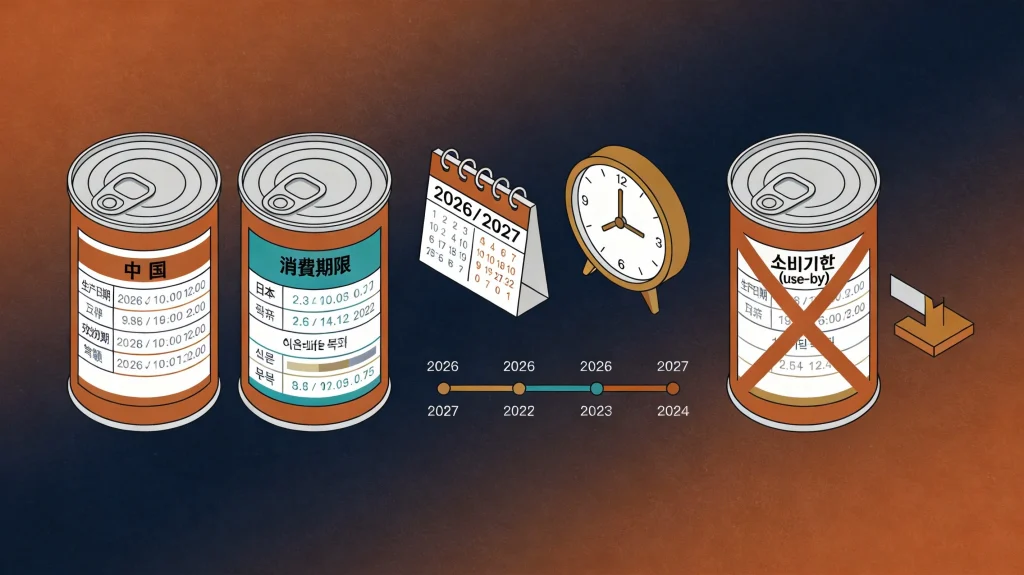
GB 7718-2025, the revised General Standard for the Labelling of Pre-packaged Foods, was published on 16 March 2025 and takes full formal effect on 16 March 2027, with a two-year transition period from publication.[7] During the transition period, products produced before 16 March 2027 may continue to be sold under GB 7718-2011; products produced on or after that date must comply with the new standard. As of June 2026, Beijing municipal market supervision authorities and other agencies were already actively publicising the new requirements and advising businesses to begin label updates early.[8]
The date marking change most relevant to canned products is:
- Both production date and shelf-life expiry date must be shown, clearly marked in year-month-day order. The previous common practice of stating only "shelf life: 24 months" (shelf life X months from production) and relying on the consumer to calculate the expiry date from the production date is no longer sufficient.
- Narrow exemption: For products with a shelf life of six months or longer, or where the largest surface area of the package is no greater than 20 cm², only the shelf-life expiry date needs to be marked; the production date becomes voluntary.[9] Many canned products will fall within this exemption due to their long shelf life (canned products typically carry 24–36 month shelf lives), but exporters must verify whether their specific package size qualifies (the largest dimension, not just the label panel, is used for the 20 cm² calculation).
- Shelf-life expiry date wording: GB 7718-2025 uses the term "保质期到期日" (shelf-life expiry date), replacing the previous "保质期" (shelf life / best before) formulation as the primary date marking for products under the exemption.
For canned food exporters, this means label artwork will in most cases require updating before March 2027. (Our Asia labelling requirements guide walks through the per-market label field differences — nutrition panel format, allergen thresholds, and mandatory warnings — that drive artwork changes alongside the date-marking transition.) If you are currently printing labels that state only "production date + shelf life duration in months," you must add a specific expiry date — or confirm the product qualifies for the six-month/20 cm² exemption and mark the expiry date in the required format. The two-year transition period means that new artwork commissioned in 2026 should already be designed to GB 7718-2025 specifications, as any labels printed after early 2027 will need to comply at the production line.
Korea and Japan date marking
- Korea moved from a combined best-before/use-by system to a bifurcated system effective 1 January 2026: general foods (including most canned products) use a "use-by date" (소비기한) set at 80–90% of the product's experimentally determined quality-safety limit, replacing the former "best before" (유통기한) system.[10] Canned products with long shelf lives must have Korean use-by dates validated through experimental data.
- Japan is reviewing its expiry date setting guidelines, with the Consumer Affairs Agency moving away from a hygiene-indicator-only approach toward more product-specific validation requirements. Japanese date marking uses both "consumption date" (消費期限, for perishable foods, not applicable to canned) and "best before" (賞味期限, for shelf-stable foods including canned).
Shelf-Life Validation: What "Self-Declaration" Actually Requires
A common misunderstanding among canned food exporters is that shelf life is simply declared by the manufacturer and accepted on that basis. It is not. China, Japan, and Korea all require shelf life to be supported by substantiating data, and expectations around what constitutes adequate validation have been tightening.
China does not prescribe a single mandatory shelf-life testing protocol in GB 7718 or GB 7098 for canned products, but the production enterprise (which for imported products means the Chinese importer as the legally responsible party) must be able to substantiate the declared shelf life if challenged by market supervision authorities or customs. For canned products, adequate substantiation typically includes:
- Microbiological stability testing over the declared shelf-life period (commercial sterility maintenance; no leakage or post-process contamination).
- Seal integrity and double-seam evaluation at production and over shelf life (can seam degradation, corrosion, internal lacquer breakdown).
- Organoleptic evaluation (taste, texture, colour, aroma) at intervals over the declared period.
- For specific product categories: nutrient retention testing (e.g., vitamin degradation in fortified canned products), headspace gas analysis, or migration testing for can-coating components.
If a canned product is detained or inspected and the importer cannot produce shelf-life validation data that supports the declared date, the product can be judged mislabelled regardless of whether it actually poses a food safety risk. In practical terms, "self-declaration" means the manufacturer declares the shelf life — but must be prepared to defend it with data.
Korea defines use-by dates at 80–90% of the experimentally determined quality-safety limit, meaning manufacturers must have experimental data establishing the point at which quality or safety parameters first fail, then set the labelled date at 80–90% of that period.[10] This is a more prescriptive requirement than China's, and exporters to Korea should expect to provide shelf-life study data to their Korean importer for HACCP and regulatory documentation.
Japan's FFC and FOSHU systems require shelf-life substantiation for functional food products, and general food distributors are expected under food hygiene guidance to apply a reasonable scientific basis for best-before date setting. Japanese importers routinely request accelerated shelf-life studies or real-time shelf-life data from foreign manufacturers.
Packaging, Can Coatings, and BPA
For canned products, the container itself is a compliance element — not an inert vessel. Food contact material requirements for metal cans and their internal coatings differ across Asian markets and are evolving rapidly.
- China: GB 4806 series standards govern food contact materials. GB 4806.10-2025, the updated standard for coatings and coating layers used on food contact materials (published by NHC on 25 September 2025 as part of Announcement No. 6 of 2025), replaces the 2016 version and tightens migration testing requirements for can coatings.[11] Bisphenol A (BPA) is not banned outright for all food contact applications in China, but specific migration limits (SMLs) apply, and specific uses (infant bottles, some infant-food packaging) are restricted. Exporters should obtain migration testing data for their can linings from their can manufacturer or coating supplier, showing compliance with GB 4806 series requirements.
- Japan: Japan has been progressively restricting BPA in food contact materials, particularly for infant and young-child products. A major revision to the Food Sanitation Act specifications for food utensils, containers and packaging was published on 30 May 2025 (in force from 1 June 2025, with transition periods), introducing new overall migration testing requirements and a new approval mechanism for substances not on the positive list for synthetic resin food contact materials.[12]
- Korea: Korea maintains BPA restrictions for certain food contact applications, including infant and young-child products, and is tracking EU BPA restrictions (Regulation (EU) 2026/250 restricting BPA and other bisphenols in food contact). MFDS publishes regulatory updates tracking international developments; Korean importers and retailers increasingly request BPA-free can linings as a market-access requirement even where not yet legally mandated.[13]
- EU reference point: The EU's regulation of BPA in food contact materials (Regulation (EU) 2026/250) is tightening, and Asian retailers supplying multinational chains are beginning to require can coatings that meet EU specifications regardless of local legal minimums.
Seam integrity and vacuum as commercial (not just safety) requirements
While Asian customs authorities do not routinely test vacuum levels on imported canned products at the border, a compromised double seam or failed vacuum leads to spoilage that may be detected during inspection, at retail, or by end consumers. Proper double-seam tear-down testing, batch-level vacuum checks, and incubation testing of production samples are elements of GMP for canned food manufacturers and should be documented. Chinese, Japanese, and Korean importers will typically request these records as part of their supplier qualification process, even if customs does not check them at import.
Aquatic Canned Products: The Registration Category That Catches Exporters Out
Canned fish, seafood, and other aquatic products occupy a separate and more tightly regulated category under China's import regime, and the implications of GACC Decree 280 (effective 1 June 2026) are frequently misunderstood by canned seafood exporters.

Under Decree 280, aquatic products fall into the category of food requiring registration recommended by the competent authority of the exporting country — as opposed to categories where overseas manufacturers can self-register through the CIFER portal.[14] This means:
- The overseas canned seafood manufacturer cannot self-register for GACC registration. The registration application must be submitted through, and recommended by, the competent authority of the exporting country (for EU member states, this is the national competent authority for food safety/fisheries products; for other countries, the equivalent government food or fisheries authority).
- The competent authority is responsible for auditing and recommending facilities to GACC, and GACC may conduct on-site inspections (in-country or virtual) of recommended facilities before granting registration.
- Once registered, the GACC registration number must appear on the Chinese-language label and commercial documents. Canned seafood shipped without a valid GACC registration number in the correct format cannot be declared for import.
This is the same registration regime that applies to fresh, frozen, and processed aquatic products, and canned products do not receive an exemption. Exporters who treat canned seafood as a simpler category than fresh or frozen seafood sometimes miss this requirement and ship a trial order only to find that the manufacturer is not GACC-registered.
Once registered, canned aquatic products are subject to import inspection focused on food safety parameters (heavy metals — particularly lead, cadmium, and mercury in larger predatory fish; histamine in scombroid species such as tuna, mackerel, sardines; microbiological contamination; and species verification for mislabelling risk) rather than the cold-chain and phytosanitary requirements that apply to fresh fruit and chilled seafood imports. Heat-process parameters (retort time/temperature, F₀ value records) are part of the commercial documentation that may be requested.
Two Common Canned Food Rejection Scenarios
Scenario 1: Canned fruit with preservatives detained in China
A European canned fruit exporter ships canned peaches to a Chinese importer using an established EU formulation that includes potassium sorbate as a preservative (permitted in the EU at specified levels for certain canned fruit categories). The product arrives at a Chinese port and is inspected. GB 2760-2024 (effective 8 February 2025) is checked against the ingredient list; potassium sorbate is identified as a preservative not permitted in canned food under the new standard. The shipment is detained. The options are return or destruction; there is no port-side reformulation or relabelling remedy for an ingredient-level formulation violation. The exporter bears the cost of return freight (USD 5,000–12,000 per 40-foot reefer or dry container, depending on route), storage and demurrage during the detention period (USD 100–300 per day), and the lost sales window with the Chinese importer. Reformulation for the Chinese market — removing the preservative and validating the new process to maintain commercial sterility without it — requires retorting process revalidation, shelf-life testing, and new label artwork before a compliant shipment can be made.
The exporter's formulation was not "unsafe" or "bad"; it was simply formulated to EU rules rather than Chinese rules. This is the most common canned food rejection we see, and it is entirely avoidable with a pre-shipment formulation review.
Scenario 2: Canned seafood shipped without competent-authority GACC registration
An exporter of canned sardines from a Mediterranean country ships a trial order of 20 containers to a new Chinese distributor, assuming that because the product is canned (not fresh) shelf-stable product, GACC registration is either not required or can be completed quickly through the CIFER self-service portal. The Chinese customs declaration is filed; the system identifies that the product is an aquatic product under HS Chapter 16 (prepared/preserved fish) and that the overseas manufacturer is not in the GACC registered facility list for aquatic products (a category requiring competent-authority recommendation). The declaration is rejected. The containers sit at the port while the exporter attempts to engage their national competent authority to begin the GACC registration process — a procedure that typically takes 6–18 months from initial competent-authority engagement to GACC registration, including audit, recommendation, and potential GACC on-site inspection. Meanwhile, demurrage accumulates, the canned product's remaining shelf life decreases, and the distributor relationship is damaged.
What Public Checklists Won't Tell You
The published standards — GB 2760, GB 7718, the MHLW designated additive list, the MFDS Food Additives Code — define the rules but do not reveal where routine operational failures occur. In our work with canned and preserved food exporters, four issues consistently cause preventable problems:
- EU additive permissions do not translate, and "permitted at QS in EU" means nothing in Asia. Even additives that are universally considered safe in the EU (like TBHQ in oil-containing products, or cyclamates in specific categories) are undesignated in Japan. The EU additive list is not a valid starting assumption for any Asian market. Formulations must be checked market by market, additive by additive, against the local positive list.
- Can coating compliance is often the last item checked. Exporters focus on formulation, labelling, and facility registration, then discover two weeks before shipment that the manufacturer cannot provide China- or Japan-compliant migration test data for the internal epoxy coating. BPA-related epoxy formulations are common in older can manufacturing lines; alternative coatings (polyester, acrylic, oleoresin) require can-line changes and qualification. This is not a one-week fix.
- Competent-authority registration for aquatic canned products moves on government timelines, not commercial timelines. Unlike self-registration categories (where a complete CIFER application can be processed in weeks or a few months), competent-authority registration requires government-to-government submission, audit scheduling, and GACC review. Starting registration when you have a pending order is too late.
- Date marking changes apply to all pre-packaged food, not just domestically produced products. Imported product is subject to the same GB 7718-2025 requirements as Chinese product, and Chinese importers are responsible for label compliance at the market supervision level. If your Chinese-language label is printed in the EU/overseas, the date marking format must be correct at print time; applying a stick-over correction label for date format is possible but creates retail compliance risk and additional cost.
These are not exotic edge cases. They are the routine mistakes of exporters who treat canned food as a "simple" category and discover at the port that Asian canned food regulation is more demanding than they assumed.
Three Signals You Need an Additive and Labelling Review Before Shipping to Asia
You should seek professional compliance review for your canned or preserved product before your first Asian shipment if any of the following applies:
- You cannot confirm that every additive in your formulation is permitted, at the level used, in your food category in each target market — and specifically whether any preservative in your canned formulation is prohibited (as all preservatives are in canned foods for China). Headline "EU approved" or "FDA GRAS" status is not sufficient; additive compliance is category-specific and market-specific.
- Your current label artwork does not reflect GB 7718-2025 date marking requirements (for China), Korean 소비기한 use-by date format (for Korea), or Japanese 賞味期限 best-before format with Japanese-language ingredient listing (for Japan). A single label cannot serve all three markets; labels must be market-specific.
- You are shipping canned seafood or aquatic product and cannot confirm that your manufacturing facility holds current GACC registration under the competent-authority-recommended pathway. Without this registration, your product cannot enter China regardless of formulation or labelling compliance.
The cost of a pre-shipment formulation and labelling review is negligible compared with a single rejected container.
Frequently Asked Questions
Do canned foods require cold-chain shipping to Asia?
No. Canned foods are shelf-stable by definition — the retorting process and hermetic seal make refrigeration unnecessary for food safety. However, canned products should be stored and shipped in dry, temperature-controlled environments to prevent external can corrosion, label degradation, and quality deterioration. For tropical routes and high-humidity destinations, warehouse conditions matter for quality preservation (external tinplate corrosion can occur in high-humidity environments without adequate ventilation) but are not a food safety compliance issue.
Is BPA-free can lining mandatory for canned food in Asia?
Not uniformly as a blanket ban across all markets and categories as of late 2026. Japan has been progressively restricting BPA in food contact materials with a focus on infant products; a major packaging standard revision came into force on 1 June 2025, introducing new migration testing and positive-list requirements for synthetic resins. Korea maintains BPA restrictions for specific applications (especially infant and young-child items) and is tracking EU BPA restrictions. China's GB 4806.10-2025 (updated coating standard) sets specific migration limits rather than an outright ban for all can applications. However, major Asian retailers and multinational supermarket chains increasingly require BPA-free can linings as a supplier specification even where local regulation does not yet mandate it, particularly for baby food and children's products. Exporters should verify both the regulatory minimum and their specific importer/retailer requirements.
How should shelf-life validation be conducted for canned products?
For canned products, shelf-life validation typically involves a combination of: microbiological stability testing (verification of commercial sterility maintenance over the declared period), can seam integrity and internal/external corrosion evaluation at intervals, organoleptic assessment (taste, texture, colour, aroma), and for specific product categories: nutrient retention testing, internal lacquer/coating integrity (migration testing at end of shelf life), and headspace analysis. China does not mandate a specific protocol in GB 7098 or GB 7718, but the Chinese importer must be able to substantiate the declared shelf life to market supervision authorities if challenged. Korea requires experimental data establishing the quality-safety limit, with the use-by date set at 80–90% of that limit. For new product launches, a combination of real-time shelf-life studies (stored at labelled storage conditions, tested at intervals) and accelerated shelf-life studies (at elevated temperature to predict long-term stability) is industry standard. For more on date marking and shelf-life differences across China, Japan, and Korea, see our Asia shelf-life and date marking guide.
Can the same formulation be used for all Asian markets?
Rarely. Additive standards differ fundamentally across China, Japan, Korea, and Southeast Asia. A formulation compliant with EU additive rules may contain preservatives now prohibited in Chinese canned foods (potassium sorbate, nisin, polylysine), antioxidants not designated in Japan (TBHQ), sweeteners banned in Japan (cyclamic acid), or colours not permitted in Korea. Market-specific reformulation is typically required — or at minimum, a market-by-market additive verification with targeted reformulation for non-compliant ingredients. For exporters seeking to cover multiple Asian markets, the practical approach is often a "common base formulation" with market-specific additive adjustments.
Do canned aquatic products require the same GACC registration as fresh or frozen seafood?
Yes, for the overseas production enterprise registration step. Canned seafood and other processed aquatic products are included in the categories requiring competent-authority recommendation under GACC Decree 280 (effective 1 June 2026), the same as fresh and frozen aquatic products. The overseas manufacturer must be GACC-registered through the competent-authority pathway, and the GACC registration number must appear on the label and documents. Once registered, the inspection focus for canned aquatic products is food safety (heavy metals, histamine, microbiology, species verification) rather than the cold-chain and phytosanitary requirements that apply to fresh or frozen seafood.
Need an additive compliance comparison and labelling review for your canned or preserved product across Asian markets? We offer a compliance snapshot covering additive cross-referencing against GB 2760-2024 (China), Japan's MHLW designated additive list, Korea's MFDS Food Additives Code, and key Southeast Asian markets, together with date marking format review and shelf-life validation expectations for your specific product category. Send us your product specification, ingredient list, target markets, and current label artwork through our contact page for a market-by-market compliance assessment, typically delivered within 7 working days.
About Specit Consulting
We help food and beverage brands enter and grow in the Chinese and wider Asian markets through trade intelligence, tariff analysis, additive and formulation compliance, labelling and date marking review, GACC registration support, importer identification, and market research.
✉ info@specitconsulting.com
[1]: Chinese customs import data (HS Chapters 16 and 20), monthly import values for canned product categories, 2025–2026, as reported through Chinese customs statistics and trade data platforms. Canned peaches (HS 2008.70) RMB 2.70m June 2026; HS 2008 NES prepared/preserved fruit RMB 66.52m July 2026; other prepared/preserved vegetables RMB 1.20m May 2026, peaking above RMB 3.7m; canned beef/offal RMB 1.36m June 2026; canned pork RMB 0.57m March 2026.
[2]: National Health Commission / SAMR, GB 2760-2024, National Food Safety Standard for the Use of Food Additives, published February 2024, effective 8 February 2025; Anhui Yuhui District Market Supervision Bureau safety advisory (October 2025) confirming removal of certain colours (beet red/basella rubra red, buddleja yellow, jujube colour), azodicarbonamide, and prohibition of preservatives in canned foods (ε-polylysine HCl, nisin, sorbic acid/potassium sorbate, stabilised chlorine dioxide).
[3]: GB 7098-2015, National Food Safety Standard for Canned Foods: semi-finished products sealed in cans must be sterilised within 2 hours; GB 2760-2024 preservative prohibition for canned foods reflects the principle that properly retorted hermetically sealed canned foods do not require added chemical preservatives.
[4]: Japan Food Sanitation Act Article 12 (prohibition on sale of food containing undesignated additives); Japan Food Surveillance (japanfoodsurveillance.org), "Food Sanitation Law Article 12 and Undesignated Additives (TBHQ/Cyclamic Acid) Import Violations Explained," March 2026: TBHQ detected at 0.001 g/kg constitutes a violation even in trace amounts; cyclamic acid banned since 1969 and routinely flagged in imported canned/processed foods; 4,372 additive violation incidents analysed.
[5]: Japan Food Surveillance, "Complete Guide to Food Additive Regulations in Japan: Substances Likely to Cause Import Violations and Verification Methods," March 2026: high-risk additives for imported foods include TBHQ, cyclamic acid, azorubine, quinoline yellow, patent blue V, and excessive sulphur dioxide.
[6]: MFDS Notification No. 2025-15 (18 March 2025), latest consolidated Food Additives Code; MFDS Public Notice No. 2026-50 (13 July 2026), partial amendment to the Food Additives Code expanding use of zinc citrate and ferrous gluconate as nutrient fortifiers.
[7]: GB 7718-2025, National Food Safety Standard – General Standard for the Labelling of Pre-packaged Foods, published 16 March 2025, effective 16 March 2027 (two-year transition period from publication); Beijing Municipal Market Supervision Bureau public advisory, May 2026.
[8]: Huainan Municipal Market Supervision Bureau advisory (August 2026): products produced on or after 16 March 2027 must be 100% compliant with GB 7718-2025 labelling requirements; products produced before the effective date may continue to be sold during their shelf life.
[9]: REACH24H, "China's 2025 Food Labelling Regulations: 5 Key Changes Before March 2027," May 2026: production date and expiry date to be marked in year-month-day order; exemption for products with shelf life ≥ 6 months or package largest surface area ≤ 20 cm² (only expiry date required).
[10]: Korea Ministry of Food and Drug Safety / Korea Consumer Agency, expiry date system change from 유통기한 (best before) to 소비기한 (use by), effective 1 January 2026: use-by dates set at 80–90% of experimentally determined quality-safety limit.
[11]: NHC Announcement No. 6 of 2025 (25 September 2025): GB 4806.10-2025 Food Contact Materials and Articles – Coatings and Coating Layers replacing GB 4806.10-2016; published with 32 national food safety standards and 2 amendment sheets.
[12]: Japan WTO/SPS Notification G/SPS/N/JPN/1319/Add.1 (11 May 2026) confirming revision of specifications for food utensils, containers and packaging; Shandong Provincial Department of Commerce advisory (June 2026): amendments include new overall migration testing requirements and an approval mechanism for substances not on the positive list for synthetic resins, effective from 1 June 2025 with transition periods.
[13]: MFDS regulatory monitoring (Korea Standards Association global trend report, June 2026): EU Regulation (EU) 2026/250 restricting BPA and classified bisphenols in food contact materials; Korean authorities tracking international developments; Declaration of Conformity (DoC) supported by supply-chain due diligence increasingly central to BPA compliance for Korean market access.
[14]: GACC Decree No. 280 (revised), Regulations of the People's Republic of China on Registration Administration of Overseas Production Enterprises of Imported Foods, issued April 2026, effective 1 June 2026; GACC Announcement No. 27 of 2026 (implementation announcement): aquatic products fall in the competent-authority-recommended registration category alongside meat, casings, dairy, bird's nest, bee products, egg products, edible fats, stuffed pasta, and edible grains.
Need help navigating your market entry?
We've helped food exporters across 10+ countries enter 13 Asian markets. Get a free initial assessment based on public data — delivered in 3 working days.
Get Your Free AssessmentContinue Reading
▶Exporting Food to Asia in 2026: A Market Prioritization Framework for Craft Food & Beverage Brands
▶Food Import Detentions in Asia: 7 Real Cases and How to Avoid Them (2026)
Questions about entering the Asian market?
Chat with us on WhatsApp →