


21 September 2026 | Shanghai, China
At Specit Consulting, we help European food and beverage exporters navigate market access requirements across 13 Asian markets. South Korea is a market we are asked about with increasing frequency, and one question dominates those conversations: "I already export to Japan — is Korea basically the same process with Korean labels?"
It is not.
The Ministry of Food and Drug Safety (MFDS) operates a registration and compliance system that differs fundamentally from both the EU and neighbouring Japan. Exporters who treat Korea as "Japan with hangul labels" routinely encounter clearance delays, re-labelling costs, and shipment rejections that could have been avoided. According to MFDS's 2026 Imported Food Inspection Annual Report, Korea imported 874,000 consignments of food products from 165 countries in 2025, valued at USD 36.6 billion — a 3.3% increase in volume year-on-year.[1] The market opportunity is real, but so is the compliance burden. This guide walks you through what MFDS registration actually requires, where the labelling traps are, how inspection works at the border, and what most first-time exporters get wrong.
Korea's Food Import Market at a Glance
Korea is structurally import-dependent. Agricultural and forest products account for 44.8% of import volume, processed foods 35.0%, livestock products 9.8%, and seafood 4.9%.[1] Health functional foods remain a small share by weight (0.1%) but command a disproportionate share of value, reflecting Korean consumers' willingness to pay a premium for functional claims.
The United States, China, and Australia are the largest suppliers by volume, together accounting for 55.2% of total import tonnage. Thailand moved into fourth place in 2025 for the first time in five years, driven by processed fruit, rice, and seafood. European exporters are not dominant by volume, but they occupy high-margin segments: cheese and dairy, chocolate and confectionery, wine and spirits, olive oil, premium pasta and sauces, organic products, and functional ingredients.[1]
Three consumption trends are shaping what European products sell in Korea right now:
- Clean-label demand. Korean consumers scrutinise additive lists more closely than many EU exporters expect. Products with long additive declarations face slower retailer acceptance even when legally compliant.
- Zero-calorie and low-sugar. The zero-calorie trend that drove import growth in beverages and table-top sweeteners continues to expand into snacks, dairy, and condiments.
- Health functional food crossover. Products positioned around specific benefits (gut health, sleep, joint support) attract a premium but fall under a stricter regulatory pathway (see Section 3).
MFDS Facility Registration: Who Must Register and How
Under the Special Act on Imported Food Safety Control, overseas food manufacturing and processing facilities exporting to Korea must register with MFDS before any import declaration can be filed. There is no way around this; MFDS will reject a shipment from an unregistered facility at the border.
What gets registered — and what does not
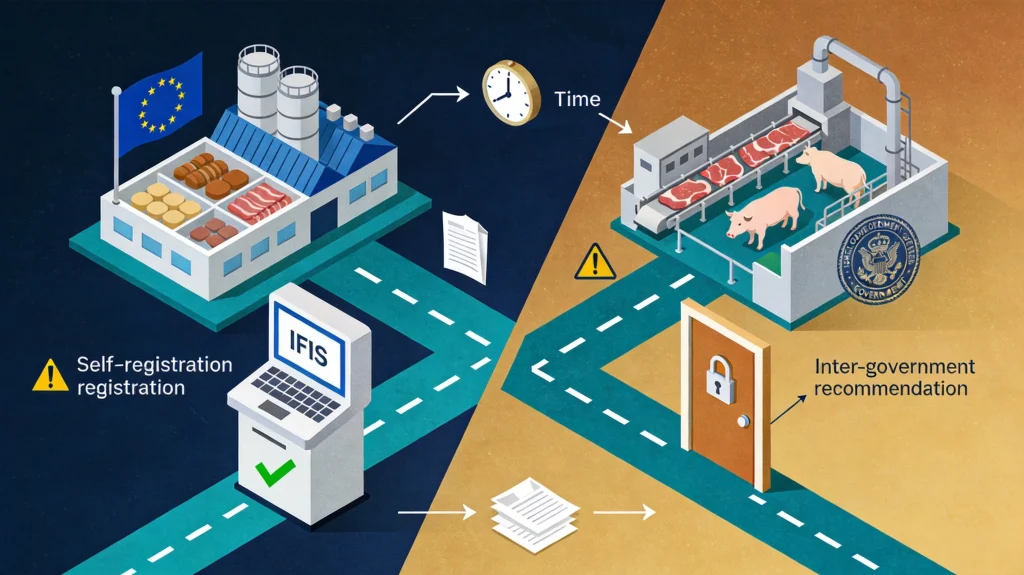
Registration applies to the actual manufacturing or processing facility, not to a headquarters office, trading company, or sales entity. If a single finished product is manufactured across multiple facilities — for example, made at one plant and packaged at another — the facility where overall production management takes place (including shelf-life setting and quality control) is the one that must register.
There is an important dual-track distinction that many exporters miss:
| Foreign Food Facility Registration | Foreign Establishment Registration | |
|---|---|---|
| Who applies | Korean importer OR overseas facility operator | Exporting country's competent authority (government-to-government) |
| How | Online via the Imported Food Information System (IFIS / "Maru") | Official document submission by the competent authority to MFDS |
| Applies to | General processed foods, health functional foods, food additives | Livestock products (meat, dairy, eggs) and certain animal-derived products |
| Processing time | Typically 7–14 business days for a complete application[2][2a] | Subject to government-to-government review; variable |
This means exporters of dairy, meat, or egg products cannot self-register or have their importer register them in the same streamlined way as processed-food facilities. Registration is initiated through the competent authority in the exporting country — for EU exporters, this is routed through the relevant national food safety authority and bilateral channels with MFDS. If you are exporting dairy or livestock products to Asia, build in significantly more lead time.
Required documents for processed-food facilities
For general processed foods and health functional foods, the core document is a Factory Verification Document issued by the competent authority in the exporting country, confirming that the facility is duly authorised, registered, or notified under local food laws. The document must include the facility's legal name and address, and must be in English.[2] If the document is not in English, a notarised Korean translation or an official letter from the facility bearing a seal or handwritten signature is required.
Supporting documents typically requested include:
- A copy of the facility's business or operating licence
- A production process flow diagram from raw material intake to finished product
- Product specifications covering raw materials, composition, and shelf-life parameters
- A facility layout diagram
- Where water is used in production, a recent potability (water analysis) report from an authorised laboratory
- HACCP, GMP, ISO 22000, or equivalent food safety management certificates (voluntary but strongly recommended, especially for first-time registrants)[2a]
Documents in languages other than Korean may require notarised translation.
Processing time, validity, and changes
MFDS's stated processing window for complete applications is short on paper — the online IFIS system confirms straightforward registrations within a few working days.[2] In practice, industry practitioners report that 7 to 14 business days is a realistic planning figure for a first-time processed-food application, because correction requests (requested documents, translation issues, missing facility details) are common and each exchange adds days.[2a] Effective June 2026, MFDS introduced remote (video-based) technical support reviews for new facility registrations, which has reduced on-site scheduling delays — but the document review cycle remains the bottleneck.[2b] Livestock product registrations through the government-to-government route take considerably longer and should be planned months in advance.
Registration is valid for 2 years from the date of approval. Renewal applications can be submitted starting 180 days before expiration.[2]
If any registered information changes — facility name, address, legal representative, or production categories — an amendment must be filed before the next shipment is exported. Shipping under outdated registration details is one of the most common causes of delayed clearance.
A practical point often missed: if multiple Korean importers source from the same overseas facility, each importer files their own registration linked to that facility, supported by a Letter of Authority (LOA) from the manufacturer. A single facility can be registered under multiple importers simultaneously. The LOA has format expectations in Korean practice that generic European head-office letters often fail on first submission — we see this cause one- to two-week delays on roughly a third of first-time registrations we support.
Health Functional Food: A Separate and Stricter Pathway
Products classified as health functional foods (건강기능식품) cannot enter Korea under the general food pathway. They are regulated under the separate Health Functional Foods Act, and the requirements are materially more demanding.
Key differences:
- The Korean importer must hold a separate business licence specifically for health functional food sales, distinct from the general food import business licence.
- The product must comply with MFDS-published ingredient and specification standards for functional raw materials. Ingredients not on the MFDS-recognised list require individual functional ingredient recognition — a dossier-based process that can take 12–18 months.
- Functional claims on the label are restricted to those MFDS has approved for the specific ingredient and dosage. Structure-function claims acceptable in the EU or US may not be used in Korea without prior recognition.
- GMP certification is strongly recommended and in many categories effectively expected by reviewers.
This distinction matters for European exporters of supplements, botanical extracts, probiotics, fortified foods, and any product making a health-related claim. A product sold as a general food in the EU may cross into health functional food territory in Korea based on claims, ingredients, or presentation, and the importer is responsible for correct classification at import declaration. Misclassification is a frequent reason for rejection.
This is one of the areas where public checklists are least useful. Whether your specific product crosses the line depends on ingredient-by-ingredient, claim-by-claim analysis against current MFDS notices, which change regularly — including the June 2026 Notification No. 2026-43 updating functional ingredient standards for eight recognised ingredients, including soy isoflavones and Haematococcus pluvialis extract. If you are uncertain whether your product falls into this category, a pre-shipping compliance review can prevent an expensive misstep.
Korean Labelling: Three Differences That Catch EU Exporters Out
Korean food labels must be in Korean. Foreign-language text may appear alongside Korean, but foreign-language characters cannot occupy a larger area than Korean, and all mandatory information must be presented in Korean. A Korean sticker applied to the original packaging is acceptable; distributing foreign-language-only packaging into Korean retail is not.
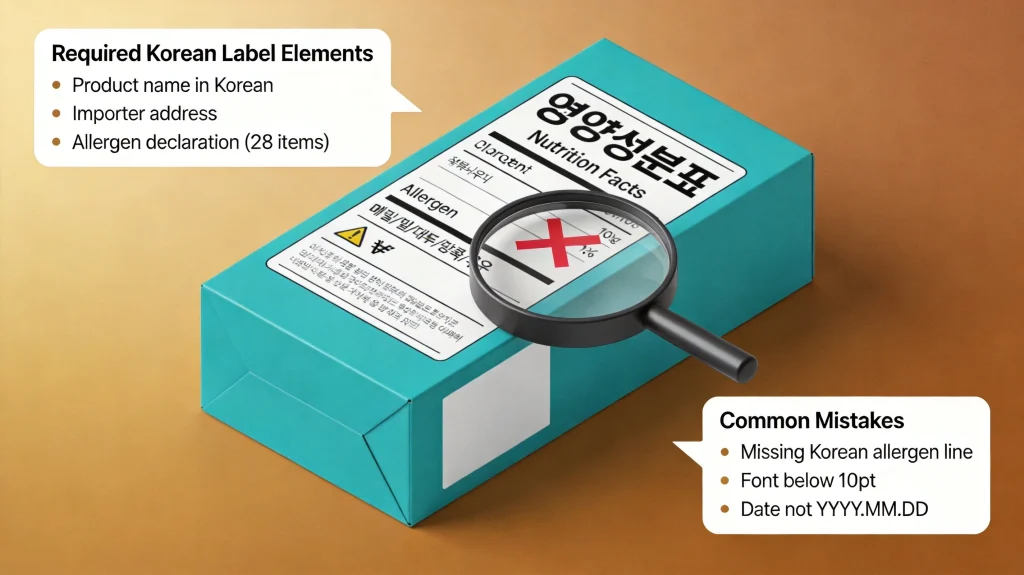
As of 2026, Korea mandates 22 allergen items, following the August 2026 draft revision adding almond, cashew, perilla seed, and sesame (with a compliance grace period until 1 January 2028).[3] Labelling violations carry administrative fines of KRW 500,000 to 5,000,000, with repeated violations leading to business suspension.
The three differences that most consistently cause problems for European exporters are:
1. The nutrition panel is more detailed than in both China and Japan
Korea requires a nutrition panel covering 9 core items on a per-serving basis: energy, carbohydrate, sugars, protein, total fat, saturated fat, trans fat, cholesterol, and sodium, each with a percentage of the Korean daily value. This is broader than China's 1+4 format (energy, protein, fat, carbohydrate, sodium) and Japan's 5-item panel, and the reference values used to calculate the percent daily value are Korean, not EU or Codex. For comparison, see our breakdown of shelf-life date marking and nutrition panel differences across China, Japan, and Korea.
Nutrient values must fall within tolerance: declared energy, total fat, saturated fat, trans fat, cholesterol, sodium, and sugars must not exceed 120% of the labelled value; protein, carbohydrate, and fibre must be at least 80% of the labelled value.[4] Laboratory analysis using Korean methodology is recommended before first shipment, because EU nutrition panel data calculated from ingredient databases often falls outside tolerance when tested against Korean standards. We see this on roughly half of the first-time EU product labels we review.
2. The allergen list is longer than most exporters expect
Korea's 22 mandatory allergens are: eggs, milk, buckwheat, peanuts, soybeans, wheat, mackerel, crab, shrimp, pork, peach, tomato, sulphites (≥10 ppm), walnut, chicken, beef, squid, shellfish (oyster, abalone, mussel), pine nut, almond, cashew, and sesame.[5] This is broader than Japan's current mandatory list and China's list of 8.
Items commonly found in European products that often catch exporters out include peach, pork, tomato, walnut, pine nut, sesame, cashew, and almond. Even "may contain" advisory statements for cross-contamination are expected where shared production lines create a risk; unlike in some EU markets, Korean labelling rules require precautionary statements when unavoidable cross-contamination potential exists.
3. Date marking must use specific Korean phrasing
Korea uses two date marking conventions: "소비기한" (consumption deadline / use-by date) and "유통기한" (distribution deadline / best-before). The "소비기한" system became the primary standard in 2023, replacing the older "유통기한" system for most products, though long shelf-life products labelled under the older system may still be in circulation.
The date must be expressed in Korean date format — "YYYY년 MM월 DD일" (year month day) — and accompanied by the appropriate Korean wording such as "까지" (until). EU-style date formats (DD/MM/YYYY, MM/DD/YYYY) or English-only date marking will trigger rejection. Korea is not unique in this — Japan also enforces language-specific date marking — but the specific phrasing differs, and a label that works for Tokyo will not automatically work for Busan.
Beyond these three, the Korean label must also carry the importer's full Korean-registered name, address, and phone number. This is not optional. A label that meets every other technical requirement but omits the Korean importer's details — or prints them in English only, or in a font size that Korean inspectors consider illegible relative to the package surface — will be rejected or required to be re-labelled at the port. Importer-information issues are consistently in the top three rejection reasons for European first-time shippers.
What Public Checklists Won't Tell You
This guide covers the published requirements — but MFDS enforcement includes details that are not written plainly in any public checklist, and these are precisely the points that sink first-time shipments:
- Additive limits differ at the ppm level. Korea publishes a positive list, but maximum usage levels for the same additive in the same product category sometimes differ from EU limits by 20–50 ppm — a gap invisible to a cross-reference done by ingredient name alone. We have seen EU-compliant confectionery fail precise inspection because an EU-permitted colour (Ponceau 4R / E124) is permitted in Korea but at half the EU maximum dosage for that product sub-category. Identifying the right sub-category in the Korean Food Code and comparing actual dosage against the Korean limit requires access to MFDS additive databases and category-mapping experience, not just the public list.
- Label artwork has invisible format rules. Beyond content requirements, MFDS enforces rules on minimum font size for importer information relative to package surface area, preferred placement of the nutrition panel (bottom third of one display panel), and sticker overwrap specifications (must not obscure original mandatory information). Exporters who print correct content but place it in the wrong location on the package face re-labelling at the bonded warehouse, adding 3–7 days and per-carton charges.
- The importer's Letter of Authority (LOA) must follow a specific format. When multiple Korean importers register the same overseas facility, MFDS expects a manufacturer-issued LOA on company letterhead with specific fields (facility registration number, importer business licence number, scope of products authorised, validity period, original ink signature or corporate seal). Generic letters from a European head office routinely get rejected, adding a week or more while documents are re-issued.
- Inspection-order designations change monthly. MFDS issues and lifts inspection orders (검사지시) without broad public announcement to overseas exporters. The H2 2026 list cited in Section 5 is current as of July 2026; categories are added and removed throughout the year. An exporter who cleared documentary inspection in Q2 may be assigned precise inspection in Q3 purely because their sub-category was added to the order list between shipments — with no advance notification to the overseas facility.
These are not "gotchas." They are routine enforcement details. The public regulations are technically complete, but mapping your specific product to the right sub-category, dosage limit, label format rule, and current inspection status requires Korean-language database access and category-by-category experience. This is the work that most first-time exporters discover they cannot do from Europe after their first container is already booked. For help with label reviews and additive screening specifically, see our Asian food labelling compliance service.
Inspection and Customs Clearance: What Actually Happens at the Border
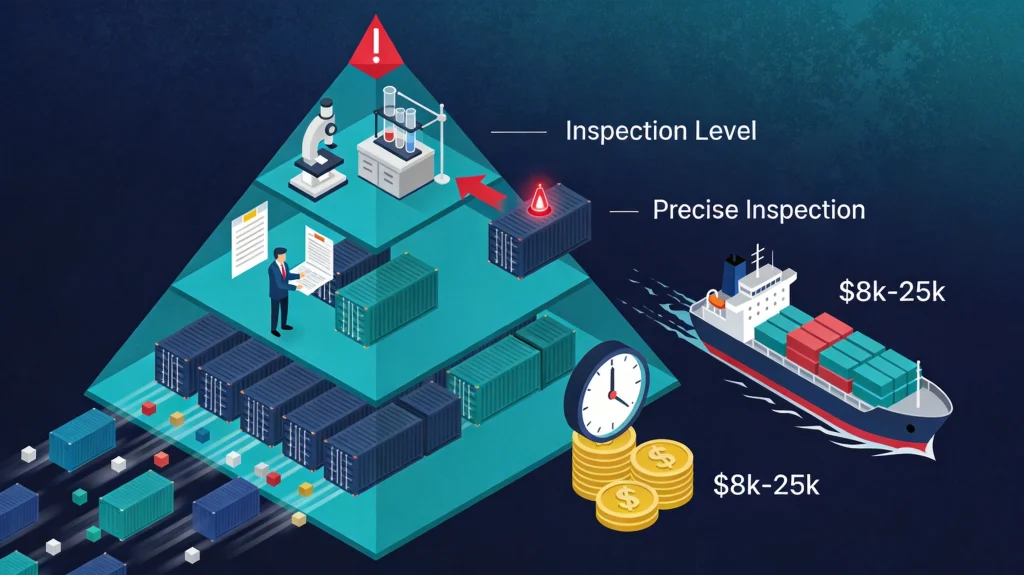
All imported food is inspected before customs clearance. MFDS assigns one of three inspection levels based on product risk, importer compliance history, and any active inspection orders:[6]
| Inspection type | What it involves | Typical duration | When it applies |
|---|---|---|---|
| Documentary inspection (서류검사) | Review of submitted import documents | Same day to 2–3 business days | Established products with a good compliance history |
| Sensory inspection (관능검사) | Document review plus visual, olfactory, and label checks by an inspector | Several days | Mid-risk categories; documentary inspection plus on-site verification |
| Precise inspection (정밀검사) | Sample collection for laboratory analysis (chemical, microbiological, residue) | 7–20 business days, depending on category | First-time imports, products with a rejection history, products flagged for hazard concerns, products subject to an active inspection order |
Random sampling for precise inspection can also be applied to products assigned to documentary inspection, at MFDS discretion. Clearance timelines should always be planned with this possibility in mind.
MFDS issues inspection orders (검사지시) for specific products, origins, or categories where repeated non-compliance has been identified. When an inspection order is in force, importers are required to undergo testing by a designated inspection agency before the import declaration is even accepted. For H2 2026, MFDS designated targeted testing for items including tar colours and aflatoxin in biscuits and confectionery, veterinary drug residues in beef and other livestock products, pesticide residues and heavy metals in agricultural products, and heavy metals and microbiological contaminants in seafood.[7]
After a non-compliance finding, subsequent imports of the same product from the same exporter are subject to elevated inspection (level-2 precise inspection) for five consecutive import shipments, each including additional testing for the parameter that originally failed.[7] This is one reason a single rejection has long-tailed commercial consequences: clearance slows, inspection costs multiply, and Korean importers become reluctant to carry products with a non-compliance history. Two 2025 to 2026 cases — an aflatoxin M1 delay on EU cheese that cost 30% of shipment value, and a liqueur HS misclassification that triggered a 120% penalty — are detailed in our Asian food import detention case review.
Non-compliant shipments are, as a rule, either returned to origin or destroyed at the importer's cost. A 40-foot reefer container returned from Busan to Northern Europe typically costs USD 5,000–15,000 in freight alone, before port storage charges (KRW 24,000–60,000 per day for a 40-foot container at Korean terminals, escalating after day three), bonded warehouse fees, and container detention penalties of USD 50–150 per day.[8] A single rejected first shipment can therefore cost an exporter USD 8,000–25,000 in direct charges — and the five-shipment elevated-inspection penalty that follows makes subsequent shipments slower and more expensive, often causing Korean importers to abandon the product rather than absorb the risk.
Three Common Reasons for Rejection
MFDS publishes non-compliance data annually. Across categories, three issues account for a disproportionate share of first-time European exporter rejections:
1. Unapproved or non-compliant food additives
Korea operates a positive list for food additives. An additive permitted in the EU — certain preservatives, colours, sweeteners, or antioxidants — may not be permitted in Korea for that food category, or may have a lower maximum usage level. Exporters who assume that "EU-approved = Korea-approved" frequently fail at precise inspection. This is the same positive-list logic that catches exporters to Japan, but the Korean permitted list differs in substance — a product that clears Japanese additive review is not automatically cleared for Korea.
This is not only about banned substances. It is also about usage levels, and the sub-category mapping issue described in Section 5 is where most of the damage happens. A preservative used within EU limits may exceed the Korean maximum for the same product category, especially in confectionery, beverages, sauces, and processed meat/fish products.
2. Missing or incomplete Korean importer information on the label
This sounds trivial, but it is consistently in the top rejection reasons for European first-time shippers. The label must include the Korean importer's name, address, and phone number in Korean. Many exporters prepare labels based on a template from their importer but fail to finalise the sticker artwork before the container ships, leaving the importer field blank or in English only. The result is either re-labelling at the bonded warehouse (adding days and cost) or outright rejection.
3. Incorrect date marking or shelf-life format
Beyond the Korean-language date format issue, Korea requires shelf-life data to be supported by shelf-life validation studies for many processed product categories. A manufacturer's internal shelf-life determination — which may be perfectly acceptable in the EU — may not satisfy MFDS requirements if it does not follow Korean-prescribed study protocols, particularly for products new to the Korean market. Date marking that uses the EU "best before" phrasing without the appropriate Korean "소비기한" or "유통기한" wording, or that uses non-Korean date ordering, will be flagged at sensory inspection.
Three Signals You Need a Compliance Snapshot Before You Ship
Most exporters who contact us after a problem already knew the basics — facility registration, Korean labelling, MFDS inspection. The question is whether you have enough product-specific certainty to ship safely. You almost certainly need a professional compliance review before your first Korean shipment if any of the following is true:
- You have not had your additive list screened against the Korean Food Code sub-category limits by someone with access to the Korean database. Checking additive names against a public positive list is not sufficient; dosage limits and sub-category mapping are the real risk points.
- Your Korean label artwork has been prepared by your importer without independent review. Importers know their market, but they are not regulatory specialists, and labelling errors discovered at the port are the importer's problem only up to a point — the cost of re-labelling, delay, and potential rejection ultimately falls on the exporter's commercial relationship and future orders.
- Your product falls into a category on the current MFDS inspection-order list, and you do not have Korean-methodology lab test results for the flagged parameters. Shipping without pre-testing into an active inspection-order category is, in practice, volunteering for precise inspection with no data to defend your product.
If none of these signals apply and you have an experienced Korean importer driving the process, you are in a reasonable position to self-manage. If one or more applies, a pre-shipping review is cheap relative to the USD 8,000–25,000 direct cost of a rejected first shipment and the five-shipment elevated-inspection penalty that follows.
Korea can be the fastest first-Asian-market win for trendy RTD and health snack brands — but only if your product and licence class are a match. Score Korea against China, Japan, and Southeast Asia using our five-dimension market-prioritization framework.
Frequently Asked Questions
How long does MFDS facility registration actually take?
For general processed foods with a complete application, plan for 7 to 14 business days from document submission, and longer if MFDS issues correction requests. Livestock and dairy products under the government-to-government pathway can take several months. We recommend initiating registration at least 45 days before the first intended shipment for processed foods, and 4–6 months ahead for livestock products.[2a]
Can an overseas exporter self-register, or must it go through a Korean importer?
For processed foods and health functional foods, registration can technically be filed by either the Korean importer or the overseas facility operator through the IFIS portal. In practice, the vast majority of registrations are filed by the Korean importer, because the import declaration itself can only be filed by a Korea-licensed importer. Exporters without a confirmed Korean importer cannot file import declarations on their own. If you need help finding and vetting a qualified Korean importer, that is a step we regularly support.
What is the difference between general food and health functional food registration?
General food imports require overseas facility registration plus a per-shipment import declaration supported by the Korean importer. Health functional foods also require the importer to hold a dedicated health functional food sales licence, the product to comply with MFDS functional ingredient standards (or go through individual ingredient recognition), and substantially tighter labelling and advertising restrictions. A product's classification depends on its ingredients, dosage, and claims — not on how it is sold in the exporter's home market.
Can I use my EU nutrition panel data for the Korean label?
We recommend against relying on EU nutrition panel data without laboratory verification using Korean methodology. Tolerance rules and reference values differ, and Korean nutrient testing may produce values outside the EU-calculated tolerance bands. This is one of the most common findings at precise inspection for first-time EU shippers.
What happens if my product fails inspection?
The shipment is typically returned or destroyed at the importer's cost. The product and exporter are flagged, and the next five shipments are subject to elevated precise inspection, including targeted testing for the parameter that failed.[7] Repeated non-compliance can lead to MFDS suspending registration for the facility.
How to Prepare Before Your First Shipment
Exporting food to Korea is entirely manageable, but it rewards preparation. The most common failure pattern we see is not that a product cannot comply — it is that the exporter assumed EU compliance or Japanese compliance was sufficient and discovered the gaps after the container was already on the water.
Before shipping to Korea for the first time, you should be able to answer yes to all of the following:
- Your manufacturing facility is registered with MFDS (or your competent authority has submitted the application, for livestock/dairy), and the registration will be valid through the shipment date.
- Your Korean importer holds the correct licence category (general food, health functional food, or livestock product import, as applicable).
- You have confirmed the additive list against the Korean positive list and relevant product category sub-limits, not just by ingredient name.
- Your Korean label has been prepared, or your sticker artwork is finalised, including the importer's Korean name, address, and phone number in compliant font size; the 9-item nutrition panel in Korean format with Korean reference values; all applicable allergens from the 22-item list; and the date marking in Korean "소비기한/유통기한" phrasing and "까지" format.
- You have Korean-methodology shelf-life validation data for the product, especially for products likely to be flagged for precise inspection. (Date marking rules across Asia vary widely — our comparison of shelf-life date marking in China, Japan, and Korea covers the key differences.)
- You have checked whether your product category is currently under an MFDS inspection order and arranged any necessary pre-testing.
If you are not confident on any of these points, that is where problems begin.
Need a compliance snapshot for your Korean market entry? We offer a free initial assessment based on public data, covering MFDS registration pathway (processed food vs. livestock dual-track), Korean labelling compliance including additive screening against the Korean Food Code sub-category limits, current inspection-order status for your product category, and importer-sourcing considerations. Send us your product specification sheet and current label through our contact page — turnaround within 7 working days.
About Specit Consulting
We help food and beverage brands enter and grow in the Chinese and wider Asian markets through trade intelligence, tariff analysis, labelling compliance, registration support, importer identification, and market research.
✉ info@specitconsulting.com
[1]: Ministry of Food and Drug Safety (MFDS), 2026 Imported Food Inspection Annual Report (2026년 수입식품 등 검사연보), published 30 June 2026.
[2]: MFDS, Enforcement Rule of the Special Act on Imported Food Safety Control (No. 1800, as amended), foreign food facility registration provisions; IFIS (Maru) portal processing standard.
[2a]: Trade NPU (industry practitioner information portal), "Guidelines on Processing Times, Status Tracking, and Required Documents for Foreign Food Facility Registration and Amendment," 19 February 2026. MFDS's stated window is shorter for complete applications; correction requests commonly extend processing to 7–14 business days in practice.
[2b]: China WTO/TBT-SPS Notification Centre (Ministry of Commerce), "Korea Amends Food Traceability Management Standards," 26 June 2026, reporting MFDS introduction of remote (video-based) technical support reviews for new facility registrations, effective 2026.
[3]: WTO TBT Notification G/TBT/N/KOR/1372 (10 August 2026): sesame, perilla seed, almond, and cashew added as mandatory allergen items; compliance grace period to 1 January 2028.
[4]: MFDS, Standards and Specifications for Foods (식품의 기준 및 규격), nutrition labelling tolerance provisions; Korea Food Industry Association (식품산업협회) nutrient tolerance reference table: energy, total fat, saturated fat, trans fat, cholesterol, sodium, and sugars ≤120% of labelled value; protein, carbohydrate, and dietary fibre ≥80% of labelled value.
[5]: MFDS, Enforcement Rule of the Act on Labelling and Advertising of Foods, Schedule 2 (allergen listing); TY Consulting, "Korean Food Labelling Complete Guide (2026 기준)" — Korean-language compliance practitioner reference.
[hff]: Freyr Solutions, "South Korea Updates Health Functional Food Standards, Expands Approved Nutrient Sources and Strengthens Safety Requirements" (MFDS Notification No. 2026-43), 11 June 2026.
[6]: MFDS, Enforcement Rule of the Special Act on Imported Food Safety Control (No. 1800), inspection-level provisions; Trustcus (Korean customs clearance information portal), "Complete Guide to MFDS Import Declaration Procedures," April 2026 — practitioner reference citing MFDS inspection-level criteria and typical durations; Indonesian Ministry of Trade export guidance confirms organoleptic inspection 3 days, precise inspection 10 days for standard categories.
[7]: Xiamen WTO/SPS Notification Centre, "Korea Releases H2 2026 Imported Food Precise Inspection Key Items," 17 August 2026, citing MFDS 1 July 2026 notice; level-2 precise inspection for five shipments following non-compliance.
[8]: Korea port storage and detention: PSA-ICT (Busan) 2026 public tariff, KRW 24,000–60,000 per day for 40-foot container days 3–6; Korea Import Hub and Landed Cost, "Free Time & Demurrage" / "Hidden Costs of Importing" guides (2026): port storage USD 100–200/day, container detention USD 50–150/day, physical examination de-stuffing/re-stuffing USD 300–800; return freight Busan–Northern Europe for a 40-foot reefer, industry estimate USD 5,000–15,000 depending on carrier and season.
Need help navigating your market entry?
We've helped food exporters across 10+ countries enter 13 Asian markets. Get a free initial assessment based on public data — delivered in 3 working days.
Get Your Free AssessmentContinue Reading
▶Exporting Food to Asia in 2026: A Market Prioritization Framework for Craft Food & Beverage Brands
▶Food Import Detentions in Asia: 7 Real Cases and How to Avoid Them (2026)
Questions about entering the Asian market?
Chat with us on WhatsApp →