

14 September 2026 | Shanghai, China
At Specit Consulting, we help food and beverage exporters navigate Asian market entry. Vietnam has been one of the fastest-growing import markets in ASEAN, and the regulatory landscape has shifted noticeably in 2026. This guide walks you through the current registration, labelling, and customs framework, and flags the points where shipments most often get held.
Vietnam's food import process has undergone significant changes in 2026, creating both opportunities and confusion for exporters. While the government has temporarily paused implementation of new regulations (Decree 46 and Resolution 66.13), the current framework under Decree 15/2018 remains the operative standard. Understanding the registration pathways, labelling requirements, and customs procedures is essential for smooth entry into this growing market.
The Dual-Track Registration System
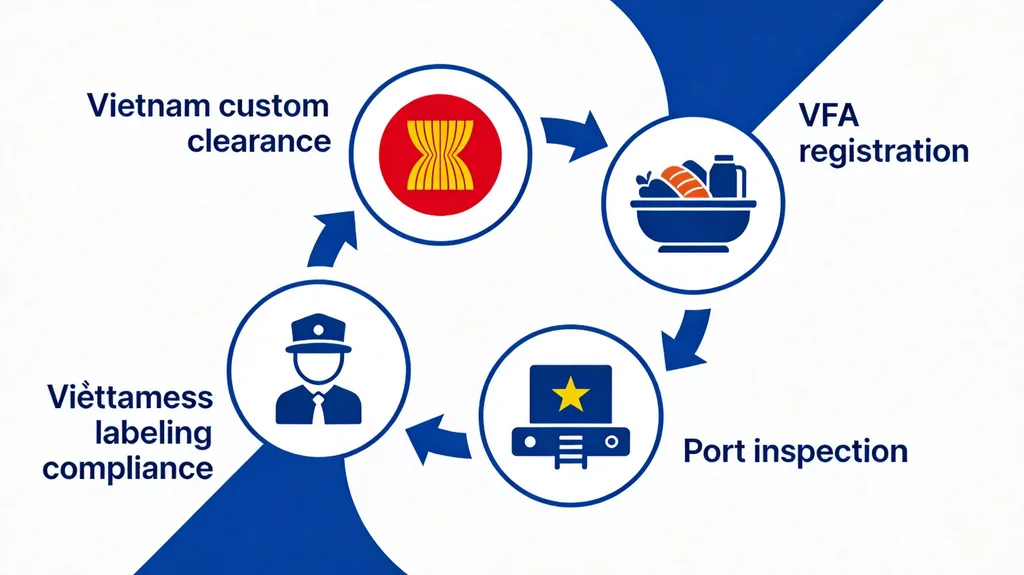
Vietnam operates a "registration plus declaration" dual-track system for food imports. The pathway your product follows depends on its category.
Product Registration (Food Safety Conformity Certificate) applies to high-risk categories: health supplements, medical foods, food for special dietary uses, nutritional products for children under 36 months, and food additives not on Vietnam's permitted list. The application is submitted by the Vietnamese importer but requires documentation from the exporter, including a Certificate of Exportation and, for dietary supplements, a GMP certificate. Processing takes seven working days once complete documents are received.
Product Declaration (Food Safety Self-Declaration) applies to most other pre-packaged foods, food additives, and food contact materials. The process requires a Vietnamese-language application form and a test report from a designated or ISO 17025-accredited laboratory issued within the past 12 months. The declaration process allows the importer to begin trading immediately upon submission, with the authority archiving and publishing the information — no waiting for approval. If the product name, origin, or ingredients change, a new declaration is required; other changes only need written notification.
Labelling Requirements: The Most Common Cause of Rejection
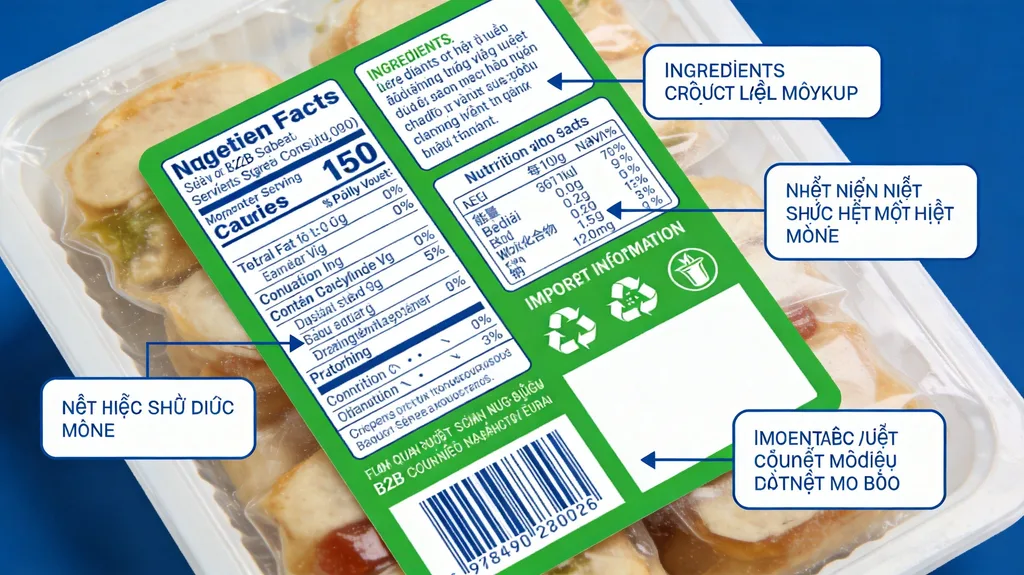
Vietnamese-language labelling is the most common reason shipments are rejected at the border. All imported food must carry a label in Vietnamese with the following mandatory elements: product name, ingredients, net content, manufacturer and importer information, expiry date, country of origin, and storage instructions.
Nutrition labelling requirements were updated under Circular 30/2026/TT-BYT, issued in 2026. Pre-packaged foods should display five mandatory nutrients: energy, protein, carbohydrates, fat, and sodium. Soft drinks and foods with added sugar should also declare total sugar content, and fried foods should list saturated fat. Labels should present information in a clear, indelible, and easily recognisable manner.
English-only labels, inaccurate translations, or missing mandatory items may trigger rejection or detention. A sticker translation alone is rarely sufficient — the Vietnamese label must be a complete, compliant regulatory document.
Customs Inspection: What to Expect
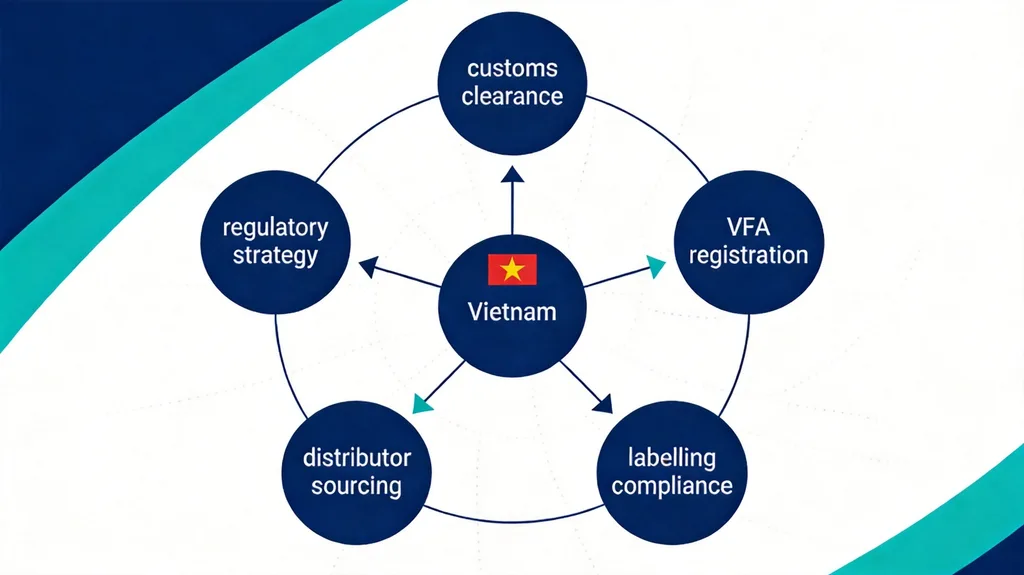
All imported food is subject to customs inspection, but the intensity varies based on the importer's compliance history and the product's risk profile. The inspection process involves document review, and potentially physical inspection and sample testing.
Under current procedures, if a product qualifies for reduced inspection — typically after establishing a clean compliance record — the importer submits a self-declaration and consecutive notifications of results confirming compliance. The customs unit checks documents and clears the shipment within the prescribed time limit.
For standard or strict inspection, sample testing can add approximately seven working days to the clearance process. During this period, goods are held at the port, incurring storage and demurrage costs. Vietnamese customs uses the VNACCS/VCIS electronic declaration platform, and incomplete documentation may result in the cargo being flagged for inspection and held.
Common Rejection Reasons and How to Avoid Them
Non-compliant labelling is the most frequent cause. Ensure your Vietnamese label is complete, accurate, and affixed before arrival.
Missing permits or declarations may result in detention. The importer should have the Food Safety Declaration or Registration Certificate in place before shipment arrival.
Non-compliant wooden packaging is another recurring issue. Vietnam requires all wooden pallets and packaging from certain origins to meet ISPM-15 standards, meaning they must be heat-treated and marked accordingly. Non-compliant pallets may require fumigation at your cost or be rejected.
Incorrect HS code classification can trigger delays and audits. The HS code should match the product description and declaration documents.
An unregistered importer is a frequent oversight. The importer of record must be registered with customs and hold the necessary business licences.
The 2026 Regulatory Transition
Vietnam's 2026 regulatory environment is in transition. The government has indefinitely suspended Decree 46 and Resolution 66.13 pursuant to Resolution 15/2026/NQ-CP, pending the amended Law on Food Safety and its implementing decrees (expected no later than February 2027). Decree 15/2018 remains the operative standard. These suspended instruments nonetheless signal the direction of future reform. Exporters can use the current period to establish compliant processes, so that when new regulations eventually take effect, their supply chains are already aligned.
Frequently Asked Questions
What is the difference between product registration and product declaration?
Product registration (Food Safety Conformity Certificate) applies to high-risk categories like health supplements, medical foods, and infant nutrition products. It requires a more extensive dossier and government review before market access. Product declaration (Food Safety Self-Declaration) applies to most standard pre-packaged foods and allows the importer to begin trading immediately upon submission, with the authority archiving the information.
How long does customs clearance take for food imports?
With complete and compliant documentation, clearance typically takes one to three days. If the shipment triggers inspection due to missing documents or errors, this can extend to three to seven days or longer. Sample testing alone can add approximately seven working days.
Is a Vietnamese-language label mandatory for imported food?
Yes. Vietnamese-language labelling is mandatory for all imported food products. The label must include product name, ingredients, net content, manufacturer and importer information, expiry date, country of origin, and storage instructions. English-only labels are a primary cause of rejection at Vietnamese ports.
Need help navigating Vietnam's food import requirements? We offer a free initial assessment of your product's market access pathway, covering registration route, labelling scope, and likely clearance timeline. Contact Specit Consulting to get started.
About Specit Consulting
We help food and beverage brands enter and grow in the Chinese and wider Asian markets through trade intelligence, tariff analysis, labelling compliance, importer identification, and market research.
✉ info@specitconsulting.com
Disclaimer: This article reflects general market observations and regulatory understanding as of September 2026. It does not constitute legal or regulatory advice. Always confirm current requirements with the relevant authority or a qualified regulatory consultant.
Need help navigating your market entry?
We've helped food exporters across 10+ countries enter 13 Asian markets. Get a free initial assessment based on public data — delivered in 3 working days.
Get Your Free AssessmentContinue Reading
▶Exporting Food to Asia in 2026: A Market Prioritization Framework for Craft Food & Beverage Brands
▶Food Import Detentions in Asia: 7 Real Cases and How to Avoid Them (2026)
Questions about entering the Asian market?
Chat with us on WhatsApp →