

18 September 2026 | Shanghai, China
At Specit Consulting, we review food labels for Asian markets every week. Date marking is one of the top causes of label rejection at import — not because the rules are obscure, but because China, Japan, and South Korea each use fundamentally different date frameworks, different terminology, and different minimum format requirements.
Many exporters discover this only after a shipment is held at the port of entry, when relabelling costs, demurrage, and delayed listing start compounding. This guide compares the three systems, flags the most common failure points we see in practice, and shows where self-audit stops and specialist support becomes necessary.
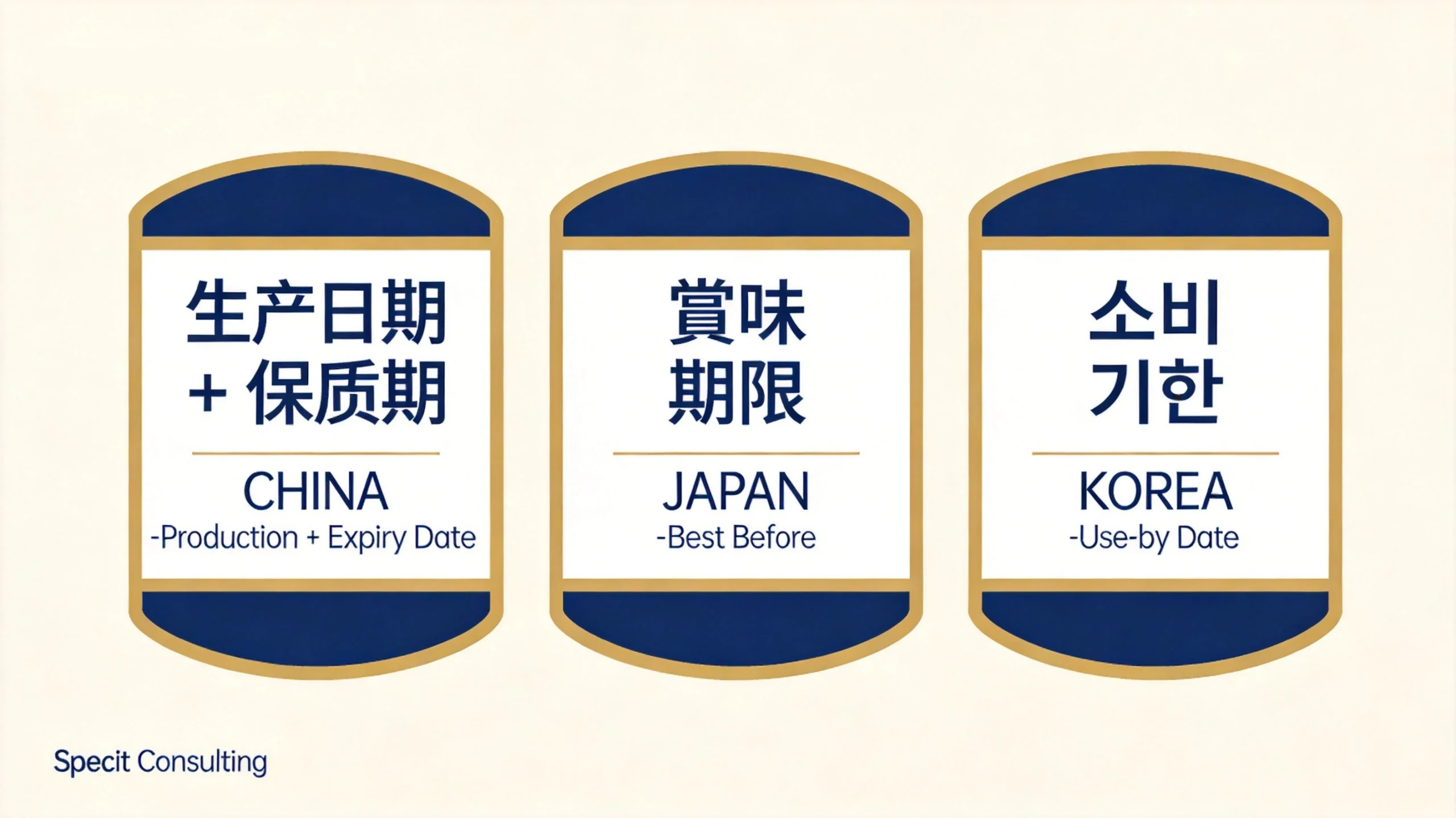
Date Framework: Production Date, Use-By, and Best Before
The three countries use date concepts that do not translate one-to-one. Getting the terminology wrong — for example, printing a "best before" date on a product that Japan treats as a perishable "use by" item — is enough on its own to trigger a label hold.
China: Dual-Date System from March 2027
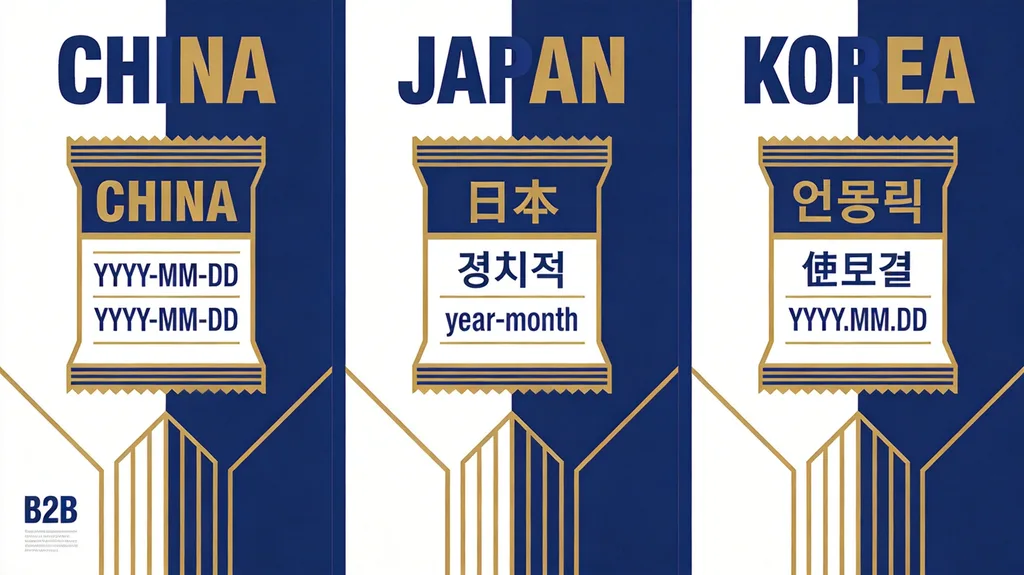
China is moving to a dual-date system under GB 7718-2025, published on 16 March 2025 and taking effect on 16 March 2027. The revised standard requires the shelf-life expiry date (保质期到期日) to be stated as a specific date in year-month-day format (e.g., 2027-06-11), rather than expressed only as a duration from the production date. The production date (生产日期) remains mandatory in most cases, so labels will carry both dates explicitly in a dedicated date field printed in high-contrast type (font height ≥3 mm where the largest label surface is ≥35 cm²; ≥2 mm below that threshold).
Two limited exceptions apply: for products with a shelf life of six months or more, or where the largest packaging surface is ≤20 cm², the expiry date is mandatory and the production date may be omitted. The date must be calculated from the day the direct-contact packaging operation is completed (not the following day, and not a date chosen for convenience). Date marking must be printed directly on the package or label — overstickering or correction of dates is not permitted under any circumstances.
Practical note for exporters:If you are designing new label artwork for China now — whether for a launch in Q4 2026 or Q2 2027 — design it to the GB 7718-2025 standard from the start. For the full picture of Chinese import labelling including ingredient naming, allergen declarations and GACC registration, see our guide to exporting food to China, and the Japan FY2027 labelling update covering QR-code supplementary labels, simplified ingredient naming, and new mandatory allergens for context on what Japan is also changing. Packaging printed to the 2011 standard will become non-compliant for production after 16 March 2027, and reprinting at short notice in Asia is expensive. If you are unsure whether your product category qualifies for the six-month / ≤20 cm² exception, a label compliance review can confirm this before artwork is locked in.
Japan: Expiration Date vs Best Before
Japan distinguishes two date concepts under the Food Labelling Act (食品表示法) :
- 消費期限 (shōhi kigen / Expiration Date): applies to foods that deteriorate rapidly and may pose a safety risk after the date — a true "use by" date, typically for chilled ready meals, fresh dairy, raw seafood, and other perishable items.
- 賞味期限 (shōmi kigen / Best Before Date): applies to shelf-stable foods where quality rather than safety is the limiting factor. The product remains safe to consume after this date, though sensory quality may decline.
Where the period from production to the best-before date exceeds three months, the date may be expressed as year and month only (e.g., 2027.06), omitting the day. Date marking must be printed in a size of at least 8 points for standard packages, or 5.5 points where the label area is ≤150 cm².
Japan revised its Guidelines for Setting Food Expiration Dates, with the amended version taking effect on 28 March 2025 (Reiwa 7) . The revision removes the previous benchmark safety factor of 0.8 for shelf-stable products and instead recommends that manufacturers set the factor flexibly according to product characteristics; low-risk products (canned, retort, certain shelf-stable items) may not require a safety factor at all. The revision also recommends considering microbiological indicators beyond total bacterial count, to avoid setting unnecessarily short shelf lives that drive food waste.
A critical point for exporters: the Japanese importer bears legal responsibility for setting the date on imported food. This means the importer must verify the overseas manufacturer's shelf-life data and, where the existing data does not meet Japanese evidentiary expectations, commission or conduct microbiological, physicochemical, and sensory testing to confirm or adjust the date for the Japanese market. In practice, many Japanese importers will not list a product until they have reviewed the full shelf-life validation dossier.
Practical note for exporters: If your Japanese importer asks for "shelf-life data in Japanese format," they are typically asking for a structured dossier covering microbiological, physicochemical, and sensory results with an explicit safety-factor rationale. Home-market test reports that only cite total bacterial count are routinely rejected. Preparing a Japan-ready dossier before approaching importers removes a common objection at the listing stage. Date marking is only one piece of the import puzzle — see our full Japan food import requirements walkthrough for the six-step clearance process, additive positive-list screening, and importer licensing.
South Korea: Use-by Date from January 2023
South Korea completed its transition from the operator-focused 流通期限 (yutong gigan / Sell-by Date) to the consumer-focused 소비기한 (so-bi gi-han / Use-by Date) on 1 January 2023. The key change is the safety margin: sell-by dates were typically set at 60–70% of the product's quality-safety limit period, while use-by dates are set at 80–90%, giving consumers a longer usable period. The date may be expressed either as a specific date followed by 까지 ("until") — for example 소비기한: 2027.06.11까지 — or as a period from production, for example 제조일로부터 270일까지 ("until 270 days from manufacture"). The use-by date is valid only when the product is stored under the stated storage conditions.
Practical note for exporters: The shift from sell-by to use-by generally gives you a longer usable period on the Korean label, but the 80–90% calculation must be supported by experimental data. If your current Korean label still shows a 유통기한 date (pre-2023 stock), it is out of compliance and should be updated before the next shipment.
Shelf-Life Validation and Storage Conditions
Setting a shelf-life date requires scientific support in all three markets, though the expected formality of the evidence varies.
China does not prescribe a single testing protocol in the labelling standard itself, but the producer or importer must be able to substantiate the declared shelf life on request. The expiry date is calculated from the production date (specifically, from the date the direct-contact packaging operation is completed, consistently applied). Storage condition instructions are mandatory — omitting them or printing them in a font smaller than the date itself is a common reason for rejection at CIQ.
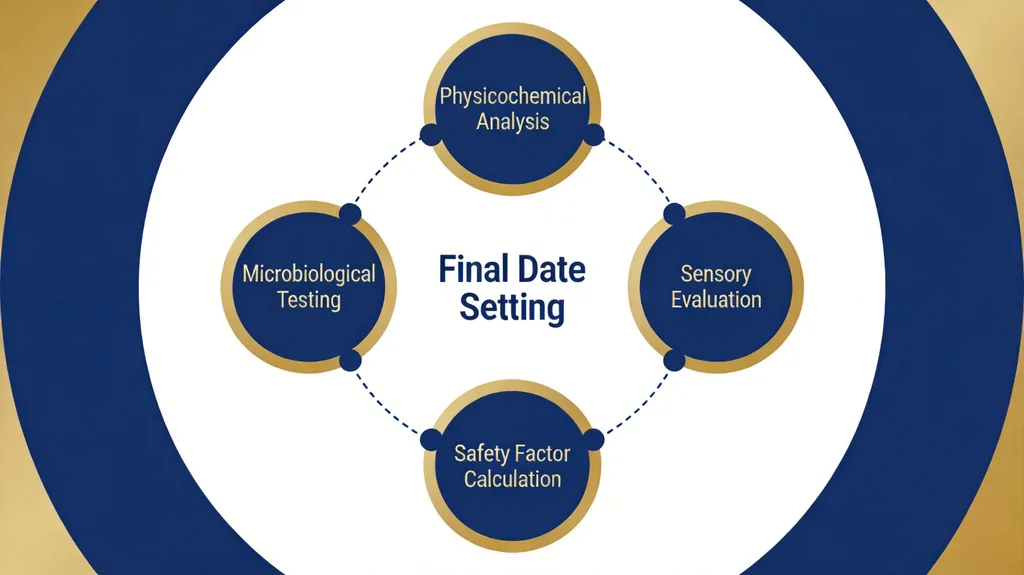
Japan, under the amended 2025 guidelines, expects the manufacturer (and, for imported food, the Japanese importer) to determine objective indicators and criteria for the product — microbiological, physicochemical, and sensory — and to set the date scientifically and rationally on that basis. The amended guidelines specifically call for temperature and humidity requirements for room-temperature-stable products to be stated where relevant. The importer is the party legally answerable to the Consumer Affairs Agency if the basis for the date cannot be explained.
South Korea defines the quality-safety limit period (품질안전한계기간) explicitly, based on experimental data covering microbiological, physicochemical, and sensory indicators. The use-by date is then set at 80–90% of that experimental limit. Storage method instructions are mandatory, and the use-by date assumes compliance with those conditions.
Where self-audit stops: Each market will accept test data prepared to internationally recognised standards (ISO, AOAC, national accredited lab methods). But the question of which indicators to test, how many sampling points to run, and what safety factor to apply is product-specific and is exactly where labels get challenged at import. A dossier accepted by your home-market authority may not satisfy Japanese importer review or Korean MFDS expectations. If you are preparing shelf-life data for the first time for Asia, or if your existing data is more than three years old, a pre-entry label and dossier review before submission can prevent costly port holds.
Worked Example: One Product, Three Labels
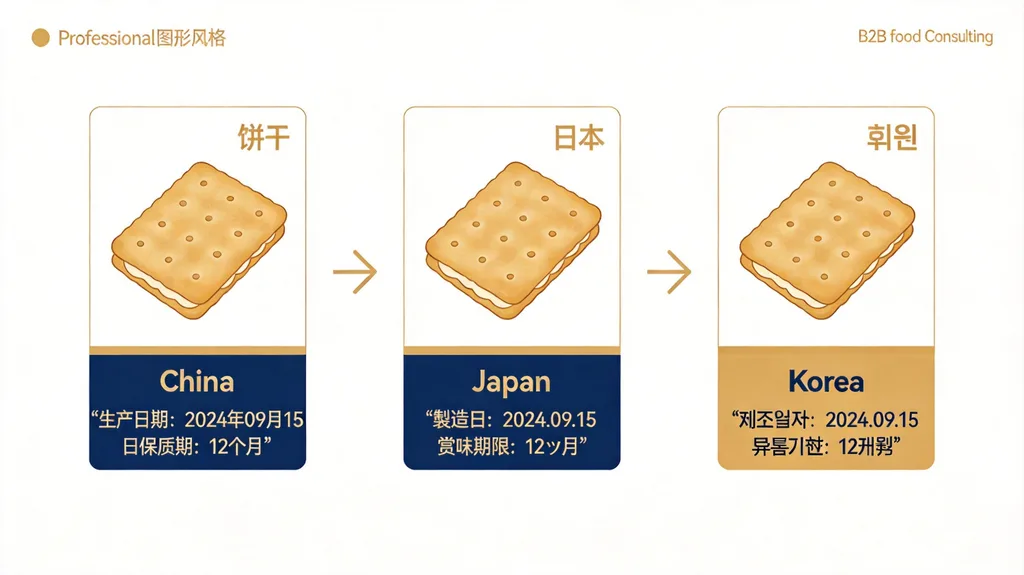
Consider a packaged biscuit or snack product with a nine-month shelf life, produced on 12 September 2026, shipping to Shanghai, Tokyo, and Busan:
| Element | China (GB 7718-2025) | Japan (Food Labelling Act) | Korea (Food Labelling Act) |
|---|---|---|---|
| Date shown | 生产日期 2026-09-12 + 保质期到期日 2027-06-11 | 賞味期限 2027.06 | 소비기한 2027.06.11까지 |
| Format | Year-month-day, both dates in dedicated high-contrast field | Year-month only (period >3 months); 8 pt minimum | Year-month-day with 까지, or days-from-production |
| Location | Dedicated date field on principal display panel, high contrast | Any visible location on label (position guidance required if outside the one-batch labelling area) | Any visible location on label |
| Date printing | Direct print or imprint; overstickering prohibited | Direct print; stickers not permitted for dates | Direct print; stickers not permitted for dates |
| Storage conditions | Mandatory; minimum font size applies | Mandatory; temperature/humidity where relevant for ambient products | Mandatory; use-by date conditional on compliance |
The core takeaway: a single date format cannot serve all three markets. A label designed for one market will likely fail in the other two. Market-specific label artwork should be prepared from the outset, shelf-life data validated against each country's evidentiary expectations, and packaging production timelines should accommodate the different artwork requirements. Which date concept applies to your specific product category, what evidence each market expects, and whether your existing test data will be accepted by the importer or regulator — these are judgements that determine whether your shipment clears or gets held.
Common Date-Marking Failures We See at Import
Before you run the self-check below, these are the three failures we encounter most often with European and Mediterranean food exporters shipping to North Asia:
- China artwork printed to the 2011 standard. The product may clear now, but any packaging printed after 16 March 2027 must carry the dual-date field in YYYY-MM-DD format with high-contrast type. Printing old artwork in late 2026 or early 2027 creates a wasted-inventory problem.
- Japan: relying on total bacterial count alone. Shelf-life dossiers that cite only TBC (一般生菌数) are routinely sent back by Japanese importers for additional indicator testing, which can add 4–8 weeks to a listing timeline.
- Korea: 유통기한 (sell-by) still printed. Labels produced before 2023 that have not been updated continue to circulate, but any new shipment arriving in Korea with the old sell-by terminology will be flagged.
If any of these three describe your current labels, they will not survive an import inspection — even if the product itself is fully compliant on substance.
Practical Self-Check for Exporters
Use the list below to audit your current date-marking labels. Items marked [self-check] can be verified from your existing artwork and technical documentation. Items marked [threshold] are judgement points where self-audit reaches its limit, and a specialist review is recommended.
- [self-check] Confirm which date concept applies to your product in each target market (use-by vs. best before vs. dual date). A biscuit is best-before / shōmi kigen / so-bi gi-han; a chilled cheese may be use-by / shōhi kigen / so-bi gi-han — the classification is per market, not universal.
- [threshold] Validate that your shelf-life testing covers the indicators each market expects. China expects substantiation on demand; Japan expects microbial, physicochemical, and sensory with a documented safety-factor rationale; Korea expects the quality-safety limit period calculated to 80–90%. If your dossier covers only total bacterial count and acidity, it will not pass Japanese importer review.
- [self-check] Prepare separate label artwork for each market. A single "Asian label" that tries to combine Chinese, Japanese, and Korean date fields typically fails on format or terminology in at least one market.
- [self-check] Ensure dates are printed or imprinted directly on packaging, not applied via removable sticker or overlabel. All three markets prohibit date overstickering; relabelling after a date error is permitted only under controlled, documented conditions.
- [self-check] For China, confirm whether your product qualifies for the six-month / ≤20 cm² exception before omitting the production date. If you are designing new artwork for a 2027 launch, design to GB 7718-2025 now.
- [threshold] For Japan, confirm with your importer whether they will accept your existing shelf-life data or require Japan-specific testing. The importer bears legal liability for the date, so most will require the full dossier in Japanese format before listing. Preparing this proactively shortens time-to-shelf.
- [threshold] For Korea, confirm that your use-by date is calculated at 80–90% of the experimental quality-safety limit and that the experimental data is available in a form acceptable to MFDS. Simply copying your EU best-before date into a Korean label without recalculation is a frequent rejection cause.
Frequently Asked Questions
Can I use the same shelf-life period across all three markets?
The numerical shelf-life period (number of months or days) may be the same if the product, packaging, and storage conditions are identical. However, the format, terminology, and mandatory supporting evidence differ. China requires both production and expiry dates in YYYY-MM-DD format from March 2027; Japan uses either 消費期限 or 賞味期限 depending on perishability; Korea uses 소비기한 with specific phrasing. If your current label uses only one of these frameworks, it needs separate artwork for the other two.
Does China still allow "shelf life: 12 months" without a specific expiry date?
Under the current GB 7718-2011, shelf life may be expressed as a duration alongside the production date, leaving consumers to calculate the expiry. Under GB 7718-2025 (effective 16 March 2027) , the expiry date must be stated as a specific date in year-month-day format; a duration-only expression will no longer be sufficient for products requiring both dates. If you are currently using a duration-only expression for China, plan the transition before Q1 2027.
Who is responsible for setting the shelf-life date on imported food in Japan?
The Japanese importer bears legal responsibility. If the overseas manufacturer's shelf-life data does not align with Japanese evidentiary standards or does not provide an adequate basis, the importer must verify the information, conduct or commission scientific testing if necessary, and set a date appropriate for the Japanese market. In practice, this means importers will ask you for a complete shelf-life dossier before agreeing to list your product. Preparing a dossier that meets Japanese expectations removes a common blocker at the negotiation stage.
Can I apply date labels with a sticker after production?
In all three markets, date marking should be printed or imprinted directly on the package or label as part of production or final packaging. Overstickering dates is generally not permitted because of the risk of tampering; if a date error is discovered, relabelling must be done under controlled conditions with the reason documented — but even controlled relabelling is viewed with suspicion by some port inspectors and is best avoided through artwork verification before print runs.
Get Your Date-Marking Labels Checked
Date-marking errors are one of the most preventable causes of import delay — but catching them requires market-by-market knowledge of the format, terminology, font-size thresholds, and evidentiary expectations described above.
Date marking is only one piece of the puzzle; for the complete facility registration, labelling, and inspection checklist, read our export to Korea compliance guide.
Shelf-life validation expectations also vary by product format, with canned goods facing specific seal integrity and migration testing requirements that fresh or frozen products do not. We cover shelf-life validation for canned products in our Asia canned food guide.
If you are currently preparing labels for China, Japan, or Korea (or for multiple North Asian markets simultaneously), we can run a free date-marking compliance review on your current artwork. We will flag any format errors, terminology issues, evidence gaps, and GB 7718-2025 transition risks within two business days, with no obligation. Send your current label PDF or artwork file to info@specitconsulting.com or reply to this article — we'll take it from there.
For a deeper look at what can go wrong even when labels and filings appear to be in order, see our analysis of recent food import detention cases across Asia, based on anonymised cases we handled directly in 2025–2026.
About Specit Consulting
We help food and beverage brands enter and grow in the Chinese and wider Asian markets through trade intelligence, tariff analysis, labelling compliance, importer identification, and market research.
✉ info@specitconsulting.com
Disclaimer: This article reflects general market observations and regulatory understanding as of September 2026. GB 7718-2025 provisions described here are based on the published standard; final implementing rules and local enforcement practice may differ. Japan's 2025 shelf-life guideline amendments are based on the published revision effective 28 March 2025. This article does not constitute professional compliance advice. Always confirm current requirements with the relevant authority or a qualified regulatory consultant in each market before initiating shipments.
Need help navigating your market entry?
We've helped food exporters across 10+ countries enter 13 Asian markets. Get a free initial assessment based on public data — delivered in 3 working days.
Get Your Free AssessmentContinue Reading
▶Food Import Detentions in Asia: 7 Real Cases and How to Avoid Them (2026)
▶Japan Food Import Requirements: A 6-Step Compliance Guide for EU Exporters (2026)
Questions about entering the Asian market?
Chat with us on WhatsApp →