

9 September 2026 | Shanghai, China
You found an importer. Now the harder question: how do you vet them?
Under China’s Food Safety Law (2015, amended 2021), the Chinese importer must vet overseas suppliers and bears liability for non-compliant imports reaching consumers. The wrong importer is not just a business risk — it is a compliance time bomb. Most failures we see are not bad faith — they are gaps the exporter did not check for.
What We Saw on the Ground
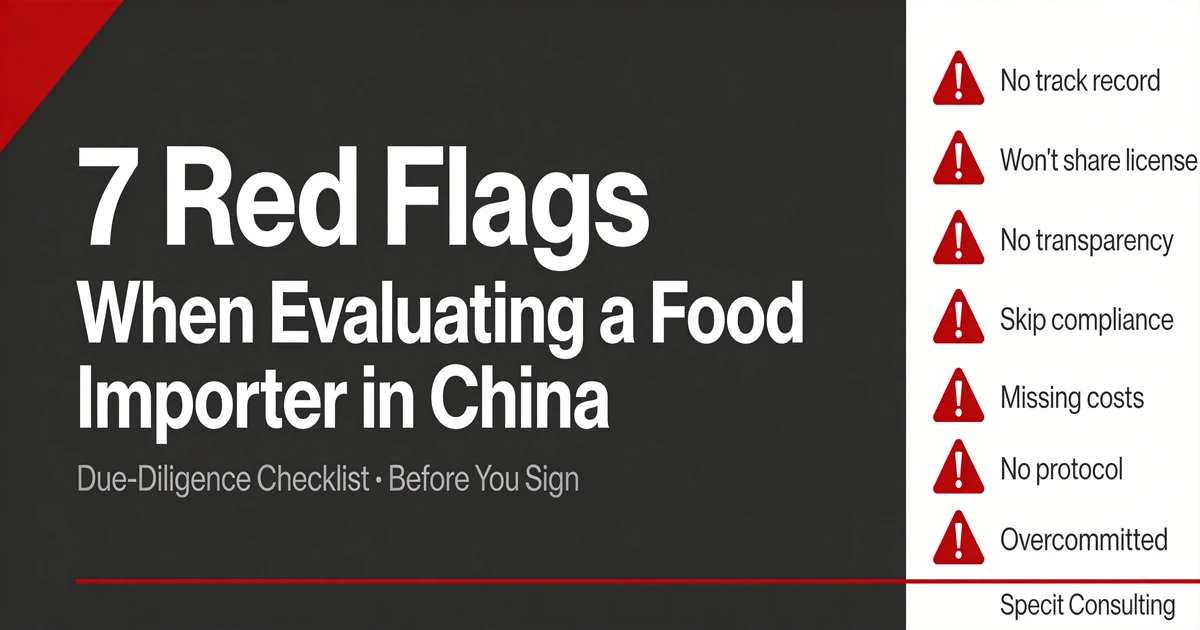
Seven red flags come up before a contract is signed.
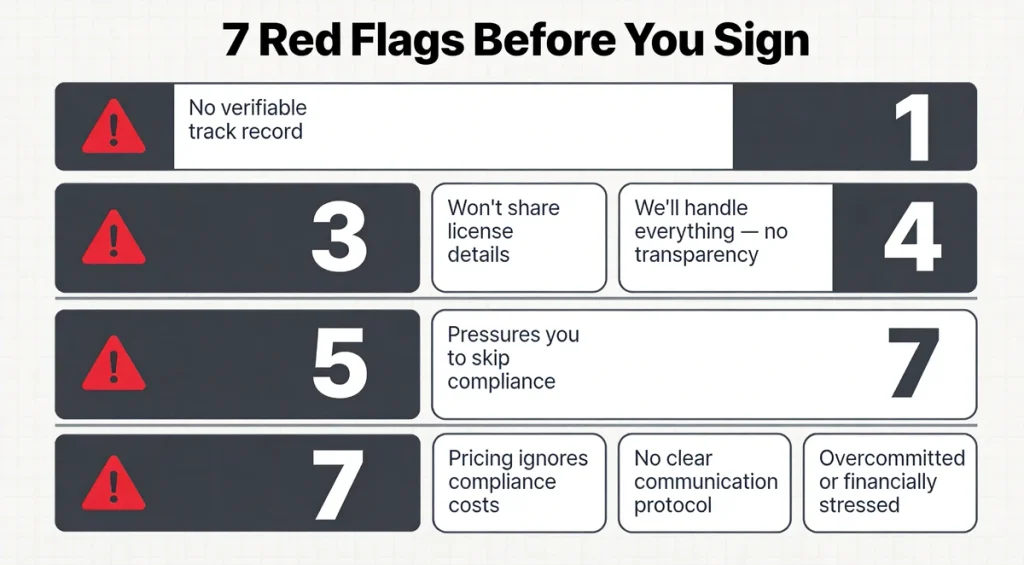
1. No verifiable track record in your product category
An importer may claim “we handle food” broadly but cannot name specific brands or HS codes they have imported in your category. Ask for import declaration numbers, port of entry, and approximately how many orders in your specific category.
Cross-reference with China’s National Enterprise Credit Information Public System (国家企业信用信息公示系统) and request a reference from an existing overseas supplier. Finding qualified importers in Asia starts with this check.
2. Unwillingness to share business license and importer registration details
Legitimate importers can provide their unified social credit code, food business license scope, and proof of their customs importer registration (进出口货物收发货人备案).
If they say “we’ll show you after the contract,” walk away. Compliance details are pre-contract information, not post-signing formalities. Search the company name on China’s National Enterprise Credit Information Public System to verify their registration status.
3. The “we’ll handle everything” offer without transparency
“We’ll take care of GACC registration, labelling, customs, distribution — you just ship.” This sounds attractive but hides risk. Without visibility into their registration actions, you cannot verify whether your facility was registered correctly under the current GACC registration regulation (Decree 280, effective 1 June 2026).
Wrong entity means future revocation. At minimum, you should see your own GACC registration certificate, review your Chinese label proof before it is filed, and receive customs declaration copies. Our GACC registration guide for food exporters explains what you should be able to verify. By the way, your partner or importer has no obligation to register GACC for your facility — that is your responsibility.
4. Pressure to skip compliance steps
Be wary of an importer who urges you to ship before GACC registration is complete, suggests using cross-border e-commerce to bypass general-trade requirements when your product is not on the CBEC Retail Import Positive List (跨境电子商务零售进口商品清单), or tells you not to worry about GB additive limits (GB 2760) because “we can handle every challenge or problem.” This is the importer whose next problem will be yours.
5. Pricing that does not account for compliance costs
A quoted import price that is suspiciously high or low — without an itemized breakdown — is a warning sign. What is missing?
Tariff, VAT, inspection fees, label adaptation costs, warehouse storage during customs holds. Our import duties and tariff analysis can help you verify whether the numbers make sense. A serious importer provides a landed-cost estimate that includes compliance overhead. A reckless one gives you a unit price and hopes customs problems become yours.
6. No clear communication protocol
Only WeChat contact, no formal email or company domain. Personal phone numbers instead of a company switchboard. Inconsistent response times. Vague reassurances instead of specific answers to compliance questions.
In Chinese business culture, indirect communication is normal — but refusal to address compliance questions directly is not. Keeping aligned with your Chinese importer requires a communication cadence agreed in writing, no matter through email or WeChat.
7. Signs of overcommitted capacity or financial stress
Pushing for very large first orders suggests they need cash flow, not a strategic partnership. Inability to explain their distribution reach beyond “we have many channels” is a red flag.
Ask about their current brand portfolio in your category — if they already carry five or more competing brands, where does yours sit?
Why This Matters for You
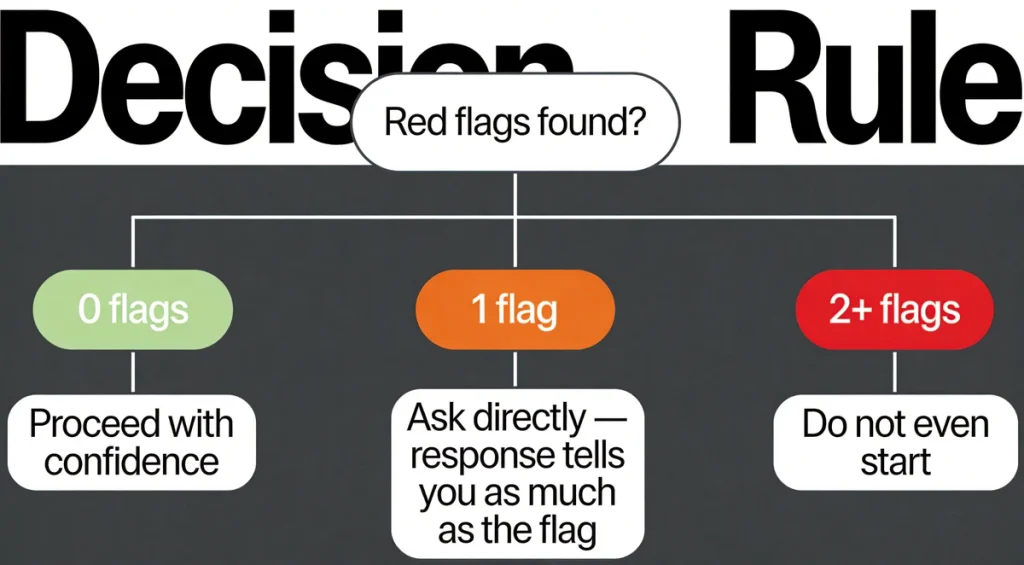
One red flag warrants a direct question. The response tells you as much as the flag itself. Two or more red flags mean pause the relationship. Do not even start.
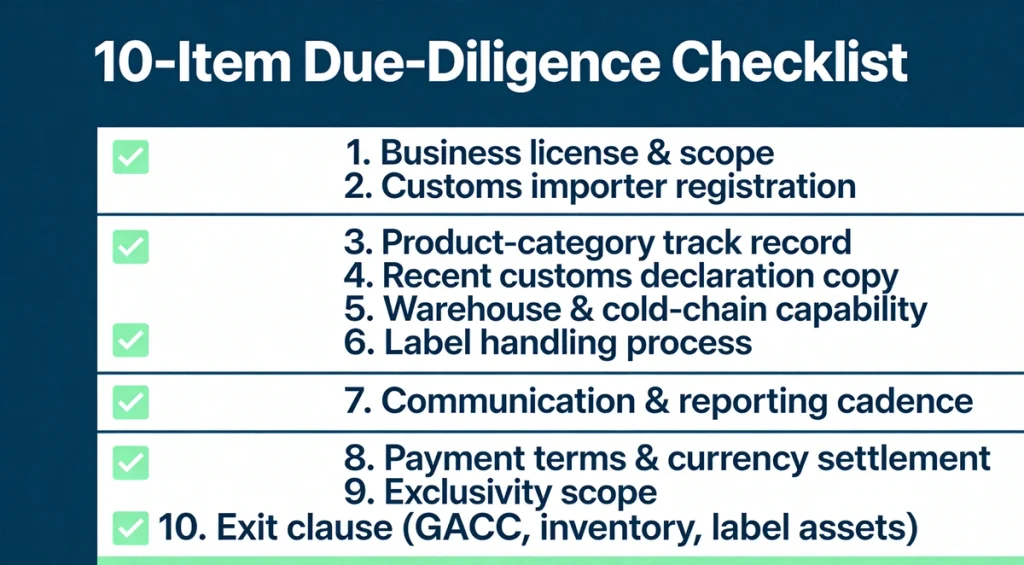
The due diligence checklist before signing should cover ten items:
- Business license and food business license scope
- Proof of customs importer registration
- Product-category import track record
- Customs declaration copy from a recent shipment
- Warehouse and cold-chain capability
- Label handling process
- Communication and reporting cadence
- Payment terms and currency settlement process
- Exclusivity scope
- Exit clause — what happens to GACC registration, product already in the importer’s warehouse, and label assets
The exit clause is the most overlooked item on the list. Exporters focus on getting in and forget that every importer relationship eventually ends, either by success or failure.
If you do not know what happens to your registration, your product already in the importer’s warehouse, and your label assets when the partnership concludes, you are negotiating without knowing the cost of leaving. Note: GACC registration is tied to your facility, not the importer — but you must update the consignee on record when you change importers.
Takeaway
Treat importer vetting as a compliance process, not a sales conversation.
Verify the license, the registration, and the track record before you sign anything. Demand transparency on GACC filings and label submissions — these are your compliance assets, not theirs.
Review the landed-cost breakdown item by item, and question any number that seems too clean. Agree on communication and reporting cadence in writing, including monthly sales, stock levels, and compliance updates. And negotiate the exit clause now, while the relationship is friendly.
Importers who welcome scrutiny are worth working with. Those who resist scrutiny are the ones you should walk away from. Our importer identification and sourcing service introduces exporters to pre-vetted importers, so you skip the guesswork.
Need help evaluating a potential food importer in China? Contact Specit Consulting for an initial assessment based on public data.
About Specit Consulting
We help food and beverage brands enter and grow in the Chinese and wider Asian markets through trade intelligence, importer identification, and market research. See how we introduce exporters to importers and our China market entry playbook.
Disclaimer: This article reflects general market observations and is intended for informational purposes only. It does not constitute legal or regulatory advice. Always confirm current requirements with the relevant authority or a qualified regulatory consultant.
Need help navigating your market entry?
We've helped food exporters across 10+ countries enter 13 Asian markets. Get a free initial assessment based on public data — delivered in 3 working days.
Get Your Free AssessmentContinue Reading
▶Exporting Food to Asia in 2026: A Market Prioritization Framework for Craft Food & Beverage Brands
▶Food Import Detentions in Asia: 7 Real Cases and How to Avoid Them (2026)
Questions about entering the Asian market?
Chat with us on WhatsApp →