

22 September 2026 | Shanghai, China
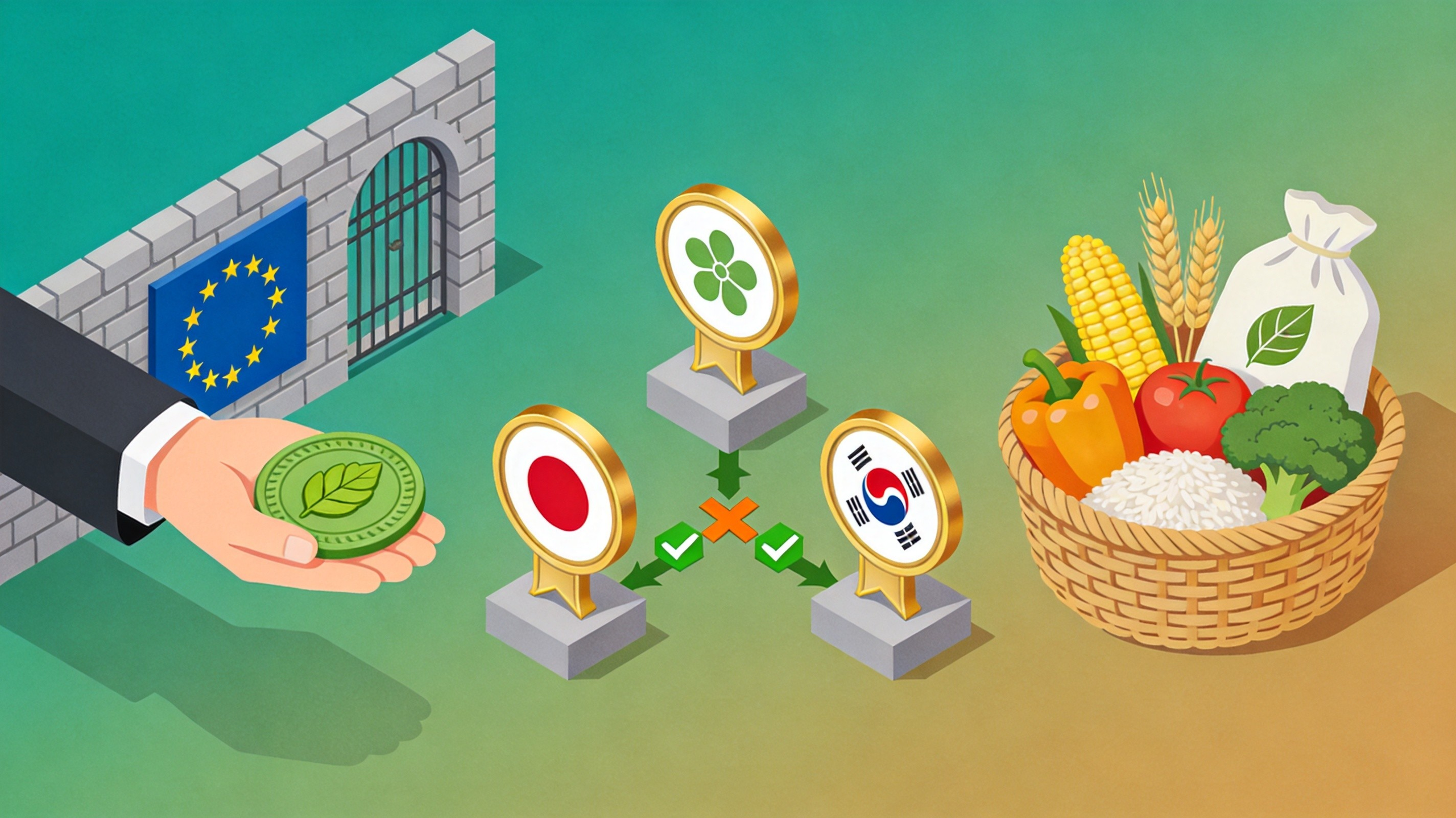
At Specit Consulting, we help European food and beverage exporters navigate certification requirements across 13 Asian markets. One assumption surfaces in nearly every conversation with organic producers: that a European organic certificate is a passport to all Asian markets.
It is not.
China, Japan, and South Korea each operate their own organic certification systems, and mutual recognition with the EU is the exception, not the rule. Without the right certification for each target market, your product cannot legally carry the "organic" label at retail. In some cases, it cannot be sold as organic at all, even if it fully meets EU organic standards. This guide breaks down what works, what does not, where the real costs and delays hide, and what exporters need to prepare before shipping.
Asia's Organic Market: Growing, but Fragmented
Organic consumption is rising across all three major East Asian markets.
China's organic product sales exceeded RMB 152.2 billion (approximately USD 21 billion) in 2025, a 22% year-on-year increase. Processed organic products contribute over 90% of sales by value; dairy, alcoholic beverages, and infant formula together account for more than 70% of the market, while vegetable products, convenience foods, and organic beverages show the fastest volume growth. Since 2022, China has ranked among the world's top three organic consumer markets.[^1] South Korea's organic food market is projected to grow at a CAGR of roughly 6–13% depending on category, supported by government subsidies for organic agriculture and high consumer concern about food safety.[^2] Japan's organic market is smaller but mature, built around government-supported JAS standards and a dedicated base of health-conscious consumers.
The challenge is not demand. It is regulatory fragmentation. Each market runs its own certification framework, and equivalence between systems is limited to specific product categories, specific production stages, and specific documentation requirements. Exporters who treat Asia as a single compliance zone routinely encounter products that sell successfully in one market but cannot be labelled organic in the next — and the cost of discovering that after shipment is significantly higher than the cost of verifying it beforehand.
Mutual Recognition at a Glance
The core question for any EU organic exporter is simple: which Asian markets accept EU organic certification as equivalent, and which require a separate certification process?
| Market | EU organic recognised? | Scope | Key condition |
|---|---|---|---|
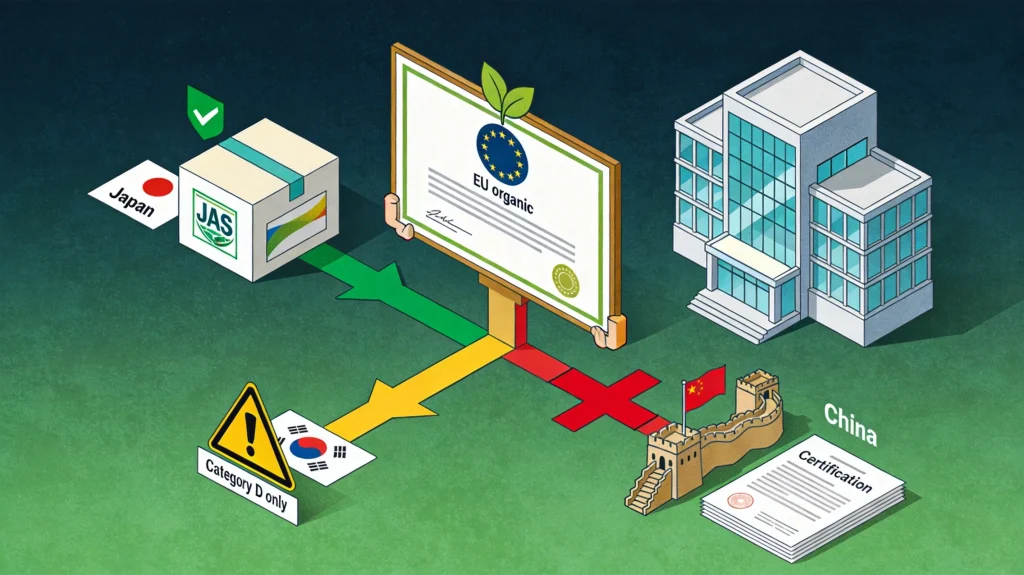
| Japan | Yes, under the EU–Japan mutual recognition arrangement | Plants, plant products, livestock, processed foods, organic alcoholic beverages (from 1 October 2025) | Japanese importer must hold organic JAS certification; post-import processing invalidates the claim; COI per shipment |
| South Korea | Yes, under EU–Korea equivalence (Category D only) | Processed agricultural products for food use | NAQS Import Certificate issued in e-NAQS before shipment leaves the exporting country; ≥95% organic ingredients; raw materials must be from EU-recognised sources |
| China | No | — | Separate Chinese organic certification through a CNCA-approved body required for domestic organic labelling |
Two important caveats apply even where equivalence exists. First, recognition applies to specific product categories and production stages — adding livestock ingredients outside the recognised scope, or processing after import, can remove a product from the equivalence scope entirely. Second, recognition of certification does not remove the need for local labelling compliance, importer licensing, or standard food import registration.
China: A Fully Separate Certification Path
China operates the most demanding organic certification regime in Asia. There is no mutual recognition agreement between China and the EU for organic products. EU-certified organic goods cannot be labelled or sold as organic in China without additional Chinese certification.
The 2026 rules
On 1 January 2026, China implemented the 2025 Edition Interpretation of the Implementation Rules for Organic Product Certification, issued by CNCA (Certification and Accreditation Administration) as Announcement No. 18 of 2025 on 25 September 2025.[^3] The updated rules tighten inspection scheduling, require advance notification of on-site audits, increase documentation standards for certification bodies, and strengthen post-certification supervision. Key requirements that directly affect exporters include:
Certification through a Chinese-approved body. Products must be certified by a certification body accredited by CNCA. EU-based control bodies cannot issue certificates valid for the Chinese organic market on their own; they must either be registered as foreign certification bodies under the CNCA system or work through a Chinese partner body. As of 2026, a limited number of EU-based control bodies hold CNCA registration, and the scope of products they are approved to certify varies.
The 95% rule (calculated correctly). For processed organic foods, organic ingredients must account for at least 95% of total ingredients by weight, excluding water and salt. This is similar in principle to the EU rule, but the Chinese calculation methodology and the list of permitted non-organic ingredients within the 5% allowance are defined by Chinese national standard GB/T 19630 and differ from EU Annex VIII.[^4] The same ingredient cannot be present in both organic and conventional form in a single product — a dual-sourcing prohibition that EU producers sometimes violate when they run partial organic production lines.
Minimum management system operation. Under the 2026 rules, applicants must have operated a GB/T 19630-aligned management system for more than three months before applying for certification, with stable operational records generated during normal business activity — records created solely for the application will be rejected.[^3a] This adds lead time for facilities that do not already operate a CNCA-compliant system.
One-year validity, annual renewal. Chinese organic certificates are valid for one year and require annual recertification, including on-site inspection. This is shorter than the EU certificate cycle and means exporters must plan for recurring audit costs.
No "in-conversion" labelling for processed products. Processing-category organic conversion certificates are not renewed under the 2026 rules and expire naturally.
Logo misuse consequences. Unauthorised use of the China Organic Product mark results in certificate revocation and public disclosure on the national certification supervision platform. This is not merely an administrative fine — it directly affects an exporter's ability to certify future products in China.
What this actually costs and how long it takes
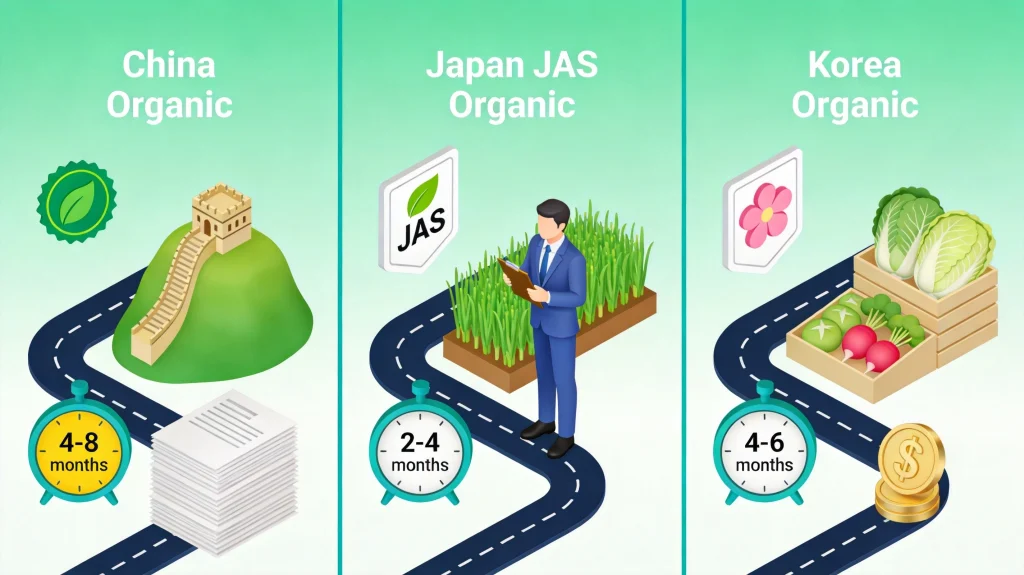
For EU facilities, the realistic cost of Chinese organic certification runs RMB 30,000–80,000 (approximately USD 4,000–11,000) in direct fees for the first year — comprising application fee (RMB 3,000–10,000), on-site inspection by a CNCA-approved auditor including international travel (RMB 5,000–20,000 base, plus travel costs for EU sites), and product testing (RMB 2,000–8,000 per sample), plus the certifier's annual management fee.[^3b] The timeline from application to certificate issuance typically runs 4–8 months, with the on-site audit scheduling and any non-conformity resolution being the main variables. Annual renewal costs less but still requires an on-site audit.
The alternative: enter without an organic claim
For exporters not yet ready to invest in full Chinese organic certification, there is a legitimate alternative: enter the Chinese market without making an organic claim, selling the product on its general merits (origin, quality, protected designation, clean-label positioning) and complying with standard GB 2760 additive requirements and import procedures. This avoids the certification burden but forgoes the price premium that the organic label commands in China — which, depending on category, can be 30–80% above conventional equivalents.
Japan: Equivalence Works — But Conditions Apply
Japan's organic JAS (Japanese Agricultural Standard) system is governed by the JAS Law (Law Concerning Standardisation and Proper Labelling of Agricultural and Forestry Products). The EU and Japan have operated a mutual recognition arrangement for organic products since 2014, and its scope has been progressively expanded.
What the EU–Japan arrangement currently covers
Under the current arrangement, Japan recognises EU organic certification as equivalent to JAS organic standards for the following categories:
- Organic plant and plant products
- Organic livestock products
- Organic processed foods
- Organic alcoholic beverages (added 1 October 2025, following MAFF notification)[^5]
Excluded from equivalence are honey, fishery products, and cosmetics. In-conversion livestock products and processed products containing in-conversion livestock ingredients are also excluded when exported from certain third countries.
Conditions that routinely catch exporters out
The Japanese importer must be JAS-certified. EU certification covers the production side, but the Japanese importer must hold organic JAS importer certification (or work through a JAS-registered importer/certifier) to affix the JAS organic mark to the product. The EU-certified operator cannot simply print the JAS mark in Europe; the JAS mark is applied under the Japanese importer's certification responsibility. JAS importer certification is not a trivial formality: initial costs for the importer run JPY 300,000–600,000 (approximately USD 2,000–4,000) with annual maintenance of JPY 200,000–400,000, and all production records, input lists, and quality management documentation must be available in Japanese or accompanied by certified Japanese translation.[^5a] Many Japanese importers who handle conventional food do not hold JAS importer certification, and obtaining it adds 2–4 months to the market-entry timeline.
No processing after import. If the product is repackaged, re-blended, milled, or otherwise processed after import into Japan — even simple operations like splitting bulk packaging into retail units — the JAS organic claim is invalidated unless the processing entity itself holds JAS certification. This rules out a common distribution model where bulk product is imported and repacked by a Japanese distributor.
Production within recognised EU member states. The equivalence applies to products produced in EU member states recognised under the arrangement. Products produced outside the EU and merely traded through an EU entity do not qualify.
Certificate of Inspection (COI) per shipment. Each shipment must be accompanied by a COI issued by the EU control body, with lot, consignee, and product details matching the shipping documents exactly. Discrepancies between COI details and bills of lading or commercial invoices are a frequent cause of delay at Japanese ports; corrections require coordination between the EU control body and Japanese certifier, which can take several days while the shipment incurs storage charges.
Practical takeaway
EU organic certification is the starting point for Japan, not the finish line. The exporter still needs a JAS-certified Japanese importer (which may take the importer 2–4 months to obtain if they do not already hold it), correct COI documentation per shipment, and a supply chain that avoids post-import processing. For EU exporters already selling into Japan with an established JAS-certified importer this is achievable; for new entrants, the importer-certification step is the one most often underestimated. For the full picture of what a Japan launch requires beyond organic equivalence, see our six-step Japan food import compliance guide.
South Korea: Equivalence for Processed Products, With a Hard Documentation Deadline
South Korea operates its own organic certification system under the Act on Fostering Eco-Friendly Agriculture and Fisheries and Managing and Supporting Organic Foods, administered by MAFRA (Ministry of Agriculture, Food and Rural Affairs) and NAQS (National Agricultural Products Quality Management Service).
The EU–Korea equivalence arrangement — Category D only
The EU and South Korea maintain an equivalence arrangement, but its scope is narrower than Japan's. Under EU Implementing Regulation (EU) 2021/2325, as most recently amended by Regulation (EU) 2026/1789 of 23 July 2026, Korea is recognised as an equivalent third country for Category D — processed agricultural products for food use.[^6] This means EU-certified organic processed foods can be sold as organic in Korea, subject to conditions; raw agricultural commodities and livestock products fall outside the equivalence scope and require separate Korean certification.
A critical restriction that many exporters miss: organic raw materials used in the Category D processed product must be (i) certified by an EU-accredited control body, (ii) produced and certified in an EU-recognised third country, or (iii) produced and certified within the EU. Ingredients from non-recognised origins, even if organically certified under a private standard, will cause the product to fail organic import review. EU certifier lists are updated regularly — the July 2026 regulation removed one Korean certifier (Dodam Eco-friendly, KR-ORG-044) from the approved list, meaning products certified by that body after the effective date can no longer clear EU–Korea equivalence.[^6]
Key requirements at import:
NAQS Import Certificate, issued before departure — no exceptions. Each shipment must be accompanied by an NAQS Import Certificate for Organic Processed Foods, lodged by the exporter's certifier through Korea's e-NAQS system before the consignment leaves the exporting country.[^6a] This is a documentary step coordinated between the EU certifier and the Korean importer, but it has a hard deadline: if the certificate is not issued before the vessel departs (or the aircraft takes off, for air freight), the shipment cannot be cleared as organic. There is no after-the-fact remedy; the product may still be imported but only as conventional food, with the organic claim removed and any organic marketing positioning for that shipment lost. Exporters are advised to initiate the certificate request at least two weeks before planned shipment, as corrections to certifier details or product listings can add days.
95% organic ingredient threshold. Products must contain 95% or more organic ingredients (by weight, excluding water and salt) to be labelled as organic. This mirrors the EU threshold, but Korea's list of permitted non-organic ingredients in the 5% allowance differs from the EU list, and ingredient substitutions must be verified against the Korean list.
No "100% Organic" claim, no "made with organic" category. Korean organic labelling rules do not permit "100% Organic" labelling (in contrast to the US market), and there is no "made with organic [ingredient]" labelling category — a product is either certified organic (and labelled as such) or it does not carry an organic claim at all.
Korean-language labelling. All mandatory label information, including the organic claim and certifier identification, must be presented in Korean, consistent with general Korean food labelling requirements. The MAFRA Korea Organic label is optional but, if used, must comply with Korean format and colour specifications.
What this means in practice
EU organic processed foods have a viable route to the Korean market through the Category D equivalence arrangement, but the pre-shipment NAQS certificate is a non-negotiable deadline with no grace period. We have seen EU exporters lose the organic status of entire containers because their EU certifier lodged the e-NAQS application a day after the vessel sailed — the certificate is date-stamped against bill-of-lading departure date, and NAQS does not grant exceptions for late submissions. Raw agricultural commodities (fresh organic fruit, organic grain) and livestock products require a separate Korean organic certification pathway, not the equivalence route.
Southeast Asia: A Quick Note on the Rest of ASEAN
This article focuses on China, Japan, and Korea because they are the largest and most strictly regulated organic markets in Asia. For completeness:
- Singapore does not have a mandatory domestic organic certification scheme; organic claims must be substantiated by a recognised certification body, and EU organic is generally accepted for retail.
- Thailand operates its own Organic Thailand certification but recognises several foreign certifiers, including EU control bodies for imported products, subject to importer registration.
- Indonesia requires organic certification through BIOCert or a recognised foreign body for the domestic organic label, under BPJPH supervision. Note that this is separate from halal certification, which becomes mandatory for a much broader range of products under the 18 October 2026 deadline — see our Indonesia halal guide for details.
- Vietnam and the Philippines are in earlier stages of organic regulation development; domestic organic labels exist, but recognition of foreign certificates varies.
For multi-market ASEAN strategies, verify certification requirements market by market. Do not assume that recognition in one ASEAN country implies recognition in another.
The Three Costs of Assuming "EU Organic = Asia"
The assumption that European certification travels automatically across Asia creates three predictable costs:
1. Product delisting and loss of organic price premium. If your product carries an organic claim without valid local certification, retailers may remove it from shelves upon regulatory inspection. In China, misuse of the organic logo triggers certificate revocation and public disclosure on the national supervision platform, which affects future certification applications. In Korea, the NAQS certificate check is performed at import, so the problem typically surfaces before retail — but a rejected organic claim at the port forces re-labelling under a non-organic claim, destroying the organic price premium (30–80% in many Asian categories) for that shipment.
2. Shipment delay, re-labelling, or rejection. Customs authorities and inspection agencies check organic claims against certification records. A shipment labelled "organic" without a valid certificate for the destination market can be detained, required to be re-labelled at a bonded warehouse (adding per-carton charges and 3–10 days), or in extreme cases returned or destroyed. The Korea NAQS pre-departure requirement means that an organic claim rejected at the port cannot be rescued after arrival — the choice is re-labelling as conventional or shipment return, at the importer's cost.
3. Fines, penalties, and reputational damage. Unsubstantiated organic claims constitute mislabelling. Penalties vary by market but include administrative fines, product recall orders, and in repeated cases, import suspension. Beyond the direct penalty, a non-compliance record can affect the frequency of precise inspection on future food shipments to that market, and can make it harder to secure and retain importers who are unwilling to carry the compliance risk.
What Public Checklists Won't Tell You
As with food import registration generally, the published regulations tell you what is required but not where the operational failures happen. In our work with EU organic exporters, four issues routinely cause problems that no public checklist explicitly warns about:
- CNCA-approved certifier availability for EU facilities is limited. The list of EU-based control bodies holding CNCA registration is short, and not all of them are approved for all product categories (dairy, alcohol, and infant formula have particularly narrow coverage). Selecting a certifier who is not approved for your product category — or whose approval is up for renewal mid-process — can add months to your China timeline.
- The dual-sourcing prohibition is actively audited. GB/T 19630 prohibits using the same ingredient in both organic and conventional form within one certified product, and Chinese auditors look for this specifically in production records and batch documentation. EU producers who run partial organic lines and source the same ingredient from both organic and conventional suppliers for different SKUs sometimes have batch-traceability systems that are insufficient for Chinese audit standards.
- JAS importer certification requires Japanese-language documentation. This is not merely a translation exercise — the JAS certifier audits the importer's documented relationship with the EU producer, and all technical documentation (process flow, input lists, traceability records, complaint handling) must be available in Japanese. Many EU producers underestimate how much of their production documentation must be reformatted and translated for the importer's JAS audit, and how much lead time that adds.
- EU organic certifier responsiveness to e-NAQS lodging is the real Korea bottleneck. The NAQS certificate itself is straightforward, but it requires the EU certifier to log into Korea's e-NAQS system and lodge the application before the vessel departs. Not all EU control bodies are set up for this; some require several working days' notice, and time-zone differences between Europe and Korea can cause a request sent on a Friday to be processed only the following week. Exporters who leave this to the last week before shipment are the ones who miss the deadline.
These are not "gotchas" — they are predictable operational issues that arise from the interaction between EU production systems and Asian certification requirements. Public regulations describe the end state; they do not map the path for you. For help designing a multi-market organic certification pathway that accounts for these operational realities, see our organic certification support service.
Three Signals You Need a Certification Review Before You Ship
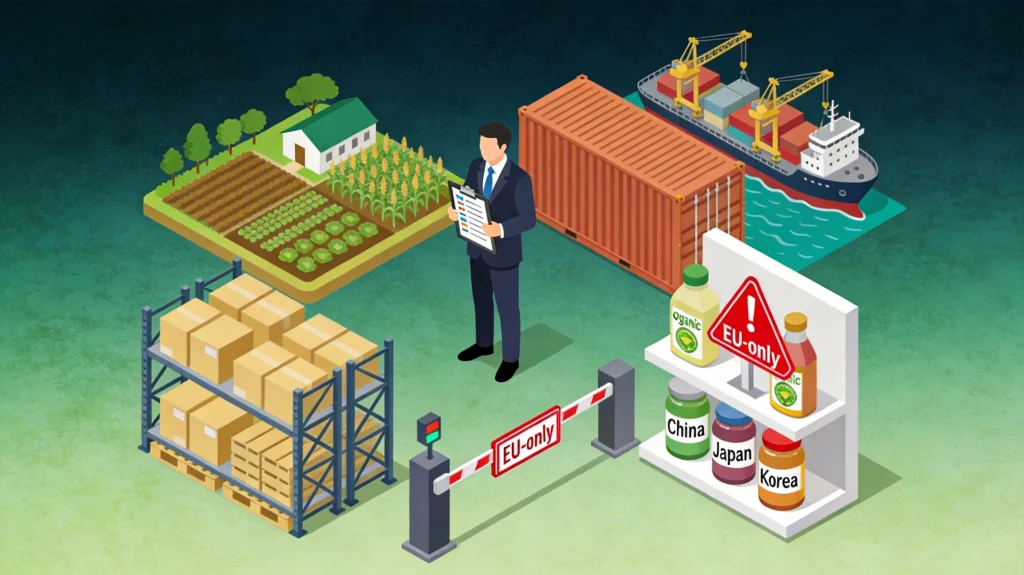
Most EU organic exporters who contact us after a problem already understood the basic principle that certification differs by market. The question is whether your specific product and supply chain are ready. You should seek professional review before your first organic shipment to an Asian market if any of the following is true:
- You are targeting China, and you have not confirmed that your EU control body holds CNCA registration for your specific product category. Being CNCA-registered for one product category does not mean registration covers your product; dairy, alcohol, infant formula, and certain processed categories require specific scope approval.
- Your Japanese importer does not currently hold JAS importer certification (or their certification does not cover your product category). Obtaining JAS importer certification adds 2–4 months and JPY 300,000–600,000 in costs for the importer — a timeline and cost that should be factored into your launch plan, not discovered after you start shipping.
- You are shipping organic processed food to Korea, and you have not confirmed that your EU certifier can lodge the NAQS Import Certificate in e-NAQS with at least two weeks' lead time before vessel departure. If your certifier cannot confirm e-NAQS capability and turnaround time in writing, you are at risk of missing the pre-departure deadline and losing organic status for that shipment.
If none of these signals apply and you have experienced importers with the right certifications driving the process in each market, you are in a reasonable position to self-manage. If one or more applies, a pre-shipment pathway review is low cost relative to losing organic premium on a single shipment, or facing the USD 8,000–25,000 cost of a rejected container in Korea or Japan. Real detention outcomes across China, Japan and Korea — covering labels, additives, aflatoxin, registration, pesticide residue and HS misclassification — are catalogued in our Asian food import detention case review.
Frequently Asked Questions
Is USDA organic equivalent to EU organic in Asia?
USDA organic and EU organic are recognised as equivalent for direct trade between the US and EU (with certain conditions around production location and compliance). However, this US–EU equivalence does not extend automatically to Asian markets. Whether USDA organic is accepted in China, Japan, or Korea depends on each country's own equivalence arrangements with the United States — for example, the US maintains its own equivalence arrangements with Japan and Korea (with similar Category D scope and NAQS certificate requirements in Korea), but not with China.
Do small-volume or sample shipments require organic certification?
If you intend to label or sell the product as organic — yes, regardless of volume. None of the three major Northeast Asian markets provide a small-volume exemption for organic claims. Products shipped without organic certification can still be sold, but not with an organic label. If the shipment is genuinely a non-commercial sample with no retail intent, organic labelling rules do not apply in the same way, but importers should document the sample status to avoid confusion at the border.
How long does organic certification take for China?
Chinese organic certification through a CNCA-approved body typically takes 4–8 months from application to certificate issuance, including the three-month minimum management system operation period, document review, scheduling and conduct of an on-site facility inspection, and product testing where applicable. Certificates are valid for one year and must be renewed annually. For EU producers already holding EU organic certification, a significant portion of the documentation (production processes, input lists, traceability records) overlaps, but the Chinese audit is a separate procedure with its own non-conformity resolution cycle.
Can I use my EU organic logo on packaging destined for China?
The EU organic leaf logo may appear as part of the original packaging artwork, but the product cannot be labelled or marketed as organic in Chinese retail without Chinese organic certification. Following the European Parliament's July 2026 vote on the revised organic regulation (Regulation (EU) 2018/848 amendments), products from recognised equivalent third countries — including those imported from China under the EU–China arrangement — are permitted to use the EU organic logo subject to additional production and control requirements.[^7] This resolved the uncertainty created by the October 2024 Herbaria II ruling of the Court of Justice of the EU, which had restricted EU organic logo use on equivalent third-country products pending legislative clarification. For packaging destined for the Chinese market specifically, coordinate label presentation with your Chinese importer to avoid any implication that EU organic certification alone authorises organic retail sale in China.
If I get Chinese organic certification, does it work in Japan or Korea?
No. Each market operates its own system. Chinese organic certification is not automatically recognised in Japan or Korea, just as EU organic is not automatically recognised in China. A multi-market strategy requires either pursuing certification or equivalence pathways in each target market, or designing the product and supply chain to meet the strictest applicable standard across the target set and then documenting compliance against each market's specific requirements.
What to Do Before Your Next Organic Shipment to Asia
Before labelling a product as organic for an Asian market, confirm all of the following:
- Certification pathway. Identify whether an EU–JAS or EU–Korea (Category D) equivalence pathway exists for your product category, or whether you need full local certification (China, and any non-equivalent categories in Korea).
- Importer readiness. Confirm that your importer holds the necessary organic importer certification for the market (JAS importer certification in Japan; the ability to lodge NAQS documentation in Korea; a relationship with a CNCA-approved certifier for China). If the importer needs to obtain certification first, build the timeline into your launch plan.
- Pre-shipment documentation. For Korea, confirm your EU certifier's e-NAQS capability and initiate the NAQS Import Certificate at least two weeks before planned departure. For Japan, confirm that your EU control body will issue the required Certificate of Inspection with details matching your shipping documents. For China, plan your certification timeline 4–8 months ahead of any intended shipment date.
- Ingredient list review. Verify that your organic ingredient percentage (excluding water and salt) meets the 95% threshold under the target market's calculation method, that any non-organic ingredients within the 5% are permitted under that market's rules, and that you are not dual-sourcing any ingredient in organic and conventional form within the same certified product (a specific China requirement).
- Label review. Ensure that the organic claim is presented in the local language and format required, that no prohibited claims ("100% organic" in Korea, "made with organic" in both Korea and China) appear, and that certifier identification is presented correctly, consistent with general Korean food labelling requirements and Japanese JAS marking rules.
Need help assessing which organic certification pathway applies to your product across China, Japan, Korea, or other Asian markets? We offer a free initial compliance snapshot covering certification pathway selection, certifier availability for EU facilities, importer-readiness requirements, and document-readiness assessment based on your product specification and current certification status. Contact Specit Consulting before you ship.
About Specit Consulting
We help food and beverage brands enter and grow in the Chinese and wider Asian markets through trade intelligence, tariff analysis, labelling compliance, halal and food certification support, importer identification, and market research.
✉ info@specitconsulting.com
[1]: State Administration for Market Regulation (SAMR) / Certification and Accreditation Administration (CNCA), "China's Organic Product Sales Reach New High," 27 August 2026. 2025 organic product sales exceeded RMB 152.2 billion (+22% YoY); processed organic products accounted for>90% of sales; dairy, alcohol, and infant formula >70%; China in global top 3 organic markets since 2022.
[2]: Industry analyst estimates vary by category scope and definitional boundary. Verified Market Reports (2026) estimates the Korean organic food market at approximately USD 2.9 billion in 2024, growing at ~6% CAGR; Future Market Insights (2026) identifies Korea as the fastest-growing organic market at ~13.5% CAGR through 2036 for certified organic processed foods. Figures cited reflect the range across analyst sources; MAFRA and NAQS do not publish a single consolidated market-size figure.
[3]: CNCA Announcement No. 18 of 2025, "Implementation Rules for Organic Product Certification (2025 Edition)," issued 25 September 2025, effective 1 January 2026. See also China Briefing, "China's New Organic Product Certification Rules in 2026," 5 January 2026; Cisema, "China Tightens Organic Certification Rules," 29 January 2026.
[3a]: Cisema, "China Tightens Organic Certification Rules," 29 January 2026, citing GB/T 19630-2019 management system operation requirements under the 2026 implementing rules.
[3b]: Chinese certification fees range from industry fee schedules published by Chinese certification bodies (CQC, OFDC, etc.), including application, on-site inspection, and testing components. International travel costs for EU site audits are additional and vary by auditor location.
[4]: GB/T 19630-2019 (China National Standard for Organic Products), processing requirements: organic ingredients ≥95% by weight excluding water and salt; no dual-sourcing (organic + conventional) for the same ingredient.
[5]: Japan Ministry of Agriculture, Forestry and Fisheries (MAFF), "Organic Alcoholic Beverages Become Eligible for Import/Export under JAS Equivalence," press release, 26 September 2025: from 1 October 2025, organic alcoholic beverages added to EU, UK, US, Australia, New Zealand equivalence scope. Exclusions remain honey, fishery products, cosmetics, and in-conversion livestock products.
[5a]: JAS certification cost and documentation requirements from Japanese certification body fee schedules (e.g., BHOOC, Japan Organic & Natural Foods Association) and practitioner guidance; JAS Law Article 63-3 requires importers to hold JAS grading certification for organic JAS-marked products.
[6]: EU Implementing Regulation (EU) 2021/2325, as most recently amended by Commission Implementing Regulation (EU) 2026/1789 of 23 July 2026 (effective 27 July 2026). Korea listed for Category D (processed agricultural products for food use); one Korean control body (Dodam Eco-friendly, KR-ORG-044) removed from the approved list. Organic raw material sourcing restriction: ingredients must be certified by EU-accredited bodies, produced and certified in EU-recognised third countries, or produced and certified within the EU. See also KATI (Korea Agro-Fisheries & Food Trade Corporation), "[EU] EU Revises Implementing Rules on Organic Product Imports," 28 August 2026.
[6a]: USDA Agricultural Marketing Service, "International Trade Policies: Republic of Korea — US–Korea Organic Equivalence Arrangement," updated March 2026; Australian Department of Agriculture, Fisheries and Forestry, "Republic of Korea — Organic Equivalence Arrangement," updated January 2026; Canadian Food Inspection Agency, "Overview: Canada–South Korea Organic Equivalency Arrangement," January 2026. All three country authorities confirm that NAQS Import Certificates must be lodged in e-NAQS before the consignment leaves the exporting country, with no post-departure remedy.
[7]: European Parliament press release, "Organic products: MEPs back measures to support EU production," 14 July 2026. The adopted text permits use of the EU organic production logo on products imported from third countries that meet equivalent standards and additional production and control requirements, with a 5% cap on non-EU organic ingredients in EU-processed products. Third-country equivalence recognitions for the 11 recognised third countries (Argentina, Australia, Canada, Costa Rica, India, Israel, Japan, Korea, New Zealand, Tunisia, United States) are proposed for extension through 31 December 2036 under the current legislative file (2025/0417(COD)).
Need help navigating your market entry?
We've helped food exporters across 10+ countries enter 13 Asian markets. Get a free initial assessment based on public data — delivered in 3 working days.
Get Your Free AssessmentContinue Reading
▶Food Import Detentions in Asia: 7 Real Cases and How to Avoid Them (2026)
▶Japan Food Import Requirements: A 6-Step Compliance Guide for EU Exporters (2026)
Questions about entering the Asian market?
Chat with us on WhatsApp →