


16 September 2026 | Shanghai, China
At Specit Consulting, we track regulatory changes across Asian markets and advise exporters on compliance timelines. Indonesia's mandatory halal certification deadline for imported food and beverage products is approaching on 18 October 2026. This article sets out the regulatory framework issued this month, the two compliance pathways available to overseas producers, and the practical steps exporters should take before the deadline.
The Regulatory Framework: BPJPH Regulation No. 4/2026
On 5 September 2026, Indonesia's Halal Product Assurance Agency (BPJPH) issued Regulation No. 4 of 2026, establishing the operational framework for verifying halal compliance of foreign products entering and circulating in Indonesia. The regulation is designed to provide both consumer protection and business certainty for importers.
BPJPH Head Ahmad Haikal Hasan described it as a guideline for assurance of halal foreign products that enter, circulate, and are traded within Indonesian territory. Trade Minister Budi Santoso has confirmed that halal certification is not classified as an import prohibition or import restriction. Products may clear customs and enter Indonesia first; halal requirements must be met before the products are distributed in the domestic market. This is a meaningful distinction — it means the halal process does not block cargo at the port, but it must be completed before the product reaches retail shelves or food service.
What Changes After 18 October 2026
Seven Product Categories Covered

The mandatory halal requirement extends beyond food and beverages. Under Government Regulation No. 42/2024, the following categories must be halal-certified by 18 October 2026:
• Food and beverage products
• Slaughtered products and slaughtering services
• Raw materials, food additives, and auxiliary materials for food and beverages
• Chemical and genetically engineered products
• Natural medicines, quasi-medicines, and health supplements
• Cosmetics
• Consumer goods including clothing, accessories, household supplies, and Class A medical devices
For food and beverage exporters, the first three categories are the immediate priority. Ingredients and additives used in food production also fall within scope — a point often missed by exporters who only certify the finished product.
Two Pathways to Compliance
Imported products can satisfy halal requirements through one of two mechanisms.
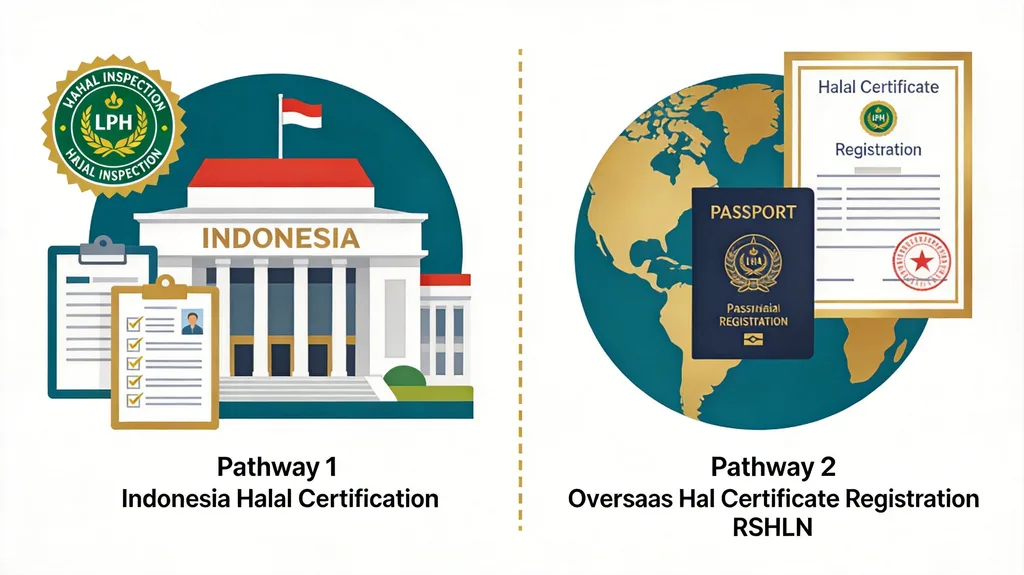
Pathway 1: Indonesian Halal Certification. The product undergoes full halal certification through an Indonesian Halal Inspection Body (Lembaga Pemeriksa Halal, LPH). This is the standard route for products that do not already hold a halal certificate from a recognised foreign body. The process involves document review, facility audit, and product testing coordinated through the Indonesian importer — read our BPJPH registration overview for the full process flow.
Pathway 2: Overseas Halal Certificate Registration (RSHLN). If the product already holds a halal certificate from a Foreign Halal Institution (Lembaga Halal Luar Negeri, LHLN) that has a mutual recognition agreement with BPJPH, the certificate does not need to be re-issued. It must, however, be registered with BPJPH through the RSHLN mechanism before the product can be distributed in Indonesia.
LPPOM, the Indonesian Halal Inspection Body under the Indonesian Ulema Council (MUI), has emphasised that a foreign halal certificate on its own is not sufficient. Registration with BPJPH is mandatory regardless of the certificate's origin or the standing of the issuing body.
What Exporters Need to Prepare
Your Existing Halal Certificate May Not Suffice
Many exporters assume that a halal certificate from their home country certifier will automatically satisfy Indonesian requirements. Two conditions must both be met: the issuing institution must be recognised by BPJPH through a mutual recognition agreement, and the certificate's scope must exactly match the product being registered. Document inconsistencies — such as different product names, ingredient lists, or production addresses between the certificate and the registration application — are a frequent cause of delay. LPPOM advises that orderly, complete, and transparent documentation accelerates verification.
The Timeline Is Constrained
BPJPH has stated publicly that there will be no further extension to the 18 October 2026 deadline. Certification through Pathway 1 (LPH audit) requires coordination for facility visits, document review, and endorsement; RSHLN registration through Pathway 2 requires verification of the foreign certificate against BPJPH records. Exporters who have not yet initiated either process should treat this as a priority.
Non-Halal Products Have Separate Rules
Inherently non-halal products (for example, pork products or alcoholic beverages) do not require halal certification but must carry a clear non-halal statement on the label. They remain subject to standard food safety and labelling requirements.
Enforcement and Sanctions
Non-compliant products after the deadline face administrative sanctions applied progressively:
1. Written warning
2. Administrative fines
3. Revocation of halal certificate (where one has been issued)
4. Product recall from circulation
The recall sanction removes products from distribution entirely until compliance is achieved. For importers with existing stock in the market, this represents a meaningful commercial risk, not a theoretical penalty.
The Market Context
The regulatory timeline is driven by consumer expectations as much as by policy. A 2023 Populix survey found that 83% of Indonesian consumers consider the halal logo a primary factor when choosing products; for food and beverage products specifically, that figure rises to 93%. Halal status in Indonesia is a market access requirement in both the regulatory and commercial sense — without it, retail listing and consumer acceptance are constrained even before enforcement action is considered. This mirrors similar tightening trends across the region, including China's GACC registration requirements for imported food.
Frequently Asked Questions
Does my product need a new halal certificate if I already have one from my home country?
Not necessarily. If your certificate was issued by a Foreign Halal Institution (LHLN) recognised by BPJPH through a mutual recognition agreement, you do not need to re-certify. You must, however, register the existing certificate with BPJPH via the RSHLN pathway before your product can be distributed in Indonesia. Check that the issuing body appears on BPJPH's current list of recognised LHLNs.
What happens if my product is not halal-certified by 18 October 2026?
Non-compliant products may be subject to written warnings, administrative fines, certificate revocation, or product recall from circulation. The recall measure means the product cannot be sold through retail or food service channels in Indonesia until compliance is achieved.
Do all imported food products need halal certification, or are there exceptions?
The mandatory halal requirement applies to all products in the seven categories listed under PP No. 42/2024, including imported food and beverages and their raw materials and additives. Inherently non-halal products do not require certification but must be labelled as non-halal. Importers should verify their specific product category and ingredients against the regulation.
Can my product clear customs before halal certification is complete?
Yes. Halal certification is a domestic distribution requirement, not a customs clearance barrier. Products may enter Indonesia and clear customs, but must not be distributed to retail or food service until the halal requirement is satisfied.
Need help determining whether your existing halal certificate is recognised by BPJPH, or which compliance pathway applies to your product? We offer a free initial assessment covering certificate recognition status, pathway selection, and document readiness for the Indonesia market. Contact Specit Consulting before the October deadline.
About Specit Consulting
We help food and beverage brands enter and grow in the Chinese and wider Asian markets through trade intelligence, tariff analysis, labelling compliance, halal and food certification support, importer identification, and market research.
✉ info@specitconsulting.com
Disclaimer: This article provides general compliance information based on regulations effective as of September 2026 (Decree 15/2018/ND-CP; Circular 30/2026/TT-BYT). It does not constitute professional compliance advice for any specific product or company. Always verify current requirements against your specific product circumstances before making regulatory decisions.
Need help navigating your market entry?
We've helped food exporters across 10+ countries enter 13 Asian markets. Get a free initial assessment based on public data — delivered in 3 working days.
Get Your Free AssessmentContinue Reading
▶Food Import Detentions in Asia: 7 Real Cases and How to Avoid Them (2026)
▶Japan Food Import Requirements: A 6-Step Compliance Guide for EU Exporters (2026)
Questions about entering the Asian market?
Chat with us on WhatsApp →