

30 September 2026 | Shanghai, China
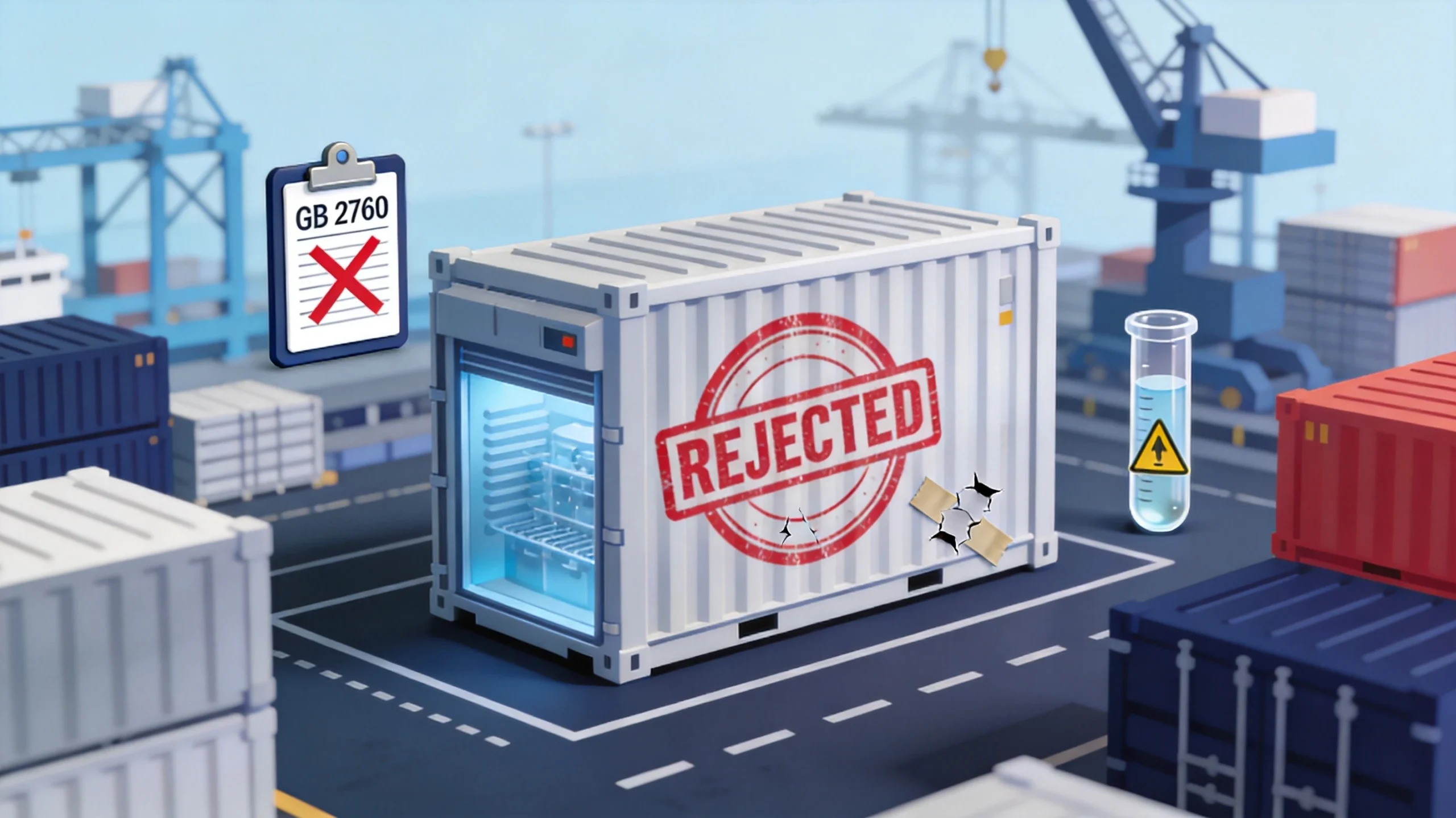
A container sits at the dock.
Day one: the importer calls to say customs has placed a hold.
Day four: the inspection report arrives. A preservative the exporter uses routinely in EU production is not on the destination country's approved list.
Day nine: destruction is authorised. The goods, valued at EUR 72,000, are gone before the exporter has finished reading the email chain.
This is not hypothetical. It happened to a Spanish olive oil producer shipping to Shanghai in 2025, and it is one of seven detentions we draw on from direct compliance work across Asian food import markets between 2025 and 2026.
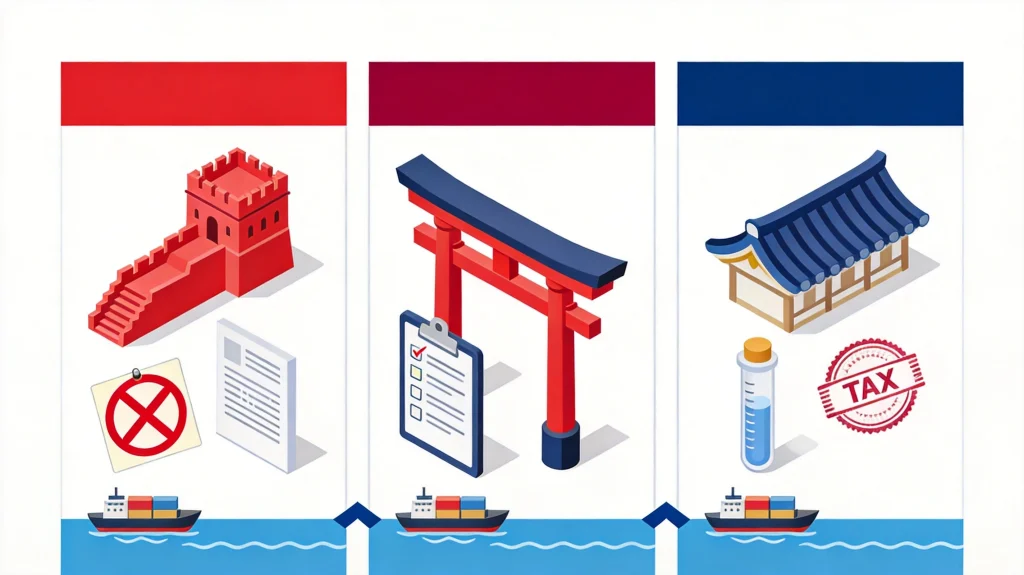
Most of the exporters involved did nothing reckless. They applied the same compliance logic they used for EU shipments. China, Japan, and Korea each operate independent food import regimes, with separate additive positive lists, separate label standards, separate registration systems, and separate inspection escalation pathways. None of them default to EU rules.
The financial damage extends well beyond the goods themselves. A single detained container can generate:
- Port storage, demurrage, and reefer power: three separate charges accumulate simultaneously when a reefer is held at an Asian port. Carrier demurrage on a 40-foot reefer starts at roughly USD 150 to 350 per day after free time (typically three days for reefers), with progressive increases after the first week;[4] terminal storage is billed separately by the port operator; and reefer electricity for continuous temperature control adds a further USD 50 to 150 per day. A 10-day hold on a 40-foot reefer can generate USD 2,000 to 4,000 in combined charges before any cargo loss is considered
- Destruction or return freight: return shipping to Europe often exceeds the original outbound cost; destruction fees at Chinese and Japanese ports are charged by weight
- Contract penalties from late-delivery clauses in distribution agreements
- Buyer attrition: importers rarely place a second order on the same terms after a detention that disrupted their supply schedule. Working with an importer who has navigated detentions before materially changes the outcome
- Heightened inspection status: a single detention can move an exporter from routine to enhanced inspection for 12 months or longer

Based on the cases we have reviewed and direct pre-shipment compliance work, roughly 70% of these detentions could have been identified before the container left port.
Case 1: Label discrepancies that held a chocolate shipment for two weeks (China, 2025)
A European chocolate brand shipped its first container to Shanghai. The Chinese label had been prepared by a translation agency. It looked fine to the importer: ingredients in Chinese, nutrition table present. Customs disagreed on three points.
Nutrition panel structure. GB 28050-2011 requires nutrients in a prescribed order under a standardised heading with defined rounding rules. The label presented data in the EU sequence, meaning correct numbers in the wrong layout.
Allergen emphasis. GB 7718-2011 requires allergens to be visually emphasised (bold, larger font, or underline) within the ingredient list. Milk and soy were mentioned but not emphasised.
GACC registration alignment. Country of origin was placed on a different panel than the one referenced in the GACC registration filing, giving customs grounds for a label and filing cross-check.
We were brought in after the hold. The label was redesigned within two weeks, corrected documents were submitted through the customs broker, and the container cleared within five business days. Direct costs were limited to port storage, label redesign, and broker fees, a fraction of what destruction or return would have cost. The full resolution is in our chocolate labelling case study. The pattern repeats often: exporters hand label translation to a language agency. Most agencies deliver correct Chinese. Few deliver a label that survives customs scrutiny.
Case 2: Unapproved preservative that destroyed a Spanish olive oil shipment (China, 2025)
A Spanish olive oil producer shipped to Shanghai with TBHQ (tert-butylhydroquinone) as an antioxidant. TBHQ is permitted in the EU at defined levels for certain oil categories. The exporter assumed EU approval implied Chinese acceptance.
Under GB 2760-2014, China's food additive standard, TBHQ is not authorised for olive oil. Permitted categories and maximum use levels differ from the EU framework. Routine customs sampling detected the additive. The entire consignment, valued at approximately EUR 72,000, was destroyed. The exporter was placed on enhanced inspection status, subjecting subsequent shipments to mandatory additive testing at port for 12 months.
No port-side reformulation or appeal was possible.
Case 3: Undesignated additive that earned a craft cider producer a 100% inspection order (Japan, 2025)
A European craft cider producer shipped to Japan using a preservative permitted in the EU. Routine monitoring inspection detected the preservative, which was not on Japan's list of designated additives.
Japan operates a Positive List System. If a substance is not explicitly designated (or covered by an exemption such as a naturally occurring residue at accepted levels), it cannot be present in food sold in Japan. This is the reverse of the EU's "not prohibited equals permitted" default, and the difference catches small producers with disproportionate frequency.
The shipment was returned. The lasting damage was the inspection order that followed: every future shipment became subject to 100% laboratory inspection at the importer's cost. Such orders can remain active for several years and add two to four weeks to clearance. We cover the framework behind this case, including how the Positive List System and monitoring inspection escalation work end-to-end, in our Japan food import requirements — six-step clearance guide.
Case 4: Aflatoxin M1 delay that cost a dairy exporter 30% of shipment value (Korea, 2026)
A European dairy exporter shipped cheese to Busan. MFDS selected the consignment for precise inspection, meaning laboratory testing for aflatoxin M1, a mycotoxin that appears in milk when feed is contaminated at source.
The testing queue was long. Results took 47 days to come back clear. The container sat in bonded cold storage throughout. The cold chain was maintained, but 47 days of port storage consumed a critical portion of the product's limited shelf life.
By release, remaining shelf life was roughly half what the distributor needed for normal retail placement. The importer negotiated a 30% price reduction to move stock through discount channels. Direct losses included the price reduction, 47 days of cold storage and inspection fees, and a relationship cost: the next order volume was cut by half.
A recent third-party laboratory report from an MFDS-recognised facility, obtained before shipment, can support faster clearance when a consignment is selected for precise inspection and may reduce the probability of selection. For Korea's inspection framework — documentary, sensory, and precise inspection tiers, plus how inspection orders are issued — see our Korea MFDS food import requirements guide. Date marking and shelf-life rules are covered separately in our shelf-life and date-marking guide.
Case 5: Missing GACC facility registration that returned canned seafood (China, 2025)
A seafood exporter shipped canned sardines to China. The manufacturing facility had not completed GACC overseas production enterprise registration under Decree 248. On arrival, customs cross-checked the facility against the GACC database. No valid registration meant the shipment was refused entry and ordered returned to origin.
There is no port-side remedy for missing facility registration. The process requires a recommendation from the competent authority in the exporting country, followed by GACC review, typically two to six months, and it cannot be initiated while goods are in transit. Aquatic products sit in a higher-risk category, often requiring a competent-authority recommendation letter rather than a straightforward enterprise application. We cover the full pathway for high-risk categories in our GACC Decree 280 guide.
Case 6: Pesticide residue over Japan's 0.01 ppm default limit (2026)
A superfood exporter shipped sacha inchi powder to Japan. Monitoring inspection detected pesticide residues above Japan's 0.01 ppm default limit, the threshold that applies automatically to any pesticide without a specific registered maximum residue limit for that crop.
The exporter had not commissioned pre-shipment residue testing, assuming that a "natural" ingredient sourced from small-scale growers would not carry problematic residues. That assumption ignored cross-contamination from neighbouring plots, inconsistent application across a co-operative supply base, and residual contamination from shared processing equipment.
The product was destroyed, and the exporter added to enhanced monitoring for future shipments.
Case 7: HS misclassification that triggered a 120% penalty in Korea (2026)
A European liqueur producer shipped to Korea using an HS code provided by the freight forwarder that classified the product as "fruit wine," which carries a lower liquor tax rate than liqueur under Korea's alcoholic beverage tax framework.
Korean customs reviewed the product specifications (ABV, sugar content, production method, ingredients) and reclassified it as liqueur. The importer was assessed the tax differential plus a 120% penalty on the underpaid amount. Customs also audited the previous three entries under the same classification and issued back-tax assessments with penalties.
HS classification and liquor tax classification are separate determinations in Korea and do not always align. A freight forwarder's suggested code is rarely sufficient for alcoholic beverages, where small differences in ABV or sugar content shift the category and multiply the tax exposure — a dynamic we break down in our HS code classification guide for food exporters. Korea's separate liquor tax regime for alcoholic beverages is covered in our Asia spirits and alcohol import compliance guide.
The 3-step pre-shipment audit that prevents most of these cases
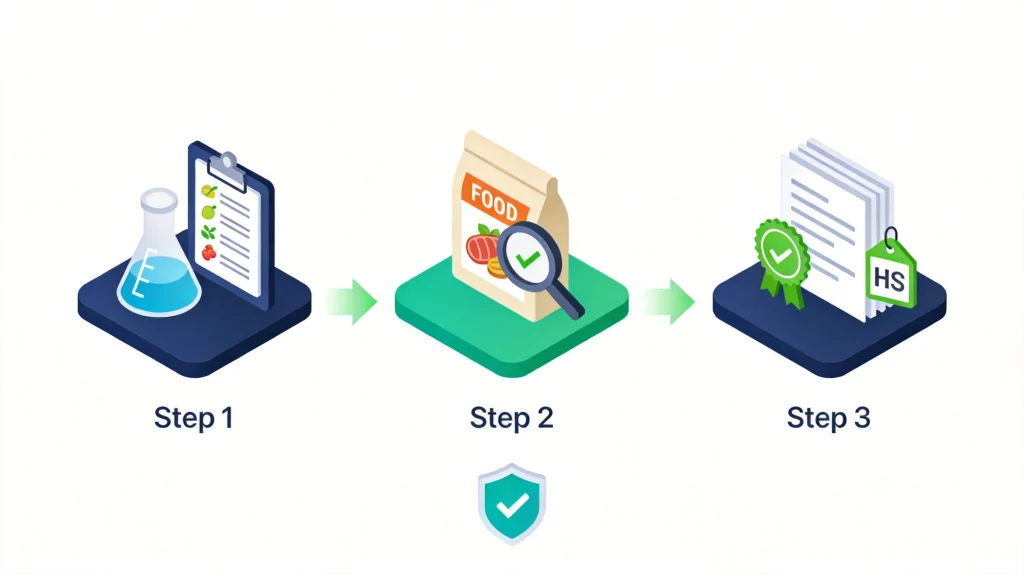
Every case above shared one characteristic: the issue was identifiable before the container was sealed. The question is whether exporters invest the three to five working days needed to check systematically.
Step 1: Formulation and additive screening. Review every ingredient, additive, and processing aid against the destination market's approved lists. Confirm maximum use levels and permitted food categories. Do not assume EU, US, or Codex approval implies approval in China, Japan, or Korea; the positive lists are independent and regularly updated. Pay particular attention to preservatives, antioxidants, colours, and artificial sweeteners, which are the categories most frequently flagged at border testing. Cases 2, 3, and 6 would have been caught here.
Step 2: Label and filing review. Have labels reviewed by someone who knows the destination market's mandatory standards, not just the language. Verify net content format, nutrition panel structure and rounding, allergen declaration emphasis, date marking, country-of-origin placement, and alignment with GACC or equivalent registration filings. A label that reads well in translation can still fail on structure, sequence, or missing mandatory elements. Case 1 would have been caught here.
Step 3: Verify documentation, registration, and classification. Confirm that all overseas production facility registrations are active and cover the specific product category; registrations can lapse, be suspended, or be superseded between seasons. Verify that phytosanitary certificates, health certificates, laboratory reports, and import permits are current and match shipping documents exactly (container number, seal number, consignee, product description). For alcoholic beverages, secure a written HS and liquor tax classification opinion from a specialist rather than relying on a freight forwarder's default code. Cases 4, 5, and 7 would have been caught here.
A pre-shipment review costs a small fraction of a single rejected container. For a EUR 50,000 shipment facing EUR 10,000 or more in potential return, destruction, and demurrage, three to five days of compliance work before loading is rarely a difficult economic case.
What to do before your next shipment
If you are planning a first or early-stage shipment to China, Japan, or Korea and cannot confirm your additive list is approved, your label matches your registration filing, your facility registration covers the product, or your HS classification will survive a customs audit, that uncertainty is itself a risk signal.
We offer a free 20-minute compliance snapshot for food exporters. Send your product specification, intended first Asian market, and target shipment date through our contact page, and we will identify which of the seven risk patterns above apply to your product and outline what needs resolving before loading. Turnaround is normally within seven working days.
This article is the first in a two-part series. Next: a market prioritisation framework for deciding whether China, Japan, Korea, or Southeast Asia should be your first Asian market, based on category fit, regulatory timeline, and competitive density.
Disclaimer: This article is provided for general information only and does not constitute professional compliance, legal, or tax advice. Regulatory requirements change frequently and may apply differently depending on product category, ingredient composition, and port of entry. Always confirm requirements with a qualified compliance professional before shipment. For a product-specific review of your case, contact us at info@specitconsulting.com.
About Specit Consulting
We help food and beverage brands enter and grow in the Chinese and wider Asian markets through regulatory compliance, tariff analysis, labelling review, registration support, importer identification, and market entry strategy.
✉ info@specitconsulting.com
References
[1]: GACC Decree No. 248 (2021) and Decree No. 280 (revised, effective 1 June 2026): expanded overseas production enterprise registration requirements and classification-based registration system for imported foods.
[2]: Japan MHLW, Food Sanitation Act and Positive List System; increase in monitoring inspection frequency reported in FY2025 imported food surveillance statistics.
[3]: Korea MFDS, Imported Food Control Act and 2025 to 2026 imported food inspection plan: extended precise-inspection periods for dairy, fishery, and health functional food categories.
[4]: Published carrier demurrage tariffs for reefer imports at major Asian ports: CMA CGM Indonesia reefer import tariff effective July 2026 lists 40-foot reefer demurrage at USD 141 per day (days 4 to 5) rising to USD 180 per day from day 8; Wan Hai Lines Japan reefer CY demurrage effective March 2026 lists 40-foot reefer at JPY 26,000 per day (days 1 to 3) rising to JPY 75,000 per day from day 10, with separate power and monitoring charges. Rates vary by carrier, port, and free-time allowance.
[5]: Cases and cost estimates drawn from direct pre-shipment compliance review work and publicly reported detention outcomes at Chinese, Japanese, and Korean ports, 2025 to 2026. We have anonymised individual case details to protect client confidentiality.
Need help navigating your market entry?
We've helped food exporters across 10+ countries enter 13 Asian markets. Get a free initial assessment based on public data — delivered in 3 working days.
Get Your Free AssessmentContinue Reading
▶Exporting Food to Asia in 2026: A Market Prioritization Framework for Craft Food & Beverage Brands
▶Japan Food Import Requirements: A 6-Step Compliance Guide for EU Exporters (2026)
Questions about entering the Asian market?
Chat with us on WhatsApp →