

29 September, 2026 | Shanghai, China
Introduction
Japan is the world's fourth-largest food retail market, with imported food accounting for over 60% of supply. Low tariffs under the EU-Japan EPA attract European exporters, but the technical barriers are where shipments fail.
Unlike China's GACC system, Japan does not require universal overseas factory registration for food imports. The 2020 Food Sanitation Act amendment added registration only for meat, dairy, aquatic products, and a small set of high-risk categories. For most pre-packaged ambient foods (snacks, oil, confectionery, beverages, sauces), no advance factory registration is needed. Every shipment, however, requires a food import notification.
Shipments get held for one reason more than any other: details. An additive permitted in the EU but not on Japan's positive list. A label missing a mandatory allergen. A health certificate that does not match the bill of lading. Bonded storage starts at JPY 15,000–30,000 (USD 100–200) per day, and MHLW can hold a non-compliant shipment indefinitely.
Below is the six-step process that gets your product through Japanese customs — and into retail.
Japan's Regulatory Framework: Who Does What
- MHLW (Ministry of Health, Labour and Welfare): Administers the Food Sanitation Act — food safety, additives, import inspection. Runs the 32 quarantine stations at ports and airports.
- MAFF (Ministry of Agriculture, Forestry and Fisheries): JAS standards, organic certification, plant/animal quarantine.
- National Tax Agency: Alcoholic beverages under the Liquor Tax Act.
Every consignment requires a Food Import Notification (食品等輸入届出) submitted to MHLW before or upon arrival. Two inspection tracks apply: Monitoring Inspections cover ~30% of shipments at random (government-paid); Inspection Orders mandate 100% testing for shipments with a violation history (all costs to the importer, typically 14–30 days' delay). One violation moves your future shipments onto the mandatory inspection track.
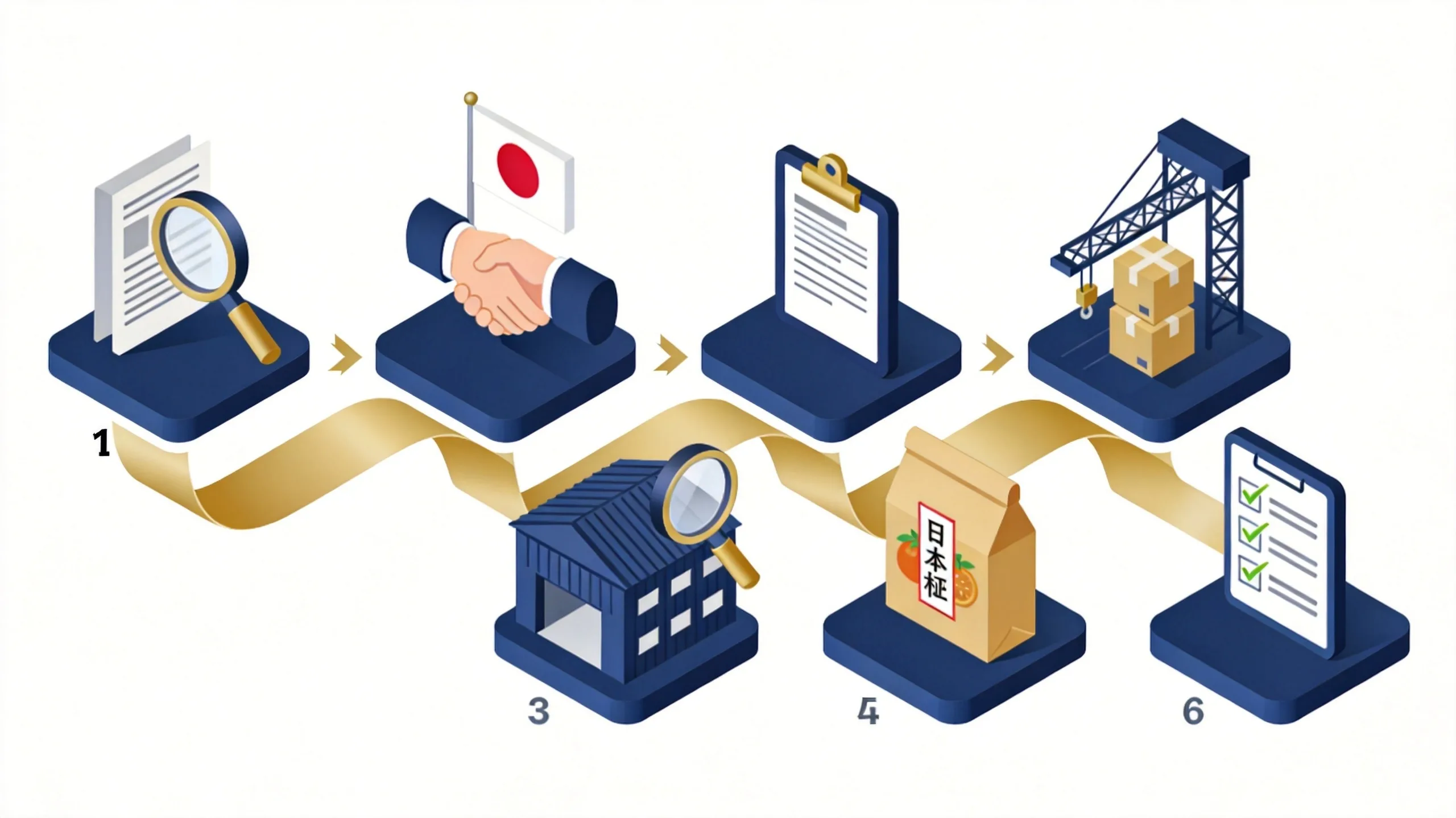
Step 1: Confirm Eligibility and Tariff Classification
Before approaching an importer, verify two things.
Product eligibility. Certain meat and aquatic products face origin restrictions based on disease status; some fruits require bilateral phytosanitary protocols. Check MHLW's published country-category list before investing.
Tariff and HS code. The EU-Japan EPA (in force since February 2019) provides immediate or phased tariff elimination for most food categories. Wine was already at or near zero for most origins; chocolate, olive oil, and many dairy categories reach 0% under EPA staging. Craft spirits face low or zero duty but incur liquor tax based on alcohol content. The UK-Japan CEPA, CPTPP, and US-Japan Trade Agreement each carry different schedules — confirm the rate for your origin before quoting a landed cost. For a detailed comparison of how EPA schedules stack up against other Asian FTAs, see our FTA food import tariff analysis for Asia.
Misclassification at clearance triggers duty shortfall plus a 10–15% penalty. Have your Japanese importer confirm the HS code before the first shipment — we cover the most common HS misclassification traps in our HS code classification guide for food exporters.
Step 2: Secure a Japanese Importer
You cannot import food into Japan without a Japan-resident importer of record. The importer bears legal responsibility for Food Sanitation Act compliance, label accuracy, and recall obligations.
Three principal routes exist:
- Trading houses (商社): Large general or category-specialist trading companies with deep regulatory expertise and national distribution. Best for high-volume, price-competitive commodity products.
- Speciality importers: Mid-size distributors focused on a category (European cheese, craft spirits, organic food) or channel (high-end supermarkets, department store food halls, independent delis). They hold the correct licences, understand additive and label requirements, and typically co-invest in marketing. This is the recommended route for most small-to-medium European brands entering Japan for the first time.
- Direct e-commerce: Amazon Japan and Rakuten allow cross-border sales to Japanese consumers without a local importer for low-volume premium products. Rakuten generally requires a Japanese entity. Trade shows remain the most efficient offline channel for finding importer partners — FOODEX JAPAN (March) and Supermarket Trade Show (February) are the two anchor events; we break down which shows actually produce buyer meetings in our three Asian trade shows guide.
Before signing, verify your importer holds: (1) a food business licence covering your category; (2) a liquor sales licence for alcohol; (3) JAS importer certification if you intend to label as organic; (4) a working track record with European products in your category. Ask for a reference brand still on the shelf.
Step 3: Prepare the Import Notification
The importer or their customs broker submits the Notification Form for Importation of Foods through the FAINS/NACCS system. Filing as a pre-arrival notification (事前届出) 7–10 days before docking allows MHLW to review documents while the shipment is at sea, reducing clearance to hours rather than days.
Required documents typically include: commercial invoice, packing list, bill of lading, full ingredient list with percentages, manufacturing process flow, additive declaration (using Japanese substance names, not E-numbers), health certificate (mandatory for meat, dairy, fishery products), laboratory test reports where applicable, label artwork, and — for organic — a Certificate of Inspection from your EU control body.
The most common document error is sending additive lists in E-numbers or English common names. MHLW inspectors do not cross-reference E-number listings; an unrecognised additive name triggers manual review and 3–7 days of delay. Provide Japanese-approved substance names from the outset.
Step 4: Quarantine Station Examination
MHLW routes each shipment to one of three paths: simplified approval; monitoring inspection; or inspection order for shipments with a violation history.
If non-compliance is found, the importer may destroy the shipment, re-export it (rarely economical for food), or apply for bonded-area rectification for relabelable errors. Product content cannot be reformulated after arrival.
With complete documentation and no flags, notification to release typically takes 2–5 business days. Plan for 5–10 days on a first shipment.
Step 5: Labelling
Japanese retail labels must be in Japanese and include eight mandatory items: product name, ingredient list in descending weight order, additives (by Japanese substance name with functional category), net content, best-before (賞味期限) or use-by date (消費期限), storage method, country of origin, and importer name and address. Nutrition labelling (energy, protein, fat, carbohydrate, salt equivalent per 100g) has been mandatory since 2015.
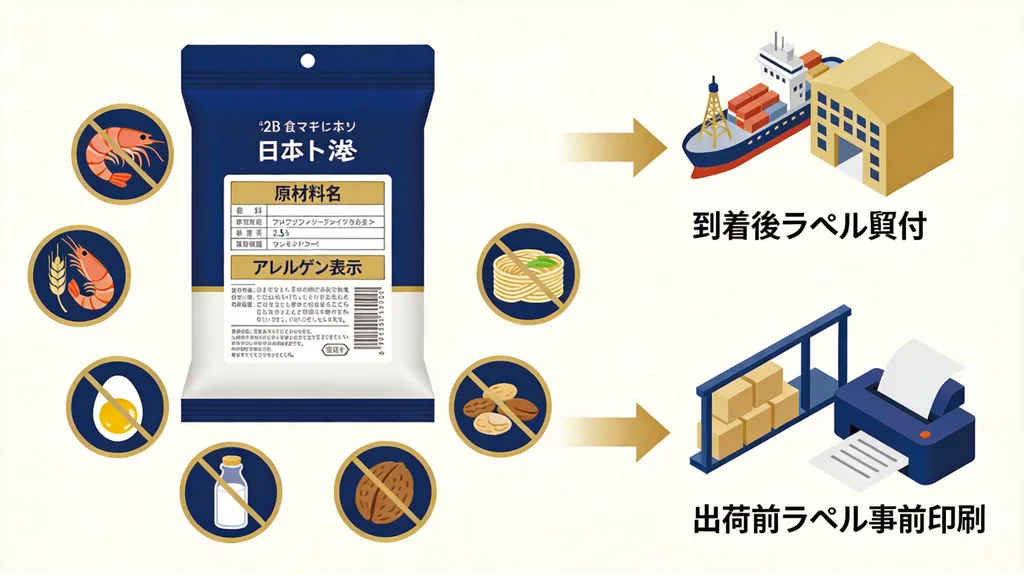
Allergen update (April 2025): Mandatory allergen labelling now covers 8 specified ingredients: shrimp, crab, wheat, buckwheat, egg, milk, peanut, and walnut (くるみ, promoted from the recommended list in April 2025) . A further 20 items (abalone, squid, salmon roe, orange, cashew, kiwi, beef, chicken, banana, pork, matsutake, peach, yam, soybean, sesame, salmon, mackerel, gelatin, and others) are recommended, and most major retailers require them.
Labels do not need to be applied before the product leaves Europe. Two common approaches are: ship in EU packaging and apply Japanese back labels in a bonded warehouse after arrival, or have your Japanese importer confirm the label content first, then print and apply the Japanese labels in Europe before shipment. Which approach suits you depends on order size, label complexity, and whether this is a first shipment or a repeat order with an approved label. Either way, label content must be reviewed by a Japanese regulatory specialist before printing.
Use 賞味期限 for shelf-stable products (best-before, quality-focused) and 消費期限 for perishables (use-by, safety-focused). The wrong date type is a frequent rejection reason.
Step 6: Run a Pre-Shipment Compliance Check
Before booking a container, confirm three things: (1) your additives are screened against Japan's positive list by a Japanese lab or your importer's compliance team — this typically costs JPY 50,000–150,000 and takes 1–2 weeks, and is non-negotiable for products containing preservatives, colourants, or sweeteners; (2) your Japanese label layout is checked by a regulatory specialist, not a general translator; (3) your importer holds all necessary licences for your category.
Typical compliance preparation from the EU: 2–4 weeks, with additive screening and label review as the critical path.
The Additive Trap: Japan's Positive List
This is the single most common cause of EU food shipment detentions. Japan operates a strict positive list: only explicitly approved additives may be used — the opposite of the EU's "permitted unless restricted" approach.
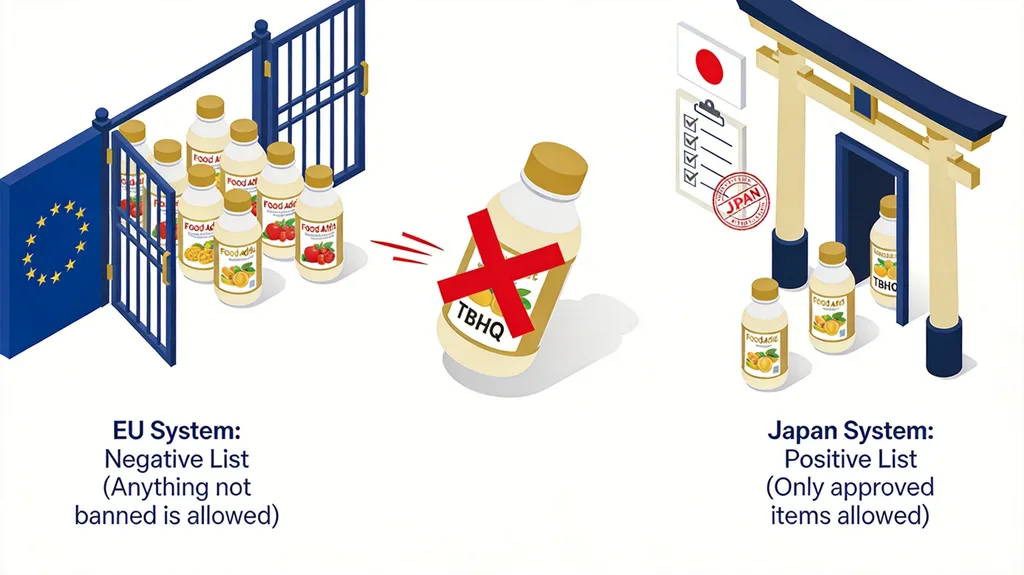
Japan maintains four categories: 476 Designated Additives with maximum use levels; 327 Existing Additives (natural substances with pre-1995 use history); Natural Flavouring Agents; and ordinary foods used as additives.
TBHQ (E319, common in oils and snacks), certain artificial sweeteners (including advantame), and some preservatives used in cider and fruit beverages are not approved in Japan. Even approved additives may carry tighter limits — for example, sulphur dioxide in wine has a lower Japanese maximum than the current EU limit for some categories.
In 2025, a craft cider shipment was detained at Yokohama for potassium sorbate at EU-permitted levels that exceeded the Japanese limit for its product category — 14 days' storage, relabelling was not an option, and the shipment ultimately required reformulation. This is why a pre-shipment additive check is not optional. The additive positive list is just one of several areas where Japan's rules diverge from what EU exporters expect; we cover the other key surprises in our Japanese food import guide beyond the official checklist.
Special Categories
Alcohol. Importers must hold a liquor sales licence under the Liquor Tax Act. Labels must show alcohol percentage, liquor category (Japan classifies liqueurs above and below 22% ABV differently), origin, and importer. Liquor tax applies per bottle based on alcohol content and beverage type, even at zero customs duty.
Organic. The EU-Japan organic equivalence arrangement has covered plant-based products since 2014 and was extended to organic alcoholic beverages effective 1 October 2025. Two conditions catch EU exporters: the Japanese importer must hold JAS importer certification (EU producers cannot apply the JAS mark on their own authority), and each shipment needs a Certificate of Inspection from your EU control body. Post-import processing (repackaging, blending, splitting) invalidates the organic claim unless the processor is also JAS-certified.
Health claims. Products making functional claims fall under the Foods with Function Claims (FFC) system, notified to the Consumer Affairs Agency. Products in capsule or tablet form risk being classified as quasi-drugs or pharmaceuticals requiring PMDA approval — a common trap for European supplement brands.
Frequently Asked Questions
Do samples or exhibition goods require import notification?
Yes, in most cases. There is no general de minimis exemption, though simplified procedures exist for non-commercial samples marked "NOT FOR SALE" with documented trade show details. Meat products are generally prohibited from sample entry without full approval.
Does Japan have an overseas factory registration system like China's GACC?
Partially. The 2020 Food Sanitation Act amendment requires foreign manufacturer registration only for meat, dairy, fishery products, and certain high-risk categories. This is narrower than China's GACC system. Most pre-packaged ambient food does not require advance registration.
Can English labels be used at retail?
No. Retail sale requires Japanese-language labels covering all mandatory items. You can either apply back labels in a bonded warehouse after arrival, or have your importer confirm the label content and pre-print Japanese labels in Europe before shipment. Cross-border e-commerce to Japanese consumers also requires Japanese labelling.
Not sure whether Japan is the right first Asian market for your product? Run it through our five-dimension market-prioritization framework before you commit budget — Japan scores 18/25 for most craft brands, but China and Korea may be a better fit depending on your runway and category. See: Exporting Food to Asia in 2026: A Market Prioritization Framework for Craft Food & Beverage Brands.
About Specit Consulting
Specit Consulting helps European food and beverage exporters clear regulatory hurdles across 13 Asian markets. We identify what will stop your product at customs, fix labelling and additive gaps before you ship, and connect you with importers who can actually sell your category — not just hold your inventory.
We are on the ground in Shanghai, backed by 19 years of food trade experience across sales, marketing, logistics, and regulatory compliance. If you are planning a Japan launch and want a clear read on what it actually takes — not a generic checklist — contact us for a free 20-minute compliance snapshot.
Need help navigating your market entry?
We've helped food exporters across 10+ countries enter 13 Asian markets. Get a free initial assessment based on public data — delivered in 3 working days.
Get Your Free AssessmentContinue Reading
▶Exporting Food to Asia in 2026: A Market Prioritization Framework for Craft Food & Beverage Brands
▶Food Import Detentions in Asia: 7 Real Cases and How to Avoid Them (2026)
Questions about entering the Asian market?
Chat with us on WhatsApp →