

3 August 2026 | Shanghai, China
China has revised GB 7718-2025 and GB 28050-2025. Both become mandatory on 16 March 2027. Non-compliant goods will be returned or destroyed — no second chance.
For food exporters targeting China, the label is not a formality — it is a regulatory gatekeeper. And the consequence of getting it wrong is more serious than many exporters expect: non-compliant goods are typically returned or destroyed, not sent back for correction.
China has revised its labelling framework through two linked standards, with a transition period running to March 2027. Here is what you need to know.
Two Standards, One Deadline
Both key standards were published on 27 March 2025 by the National Health Commission and the State Administration for Market Regulation, and both become mandatory on 16 March 2027.
GB 7718-2025 — General Rules for the Labelling of Prepackaged Foods. Three changes matter most:
- Date labelling. Production and expiry dates must appear together in a clearly defined, independent area with high colour contrast.
- "Zero additive" claims banned. Terms such as 零添加 (zero added), 不添加 (no added), and 未添加 (not added) are prohibited — including equivalent claims in foreign languages.
- Digital labelling. QR codes are encouraged, but all mandatory information must remain on the physical package.
GB 28050-2025 — General Rules for Nutrition Labelling. This standard has been substantially revised:
- Mandatory nutrients expand from "1+4" to "1+6." Saturated fat and sugar join energy, protein, fat, carbohydrate, and sodium.
- NRV values and NRV% calculation methods have changed. This directly affects the percentages printed on labels and may downgrade existing nutrient content claims.
- "Zero" threshold values have been revised. A product that legitimately declared "0" under the old standard may no longer qualify.
Exporters who update only their general label and overlook the nutrition panel will still be non-compliant.
Chapter 8: Rules Specific to Imported Food
GB 7718-2025 dedicates an entire chapter — Chapter 8 — to imported prepackaged food. This is new: the old standard had no import-specific section. Five rules matter most:
- Chinese text must correspond one-to-one with foreign text on all compulsory items. If China requires a declaration that the original label omits (such as allergens), the Chinese label must add it.
- The overseas manufacturer's China registration number (or the registration number issued by the competent authority in the country of origin) must appear on the label, alongside the importer or agent's name, address, and contact details.
- Country of origin must be stated. If the product is filled or repacked in a different country from where it was manufactured, that country must also be declared.
- Date marking for imported goods: production date and expiry date must both appear in YYYY-MM-DD format. If the original package does not show a production date, it may be calculated from the stated shelf life.
- Imported food is exempt from displaying the domestic food production licence number (食品生产许可证编号) and the product standard code (产品标准代号) — two items that domestic products must show.
Three Supporting Documents
GB 7718-2025 and GB 28050-2025 are the core standards, but three additional documents govern labelling in practice:
SAMR Decree No. 100 — Measures for the Supervision and Administration of Food Labelling (食品标识监督管理办法), issued 14 March 2025, effective 16 March 2027. This decree replaces the former labelling administration provisions and adds enforcement teeth: it specifies font-size minimums, prohibits misleading statements, defines audit obligations for importers, and sets out the penalty framework for non-compliance.
For a detailed breakdown of what health and nutrition claims you can actually make on those labels — including what "zero sugar," "high fibre," and function claims require market by market — see our guide to food health and nutrition claims in China, Japan and Korea.
Implementation Q&A — Official interpretive guidance published alongside both standards by the National Health Commission. The Q&A clarifies practical scenarios: date-area layout, ingredient-list sorting, allergen declaration format, and import-specific marking. When the standard text is ambiguous, the Q&A controls.
Digital Label Announcement No. 5/2025 — Issued jointly by NHC and SAMR on 29 July 2025, effective immediately. This announcement provides the operational rules for QR-code digital labels: what content may appear digitally, how updates must be tracked, when a simplified physical label is permitted, and what constraints apply to special foods. As of August 2026, over 2,200 food enterprises and 15,000 products have deployed digital labels in China. Digital content must be authentic, objective, and free from advertising — it cannot replace mandatory physical information.
What Must Appear on a Chinese Food Label
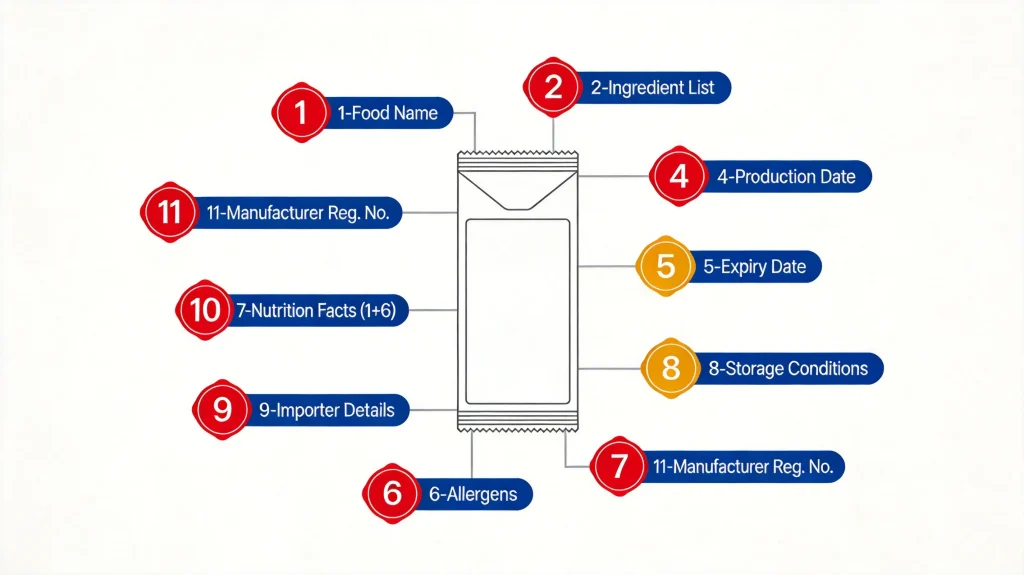
| Item | Requirement |
| Food name | Must reflect the food's true nature |
| Ingredient list | Descending order by weight |
| Net content and specifications | Same display panel as the product name |
| Importer / distributor name and address | Required for imported goods |
| Country of origin | For example, "Product of …" |
| Production and expiry dates | YYYY-MM-DD, in an independent high-contrast area |
| Storage conditions | Where special storage applies |
| Allergen information | Eight categories now mandatory |
| Nutrition information | Must comply with GB 28050-2025 |
Overseas manufacturer registration number — Under Chapter 8, the manufacturer's China registration number (or the registration number issued by the competent authority in the country of origin) must appear on every imported product label, alongside importer/agent details and country of origin.
Imported goods must carry a Chinese label, printed directly or applied as a sticker.
Allergen labelling is now mandatory — previously only recommended. The eight categories are: cereals containing gluten, crustaceans, fish, eggs, peanuts, soybeans, milk, and nuts. Allergens must be emphasised in the ingredient list or listed separately.
Why the Deadline Deserves Your Attention Now
This is where exporters underestimate the risk. When Chinese customs identifies a non-compliant label on arrival, the practical outcome is return to origin or destruction — there is no mechanism to correct the label and re-present the shipment.
The scale is not theoretical. China Customs returned or destroyed thousands of batches of non-compliant food and agricultural imports in recent reporting periods, and hundreds of batches are refused entry in a typical month.
That means the cost of a labelling error is not a fine and a reprint. It is the full value of the container, the freight both ways, the lost listing window, and a buyer left without stock.
Practical Compliance Steps
- Start now. Packaging redesign, nutrition retesting, and reprinting take months — not weeks.
- Audit both standards together. General label and nutrition panel.
- Retest nutrition data. New NRV values and revised "0" thresholds may change your declarations and invalidate existing claims.
- Remove every "zero additive" claim, in all languages.
- Redesign the date area and highlight allergens.
- Check font sizes. Minimum character heights apply and vary by package size.
- Brief production, marketing, and export teams — labelling errors often originate in marketing copy.
- Map every foreign-language item to its Chinese counterpart — Chapter 8 requires one-to-one correspondence; omissions on the original label do not excuse omissions on the Chinese label if China mandates the declaration.
- Include the overseas manufacturer's China registration number on every imported product label.
Takeaway
China's revised labelling requirements are stricter and more detailed, but also clearer than before. The transition period gives you time — provided you use it.
Three priorities stand out: eliminate all "zero additive" claims, revalidate your nutrition data against GB 28050-2025, and meet the new allergen requirements. Labels compliant only with the old standards may be rejected at customs after 16 March 2027 — and rejection generally means return or destruction, not a second chance. Japan's labelling requirements add another layer — the Food Labelling Act mandates Japanese-language labels with specific format rules that translation alone cannot satisfy. In Vietnam, label enforcement varies by port— what passes in one city may be delayed in another.
Preparing to export food to China? Read our guide on protecting your GACC registration.
Need help preparing compliant labels across Asian markets? See our Labelling & Regulatory Requirements service.
Frequently Asked Questions
When do China's new food labelling standards take effect?
GB 7718-2025 and GB 28050-2025 were both published on 27 March 2025 and become mandatory on 16 March 2027. The transition period runs until that date.
What changed in GB 7718-2025 (general labelling)?
Three key changes: (1) production and expiry dates must appear together in a high-contrast independent area; (2) "zero additive" claims (零添加, 不添加, 未添加) are banned in all languages; (3) QR codes are encouraged but all mandatory information must stay on the physical package.
What changed in GB 28050-2025 (nutrition labelling)?
Mandatory nutrients expand from "1+4" to "1+6" (saturated fat and sugar added). NRV values and "zero" thresholds have been revised — products that qualified as "0" under the old standard may no longer qualify.
Is allergen labelling now mandatory in China?
Yes. Eight allergen categories are now mandatory (previously only recommended): cereals containing gluten, crustaceans, fish, eggs, peanuts, soybeans, milk, and nuts. Allergens must be emphasised in the ingredient list or listed separately.
Can I still use "zero additive" or "no added" claims on food labels for China?
No. GB 7718-2025 prohibits terms such as 零添加 (zero added), 不添加 (no added), and 未添加 (not added) — including equivalent claims in foreign languages.
What happens if a food label is non-compliant at Chinese customs?
Non-compliant goods are typically returned to origin or destroyed. There is no mechanism to correct the label and re-present the shipment. The cost equals the full container value, freight both ways, and the lost listing window.
What is Chapter 8 of GB 7718-2025?
Chapter 8 is a new, dedicated section of GB 7718-2025 that sets labelling rules specifically for imported prepackaged food. It requires one-to-one correspondence between Chinese and foreign text on compulsory items, mandates the overseas manufacturer's China registration number, and clarifies date-marking and country-of-origin rules for imports.
What is SAMR Decree No. 100?
The Measures for the Supervision and Administration of Food Labelling (Decree No. 100) is an enforcement regulation issued by the State Administration for Market Regulation on 14 March 2025, effective 16 March 2027. It specifies font-size requirements, prohibits misleading statements, defines importer audit obligations, and sets penalties for non-compliance.
About Shanghai Specit Management Consulting Co Ltd
We help food and beverage brands enter and grow in the Chinese and wider Asian markets through trade intelligence, importer identification, and market research.
Already registered? Make sure your registration details match before you ship — see what two months of rejection data reveal about GACC Decree 280 enforcement.
Not yet registered? See how to register your food manufacturing facility across Asian markets.
Disclaimer: This article is for general guidance only and does not constitute legal or regulatory advice. Labelling requirements are subject to interpretation and change, and enforcement practice may vary by port. Always confirm current requirements with the relevant Chinese authority or a qualified regulatory consultant before printing labels.
Need help navigating your market entry?
We've helped food exporters across 10+ countries enter 13 Asian markets. Get a free initial assessment based on public data — delivered in 3 working days.
Get Your Free AssessmentContinue Reading
▶Send Food Samples to Asia: Avoid These Customs Mistakes
▶Food Import Detentions in Asia: 7 Real Cases and How to Avoid Them (2026)
Questions about entering the Asian market?
Chat with us on WhatsApp →