

5 October 2026 | Shanghai, China
A real scenario: you've prepared twenty kilograms of handmade cookies as samples for next month's trade show in Japan. You plan to carry them in your luggage. At Narita Airport, a customs officer looks at your suitcase and asks: "Are these commercial samples or personal items?"
You say samples. He directs you to the red channel.
As the expo starts, your booth is empty, and the cookies are still in a customs warehouse.
This isn't a tariff problem. It's a "shipped your samples the wrong way" problem. And it happens to food exporters every single quarter 鈥?often on the eve of their most important buyer meetings.
Why Samples Are Different From Commercial Shipments
Samples are not for sale. No payment. No resale. No commercial transaction. In theory, customs should treat them differently.
They don't.
In the eyes of customs authorities across Asia, samples are still goods 鈥?they have value, an HS code, an origin, and potential commercial use. Unless you can prove they qualify for a specific temporary-import or duty-free condition, they follow essentially the same process as commercial cargo.
This matters because the cost of getting it wrong is not just the duty bill. It is the missed meeting, the empty booth, the buyer who met your competitor instead. We have seen clients lose six-figure distribution opportunities because a 20 kg sample shipment was held for three weeks over a missing import notification.
The key is choosing the right entry route before you ship. Four routes exist. Choose wrong, and you are stuck at the show entrance. Choose right, and your samples clear in hours.
A word of caution on "just putting it in your luggage." Many first-time exhibitors have heard stories 鈥?from peers, online forums, or competitors 鈥?about carrying food samples in checked baggage without declaration, walking through the green channel, and making it to the booth without a single question.
It is true that enforcement intensity varies across Asian airports, and that not every bag is opened. Treating luck as a procedure, however, is a dangerous bet. When you are caught 鈥?and you will be, eventually 鈥?the consequences are not limited to paying a duty bill. Your samples may be detained or destroyed.
Your booth is empty for the opening day, when buyers and press are most active. Your scheduled buyer meetings that week are reduced to "I'm sorry, the samples didn't arrive." In the worst cases, you face a customs record that flags every future shipment under your company name. A trade show appearance costs 鈧?,000鈥撯偓25,000 in booth fees, travel, and logistics; gambling that investment on an unchecked suitcase is playing with fire.
Route 1: ATA Carnet
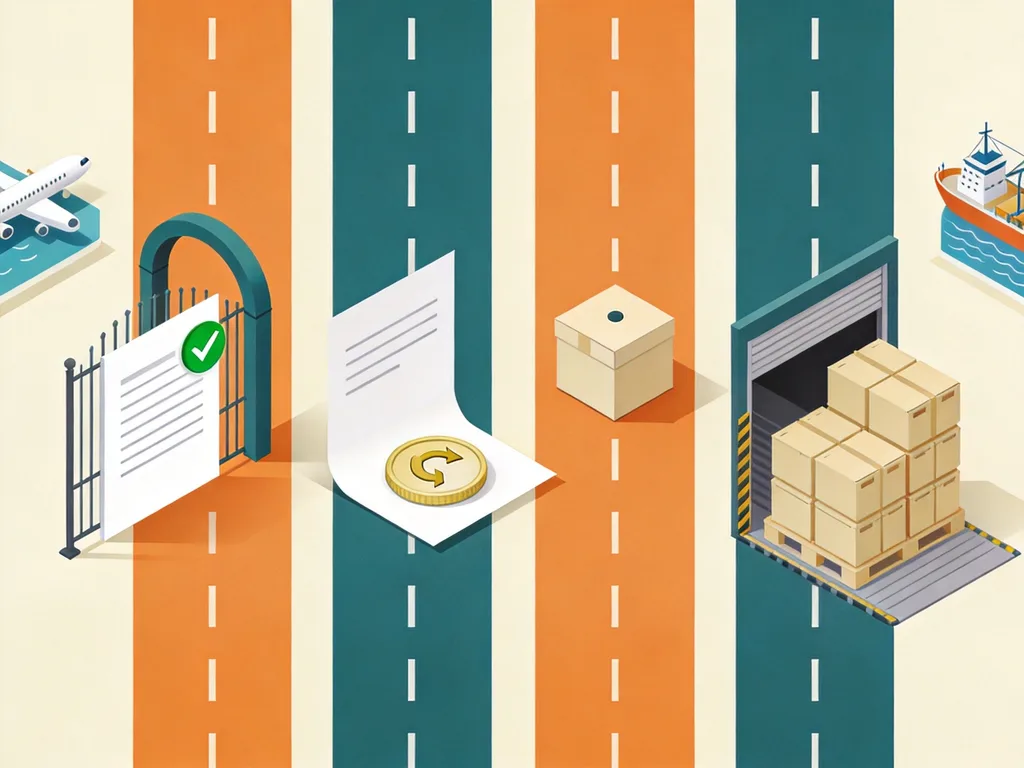
The ATA Carnet (Admission Temporaire / Temporary Admission) is known as a "goods passport." Established by the World Customs Organization's Istanbul Convention, it allows goods to be temporarily imported into contracting parties without paying import duties and taxes 鈥?and without lodging separate customs declarations in each country.
China acceded to the ATA Convention in 1993 and began implementation in May 1998 through the China Council for the Promotion of International Trade (CCPIT).
Applicable countries and regions
The ATA Carnet system covers 81 countries and territories globally, including the EU member states, the United States, Japan, South Korea, Australia, Singapore, Switzerland, the United Kingdom, and Canada. Notable absences include Brazil, India (partial), Vietnam (no food coverage), and most of the Middle East outside the UAE and Turkey.
For food exporters targeting Japan and Korea 鈥?the two most developed premium food markets in Asia 鈥?the ATA Carnet is available in principle. But "in principle" is doing a lot of work.
Can food use an ATA Carnet?
This is where most costly mistakes happen.
- Singapore: Singapore Customs explicitly states that ATA Carnets cannot be used for consumables, including food, alcoholic beverages, and tobacco products. Samples of packaged food sent to Singapore must use the temporary import or low-value route instead.
- Japan: Japan Customs accepts ATA Carnets for commercial samples under the "commercial samples and professional equipment" category. However, food samples still require a food import notification (鍠灞婂嚭 / shokuhin todoke) to the MHLW Quarantine Station unless they qualify as display items under 10 kg that will not be consumed. Many exhibitors assume the Carnet replaces food-safety clearance; it does not.
- South Korea: Korea Customs accepts ATA Carnets for commercial samples, but food items remain subject to KFDA import inspection requirements. Customs may request translated ingredient lists and allergen declarations at the border.
- China: China accepts ATA Carnets for professional equipment and display goods, but consumable food items are generally not covered under the standard Carnet. Food samples for CIIE and other major exhibitions are handled through the exhibition's unified guarantee mechanism (see Route 4).
Processing, cost, and validity
Applications are submitted entirely online through the CCPIT ATA portal (e.g., EU exporter, through your national chamber of commerce). Processing typically takes three working days.
A guarantee deposit is required 鈥?typically 10% to 50% of the goods' declared value, depending on the destination country and whether the issuing chamber requires a bank guarantee or cash deposit. The deposit is refunded upon proof of re-export.
A Carnet is valid for 12 months from issue and can be renewed once for another 12 months. However, a single Carnet cannot be used for multiple unrelated exhibitions; if you add a new destination after issue, you must return the goods to the origin country and apply for a new Carnet or use an alternative route for the additional leg.
For a more complete picture of Japan's compliance framework that samples must still satisfy under any route, see our Japan Food Import: 6-Step Compliance Guide.
Route 2: Temporary Import Without Carnet
When an ATA Carnet does not apply 鈥?either because food is excluded or because the destination country does not accept Carnets for consumables 鈥?the second route is temporary import with a security deposit or guarantee.
China
Temporarily imported goods require a customs tax guarantee, submitted online through the China International Trade Single Window. After approval, the guarantee deposit (typically equivalent to the applicable import duties and VAT) is paid electronically.
Goods must be re-exported within six months of entry. Extensions are possible in six-month increments, up to a maximum of three extensions (total 24 months). After that, the goods must either be formally imported with full duty paid or destroyed under customs supervision.
Important: food samples entering China under temporary import still require a GACC registration number for the overseas manufacturer if the product falls under the GACC Decree 280 registration scope. This is a separate compliance step that has nothing to do with the customs entry route. Details here: What Is GACC Decree 248/249 and Why It Matters for Food Exporters.
Japan
Article 14, Item 6 of Japan's Customs Tariff Law provides duty-free and consumption-tax-exempt treatment for "samples for order collection" (娉ㄦ枃鎺″彇瑕嬫湰). Qualifying samples must meet one of the following conditions:
- Clearly marked "SAMPLE" or "瑕嬫湰" on the packaging;
- Physically processed so they cannot be sold as finished goods (cut, perforated, marked with indelible ink);
- Have a dutiable value of 楼5,000 or less per item (excluding alcohol, which has no de minimis threshold for food samples).
This is the route most SME exporters use for buyer-meeting samples outside trade shows. It does not require a Carnet, but it does require a correctly completed commercial invoice stating "samples for order collection 鈥?no commercial value," plus the MHLW food import notification if the samples will be tasted.
South Korea
Temporary imports into Korea require a cash deposit or bank guarantee equivalent to the applicable duty. Korea accepts ATA Carnets for commercial samples, but food-specific eligibility depends on the product category 鈥?processed foods and confectionery generally clear without additional permits, while fresh produce, dairy, and meat products require separate MFDS quarantine applications regardless of entry route.
ASEAN markets
For Thailand, Vietnam, Indonesia, and the Philippines, temporary import regimes vary considerably. Thailand's Customs Department allows temporary import with a bank guarantee for up to six months, but food samples require prior Thai FDA import permits in most cases. Indonesia has tightened sample clearance since BPOM Regulation 27/2022; even small food samples nominally require a BPOM notification unless routed through an official trade-fair mechanism. If your first Asian market is Southeast Asia rather than North Asia, read our Indonesia Food Import: BPOM Registration and What It Really Takes.
Route 3: Low-Value Sample Clearance
This route is for genuinely small, low-value samples sent by courier (DHL, FedEx, UPS) 鈥?typically 2鈥? units per SKU, under the de minimis threshold, for lab testing, evaluation, or small-scale buyer review.
Country thresholds
| Country | De minimis threshold (formal entry) | Notes |
|---|---|---|
| China | RMB 5,000 per shipment | "Advertising materials and samples of no commercial value" can be duty-exempt, but GACC registration still applies for regulated food categories. |
| Japan | 楼5,000 per item (鈮堚偓31) | Alcohol is excluded from de minimis. Must qualify as "samples for order collection." |
| South Korea | USD 150 per shipment | Processed food under this value typically clears via simplified channel; MFDS inspection may still be triggered. |
| Thailand | THB 1,500 per shipment (鈮堚偓40) | Thai FDA notification still required for food. |
| Singapore | SGD 400 per shipment (鈮堚偓275) | Food must still be cleared by SFA; no Carnet needed for low-value samples. |
When this route works
Genuine samples for testing, evaluation, or display, in quantities clearly too small to resell. Courier companies will typically handle clearance as part of their service if the commercial invoice is correctly prepared.
When it does not work
Products with full retail packaging that are clearly saleable, shipments in case quantities, anything requiring temperature control, or any shipment containing meat, dairy, fresh fruit, or plant products subject to quarantine. These will be flagged regardless of declared value, and you will be asked to produce import permits that you likely do not hold.
Route 4: Trade Show and Exhibition Logistics
If samples are destined for a trade show, this is the most reliable route 鈥?and the one most first-time exhibitors miss until it is too late.
For major Chinese exhibitions such as CIIE (Shanghai, November), SIAL Shanghai, FHC Shanghai, and ProWine Shanghai, the National Exhibition and Convention Center or the show organiser provides a unified bank guarantee or duty-guarantee insurance policy to China Customs. Exhibitors do not need to submit individual tax guarantees; they simply present the official inbound-materials certificate and inventory list through the show's nominated freight forwarder.
This mechanism extends to food and beverage samples 鈥?the organiser's guarantee covers consumable items that would not qualify for a standard ATA Carnet or standalone temporary import. Samples for tasting at the booth are covered; surplus stock after the show can be re-exported, donated (with approval), or formally imported with duty paid.
For trade shows in Japan (FOODEX, Supermarket Trade Show, Wine & Spirits Expo), Korea (Seoul Food & Hotel), and Singapore (FHA, ProWine Asia), there is typically an official recommended freight forwarder nominated by the organiser. These forwarders know the exact sample-clearance pathway for that specific show and venue, including the food-import notification procedures.
For a step-by-step guide focused specifically on trade show sample shipping 鈥?ATA Carnet application, booth sample labelling, and pre-show customs document checklists 鈥?see Trade Show Food Samples Asia: Shipping, ATA Carnet and Labelling.
ATA Carnets offer the clearest advantage at trade shows where they are accepted: fast clearance, duty-free entry, and no need for individual guarantees. The key limitation to remember is the "single exhibition per Carnet" rule 鈥?if you are doing a roadshow (e.g., FOODEX Japan then Seoul Food then ProWine Shanghai), you cannot use the same Carnet for all three legs.
Samples that clear customs and make it onto the stand still need to be converted into business after the doors close — the 48-hour follow-up window and three-touch email cadence are where most exhibitors lose the leads they paid to win.
Disposal of remaining samples after the show
After a trade show concludes, samples under temporary import have three possible outcomes:
- Re-exported: The default expectation. Goods leave the country under customs supervision, and your Carnet or guarantee is discharged.
- Sold or retained in-country: Requires formal import declaration and duty payment, plus any applicable food-safety clearances. For Chinese shows, this is handled through the exhibition's unified customs process.
- Consumed or destroyed: Promotional tasting samples consumed at the booth are typically written off under the exhibition guarantee. Samples given away as gifts may have quantity limits.
Goods under ATA Carnet that are to be retained in-country always require prior customs approval and duty payment 鈥?you cannot simply leave them behind.
Importer of Record: The Overlooked Requirement
This is the single most commonly missed step. When samples enter any Asian country, a legal person or entity must act as the Importer of Record (IoR) 鈥?the party legally responsible to customs for the goods, their classification, their value, and their compliance with local regulations.
If your buyer, distributor, or agent refuses to act as IoR 鈥?which happens frequently in early-stage conversations before any agreement is signed 鈥?the samples are, in practical terms, dead. They will not clear customs. They will sit in a bonded warehouse accruing storage fees until they are either abandoned, destroyed, or returned at the sender's cost.

Your three IoR options
Option 1: The buyer or distributor acts as IoR. This is the cleanest option if you already have a signed distribution agreement or a committed buyer. They have the import licences, the food-safety registrations, and the customs broker relationships. Do not assume they will do this before a contract is in place 鈥?many importers will not accept liability for samples from a brand they have not yet committed to.
Option 2: Set up your own entity. Only viable if you plan long-term, multi-year operations in that market. Entity setup in Japan or China takes months, costs tens of thousands of euros, and comes with ongoing accounting, tax, and compliance obligations. Overkill for sample shipments.
Option 3: Use a third-party IoR service. A local company (often a freight forwarder with import licences, or a compliance consultancy) acts as your importer of record for the sample shipment, for a fee. This is the most realistic option for small brands doing early-stage exploration. The downside: third-party IoR services will not usually take on liability for products without prior review, and they will not help you with downstream distribution 鈥?they solve the customs problem, not the sales problem.
How our Importer Sourcing service helps
This is precisely why our importer sourcing engagement includes IoR readiness as a qualification criterion. When we shortlist Japanese, Korean, or Chinese importers for a client, we filter for partners who hold active food import licences, have existing customs broker relationships, and are willing to act as IoR for initial sample shipments as part of the qualification dialogue. "Find an importer" is easy; "find a qualified importer willing and able to clear your samples before you have signed anything" is what actually moves a deal forward.
Label and Document Checklist for Samples
Regardless of which route you choose, the following documents and labelling elements are essential. Missing any one of these is a common cause of holds:
On the product (even for non-sale samples):
- Full ingredient list in English (with local-language translation for Japan and Korea)
- Allergen declarations conforming to local requirements 鈥?Japan mandates 28 specified allergens including buckwheat (soba), cashew, sesame, and macadamia; Korea mandates 25 allergens
- Production date and best-before / expiry date
- Country of origin
- "SAMPLE" or "瑕嬫湰" marking, indelible if using the duty-free sample route in Japan
On the documentation:
- Commercial invoice (or pro forma invoice) clearly stating: "Samples for order collection 鈥?no commercial value 鈥?not for resale"
- Packing list
- ATA Carnet (if using Route 1)
- Food import notification (Japan MHLW) or prior import confirmation (Korea MFDS / China GACC) where required
- Certificate of origin if claiming preferential tariff treatment under an FTA 鈥?for context on how much duty this can save, read How to Save on Asian Food Import Duties Using FTAs
- Health certificate / free-sale certificate from the EU member-state authority, if requested
For Japan specifically, the determination of whether goods qualify as "samples for order collection" involves reviewing both the invoice wording and the physical goods themselves. Clear labelling and physical marking (e.g., perforation, "SAMPLE" stamp, indelible marker) is the single highest-impact step you can take before shipping.
Seven Mistakes That Get Food Samples Held in Asia
Having reviewed dozens of sample shipments that went wrong across China, Japan, Korea, and ASEAN, the same seven mistakes account for the vast majority of delays:
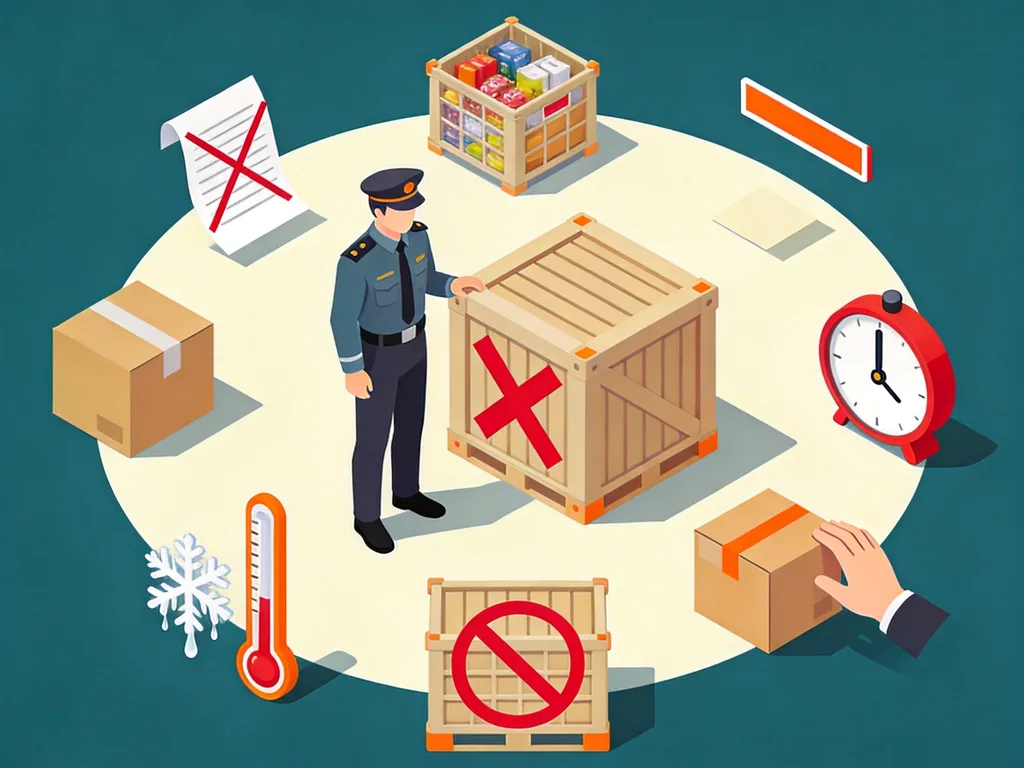
- Under-declaring value. Declaring "no value" or "USD 1" on the commercial invoice when the goods clearly have commercial value. If discovered, the shipment is not only he,ld but your company's future shipments may be flagged for enhanced inspection. Declare the actual production cost or a reasonable sample value.
- Mixing saleable goods into sample shipments. Including full retail cases, multi-pack units, or quantities that clearly exceed what can be consumed or evaluated as samples. Customs will reclassify the entire shipment as commercial cargo.
- Missing or incomplete labels. No ingredient list, no allergen declaration, no production date, or labels only in the origin language. Japan and Korea will reject samples that do not meet minimum labelling requirements even if they are not for sale. Trade labels show food samples must still respect local claim rules 鈥?an on-pack "boosts immunity" or "clinically shown" that is legal at home can get your samples detained at the port. See our food health and nutrition claims guide for China, Japan and Korea for what wording to remove before shipping.
- Insufficient remaining shelf life. Many Asian markets require at least 60% of shelf life remaining on arrival for food products 鈥?including samples. If your cookies have a 6-month shelf life and you ship them in month 4, they will be refused entry even with perfect paperwork.
- Cold chain breaks. Temperature-controlled samples (chocolate, dairy, fresh products, certain health supplements) that lose temperature control in transit. Not only do they fail inspection, but many Asian customs authorities will require destruction rather than return for cold-chain failures.
- Shipping prohibited categories without prior permits. Meat, dairy, fresh fruit, vegetables, seeds, and certain plant products require quarantine permits, health certificates, and often import licences regardless of whether they are samples. Shipping these by courier "to see if they get through" is a reliable way to have them seized and destroyed.
- Freight collect. Sending samples freight collect without confirming the recipient will accept the charges and act as IoR. When the recipient refuses (which happens routinely when no commercial relationship exists), the goods sit at the airport or port until storage fees exceed their value, and they are auctioned or destroyed.
Starting 16 October 2026, we open new client engagements for Q4 2026. If you are planning to exhibit at Asian trade shows this autumn or winter and need introductions to qualified food importers who can also act as Importer of Record for your sample shipments, get in touch.
Frequently Asked Questions
Do food samples to Asia always incur import duty?
It depends on the route. ATA Carnet: duty-free and deposit-free for covered categories. Temporary import with guarantee: duty is secured by a deposit that is refunded on re-export. Low-value sample clearance: duty-exempt below the de minimis threshold in most markets if the goods qualify as genuine samples. The key point is that some countries (notably China and Singapore) exclude food from ATA Carnet coverage, so the Carnet alone does not guarantee duty-free treatment for consumables.
Can you sell food samples after a trade show?
Yes, but only after completing a formal import declaration and paying full duty and consumption tax. Samples that were cleared under temporary import or ATA Carnet are legally required to be either re-exported, destroyed, or formally imported 鈥?they cannot be sold, given away as commercial inventory, or left in the country without customs approval. Major Chinese exhibitions handle this through the organiser's unified customs process; in Japan and Korea, you must submit a separate import declaration to convert samples to formal import status.
What is the minimum information required on sample labels?
Even for non-sale samples, the minimum is: full ingredient list, allergen declarations meeting local requirements (28 items for Japan, 25 for Korea, China's GB 7718 mandatory allergens), production date and shelf life, country of origin, and a clear "SAMPLE" marking for goods claiming duty-free sample status. Japanese and Korean customs may request a local-language translation of the ingredient list during inspection.
Related Reading
- Japan Food Import Requirements: The 6-Step Guide
- What Is GACC Decree 248/249 and Why It Matters for Food Exporters
- FTA Tariff Savings in Asia: A Practical Guide for Food Exporters
- Customs mistakes when sending samples to Asia: a pre-shipment checklist for exporters 鈥?the most common errors that hold food sample shipments at Asian ports, and a quick two-route decision framework
Disclaimer: This article is based on publicly available information as of 5 October 2026. It does not constitute legal, customs, or trade advice. Customs procedures, ATA Carnet coverage, food-safety requirements, and de minimis thresholds can change rapidly and vary by product HS code and port of entry. Exporters should confirm current requirements with their chamber of commerce, a licensed customs broker in the destination country, and the relevant food-safety authority 鈥?including China GACC, Japan MHLW, Korea MFDS, and relevant ASEAN authorities 鈥?before shipping food samples to Asia. For practical assistance with sample clearance pathway selection, Importer of Record identification, or qualified-importer sourcing in China, Japan, Korea, or Southeast Asia, please contact us at info@specitconsulting.com.
Need help navigating your market entry?
We've helped food exporters across 10+ countries enter 13 Asian markets. Get a free initial assessment based on public data — delivered in 3 working days.
Get Your Free AssessmentContinue Reading
▶Email Asian Food Importers: 5 Mistakes to Avoid
▶Exporting Food to Southeast Asia: A 6-Country Compliance Roadmap
▶Canned Food in Asia: Where European Conservas, Confit and Tinned Seafood Actually Sell
Questions about entering the Asian market?
Chat with us on WhatsApp →