


7 October 2026 | Shanghai, China
More than 60% of the English-language labels we send back for revision fail for the same reason: a food health claim on the front of the pack that should not be there.
That word might be "detox." It might be "immunity." It might be "clinically proven" or "natural" or even "zero sugar" when the formulation does not actually meet the threshold. A port inspector sees it, flags the shipment, and the container sits in bonded storage while the importer argues with the exporter about who pays for relabelling. By the time the product reaches shelves, three or four months of the promotional window are gone.
These failures happen because exporters treat "claim" as a single concept. Regulators in China, Japan and Korea all divide food health claims into distinct categories, and the dividing lines fall in different places. A phrase that counts as a permitted nutrient-content claim in one market will read as an illegal disease-prevention claim in another. A label approved for Tokyo can get turned back at Busan, and the reason will almost always be a food health claim that slipped past review.
This article maps the four claim categories across the three markets, identifies the five trigger words that most often cause detention, and ends with a label-review framework that catches the majority of these problems before print.
The Four Claim Categories
Before looking at country rules, it helps to separate claims into four buckets. A single product label usually carries claims from more than one bucket, and regulators do not treat them equally.
| Category | What it says | Example |
|---|---|---|
| Nutrient content claim | States the level of a nutrient | "High in fibre," "low sugar," "zero trans fat" |
| Nutrient function claim | Describes a nutrient's established role in the body | "Calcium contributes to maintenance of normal bones" |
| Health claim | Links a food or ingredient to a health outcome | "Supports immune function," "helps maintain healthy cholesterol" |
| Disease risk-reduction claim | Links a food to reduced risk of a disease | "May reduce the risk of coronary heart disease" |
Most Asian markets allow the first two subject to conditions, restrict food health claims in the third category to notified or approved products, and prohibit the fourth outside specific approval regimes. The problem for exporters is deciding which bucket a phrase falls into, and the answer changes at the border.
A British biscuit label that says "high in fibre" sails through Shanghai if the fibre threshold is met; the same label saying "fibre supports digestive health" is a nutrient function claim that may still be acceptable in China under Appendix C; the label saying "fibre for a healthy heart" crosses into disease risk-reduction territory and triggers rejection as an unauthorised food health claim in all three markets. The wording differs by a handful of words. The commercial outcome differs entirely.
China: GB 28050 + Blue Hat Health Foods
China draws the line between general food and health food fairly sharply. General food operates under the nutrition labelling standard. Health food operates under a separate registration regime. Crossing the line without the right approval is a frequent reason for food health claim detentions at Chinese ports.

General food: GB 28050-2011
GB 28050-2011 (General Rules for Nutrition Labelling of Prepackaged Foods) governs nutrient content claims, nutrient comparative claims, and the nutrient-function food health claims permitted under Appendix C. Appendix D lists the permitted comparative wording ("reduced," "light," "free of") and Appendix C sets out around twenty approved nutrient function claims, each with fixed wording that cannot be paraphrased.
Common thresholds for nutrient content claims:
- "Sugar-free" / "zero sugar": ≤0.5 g sugar per 100 g (solid) or 100 mL (liquid)
- "Low sugar": ≤5 g per 100 g (solid) or ≤5 g per 100 mL (liquid)
- "Low fat":≤3 g per 100 g (solid) or ≤1.5 g per 100 mL (liquid)
- "High in / source of protein": specific per-reference-amount thresholds in the standard
- "High in dietary fibre" : ≥6 g per 100 g (solid) or ≥3 g per 100 mL (liquid)
The function claims in Appendix C cover a defined list: calcium and bone health, iron and cognitive development in children, vitamin D and calcium absorption, dietary fibre and digestive function, zinc for children's appetite, and a handful of others. The exact Chinese wording must appear on the label. Marketing teams who rewrite "calcium contributes to bone health" as "calcium for strong bones" or "builds healthy bones" create a food health claim that no longer matches the approved wording. Customs will flag it.
A note on one frequent misunderstanding: making an Appendix C function claim does not make the product a health food. It does invite closer scrutiny of the nutrition panel to confirm the product meets the relevant threshold.
Consider the example of a Spanish olive oil exporter we worked with last year. The front of the bottle said "rich in natural antioxidants," a phrase that sits comfortably on EU retail shelves. A Chinese port inspector classified the wording as an unauthorised food health claim. The product had no Blue Hat, the wording did not match any entry in Appendix C, and the shipment sat in bonded storage for six weeks while the label was rewritten and reprinted. The cost in demurrage, relabelling, and missed promotional window ran well into five figures. All for three words on the front of the pack.
Health foods: Blue Hat registration
Products making function claims beyond Appendix C, including "enhances immunity" (增强免疫力), "assists in lowering blood lipids" (辅助降血脂), "improves sleep," and around twenty-five other approved functions, require Blue Hat registration or filing with the State Administration for Market Regulation (SAMR) . Two routes exist:
- Registration (first-time or imported products): for products using new ingredients or making function claims that require toxicological review. Lead time runs 6–12 months from dossier submission.
- Filing (notification): for products using approved vitamin and mineral ingredients at standard dosages. Faster, typically 2–3 months, and uses a standard template.
Only products that have completed one of these routes and carry the Blue Hat logo printed on the label may use approved health-function wording. Imported health food products go through a slightly different track at the port, requiring a record filing with the local market supervision bureau in addition to normal customs clearance.
Claims that will get the shipment stopped.
- Disease prevention, treatment, or cure language, whether explicit ("prevents cancer") or implied ("lowers blood pressure" without Blue Hat).
- Function claims outside Appendix C and without a Blue Hat filing. The wording "boosts immunity" appears on dozens of European supplement labels; on a Chinese general-food label it is a detention trigger.
- "Zero additives" / "no added" / "purely natural" claims. These are explicitly prohibited under GB 7718-2025, discussed below, regardless of formulation.
- Unqualified comparative claims ("healthier," "better for you") without a named reference product and a documented nutrient difference.
GB 28050-2025 and GB 7718-2025 (effective 16 March 2027)
Both the nutrition-labelling standard and the general food-labelling standard have revised versions taking effect on the same date. The changes that matter for claims:
- The mandatory nutrition panel expands from "1+4" (energy plus protein, fat, carbohydrate, sodium) to "1+6, adding saturated fat and total sugars. Labels printed for shipments arriving after March 2027 need to show all six.
- "Zero additives," "no added," and "purely natural" wording implying absence of additives are explicitly banned. Exporters who use "no preservatives" or "all natural" as front-of-pack claims need to find alternative positioning.
- "Reduced sugar" and "low sugar" products that contain sugar alcohols face new wording and disclosure rules.
Products manufactured before the effective date can continue to be sold through their shelf life, so labels printed now will still be usable for existing stock — but new print runs after the effective date must comply. Exporters planning Q1 2027 shipments should already be redesigning.
Japan: Food Labelling Act + Health-Function Food System
Japan operates a three-tier system for health-related claims, each tier carrying a different burden of proof. The system has been stable for a decade, but the filing tier in particular is where exporters get caught out.
Nutrition Function Foods (栄養機能食品, NFF)
A defined list of vitamins and minerals (seventeen base nutrients, expanded in recent years to include n-3 fatty acids and other ingredients) carries standardised food health claims usable without individual approval. The wording is fixed by the Consumer Affairs Agency (CAA), nutrient content must meet specified daily-intake thresholds, and the label must carry a standard disclaimer: "This product is not intended for diagnosis, treatment or prevention of disease."
This is the lowest-barrier tier and is the category most imported fortified foods fall into. Lead time is minimal: essentially a label check rather than a regulatory approval.
Foods with Function Claims (機能性表示食品, FFC)
Introduced in 2015, FFC lets food businesses make food health claims based on scientific evidence they compile themselves. There is no individual pre-approval from CAA, though this makes the process sound simpler than it is. The operator must submit a notification to CAA before sale, including clinical trial or systematic-review evidence, a safety assessment, and standardised label disclosure. The Japanese importer or a Japanese entity must file the notification; foreign exporters cannot file directly.
For European exporters, this means: you can make a food health claim on a product sold in Japan, but you need a Japanese partner willing to take legal responsibility for the evidence dossier. CAA audits a sample of notifications each year and publicly names businesses whose evidence falls short.
FFC is the category most functional beverages, fermented products, and fortified foods intended for the Japanese market will use. A well-prepared dossier takes two to four months.
Foods for Specified Health Uses (特定保健用食品, FOSHU / Tokuh)
FOSHU requires individual CAA approval based on clinical evidence submitted by the applicant. This is the highest bar, reserved for products making specific physiological-function claims: "helps moderate the absorption of dietary fat," "supports gastrointestinal health," "helps maintain healthy blood pressure," and similar. Approval takes 12–18 months and goes through a dedicated scientific review panel.
FOSHU approval carries real marketing weight in Japan: consumers recognise the mark and pay a premium. It is rarely the right tier for a first-shipment product, but may become relevant after the brand has established on-shelf presence.
Claims that will trigger enforcement
- Disease diagnosis, treatment, or prevention language is a Food Sanitation Act violation that can trigger immediate recall and a written warning to the importer.
- Food health claims made outside the three approved systems. A general food label that says "supports gut health" without being filed under FFC is illegal. The Japanese importer, not just the foreign manufacturer, faces consequences.
- Wording implying a medical or drug-like action: "detox," "cures," "boosts," "medicinal."
Korea: Health Functional Food Act
Korea draws a harder line between general food and functional food than either of the other two markets. Exporters who get China and Japan right still routinely fail in Korea because the threshold for what counts as a "claim" is lower.
Health Functional Foods (건강기능식품, HFF)
HFF products must contain functional ingredients recognised by MFDS (Ministry of Food and Drug Safety). More than thirty functional ingredient categories are currently approved, covering vitamins, minerals, ginsenosides, omega-3 fatty acids, chlorella, glucosamine, probiotics, red ginseng, and others. Products must be in specific dosage forms (capsules, tablets, liquids, powders, granules, or certain conventional food formats), and importers must hold a separate HFF business licence (건강기능식품수입업) in addition to standard food import registration.
Function claims must use pre-approved MFDS wording. New functional ingredients go through an "individual recognition" system (개별인정형), typically taking 6–12 months, in which the applicant submits safety and efficacy evidence for MFDS review.
General food
This is the part most exporters miss. General foods cannot make functional claims at all. Even soft wording like "helps support," "contributes to," or "good for" will trigger MFDS enforcement if a port inspector reads it as implying a food health claim beyond basic nutrition. Phrases that pass as a nutrient function claim in China, or that could be filed under FFC in Japan, get flagged in Korea on a non-HFF product.
The practical consequence: the same SKU almost always needs a different label for Korea. A "calcium for strong bones" claim that is acceptable under GB 28050 Appendix C in China, and as an NFF claim in Japan, has to come off the Korean label entirely unless the product has HFF status.
Claims that will trigger enforcement
- Any functional or food health claim on a general food product.
- Disease-prevention or treatment claims, including on HFF products.
- Unapproved function wording, or claims for ingredients not on the MFDS recognised list.
- Deceptive nutrient content claims ("sugar-free" when the sugar alcohol content exceeds the applicable threshold, for example).
Three-Country Comparison: Can You Say It?

The table below maps common food health claim wording exporters use against the three regimes. The emoji flags are shorthand: ✅ means the claim is permitted on general food subject to thresholds and wording rules; ⚠️ means the claim requires a specific notification, registration, or approved tier; ❌ means the claim is prohibited on food.
| Claim | China | Japan | Korea |
|---|---|---|---|
| "Rich in antioxidants" | ⚠️ Only if tied to a listed antioxidant nutrient (vitamin E, vitamin C, etc.) meeting content thresholds, with approved wording | ⚠️ Only if filed under FFC with substantiation, or an NFF nutrient claim for vitamin C/E | ❌ Not permitted on general food; requires HFF approval |
| "Low sugar" | ✅ ≤5 g/100 g (solid) or ≤5 g/100 mL (liquid) | ✅ Meets CAA threshold criteria | ✅ Meets MFDS threshold criteria |
| "Supports immune function" | ⚠️ Blue Hat registration required; approved wording is 有助于增强免疫力 | ⚠️ Requires FFC notification or FOSHU approval | ❌ HFF-only function claim |
| "Calcium for strong bones" | ✅ Appendix C wording, nutrient threshold met | ✅ NFF standard wording for calcium | ⚠️ HFF claim only — general food cannot carry it |
| "May reduce risk of heart disease" | ❌ Disease risk-reduction claim; prohibited on food | ❌ FOSHU only, and only for approved ingredients | ❌ Prohibited |
| "Natural" | ⚠️ A defined claim; "purely natural" implying zero additives is banned under GB 7718-2025 | ⚠️ JAS organic scrutiny applies if the word implies organic production | ⚠️ MFDS will act if the term implies functional benefit |
The pattern across the table is consistent: China has the widest tolerance for function claims on general food, as long as you stay within Appendix C and meet thresholds. Japan requires notification for anything beyond the standard NFF list. Korea requires HFF status for virtually any function claim at all.
Why does Korea draw the line harder? The MFDS inherited a regulatory tradition that treats any food health claim on a food product as an implicit drug claim unless the product has passed full functional-food review. Japanese regulators, by contrast, accept the FFC model where the business operator takes responsibility for scientific evidence. China sits in between, with a defined list of acceptable function wording for general food and a separate registration system for anything beyond. In practice, this means Korea is the market where label review most often forces wording changes, even when China and Japan accept the same phrasing on the same SKU.
The Five Words That Stop Shipments
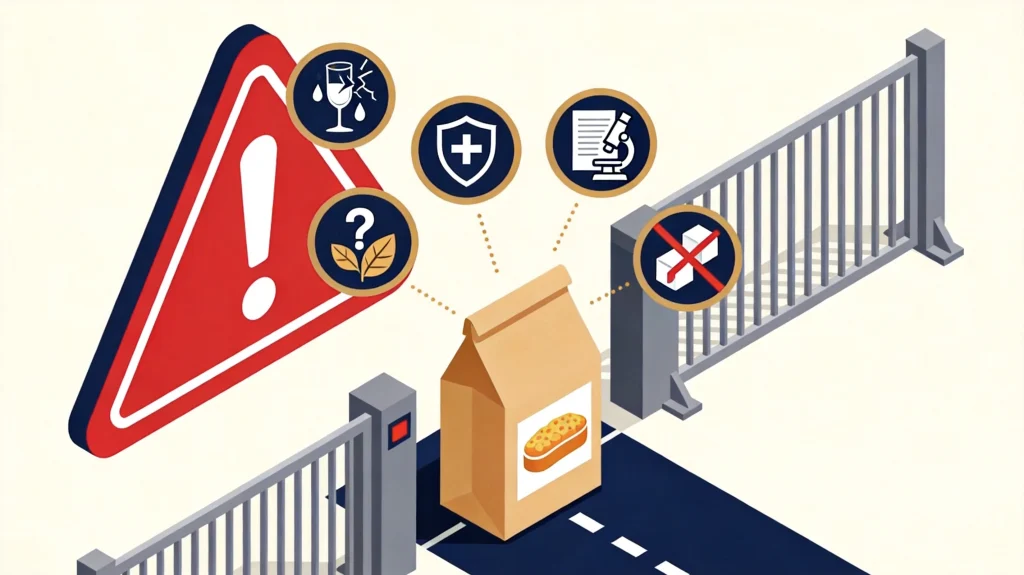
These five food health claim trigger words and phrases come up in nearly every label rejection we see. If you do nothing else before sending artwork to print, search for these five on your Korean and Japanese labels.
"Detox."
Prohibited or heavily restricted across all three markets. The word implies a therapeutic or drug-like function — removing "toxins" from the body — that no general food can legally claim. The softened versions ("cleanse," "purify") draw the same scrutiny.
"Immunity boost" / "boosts immunity."
A function claim, not a nutrient content claim. In China, it requires Blue Hat registration using specific wording. In Jap, it requires FFC notification or FOSHU approval. In Korea, it is HFF-only. A general food label carrying this phrase in any of the three languages will be flagged.
"Clinically proven."
Implies that clinical trials support a health outcome — a food health claim in every market. Permitted only where the claim itself is permitted (FFC in Japan; approved Blue Hat function in China; HFF in Korea) and the clinical evidence matches the dossier submitted. On a general food label, the phrase triggers detention in every market.
"Natural."
A word everyone thinks is safe and no regulator treats as safe. Under GB 7718-2025 in China, "zero additives" and "purely natural" wording implying absence of additives are banned from March 2027. In Japan, "natural" invites JAS organic scrutiny if it reads as an organic-production claim. In Korea, MFDS treats it as a functional claim if it implies a health-relevant attribute. If you keep it, be prepared to substantiate what "natural" means when asked.
"Zero sugar" / "sugar-free."
A nutrient content claim with strict thresholds — ≤0.5 g/100 g or 100 mL in China, with similar limits in Japan and Korea. The typical failure is products labelled "no added sugar" that still contain naturally occurring sugars (dried fruit, dairy, certain grain products) above the threshold. Under GB 28050-2025, the "no added sugar" wording itself faces restrictions, so relying on that as a substitute for "zero sugar" will not work either.
What to Do Before Printing
We review hundreds of English-language labels for Asian markets each year. Five practices catch the majority of food health claim problems before they reach a port.
Run a claim map before translation.
For every food health claim on the English label, note which of the four categories it falls into, then check whether that category is permitted on general food in each target market. Do this before sending the label for translation, not after — reworking an approved Chinese or Japanese label costs more than getting the English source right. Translation does not equal compliance; a correctly translated claim can still be an illegal claim.
Build three label versions when needed.
Exporters often ask whether a single label can cover all three markets. The answer, for any product carrying function claims, is almost always no. A phrase permitted on Chinese general food may require FFC filing in Japan and removal for Korea. Treat the three markets as separate compliance exercises. Accept the cost of three label versions at the start rather than paying for bonded relabelling later. For a worked example of how this kind of three-market label review works in practice, see our compliance comparison for olive oil exporters covering China, Japan and Korea.
Keep the evidence dossier.
Retain the scientific evidence supporting any function claim for at least the product shelf life plus two years. Japan's FFC system requires that evidence to be available for CAA inspection on demand; Korea's MFDS can request substantiation for any claim at import; China's Blue Hat system requires the dossier as part of the registration file. If you cannot produce the evidence when asked, the claim collapses.
Leave supplement and pharma wording on the supplement label.
Phrases that are acceptable on dietary supplements in the US or EU — "supports," "boosts," "defends," "clinically shown" — are routinely illegal on food products in Asia. Food and supplement regimes in all three countries are separate, with different lead times, licensing requirements, and permissible wording. If your product is classified as a food, use food claim wording.
Start the GB 7718-2025 / GB 28050-2025 transition now.
Labels printed before 16 March 2027 can be sold through their shelf life, but new print runs placed after that date must comply with the new rules. Any label artwork being commissioned now should already incorporate the "1+6" nutrition panel (adding saturated fat and total sugars), the eight mandatory allergen categories, and the removal of "zero additives" / "no added" / "purely natural" wording. Our food labelling guide for exporters to China walks through the full transition, including how the new wording rules affect food health claims.
FAQ
Can I use the same health claim across China, Japan and Korea?
Rarely. The categories are drawn differently, the approved wording differs, and the approval regimes do not align. A food health claim that is permitted on Chinese general food may be a notification-only claim in Japan and an HFF-restricted claim in Korea. Claim mapping has to be done market by market.
Does "natural" count as a health claim?
As a standalone word, it is not defined as a health claim in any of the three markets. But it is far from safe. In China, GB 7718-2025 bans "purely natural" and similar wording that implies the absence of additives. In Japan and Korea, if "natural" is used in a way that implies a health or functional benefit, inspectors will treat it as a functional claim.
What actually happens if I make an unapproved claim?
The immediate consequence of an unapproved food health claim is shipment detention and forced relabelling or destruction at port. The importer bears the direct cost and will usually pass it back to the exporter or refuse future shipments. Repeat violations lead to enhanced inspection for future containers — a "high-risk" designation that slows every subsequent shipment from the same manufacturer. In serious cases, particularly therapeutic claims on general food, the overseas manufacturer can be placed on an import restriction list.
Do I need Blue Hat, FOSHU or HFF status for every functional product?
For products carrying only approved nutrient content and nutrient function claims that meet the relevant thresholds, general-food status is sufficient in China and Japan. In Korea, anything beyond basic nutrition-content claims typically requires HFF status — this is where Korea differs most sharply from the other two. The tier decision depends on which claims you actually need to make, and on how much lead time you have before first shipment.
This article is provided for general informational purposes only and does not constitute professional compliance advice. Regulatory requirements change frequently, and specific obligations depend on product formulation, dosage form, dosage levels, and the exact wording used on the label. For claim-review or label-compliance questions specific to your product, please contact us at kevin@specitconsulting.com.
The window to relabel cheaply is always before printing. Once a container is bonded at the port, relabeling costs ten to twenty times what a pre-print label review would have cost, and the delay costs the launch window itself. Most exporters who run into food health claim problems did not set out to violate regulations; they assumed that acceptable marketing language in their home market would carry the same meaning in Asia. It rarely does.
Need a claim review for your Asian labels? We can prepare a label compliance audit mapping every food health claim on your English label to its permitted category in China, Japan, and Korea — including required wording changes, threshold checks, and recommendations on which claims require Blue Hat, FFC, FOSHU, or HFF filings. Get in touch for a 20-minute compliance snapshot tailored to your product.
Need help navigating your market entry?
We've helped food exporters across 10+ countries enter 13 Asian markets. Get a free initial assessment based on public data — delivered in 3 working days.
Get Your Free AssessmentContinue Reading
▶China Food Safety Law Revision 2026: What Foreign Food Exporters Face
▶Exporting Olive Oil to Asia in 2026: A Compliance Comparison for China, Japan and Korea
Questions about entering the Asian market?
Chat with us on WhatsApp →