

SIAL Paris opens next week. Gulfood wrapped up in February. And right now, across Europe, exporters are shoving sample boxes into courier envelopes headed for Asia.
Most of them will clear. Some will not — and the ones that get held almost always fail for the same reasons. Not because the exporter did something illegal, but because they picked the wrong route or filled out the wrong paperwork.
If you need to send food samples to Asia and want them to arrive instead of ending up in a customs inspection shed, here are the two routes that actually work, what documentation each requires, and the quantity limits that keep shipments moving.
Route 1: The Personal Gift Parcel
This is the route most small producers use when they first send food samples to Asia. A DHL or FedEx envelope with one to three units, marked as a gift. It is fast, cheap, and needs almost no documentation — which is exactly why it fails when used for the wrong product or in the wrong quantity.
Who uses it: Small and mid-sized producers sending first-contact samples — olive oil, chocolate, coffee, snacks, mini bottles of spirits, condiments, confectionery.
How it works: Ship via DHL, FedEx, or UPS. Mark the parcel "Gift / Personal Use / No Commercial Value." Declare below the destination country's duty-free threshold. Address it to a named person, not a company.
Quantity logic: One recipient, one to three SKUs, small quantities. Any more than that and customs will treat it as a commercial shipment regardless of what the box says. Repeat parcels to the same address get flagged fast.
What clears: Long-shelf-life pre-packaged foods, mini bottles of wine or spirits (within personal alcohol allowances), chocolate, olive oil, coffee, tea, biscuits, snacks.
What does not clear: Cold-chain products — no health certificate travels with a gift parcel, and chilled or frozen goods cannot come through personal-use channels. Meat, dairy, fresh fruit, honey, eggs, and anything with animal-derived ingredients require quarantine inspection in nearly every Asian market, with no personal-use exemption. Products containing additives not approved under China's GB 2760 or Japan's positive list — common in some European confectionery and baked goods — will also be held.
Duty-free thresholds
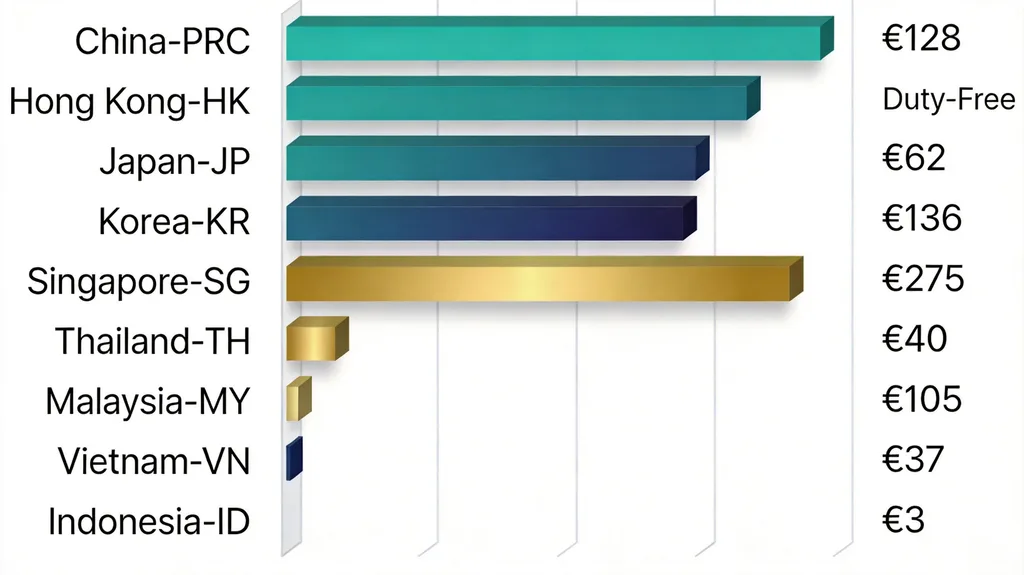
- China — RMB 1,000 per recipient, under "reasonable personal quantity." Multiple identical items above a handful may be deemed commercial even under RMB 1,000.
- Japan — JPY 10,000 standard allowance; alcohol has its own limit (3 bottles × 760 ml duty-free).
- Korea — USD 150; separate allowances for alcohol and tobacco.
- Singapore — SGD 400; GST applies above the threshold.
- Thailand — THB 1,500.
- Malaysia — RM 500; alcohol is restricted regardless of value.
- Vietnam — VND 1,000,000 (roughly USD 40); the low threshold makes the gift route fragile here.
- Indonesia — USD 3 de minimis; nearly every food shipment attracts duty and inspection. The gift route is not practical for Indonesia.
- Hong Kong — Free port; no general food duty, but excise applies to alcohol above 30% ABV.
Risks. Customs reclassifies the parcel as commercial, and the recipient gets a duty bill, or the shipment goes back. If inspection finds an under-declared value, it can lead to seizure and penalties, and it can flag you and the recipient for future shipments. A named contact receiving the same "gift" every two weeks gets noticed. The gift route works for first-contact samples. It does not scale. It does not work for every product category.
Route 2: Commercial Samples
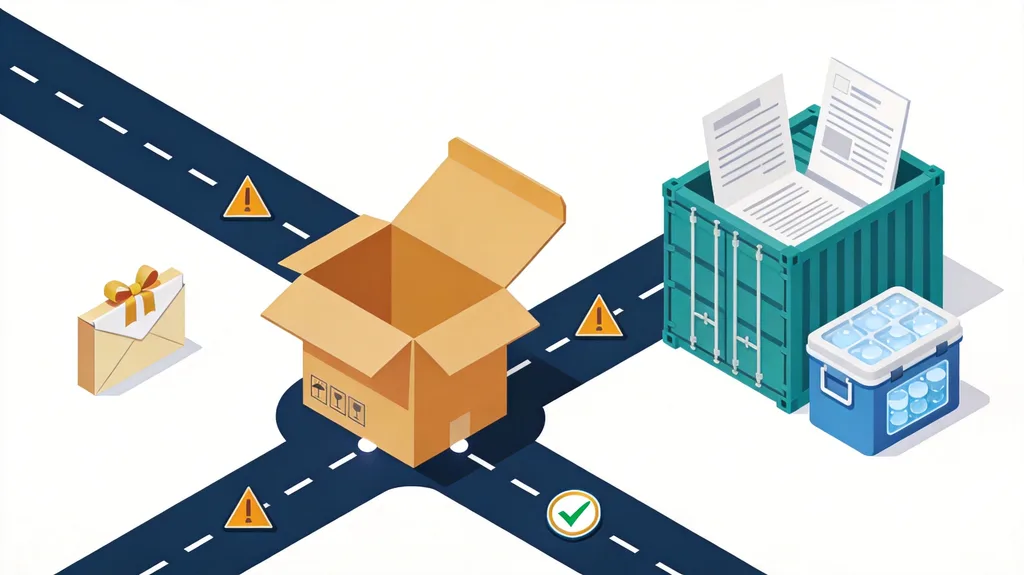
Once a sample is part of an actual commercial conversation — an importer asked to evaluate your range, you are sending multiple SKUs for a listing meeting, cold chain is involved — the gift route becomes a liability. This is the proper way to send food samples to Asia once a business relationship has started: commercial samples, properly documented.
When you need this route: Multiple SKUs or multiple contacts at the same importing company. Cold-chain or temperature-controlled products (chilled dairy, frozen seafood, short-shelf-life items). High-value goods or volumes that clearly exceed personal use. An importer or distributor is already involved. A formal order is expected to follow.
Documents:
- Commercial invoice on company letterhead marked "Sample — No Commercial Value — For Evaluation Only." List every item with a nominal value. State clearly that the goods are not for resale.
- Packing list with itemised contents, weights, and packaging.
- Full ingredient list per SKU.
- Certificate of origin.
- Health certificate, certificate of free sale, or sanitary certificate for animal-origin products, dairy, and categories requiring it under GACC or local rules.
- For alcohol, a certificate of analysis or age statement where applicable.
Labelling.
- China: A Chinese "sample" label (样品 — 不得销售) can be applied before shipment or stuck on by the importer on arrival, with product name, origin, and importer details. Full GB 7718 retail labelling is not required for evaluation samples, but basic origin and identity information must be visible.
- Japan: The Japanese importer applies the label under the Food Labelling Act; samples do not need full retail compliance but must carry enough information for customs to classify the product.
- Korea: Pre-applied Korean labelling is expected even for samples, or the Korean importer applies a sticker before clearance under MFDS guidance.
Value declaration. Do not write zero. Declare production cost or a nominal USD 1–5 per unit. Zero is an inspection flag, and customs will re-assess at market rate anyway.
Cold-chain samples. These must go through a freight forwarder or an importer with food import qualifications and cold-chain capability. Courier companies do not handle bonded cold-chain clearance for food in China, Japan, or Korea. The importer arranges health certificates in advance and clears under their licence. If you have no importer appointed yet, a compliance partner or trade-service provider can act as consignee.
Which Route to Pick
The route you use to send food samples to Asia depends on where you are in the conversation, not on what is cheapest.
Use the gift parcel for first contact when you have no commercial relationship yet, and the product is ambient, shelf-stable, and non-animal. Three units, one SKU, to a named person.
Use commercial samples the moment an importer is involved, the product requires cold chain, you are sending a range, or you expect the evaluation to lead to an order. The extra documentation costs half a day and prevents a two-week delay or a destroyed shipment.
Some exporters try to stretch the gift route when they send food samples to Asia in larger volumes — a dozen units across five SKUs to a company address. That is not a gift. It is an unlicensed commercial shipment, and customs in most Asian markets have seen it enough times to recognise it immediately.
Before You Seal the Box
Four quick checks to run before you send food samples to Asia — especially if you have never shipped to that market before.
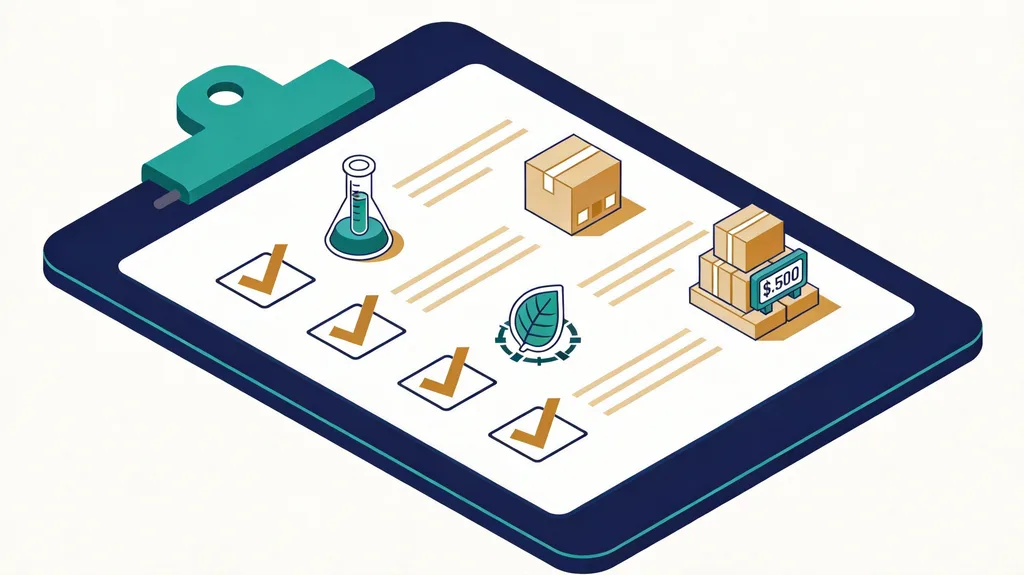
Additives. Cross-reference every ingredient against the destination market's approved list. China's GB 2760 and Japan's positive list are the ones that catch European confectionery and processed foods most often.
Packaging. Country of origin, ingredient list, production date or lot code, and net weight must be on the pack or a label — even on samples. Blank tins or unmarked bottles with no origin create suspicion.
Quarantine categories. Meat, dairy, eggs, honey, fresh produce, and seeds need phytosanitary or veterinary certificates even in sample quantities. Check before you ship, not after the hold notice arrives.
Quantity. If it looks like stock, it gets treated as stock. A carton of 24 identical units to a company address is not a sample no matter what the invoice says. Keep it to evaluation quantities — two to six units per SKU.
When to Use an ATA Carnet
The ATA Carnet is not the normal document when you send food samples to Asia by courier. It is for when a representative is physically carrying samples to a trade show and bringing the unused portion back — SIAL, Anuga, Gulfood, FHC Shanghai, Foodex Japan. Under a Carnet, samples are temporarily admitted without duty, bonded, and re-exported after the show. For samples sent ahead by freight, or samples handed out or consumed at the show rather than returned, a Carnet is the wrong tool. It also does not replace health or phytosanitary certificates — those are still required for quarantine-controlled categories.
Getting your samples onto the stand is only half the job — what happens after the show determines whether those conversations turn into orders; we cover the 48-hour window and three-touch cadence in our guide to trade show follow-up for food exporters.
If Your Shipment Gets Held
It happens — even when you send food samples to Asia by the book, a shipment can end up in inspection. Three outcomes.
Pay duty and release. Works for commercial samples where paperwork is essentially in order but duty was not prepaid. The importer pays assessed duty and VAT/GST and the goods clear. Not an option for gift parcels reclassified as commercial — there is no registered importer to take responsibility.
Return to sender. Shipped back at your cost. The default for gift parcels that cannot be re-routed through commercial clearance, or for prohibited items.
Destruction. Customs destroys the goods at no direct charge. The standard resolution for products containing prohibited ingredients or where return cost exceeds the shipment's value.
For gift parcels flagged as commercial, return or destruction are usually the only options because there is no importer on the paperwork to assume duty and clearance responsibility.
Next Step
Sample shipping is the first operational question after a trade-show meeting or a warm reply, and getting the route wrong wastes weeks of momentum. Before you send food samples to Asia, confirm which route applies and what paperwork your destination actually requires. If you are preparing samples for a specific market, tell me your product category and destination — or contact Specit Consulting for a sample-shipment compliance check.
Disclaimer: This article is provided for general informational purposes only and does not constitute professional customs, legal, or compliance advice. Customs procedures, duty thresholds, and quarantine requirements change frequently; specific shipments may be treated differently depending on the port of entry, courier, and discretion of local officers. All thresholds and procedures are current as of October 2026. For practical compliance support tailored to your product category and target market, contact us at kevin@specitconsulting.com.
About Specit Consulting
Specit Consulting advises overseas food and beverage exporters on regulatory compliance and market entry across 13 Asian markets — China, Japan, Korea, Singapore, Thailand, Vietnam, Indonesia, Malaysia, the Philippines, Hong Kong, Macau, Taiwan, and India. We handle regulatory mapping and registration (GACC Decree 280, Japan MHLW, Korea MFDS, Thai FDA), labelling, health claims review, detention resolution, and distributor due diligence. We do not sell freight or act as importer of record; we work alongside your logistics partners and distributors to get products to market compliantly.
Further reading
- What to Do When Your Food Shipment Is Detained at an Asian Port
- How to Export Food to China in 2026: GACC Registration, Labelling and Customs
- Asia Food Geographic Indication Labelling: Compliance Guide for EU Producers
- Q4 2026 Food Compliance Calendar for Asia
- Food Export Asia Self-Audit Checklist
FAQ
Can I send meat or cheese samples to Asia marked as a gift?
No. Meat, dairy, eggs, honey, and fresh animal-origin products need sanitary or veterinary health certificates for China, Japan, and Korea, and there is no personal-use exemption. These must go through commercial sample channels with the right paperwork, or they will be seized.
What happens if I declare USD 0 on the sample invoice?
Zero is a well-known inspection red flag. Customs will re-assess at retail rate, charge duty and possibly penalties, and flag you and the recipient for future shipments. Declare production cost or USD 1–5 per unit.
Do I need an ATA Carnet to send samples to SIAL or Anuga?
A Carnet is for samples you personally carry through customs and bring back after the show. For samples sent ahead by courier, or samples you hand out rather than return, use a commercial invoice marked as samples. A Carnet does not replace health or phytosanitary certificates for controlled categories.
Can chilled or frozen samples govia DHL or FedEx?
Generally no. Cold-chain food needs a licensed importer doing bonded clearance with cold-chain handling. Couriers do not manage health certificate validation or cold-chain bonded clearance in major Asian markets. Route through a freight forwarder or your appointed importer.
How many units per SKU is too many for a gift parcel?
One to three units per SKU, one to three SKUs, to a named individual. A carton of 24 identical units to a company is a commercial shipment regardless of the marking
Need help navigating your market entry?
We've helped food exporters across 10+ countries enter 13 Asian markets. Get a free initial assessment based on public data — delivered in 3 working days.
Get Your Free AssessmentContinue Reading
▶Food Import Detentions in Asia: 7 Real Cases and How to Avoid Them (2026)
▶Japan Food Import Requirements 2026: MHLW, Labels & Avoiding Detention
Questions about entering the Asian market?
Chat with us on WhatsApp →