

10 September 2026 | Shanghai, China
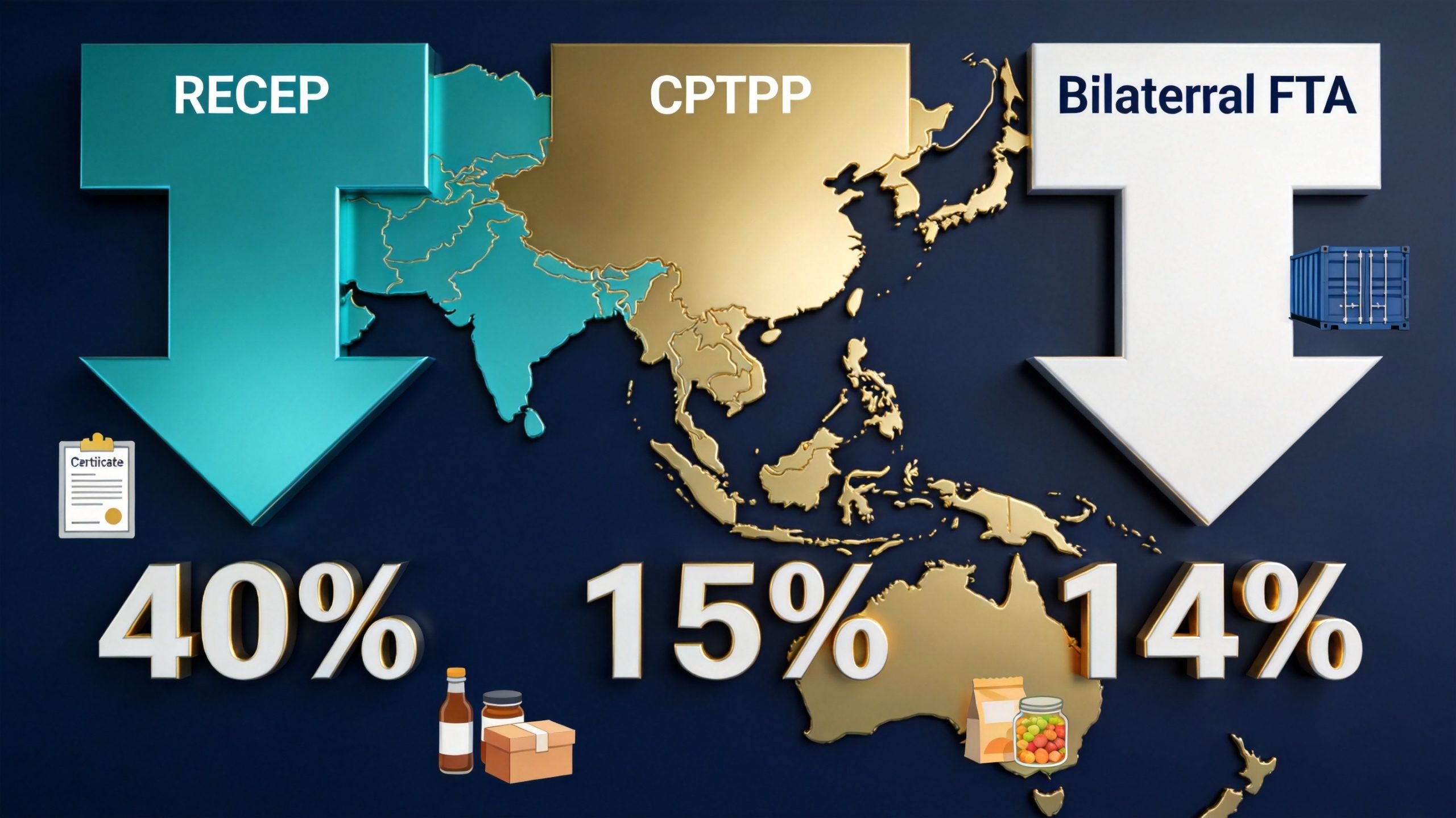
Most exporters pay WTO MFN rates by default. FTAs can reduce or eliminate tariffs — but only if the exporter actively claims them. In 2026, a new round of RCEP reductions took effect in January, with further cuts from April for several product categories. CPTPP continues to phase down. Bilateral deals offer further savings in specific lanes. This article maps the FTA landscape for food exporters to Asia.
RCEP: The 2026 Tariff Position
RCEP is the largest FTA that many food exporters are not using. Fifteen members — the ten ASEAN countries plus China, Japan, South Korea, Australia, and New Zealand — cover roughly 30% of global GDP and population. It is the first FTA between China and Japan, and between Japan and South Korea.
The 2026 tariff position varies by bilateral pair:
- China–Japan: approximately 86% of Japanese goods are on track for eventual duty-free treatment under RCEP, with a further round of cuts taking effect in January 2026. Sensitive food items such as rice, sugar, and dairy remain on longer phase-out schedules of 10 to 21 years.
- China–South Korea: approximately 92% of goods are duty-free under the current schedule, with processed food, confectionery, and beverages seeing ongoing reductions.
- China–ASEAN: over 95% of goods are already duty-free under ACFTA; RCEP adds cumulation benefits relevant to multi-country sourcing operations. Fresh fruit exporters should note that tariff elimination under ACFTA and RCEP does not remove non-tariff requirements — GACC orchard registration, cold-treatment records, and phytosanitary certification remain mandatory and are the most common cause of shipment rejection. See our fresh fruit import guide for the full compliance checklist.
| Agreement | Members | Food tariff snapshot |
| RCEP | 15 (ASEAN+5) | 86–95% duty-free on phased schedules; sensitive foods 10–21 years |
| CPTPP | 12 (incl. UK) | Higher share of immediate duty-free lines; faster phase-out overall |
| Bilateral FTAs | 2 countries | Often deepest cuts on specific products; varies by agreement |
Worked Examples for Food Products
Japanese sake entering China carries an MFN rate of 40% (HS 2206). Under RCEP, the preferential rate for Japan-origin sake was about 38.1% in 2026, with a phased reduction over roughly 21 years. Wine from Japan entering China (HS 2204.21) faces an MFN rate of 14%; the RCEP preferential rate for Japan was approximately 7.6% in 2026, with staged elimination over roughly 11 years. Note that Australian, Chilean, and New Zealand wine already enters China at zero duty under bilateral FTAs — these examples apply to Japan-origin products under RCEP. For the full Japan tariff schedule, refer to the Japan Customs tariff schedule.
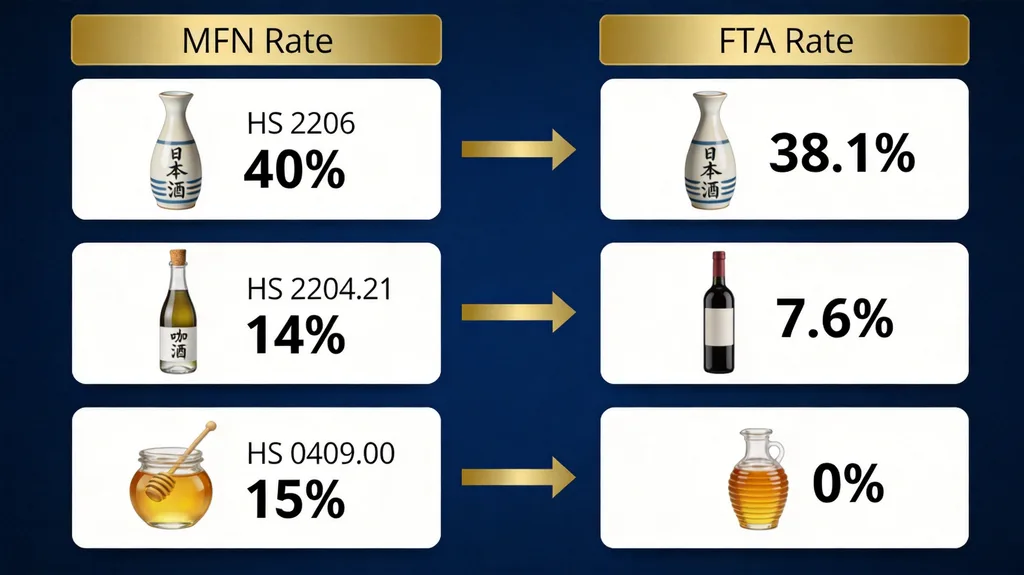
Australian honey entering China (HS 0409.00) faces a 15% MFN rate. Under ChAFTA, this tariff has already been eliminated to zero, and RCEP matches that preference. On a USD 100,000 CIF shipment, that is USD 15,000 in duty saved — but only when the exporter provides a valid Certificate of Origin. Without it, the importer pays full MFN.
Cumulation Rules for Food Supply Chains
Cumulation provides particular value for food supply chains that source ingredients across multiple RCEP members. Originating value from any member country counts toward the applicable origin threshold. For most food products, RCEP requires a regional value content (RVC) of 40%; some product lines use a change in tariff classification (CTC) rule instead.
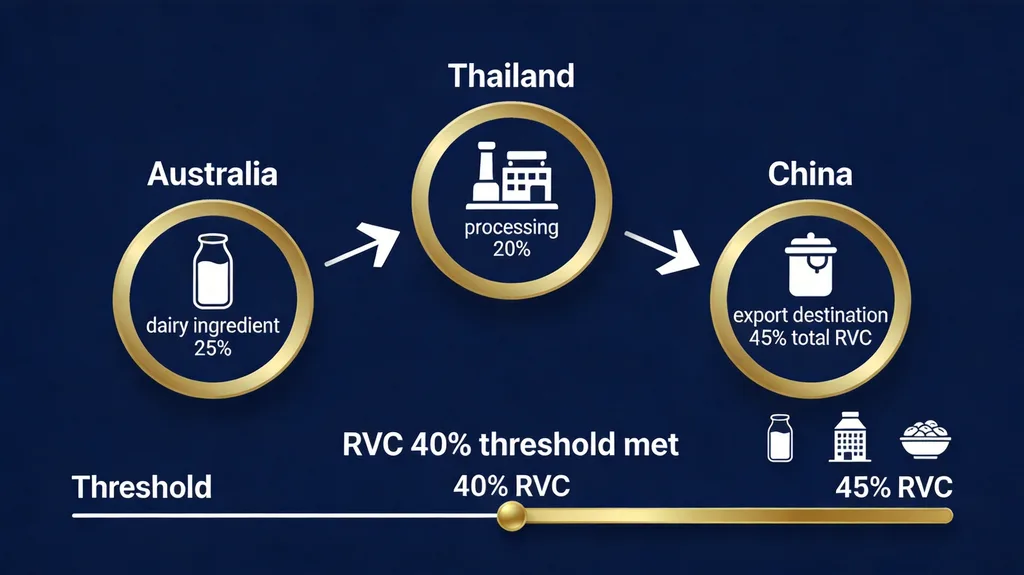
For illustration: an Australian dairy ingredient contributing 25% originating value, processed in Thailand with 20% originating value, and exported to China at 45% total RVC would meet the threshold. Actual qualification depends on the product-specific rule of origin for the HS code in question.
CPTPP: Deeper Liberalisation, Narrower Membership
CPTPP offers deeper and faster tariff liberalisation than RCEP, though its membership does not include China or South Korea. Current members are Japan, Vietnam, Malaysia, Singapore, Brunei, Australia, New Zealand, Canada, Mexico, Chile, Peru, and the United Kingdom (which deposited its instrument of accession in October 2023 and entered into force for all existing members during 2024).
China formally applied to join CPTPP in September 2021; accession negotiations have not commenced. South Korea’s government began public consultations on potential CPTPP accession in August 2026, but had not submitted a formal application as of the date of publication. Exports to China or South Korea therefore rely on bilateral or RCEP rates. CPTPP provides a higher share of immediate duty-free lines and faster phase-out schedules than RCEP overall, and Japan’s CPTPP concessions on beef, pork, dairy, and wheat are deeper than its RCEP commitments for member-country suppliers.
Bilateral FTAs Remain Relevant
Key bilateral FTAs offer preferential rates that often match or outperform RCEP for specific lanes: China–Australia (ChAFTA), China–New Zealand, Japan–Australia (JAEPA), the Japan–EU EPA, and South Korea–Australia (KAFTA). If the exporting country is not an RCEP member — most EU member states and the United States, for example — RCEP rates do not apply to direct shipments.
In practice, compare bilateral, RCEP, and CPTPP rates for the specific HS code before selecting which agreement to claim. HS code misclassification is a frequent cause of unexpected duty charges, often arising when exporters have not verified which FTA rate applies to their product's actual classification — our export guide covers the China food import clearance and duty process step by step.
Documentation and Compliance
Documentation errors are a common reason FTA preferences are denied at import. RCEP uses a standard Certificate of Origin template (Form RCEP), and approved exporters in participating economies may self-certify.
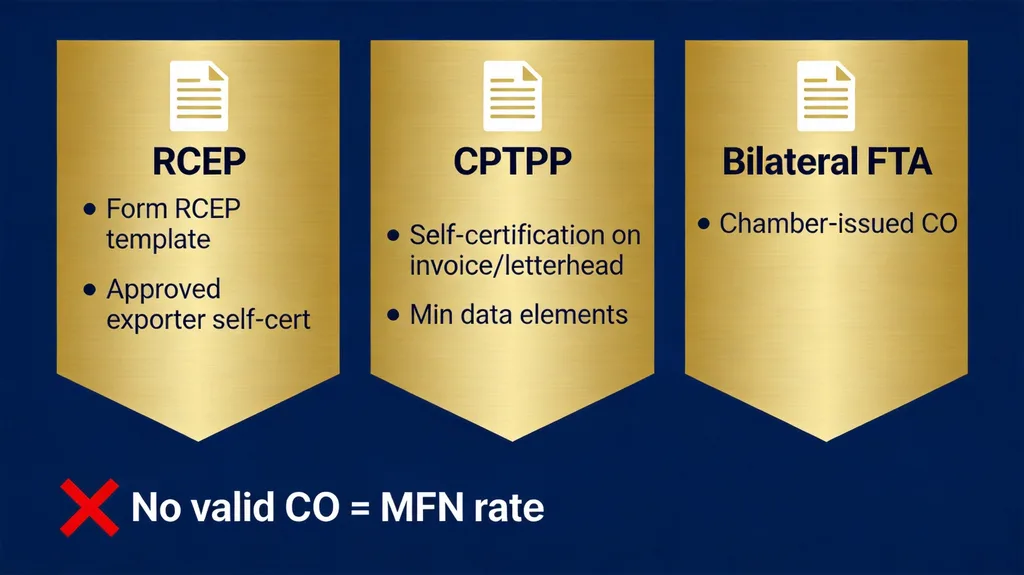
CPTPP uses self-certification as standard: the certification of origin may appear on a commercial invoice or company letterhead, provided it contains the minimum data elements specified in Chapter 3, Annex 3-B. Most bilateral FTAs require a CO issued by a chamber of commerce or the competent customs authority.
Common reasons claims are rejected:
- Origin criteria not met — the RVC threshold is not reached where applicable, or the required tariff classification change is not satisfied.
- CO errors in HS code, quantity, or consignee details.
- Goods transiting a non-member country without meeting the direct consignment rules.
The same product, the same route, and the same buyer can attract different duty outcomes depending on whether a valid CO accompanies the shipment. Exporters who treat CO preparation as a post-shipping formality rather than a pre-shipment step routinely forfeit available preferences. Integrating CO preparation into the standard export documentation workflow helps ensure preferences are captured consistently. Our tariff analysis service can identify which agreement provides the lowest rate for each HS code.
Which agreement to claim depends on the lane. For exports to Japan from Australia, New Zealand, or Canada, CPTPP generally offers faster or deeper reductions. For exports to China or South Korea from non-CPTPP countries, RCEP or bilateral FTAs are the available options. For multi-country supply chains within ASEAN plus China, Japan, and South Korea, RCEP cumulation can be a material advantage. The outcome depends on the specific HS code, origin structure, and destination market. Note that trade remedy measures — anti-dumping and countervailing duties — can apply independently of FTA preferential rates. For an up-to-date overview of current tariffs affecting EU food exports to China, see our summary of EU–China tariff risks for food exporters.
Practical Steps
- Identify the top five exported HS codes and destination markets.
- For each pair, compare the MFN rate, the RCEP rate, the CPTPP rate where applicable, and the relevant bilateral FTA rate. Confirm which agreement offers the lowest rate and whether the goods meet the applicable origin criteria.
- Assess whether RCEP cumulation or back-to-back COs can support origin qualification where regional ingredients are used. Consider approved-exporter status under RCEP where available, and understand the CPTPP self-certification process for relevant lanes.
- Integrate CO preparation into the standard export documentation workflow as a pre-shipment step.
Exporters who address FTA eligibility systematically as part of landed-cost calculation, rather than treating it as a shipping-desk afterthought, are better placed to realise available duty savings. Our market entry assessment includes FTA tariff mapping as part of the broader market-entry evaluation.
Do I need a Certificate of Origin to claim FTA preferential rates?
Yes. Without a valid Certificate of Origin (or self-certification where permitted), the importer pays the full MFN rate. The CO must meet the format and data requirements of the specific agreement being claimed — Form RCEP for RCEP, a declaration on a commercial document for CPTPP, or a chamber-issued CO for most bilateral FTAs.
Can EU food exporters use RCEP for shipments to Japan or China?
No. RCEP preferences apply only to goods originating in RCEP member countries. EU-based exporters shipping directly to Japan can claim Japan–EU EPA rates. For China, check whether a bilateral FTA exists between the exporting country and China. Goods that undergo sufficient processing in an RCEP member country may qualify under cumulation rules.
What is the RVC 40% rule under RCEP?
The Regional Value Content threshold requires that at least 40% of the product’s value originates from RCEP member countries for most product lines. Some product categories use a Change in Tariff Classification (CTC) rule instead. Cumulation allows originating value from any RCEP member to count toward the threshold.
How long does it take for food tariffs to reach zero under RCEP?
It varies by product and bilateral pair. Many industrial goods reached zero immediately or within the first few years, but sensitive food items — including rice, sugar, dairy, and some alcohol categories — have phase-out schedules of 10 to 21 years. Check the specific staging schedule for your HS code and country pair.
Can I claim more than one FTA for the same shipment?
No. You claim one preferential agreement per shipment. Compare the preferential rate under each applicable agreement (bilateral, RCEP, CPTPP) for the specific HS code and claim the one offering the lowest rate, provided origin criteria are met.
Need help mapping FTA tariff savings for your food exports to Asia? Contact Specit Consulting for an initial assessment based on public data.
About Specit Consulting
We help food and beverage brands enter and grow in the Chinese and wider Asian markets through trade intelligence, importer identification, and regulatory research. For further context on Japan's food import regulatory framework, see our dedicated guide. See our services overview for more information.
✉ info@specitconsulting.com
Disclaimer: This article reflects general market observations and regulatory understanding as of September 2026. Tariff rates and FTA schedules are indicative and subject to change. Always confirm current rates with the relevant customs authority or a qualified customs professional before shipping.
Need help navigating your market entry?
We've helped food exporters across 10+ countries enter 13 Asian markets. Get a free initial assessment based on public data — delivered in 3 working days.
Get Your Free AssessmentContinue Reading
▶How to Read China HS Tariff Code (Chapter-by-Chapter)
▶EU Food Exports to China: Understanding Tariff Risks (2026–2029)
▶HS Code Misclassification: When Our Report Predicted a Tariff Shock
Questions about entering the Asian market?
Chat with us on WhatsApp →