


6 October 2026 | Shanghai, China
The three most common wrong assumptions we hear from Mediterranean olive oil producers are: "English labels are fine," "Japan just needs JAS," and "tariffs are all about the HS code." Each can stop a shipment at the port. Between grade classification standards that diverge from EU terminology, additive rules banning TBHQ in extra-virgin categories, aflatoxin testing thresholds, and mandatory Korean-only labelling, the compliance surface is wider than most export teams expect.
This article maps registration, labelling, tariff, testing, and clearance requirements for olive oil entering China, Japan, and South Korea. It flags the three detention triggers behind most border holds for Mediterranean oil shipments.
China: GACC Registration + Chinese Labelling + GB/T 23347
Registration requires competent-authority recommendation.
Under GACC Decree No. 280 (effective 1 June 2026, replacing Decree 248), edible fats and oils sit within the 17 categories requiring official recommendation from the exporting country's competent authority before the overseas manufacturer can register. Olive oil mills and bottling plants cannot self-register through CIFER — the application must be routed through the competent authority in Spain, Italy, Greece, or whichever origin country is exporting.
Registration is valid for five years with automatic renewal for olive oil (unlike meat and bird's nest). Lead times run 2–4 months from the authority submission, so producers targeting Q1 2027 should engage their competent authority by November 2026.
Grade classification: GB/T 23347 diverges from IOC/EU terminology
This is the most commonly overlooked compliance point. China's product standard GB/T 23347 defines grade categories that differ from IOC and EU terminology:
- Extra virgin and virgin map to 特级初榨橄榄油 and 初榨橄榄油, but Chinese acidity and organoleptic thresholds are independently specified.
- Refined olive oil and olive oil (refined + virgin blend) are separate sub-categories; the EU label phrase "olive oil — composed of refined olive oil and virgin olive oils" cannot be used without confirming the Chinese designation.
- Olive-pomace oil (油橄榄果渣油) is a distinct GB/T 23347 category and falls under HS 1510 — not HS 1512 (sunflower, safflower, cotton-seed oil). Misclassifying pomace oil under 1512 risks duty short-payment and detention.
We have seen a Mediterranean olive oil shipment that shared the same aflatoxin pitfall detained because the invoice declared "olive oil" without specifying the GB/T 23347 sub-category, leaving customs unable to apply the correct testing panel.
Labelling: GB 7718-2025 and GB 28050-2025 (effective 16 March 2027)
Two new standards take effect together. For olive oil, the highest-impact changes are:
- Dual-date zone: a dedicated, high-contrast area displaying both production date and shelf-life expiry date in year-month-day order. "Best before" alone is insufficient for most olive oil SKUs.
- Eight-allergen mandatory declaration (gluten, crustaceans, fish, eggs, peanuts, soy, milk, nuts). Plain olive oil contains none; flavoured or infused SKUs must highlight any applicable allergen in bold or a dedicated "Contains" statement.
- Item-by-item correspondence: the Chinese label must address every claim, certification mark, and nutrition statement on the foreign label. Non-compliant claims — such as an EU "high in polyphenols" health claim not approved under Chinese rules — must be removed or obscured.EVOO health-benefit claims — polyphenols, heart health, anti-inflammatory — are heavily restricted in Asia. What works in the EU as an authorised EFSA claim often does not transfer. Our guide to health and nutrition claims in China, Japan and Korea maps what you can and cannot say.
- "Zero additives / no added" claims are explicitly prohibited.
- Nutrition table expands to "1+6" under GB 28050-2025, adding saturated fat and total sugars (for olive oil, sugar is 0 g but must be declared). The advisory "Children and adolescents should avoid excessive intake of salt, oil and sugar" must appear directly below the table.
Stick-on Chinese labels need roughly 15–20% more space versus pre-2027 designs.
Additives, testing, and tariffs
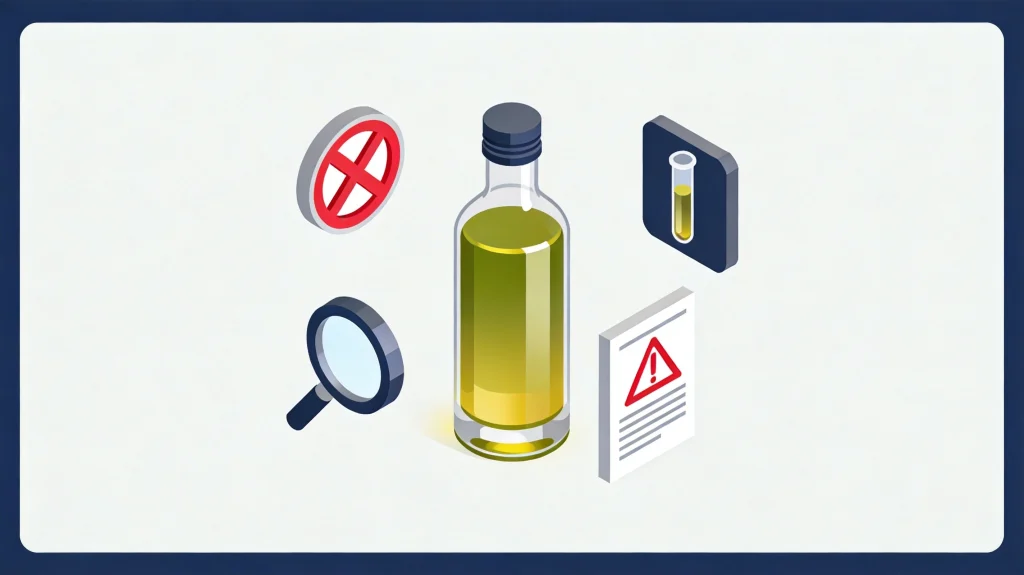
China permits the antioxidant TBHQ in refined oils at 200 mg/kg (GB 2760), but TBHQ is not permitted in virgin or extra-virgin olive oil. EVOO using TBHQ, or bottled on shared filling lines with TBHQ-treated refined oil without documented cleaning validation, will fail the additive panel at port.
Port testing routinely covers aflatoxin B1 (2 μg/kg, GB 2761), benzo(a)pyrene (10 μg/kg, GB 2762), fatty acid and sterol profiles (adulteration screening), peroxide value, and solvent residues (pomace oil only). EU COAs serve as a reference; customs may independently re-test against GB standards.
| Grade | HS code | MFN duty | VAT |
|---|---|---|---|
| Virgin olive oil (incl. extra virgin) | 1509 | 10% | 9% |
| Refined olive oil | 1509 | 10% | 9% |
| Olive-pomace oil | 1510 | 10% | 9% |
There is no EU-China FTA preferential rate for olive oil; all EU-origin oil enters at 10% MFN + 9% VAT. Plain olive oil carries no consumption tax. The full GACC pathway for high-value plant oils covers the registration-to-clearance sequence. First-shipment clearance runs 2–4 weeks with compliant labels; relabelling can extend this to 8–12 weeks.
Japan: JAS Organic Trap, Positive-List Residues, Zero Tariff
Japan does not impose a tariff on olive oil — under the EU-Japan EP, the rate is zero. Tariffs are not the barrier. Compliance is.
Japan operates no central pre-market factory-registration system for general food imports. The Japanese importer of record carries compliance responsibility, with quarantine stations inspecting documents and samples at entry. Identifying a capable importer matters more in Japan than in most other Asian markets.
Organic claims are the biggest trap
Under the JAS Law, retail labelling as "organic" or "オーガニック" requires Organic JAS certification. The EU-Japan equivalence arrangement allows EU-certified organic products to enter Japan, but the Japanese importer must hold JAS importer certification to apply the JAS mark. Three implications:
- EU organic certification alone does not permit use of the JAS mark or the word オーガニック on the retail label.
- Without a JAS-certified importer, product can still sell through the general food pathway, but the word "organic" (in any language) must be removed from the label and retail marketing.
- JAS importer certification belongs to the Japanese entity; switching importers means losing access to the organic claim until the new importer certifies.
Positive list, labelling, and health claims
Under Article 11 of the Food Sanitation Act, any pesticide without an established Japanese MRL falls under a default 0.01 ppm limit. EU multi-residue panels do not always cover every item Japan regulates. Olive oil is low-risk as a pressed fat, but two scenarios bite: (a) conventionally grown olives with heavy copper-fungicide exposure, and (b) flavoured or infused oils with added herbs, garlic, or citrus carrying their own residue profiles.
Retail labels follow the JAS Law and the Premiums and Representations Act (景品表示法). Mandatory items: Japanese product name, raw-material country of origin (country of olive harvest, not bottling), importer name/address, net content, best before (year/month acceptable), storage instructions, allergens, and nutrition facts (energy, protein, fat, carbohydrate, salt equivalent).
Health claims such as "reduces cholesterol" or "high in polyphenols" require filing under the Foods with Function Claims (FFC) system — a notification regime requiring a Japanese filer. Foreign exporters cannot file directly. First-shipment clearance runs 1–2 months; common detention causes are organic claims without a JAS-certified importer, residue gaps, missing Japanese origin labelling, and undeclared additives.
Korea: MFDS Registration + Korean-Only Labelling + FTA Origin Documentation
MFDS registration and tariffs
All overseas food manufacturers must register with MFDS via the Food Safety Information Service, supported by an exporting-government business licence. The Korean importer typically initiates and manages registration.
The basic tariff is 8%. EU-origin olive oil qualifies for 0% under the EU-Korea FTA, but the importer must present a valid certificate of origin (or approved exporter's origin declaration) and meet rules of origin (wholly obtained for EU-grown and processed oil). Without a certificate or declaration, the 8% MFN rate applies and is generally non-refundable. Korea applies 10% VAT. See EU-China and EU-Korea FTA duty treatment for olive oil for the full breakdown.
Korean-only labelling and health claims.
Korea has the strictest language requirement of the three markets: retail labels must be entirely in Korean; supplementary English is only permitted alongside required Korean text. Mandatory items: product name (KFDA grade in Korean), ingredients, net content, shelf life, importer name/address/phone (Korean), country of origin, storage, nutrition facts, and allergen warnings for the Korean-specified list (eggs, milk, buckwheat, peanut, soybean, wheat, mackerel, crab, pork, peach, tomato, sulphites, walnut, chicken, beef, squid, shellfish, pine nut). Plain olive oil carries none; infused or blended SKUs must be checked.
Health or function claims — including "rich in antioxidants" or "high in vitamin E" — generally require MFDS pre-review. Unapproved claims can trigger reclassification as a health functional food, bringing a far heavier registration pathway. First-shipment clearance runs 1–2 months; leading detention causes are non-Korean labelling, missing CoO for FTA claims, undeclared health claims, and residue/additive non-compliance.
Three-Country Comparison
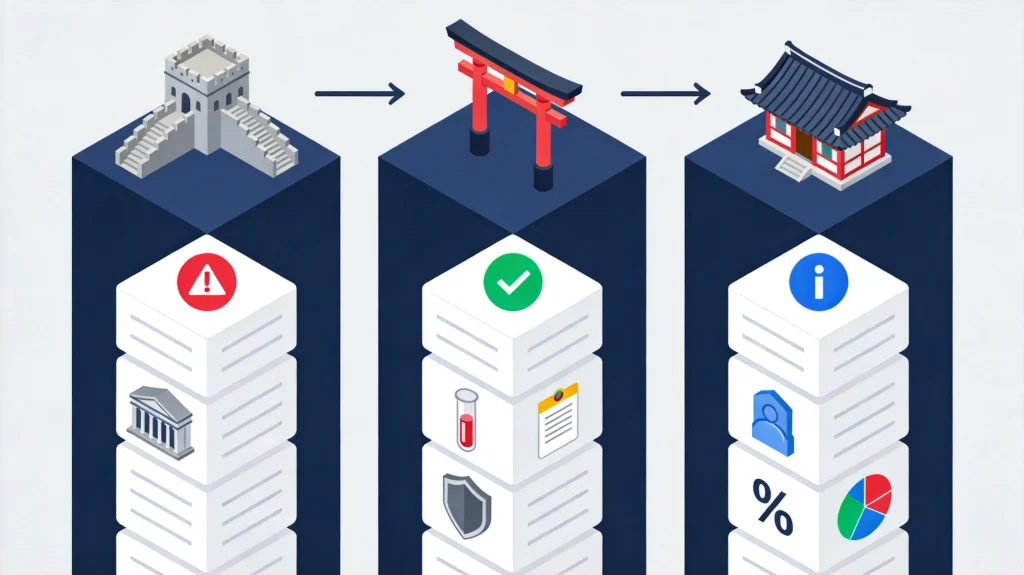
| Dimension | China | Japan | Korea |
|---|---|---|---|
| Registration | GACC, competent-authority recommendation for edible fats/oils | No factory registration; JAS importer certification for organic | MFDS, via Korean importer with exporting-government licence |
| Grade standard | GB/T 23347 (diverges from IOC/EU) | JAS grade classification | KFDA Food Code |
| Label language | Chinese, item-by-item correspondence | Japanese, JAS Law + Premiums Act | Korean, no English exemption |
| Organic recognition | China Organic (EU organic not recognised) | JAS Organic (EU equivalence only with JAS-certified importer) | Korea Organic (EU organic not recognised) |
| Tariff | 10% MFN + 9% VAT; no EU-China FTA for olive oil | 0% (EU-Japan EPA) | 8% MFN; 0% with EU-Korea FTA CoO + 10% VAT |
| Key additive risk | TBHQ banned in EVOO | Positive list for processing aids | Korean Food Code additive limits |
| Testing focus | Aflatoxin B1, BaP, fatty acid/sterol profile, solvent (pomace) | Positive list 0.01 ppm default | MFDS panel (fatty acids, UV absorbency, peroxide, residues) |
| First-shipment clearance | 2–4 weeks if labels compliant; 8–12 weeks if relabelling needed | 1–2 months | 1–2 months |
Three Typical Mistakes
1. Assuming EU Organic works across all three markets.
In Japan, EU organic equivalence exists on paper, but the JAS mark can only be applied by a JAS-certified Japanese importer — it is not automatic. In Korea, EU organic is not recognised; separate Korean organic certification is required to use the claim.
2. Relying on EU test reports as sole compliance evidence.
China's GB standards and Japan's positive list regulate items not fully covered by EU harmonised panels. An EU COA supports the file but does not prevent port-ordered re-testing. Run a target-market-specific pre-shipment panel for first shipments.
3. Modelling duty without VAT.
Teams often stop at the 10% MFN figure and forget China's 9% VAT and Korea's 10% VAT, both of which directly affect landed cost. Plain olive oil carries no consumption tax; infused SKUs with sugar or flavourings can fall into different tax categories. Build the model on HS-code-verified rates for the exact SKU.
FAQ
Does exporting olive oil to China require GACC registration?
Yes. Olive oil falls within edible fats and oils in GACC Decree 280's recommendation catalogue. The exporting country's competent authority must recommend the facility; self-registration via CIFER is not available. Registration is valid for five years, with automatic renewal for olive oil. Allow 2–4 months from authority submission.
Can organic olive oil be sold in Japan?
Yes, but the retail label can only carry the JAS mark and the word オーガニック if the Japanese importer holds JAS importer certification. Without a certified importer, the product must sell through the general food pathway with all organic claims removed.
How do I claim the Korea FTA rate?
A valid certificate of origin (or approved exporter's origin declaration) is required, confirming the oil meets EU-Korea FTA rules of origin. For wholly EU-grown and processed olive oil, the wholly obtained rule applies. The Korean importer submits the certificate at declaration. Without it, the 8% MFN rate applies.
What changes with China's new GB 7718-2025 and GB 28050-2025?
Both take effect on 16 March 2027. Key changes for olive oil: dual-date zone (production date plus expiry), eight-allergen mandatory declaration (infused SKUs), nutrition table expansion from "1+4" to "1+6" with the salt-oil-sugar advisory, prohibition of "no additives" claims, and item-by-item Chinese label correspondence with foreign content. Products manufactured before the effective date can continue to be sold through their shelf life.
This article is provided for general informational purposes only and does not constitute professional compliance advice. Regulatory requirements change frequently, and specific obligations depend on product formulation, packaging, port of entry, and importer setup. For operations or compliance questions specific to your product and target market, please contact us at kevin@specitconsulting.com
Need a compliance assessment for olive oil market entry in Asia? We can prepare a category-specific label compliance audit covering China, Japan, and Korea for your SKU — including GB/T 23347 grade alignment, target-market test panel design, Chinese and Korean sticker layout, and an HS-code-verified landed-cost model. Contact us for a 20-minute compliance snapshot tailored to your product and target market.
Need help navigating your market entry?
We've helped food exporters across 10+ countries enter 13 Asian markets. Get a free initial assessment based on public data — delivered in 3 working days.
Get Your Free AssessmentContinue Reading
▶Email Asian Food Importers: 5 Mistakes to Avoid
▶Exporting Food to Southeast Asia: A 6-Country Compliance Roadmap
▶China Food Safety Law Revision 2026: What Foreign Food Exporters Face
Questions about entering the Asian market?
Chat with us on WhatsApp →