

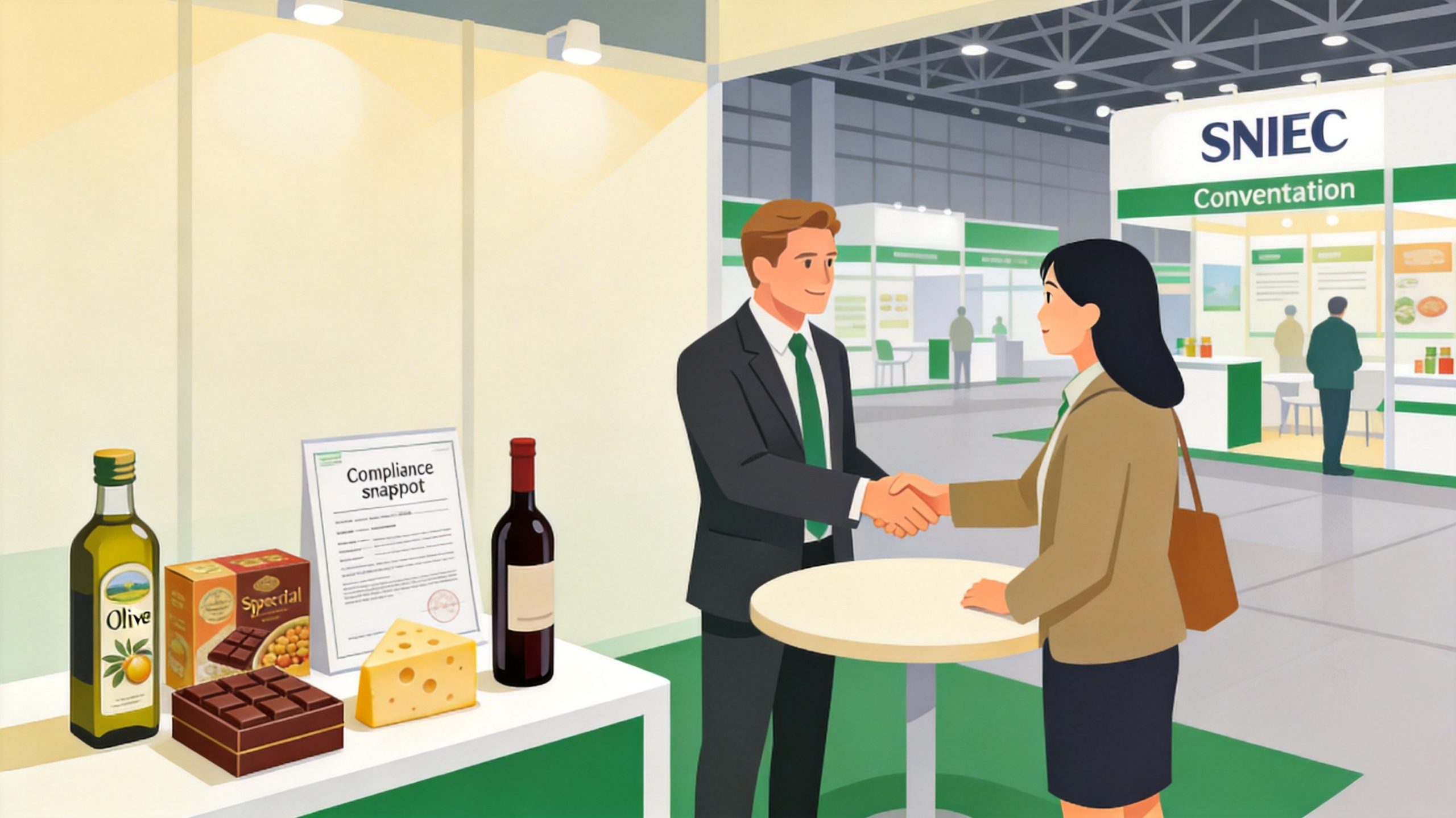
FHC Shanghai 2026 opens on 10 November at the Shanghai New International Expo Centre (SNIEC). With over 3,000 exhibitors and an expected 180,000 professional buyers across import, distribution, retail, and foodservice, the scale is real.
Scale does not convert itself.
Two weeks out is not the time to print brochures. It is the time to lock the meetings that make the booth fee worth paying. Walk-up traffic at a show this size produces, in our experience running on-ground support for over 40 international brands at FHC and sister shows, somewhere between 2% and 5% qualified leads. The rest are competitors, agents reselling agency services, students, and booth neighbours killing time.
Here are the five actions to complete now.
1. Pre-Book Target Buyers Before You Land

Do not rely on the floor. The buyers you want are already scheduling their show days.
Most first-time exhibitors assume that because FHC is China's largest imported food show, qualified importers will naturally walk past their stand and stop. They do — but the ones you want have three days of meetings, 20+ booths per aisle, and an agenda set in advance. By the time they walk your aisle, their calendar is full.
What to do instead:
Reach out on LinkedIn and by email with a specific request: a 15-minute meeting at your booth, with a clear reason why your product fits their channel. Name the SKU. Name the category gap. Reference their existing portfolio if you can. FHC's buyer base includes importers, distributors, supermarket chains (Hema, Ole', Sam's Club, Yonghui, City Shop), e-commerce platforms (Tmall Global, JD Worldwide, Douyin), and hotel and restaurant groups. Decide which channel matters for your product and target accordingly.
A simple, effective invite reads:
We are launching [SKU] at FHC, stand [number], 10–12 November. Your [existing brand / category focus] suggests this might be a fit for your 2027 premium imported range — could we book 15 minutes on Day 1 or Day 2 to walk you through the range and landed-cost structure?
Send this at least 10 days out. If you wait until show week, response rates collapse. Buyers are already on planes or in pre-show dinners.
How many to target? Realistic conversion on cold pre-show outreach is 15–25%. To get 12–15 qualified meetings over three days, reach out to 50–80 target buyers. That takes one day of focused work now and pays for the entire trip.
2. Get Sample Clearance Documents Ready Before You Ship
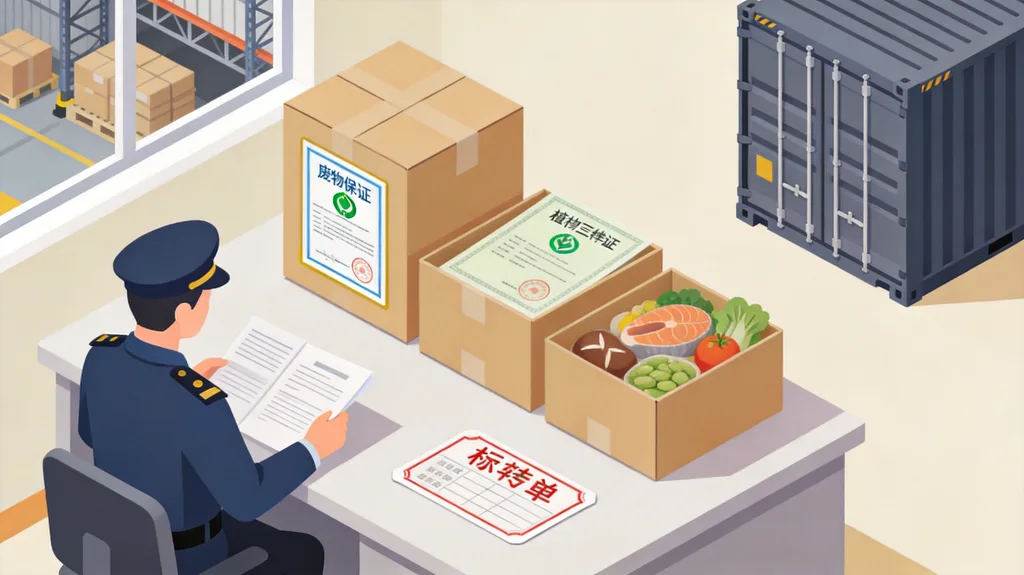
If you are shipping samples ahead, confirm the customs route before you pack the case.
This is the single most common pre-show mistake that derails exhibitors — samples that do not clear customs in time, or worse, get detained because paperwork is missing. For food samples into mainland China, the ATA Carnet route is available for some categories but not universally used for perishables. The practical route for most FHC exhibitors is the exhibition filing through the official freight forwarder appointed by the organiser, who handles temporary import under the show bond. Samples shipped through this route are not released into domestic commerce; they must be re-exported or destroyed after the show.
The three document gaps that consistently cause delays:
- Animal-derived products (dairy, cured meat, seafood, honey, egg products): require a veterinary/health certificate issued by the competent authority in your home country, countersigned for export to China. For GACC-registered facilities (Decree 248/249 categories), the facility must already hold a valid GACC registration number before samples can even be filed. Meat and dairy in particular face extended document review.
- Plant products (fresh fruit, vegetables, nuts, grains, unprocessed plant ingredients): require a phytosanitary certificate from your national plant protection authority, plus in many cases a China entry plant quarantine permit (进境动植物检疫许可证) applied for in advance by the importer or forwarder.
- Processed food and confectionery: generally simpler, but still require an ingredient list, production date, shelf life statement, and a Chinese label draft.
Chinese label drafts should be pre-reviewed against GB 7718 before the show, not after. Pre-printed full back labels are not required for samples — a stick-on simplified-Chinese label covering product name, country of origin, importer (use your forwarder or China representative's details), allergens, date format, and storage conditions is sufficient for exhibition purposes. But if a buyer asks to take a sample off-stand for internal tasting or retail review, an unlabelled or non-compliant sample becomes a problem.
If you are hand-carrying samples in your luggage, declare them. Undeclared food items found by customs at PVG or Hongqiao can be confiscated on the spot and,d in the worst case,se delay entry.
We have published a detailed guide to shipping food samples to China for exhibitions covering ATA Carnet vs temporary import vs parcel post, and which categories need which documents.
3. Three Booth Materials You Must Have — and Two You Do Not Need
You do not need a 40-page catalogue. You do not need branded tote bags.
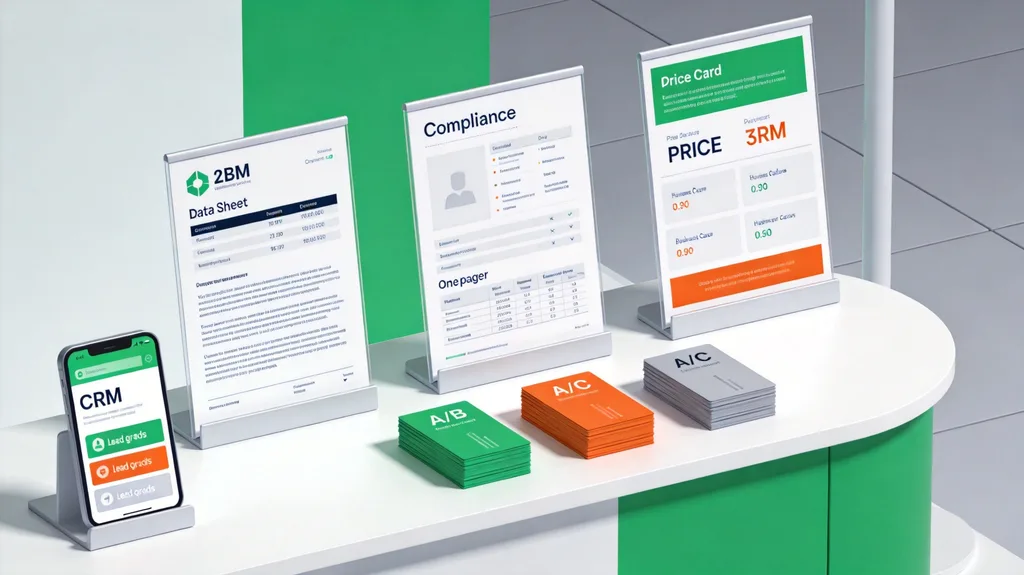
You do need these three documents, printed in colour on A4 or A5 and ready on the stand:
Chinese technical data sheet (not English-only).
Buyers — especially distributors outside the tier-1 cities — need ingredient, specification, allergen, shelf-life,ife and storage information they can read. An English-only data sheet gets handed to a procurement assistant who then has to translate it. That assistant cannot approve a listing. Your Chinese TDS should include: full ingredient list in Chinese GB 7718 order, allergen declaration (note that China mandates labelling of 14 allergen categories under GB 7718-2025, compared with 14 in the US and 14 in the EU, but with differences — sesame and sulphites are not universally labelled in all markets, for example), net weight, production/shelf life, storage conditions, country of origin, producer name and address, and a photo.
Compliance snapshot (one page).
A single page summarising your registration status, label readiness, and any market-specific requirements. This answers the unspoken question every serious buyer asks on the stand: can you actually ship to China? Include: GACC facility registration number and category, category if applicable; existing export markets; halal/kosher/organic certifications held; whether labels exist in simplified Chinese; whether the product formula requires any reformulation for GB 2760 additive approvals; and HS code at 6-digit level.
If GACC registration is not yet in place, say so honestly. Do not pretend you are "fully registered" when you are not — experienced China importers will verify your CIFER number on the GACC portal in 30 seconds on their phone.
Price range card (not a formal quote).
An indicative ex-work price range by SKU or tier, so buyers can qualify themselves without a long conversation. Formal quotes come later, after volume and Incoterms are agreed. A price range card saves you 10 minutes per tyre-kicker who cannot land your product at their price point.
What you can skip: fancy booth design, video walls, giveaways. FHC is a working show — the buyers who write orders are looking at the product and the paperwork, not the lighting.
For more on packaging and label compliance for the China market, see our guide to China food label regulations.
4. Lead Grading SOP — Decide Before the Show Opens
Not all leads are equal. If every business card goes into the same pile, they all look the same by the evening of Day 2, and by Day 3 you cannot remember who said what.
Define A / B / C grading before the doors open, brief every person working the stand, and physically grade cards in real time (a corner fold or coloured dot works fine if you are not using a lead-capture app).
表格
| Grade | Definition | Follow-up window |
|---|---|---|
| A | Authorised importer or distributor with category fit, existing portfolio, and stated budget or volume intent | Within 24 hours — same-day or next-morning personalised email while the meeting is fresh |
| B | Interested party (retail buyer, e-commerce platform, regional distributor, HORECA group) who needs internal approval, further tasting, or a second meeting | Within 72 hours — send product info and a proposed next step |
| C | Curious visitor, student, competitor, service provider, or visitor with no clear distribution path | Add to quarterly newsletter; do not send a personalised follow-up |
The grading decision takes 10 seconds per conversation if the criteria are pre-agreed. Here is what matters most for the A/B split: does this person have authority to write a purchase order, or are they collecting information for someone else?
A common mistake at FHC is treating every visitor who spends five minutes tasting the product as a lead. They are not. A genuine A-grade lead will ask specific questions — MOQ, shelf life in China climate, GACC status, existing distributors, whether you are working with a national or regional partner — and will offer you their card before you ask. We cover the full set of on-booth errors — from the ones that lose buyers in the first minute to the ones that kill follow-up — in our breakdown of the 9 mistakes brands make at Asian food trade shows.
5. Write the First Follow-Up Template Before You Leave Home
Write the first follow-up email before the show.
This sounds backwards. You have not had any meetings yet; what is there to follow up on? That is exactly the point — if you wait until after the show, you are tired, you have 60 business cards, and you will send generic "nice to meet you at FHC" emails that blend into the 200 other generic emails each buyer receives after the show.
A high-converting post-show follow-up references the specific conversation, not the booth. Mention the SKU they tasted, the question they asked about shelf life, the category gap they mentioned, or the volume they said they could do in Year 1. Those details prove you were listening, not scanning.
Prepare three templates before you travel:
- A-grade personalised template: open with a specific conversation reference, attach the Chinese TDS and compliance snapshot, propose a specific date for a follow-up call or tasting in their city within two weeks.
- B-grade template: thank them for the visit, provide the information they requested, state the next step (e.g., "we will send the full distributor proposal by Friday"), and keep the door open.
- C-grade template: a short "nice to meet you" note with a link to your website or a downloadable brochure, added to the newsletter list.
Have all three loaded into your CRM or draft folder before you fly. Then during the show, every time you grade a lead A or B, jot one sentence on the back of their card — "asked about frozen shelf life", "current distributor contract ends March", "needs halal certification" — and that sentence becomes the opening line of your follow-up.
Send A-grade follow-ups within 24 hours. Send them from your hotel room on Day 1 and Day 2 evening, not after you get home. The faster you write, the higher the response rate. Data from the last three FHC cycles we supported shows that follow-ups sent within 24 hours of a booth meeting get a reply rate roughly 3x higher than those sent one week later.
For the follow-up email structure and post-show cadence, see our trade show follow-up guide.
The Bottom Line
FHC Shanghai is not a branding exercise for most overseas SMEs. It is a sourcing meeting. If you are paying for a stand, flights, accommodation, samples,s and three days on the floor, you are paying for qualified conversations with buyers who can place orders. Everything else is secondary.
Two weeks before the show, your time is better spent booking those conversations and preparing the paperwork that answers the real buyer questions — "can you legally ship this to me, at what landed cost, and in what timeframe?" — than it is refining booth graphics.
If you are exhibiting at FHC 2026 (or ProWine Shanghai, which runs concurrently in the same venue complex) and would like an independent review of your pre-show readiness — GACC registration status, Chinese label draft, sample documentation, or target buyer list — send your current product sheet and stand number to kevin@specitconsulting.com before 4 November. We will provide a free 1-page pre-show gap analysis within 48 hours, flagging the items most likely to delay a first shipment after the show.
Specit Consulting advises overseas food and beverage exporters on regulatory compliance and market entry across 13 Asian markets — China, Japan, Korea, Singapore, Thailand, Vietnam, Indonesia, Malaysia, the Philippines, Hong Kong, Macau, Taiwan, and India. We handle regulatory mapping and registration (GACC, MHLW, MFDS, Thai FDA, BPOM, SFA), labelling compliance, halal certification, health claims review, detention resolution, and distributor matching. We do not sell freight or act as importer of record; we work alongside your chosen logistics partners and distributors.
One more thing: what you do after the show matters as much as what you do before it. Once the booth comes down, you have roughly 14 days to convert booth conversations into real distribution discussions — and most exporters waste that window with generic follow-up. If you want a concrete framework for what to send and when, see our guide to your post-show email sequence.
Disclaimer: The information in this article is based on regulations and on-the-ground experience as of October 2026, and is provided for general guidance only. It does not constitute legal advice. Regulatory requirements change frequently — always verify current rules with the relevant authority or a qualified advisor before shipping. Specit Consulting accepts no liability for decisions made based on this article.
Further Reading
- Shipping Food Samples to China: ATA Carnet, Temporary Import and Parcel Post
- China GB 2760 Additive Approval: The Pre-Shipment Check Every Brand Must Run
- FHC Shanghai 2026: Exhibitor Checklist for Imported Food Brands
- GACC Facility Registration: Why Rejections Happen and How to Recover
- Trade Show Follow-Up: The Email Sequence That Gets Replies
FAQ
When does FHC Shanghai 2026 take place and where?
FHC Shanghai 2026 runs 10–12 November 2026 at the Shanghai New International Expo Centre (SNIEC), Pudong. ProWine Shanghai runs concurrently in the same venue complex for wine and spirits exhibitors.
Do I need GACC registration to exhibit samples?
For exhibition samples imported under the official show bond through the appointed freight forwarder, a valid GACC facility registration (Decree 248/249) is required for high-risk categories — meat, dairy, seafood, bird's nest, honey, infant formula and other special categories. Processed food, confectionery, beverages, condiments, and plant-based products that do not fall under the mandatory GACC registration list can be exhibited as samples without a CIFER number, but you cannot sell or release them into domestic commerce.
Can I hand-carry food samples in my luggage for FHC?
You can, but declare them on the customs declaration form. Undeclared animal-derived products (dairy, cured meat, seafood) are routinely confiscated at Chinese airports and can delay your entry. For anything perishable, animal-derived, or high-value, ship through the official forwarder and use the exhibition bond.
Do my sample labels need to be fully compliant with GB 7718-2025?
For exhibition-only samples under temporary import, a simplified stick-on label in simplified Chinese covering product name, country of origin, importer/show representative details, allergens, production date, and storage conditions is acceptable. However, if a buyer takes a sample off-stand for internal review, testing, or retail assessment, that sample should carry a near-compliant label, or you risk the buyer forming a negative impression of your readiness. GB 7718-2025 becomes fully mandatory on 16 March 2027.
How many pre-show meetings should I target?
Pre-show outreach to 50–80 carefully selected buyers, sent 10+ days in advance with a specific meeting request, typically converts to 12–15 confirmed meetings over three show days (15–25% response rate). This is in addition to walk-up traffic and pre-existing distributor meetings.
What follow-up timeline works best after FHC?
A-grade leads (importers with clear authority and fit) should receive a personalised follow-up within 24 hours of the booth meeting. B-grade leads should be followed up within 72 hours. C-grade leads go to the newsletter list. If you have not had a reply to the A-grade follow-up within 10 days, send one brief reminder referencing your conversation — after that, move to quarterly nurture rather than chasing.
Do I need a Chinese-speaking staff member on the stand?
Yes. Even if you have English-speaking distributor partners joining, you need at least one Mandarin-speaking person on the stand for all three days — ideally someone who understands your product specification, pricing,g and compliance status. Tier-2 and tier-3 distributors, many retail buyers, and some HORECA group procurement teams do not negotiate comfortably in English. The organiser can provide translators, rs but quality is inconsistent; bringing your own or pre-booking a specialist interpreter is the safer option.
Need help navigating your market entry?
We've helped food exporters across 10+ countries enter 13 Asian markets. Get a free initial assessment based on public data — delivered in 3 working days.
Get Your Free AssessmentContinue Reading
▶FOB CIF Pricing for Asian Food Importers: FOB, CIF or DDP?
▶5 Questions That Make Asian Importers Commit at Trade Shows
▶Wine & Spirits Import in Japan, Korea, Taiwan & Singapore: A Small Winery Guide
Questions about entering the Asian market?
Chat with us on WhatsApp →