

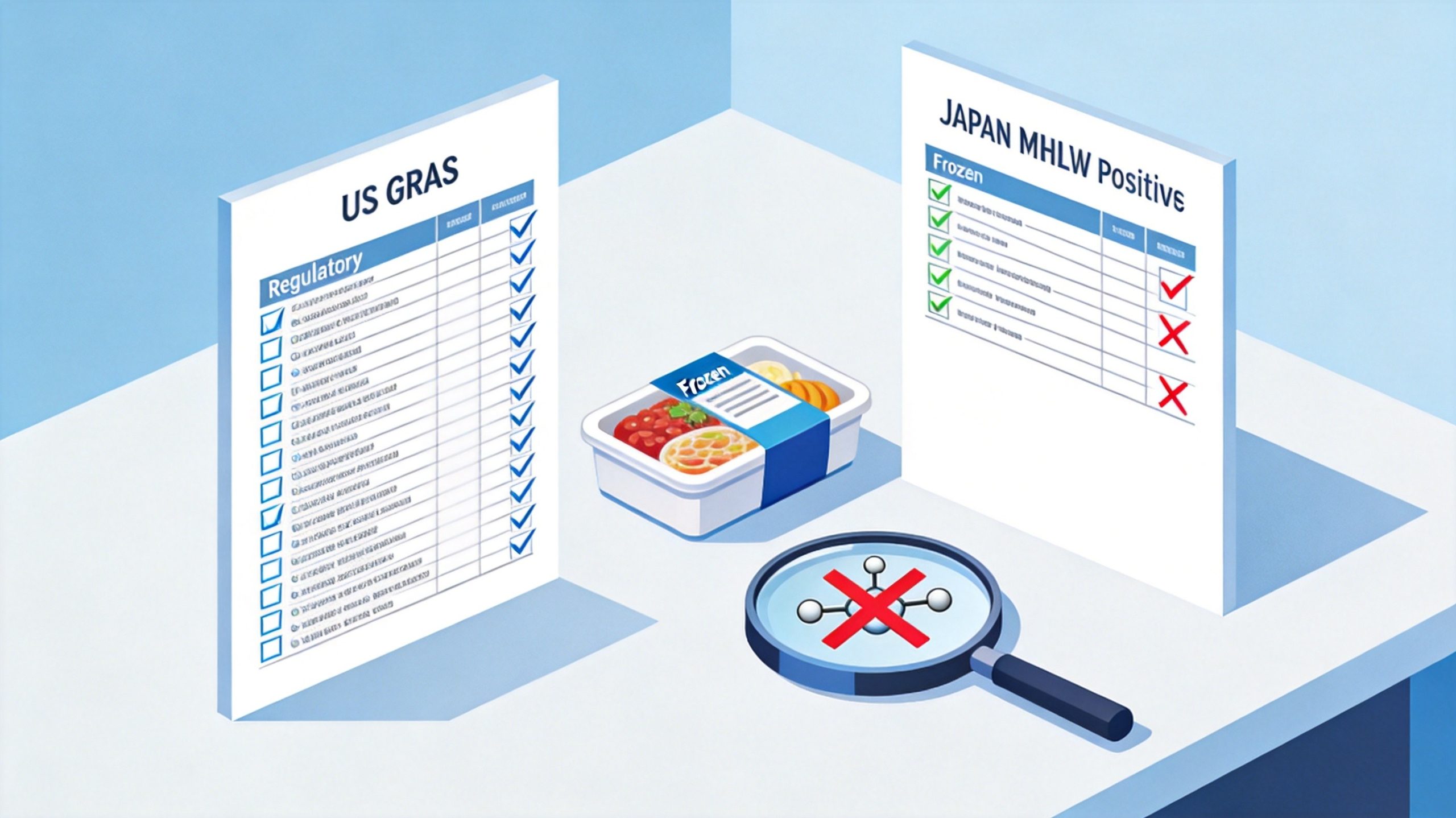
Japan frozen food additives compliance is the single most common reason international brands see their first container held at a Japanese port. Japan permits approximately 470 designated food additives. The United States operates a GRAS system with over 10,000 substances considered Generally Recognized As Safe. The European Union lists around 330 authorised additives under Regulation 1333/2008, but with a more permissive carry-over framework and hundreds of flavourings authorised separately.
The gap is not a technicality. It is a regulatory philosophy.
Japan's Food Sanitation Act (食品衛生法) operates a positive list system. Only additives that have been individually designated by the Ministry of Health, Labour and Welfare (MHLW, 厚生労働省) — or that qualify as "existing additives" (既存添加物) with a documented pre-1995 commercial usage history in Japan — are permitted. If an additive is not on either list, it cannot be used in food sold in Japan. It does not matter if the substance is GRAS in the US, approved in the EU, or used safely in your product for twenty years.
No designation, no market.
For frozen prepared meals — a category that includes frozen entrees, frozen pizza, frozen pasta, frozen vegetables with sauce, frozen breakfast items, frozen ready meals, and frozen side dishes — this is where brands consistently get stuck. Frozen meals tend to use multiple functional additives across several ingredients (preservatives in the sauce, emulsifiers in the dough, antioxidants in the oil, stabilisers in the filling, colours in the glaze), and every one of them must clear Japan's list, in the specific food category, at or below the permitted use level.
In our experience handling MHLW import notifications (輸入届出) for international food brands, frozen prepared meals are one of the top three categories most likely to receive an "initial hold" (保留) at the port of entry — alongside processed meat and dietary supplements. A single non-designated additive can halt an entire container.
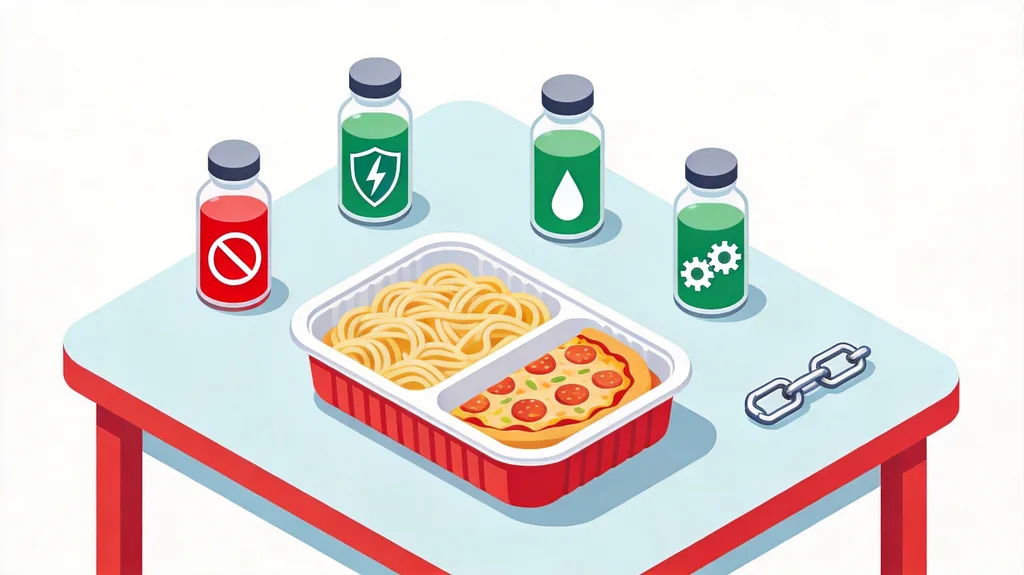
The Five Additive Categories That Trigger Holds
1. Preservatives
An antimicrobial preservative that is GRAS in the US or permitted under EU Regulation 1333/2008 is not automatically designated in Japan. Common culprits in frozen meals:
- Potassium sorbate and sorbic acid are designated in Japan, but their permitted maximum levels vary significantly by food category — and frozen prepared meals often fall into a category with a lower limit than what the US formulation uses.
- Sodium benzoate is designated but restricted to specific categories (soft drinks, syrups, certain sauces), and is not permitted in all frozen foods.
- Natamycin, used in some EU frozen bakery and cheese products, is not designated in Japan for food use.
- E235 Natamycin / Pimaricin is similarly not permitted.
The classic mistake: a frozen pizza formulation that uses natamycin on the cheese topping (common in EU production) will be rejected outright. There is no workaround short of reformulating the cheese component.
2. Antioxidants
Antioxidants are the single most common cause of frozen meal holds in our experience. Two names come up repeatedly:
- TBHQ (tert-Butylhydroquinone, E319): Widely used in the US and parts of Asia to stabilise vegetable oils in frozen fried items (frozen French fries, frozen fried chicken, frozen spring rolls, frozen tempura). In Japan, TBHQ is designated but only for a narrow set of food categories and at a maximum level of 0.20 g/kg in oils and fats — which does not automatically translate to permission for use in all frozen prepared meals containing oil. In practice, TBHQ in a frozen meal's oil component is often accepted only where the oil component is itself a permitted vehicle, but MHLW border inspection may still flag and request documentation.
- BHA (Butylated hydroxyanisole, E320): Designated in Japan, but with strict category restrictions. BHA is not permitted in all frozen food categories, and its use in fish and shellfish products faces additional restrictions. BHT (Butylated hydroxytoluene, E321) is similarly restricted.
If your frozen meal uses an oil that contains TBHQ or BHA added by the oil supplier (which is extremely common — you may not even know it is there unless you check the oil spec sheet), you may be importing a non-compliant product without realising it.
This is a recurring blind spot. Brands send us their finished-product ingredient list showing "vegetable oil" without knowing the oil supplier added TBHQ as a processing aid. Under Japanese additive rules, processing aids that carry over into the final product and perform a technical function are treated as additives in the final food, regardless of how they got there.
3. Thickeners and Stabilisers
Hydrocolloids and stabilisers are another frequent problem area.
- Xanthan gum, guar gum, locust bean gum, carrageenan, pectin, gelatin — these are all either designated or on the existing additives list, generally fine.
- Modified starches: Some modified (E14xx) starches used widely in EU frozen sauces and ready meals are not individually designated in Japan. A frozen sauce thickened with a specific E1422 (acetylated distarch adipate) or E1442 (hydroxypropyl distarch phosphate) may require verification — while several modified starches were added to the designated list in recent years, the full range used in EU food manufacturing is not covered.
- Microcrystalline cellulose (E460ii), methyl cellulose (E461), and carboxymethyl cellulose (E466) are designated with varying permissions.
- Gellan gum, konjac, and curdlan are designated and widely used in Japanese food manufacturing (so your competition uses them).
- Polyacrylic acid / cross-linked polyacrylates used in some ice cream and frozen dessert stabiliser systems are not designated in Japan.
The practical problem: thickener systems are often supplied as proprietary blends by ingredient companies. The brand on the finished product may know it as "Stabiliser Blend 47B" and have no visibility on every individual hydrocolloid in the blend. MHLW does not accept proprietary blends without full ingredient disclosure.
4. Emulsifiers
Emulsifiers cause issues because several common EU/US emulsifiers have partial or restricted designation in Japan:
- Polysorbates (Polysorbate 60, 65, 80 / E432–E436): These are designated in Japan, but with narrow food-category permissions. Polysorbate 80 (common in US frozen desserts and ice cream) is permitted in some categories but not universally across all frozen foods.
- Sucrose esters of fatty acids (E473, SE): Widely used in Japan and fully designated. This is usually the safe substitute if polysorbate permission is lacking.
- Lecithin (E322), mono- and diglycerides (E471), SSL/CSL (E481/E482): Designated and generally unproblematic.
- Diacetyl tartaric acid esters of mono- and diglycerides (DATEM, E472e): Common in EU frozen bread and bakery products. DATEM is not a designated additive in Japan. This is a frequent problem for frozen pizza, frozen pastry, and frozen bread products manufactured in Europe.
- Polyglycerol polyricinoleate (PGPR, E476) is used in chocolate and confectionery; designated in Japan with limits.
5. Carry-Over from Seasonings, Sauces and Compound Ingredients
This is the subtlest category and the one that surprises even experienced exporters.
Under Japan's Food Sanitation Act, an additive that is legally present in a compound ingredient (e.g., a sauce, seasoning blend, coating, or filling supplied by a third party) becomes the responsibility of the final food manufacturer if that additive continues to perform a technical function in the finished frozen meal. This is Japan's application of the carry-over principle, and it is narrower than the EU's Quantum Satis approach for flavourings and processing aids.
A practical example: your frozen pasta meal uses a commercially supplied tomato sauce that contains a preservative not designated for use in frozen pasta. The sauce manufacturer uses that preservative legally in their home market. When you incorporate the sauce into the finished frozen meal, the preservative is now present in a food category where it is not permitted — and MHLW will treat this as your responsibility, not the sauce supplier's.
The carry-over rule also applies to additives in cooking oils (see the TBHQ/BHA note above), seasoning blends, glazes, batters, breadcrumbs, and even printing inks on food contact packaging in some cases.
You must audit every ingredient, not just the formula you control.
The "Existing Additives" Grey Zone
Japan maintains a list of existing additives (既存添加物リスト), currently comprising around 360 natural substances with a documented history of commercial use in Japanese food before 1995. These are permitted without individual designation and include many natural extracts, enzymes, and traditional ingredients.
But the list is specific, not analogical. A substance that is chemically similar to an existing additive does not automatically qualify. For example:
- "Rosemary extract" is on the list as a natural antioxidant; specific deodorised or standardised rosemary extracts with defined carnosic acid content may or may not fall under the existing designation depending on composition.
- "Green tea extract" is not a free pass for all catechin-based antioxidant preparations — specific catechin isolates used as additives may require separate designation.
- Enzymes fall into a separate category; many are accepted as processing aids, but enzymes used in a way that affects final product composition (e.g., transglutaminase as a binding agent) require specific analysis.
The compliance check requires verifying each additive, CAS number by CAS number, against:
- The Designated Additives List (指定添加物リスト) — current as of the latest MHLW amendment
- The Existing Additives List (既存添加物リスト) — current as published by the Japan Food Additives Association
- The permitted food category and maximum use level for each designated additive (this is where most US/EU brands fail — the additive is designated, but not for their specific food category, or only at a level below their current formulation)
- The Flavouring Substances List (香料リスト) for flavour compounds — these follow a separate, more permissive framework, but the line between flavouring and additive can be contested.
MHLW publishes these lists (in Japanese only) and updates them several times per year. The Japan External Trade Organization (JETRO) maintains an unofficial but generally reliable English reference handbook for exporters.
The MHLW Import Notification Process in Practice
When your frozen meal arrives at a Japanese port (Nagoya, Yokohama, Kobe, Osaka are the main food entry points), your Japanese importer of record files an import notification (輸入届出) with the MHLW Quarantine Station (検疫所) under Article 27 of the Food Sanitation Act.
The notification includes, among other documents:
- Full ingredient list (in Japanese, with additives listed by their Japanese designated names or valid synonyms)
- Manufacturing process description
- Additive specification sheets for every additive used
- Certificate of analysis from the manufacturer
- Raw material origin documentation
- Labelling artwork in Japanese
What actually happens at the port:
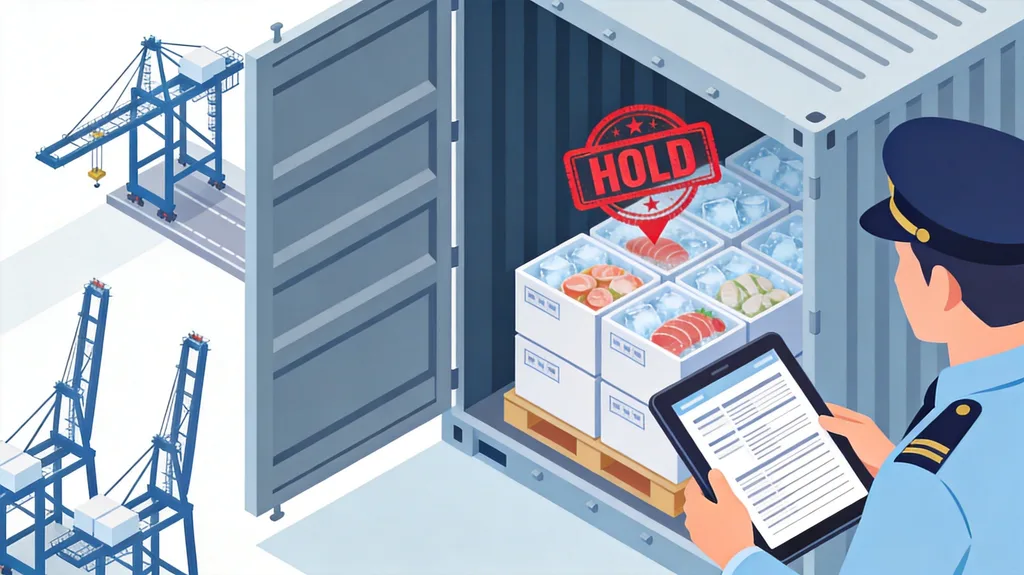
In most cases, first-time importers of a new product receive a "document examination" (書類審査) that may trigger an "initial hold" for detailed review — especially if the product category is on MHLW's monitoring list (モニタリング検査) or if any additive raises a flag. Roughly 5–8% of frozen food import notifications are flagged for physical inspection or sampling; for new-to-Japan brands, that rate is closer to 20%.
If a non-compliant additive is found during document review or inspection, the shipment is subject to:
- Voluntary return or destruction (積戻しまたは廃棄): The most common outcome for non-compliant products; the importer chooses to ship the container back or destroy it under customs supervision.
- Import prohibition (輸入禁止): For serious or repeat violations, MHLW can issue a formal prohibition order and place the foreign manufacturer on an elevated inspection list, meaning every future shipment from that facility is subject to mandatory 100% inspection (命令検査) at the importer's cost — effectively closing the market for that manufacturer until the issue is resolved and lifted.
MHLW does not "approve" individual additives for you at the border. If the additive is not designated, there is no on-the-spot waiver or temporary permission. The product does not enter Japan.
For brands new to Japan frozen food additives compliance, the carry-over rule and the distinction between designated, existing, and flavouring substances are the two areas that most consistently cause delays.
For an overview of the full process, see our guide to Japan MHLW food import requirements and detention reasons.
Three Reformulation Strategies
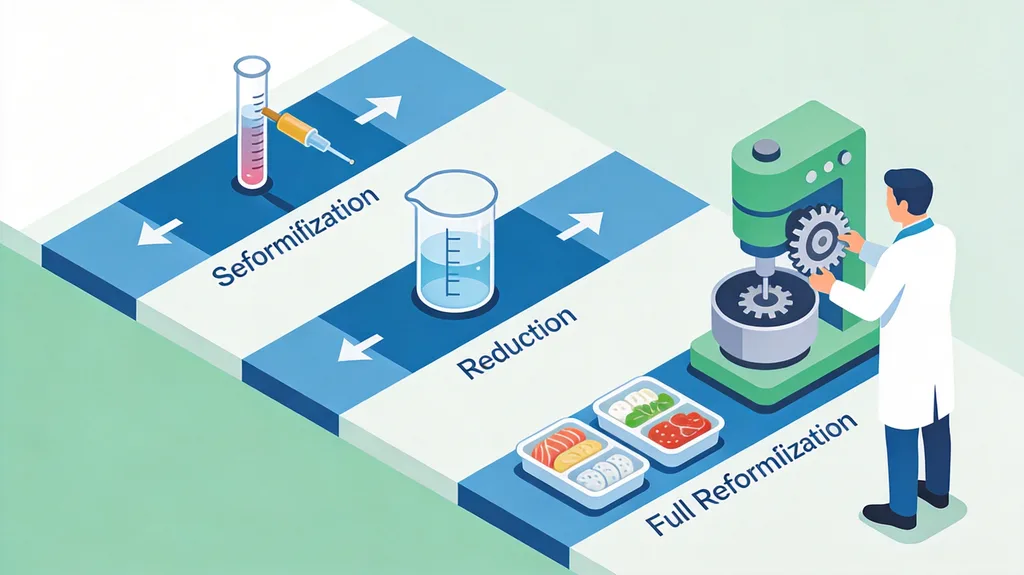
Once you have completed an additive-by-additive gap analysis and identified the non-compliant substances, three reformulation paths are available. They are listed in order of preference from fastest-to-market to most expensive.
Strategy 1: Substitution with a Designated Alternative
Identify a designated additive in the same functional class that achieves the same technical effect in your product. This is the cleanest path. Examples:
- Replace TBHQ in oil with a designated natural antioxidant (tocopherolconcentrate/vitaminn E, which is designated; or rosemary extract, which is on the existing additives list). Note that natural antioxidants may require higher dosages and can affect flavour profile.
- Replace DATEM (E472e) in frozen bakery with CSL/SSL (E481/E482, calcium or sodium stearoyl lactylate), both designated in Japan, or with mono- and diglycerides (E471) combined with sucrose esters (E473).
- Replace non-designated modified starch E1422 with a designated modified starch (check the latest designated list; hydroxypropyl distarch phosphate E1442 and several others are now designated with category restrictions) or switch to a native starch + hydrocolloid system that achieves similar freeze-thaw stability.
- Replace natamycin on cheese with a designated surface treatment, or switch to a non-natamycin-treated cheese supply for the Japan market.
Every substitution requires production-scale testing to confirm the product performs the same — freeze-thaw stability, shelf life, texture, and bake/microwave performance must all be revalidated. This typically takes 4–8 weeks per product.
Strategy 2: Use-Level Reduction to Within Permitted Limits
Some additives are designated for frozen foods but at a lower maximum level than your current formulation uses. In some cases, reducing the dosage to within the Japanese limit is a viable option — but only if the product's technical performance (preservation, texture, emulsion stability, shelf life) is maintained at the reduced level.
This is common with sorbic acid and potassium sorbate in sauces, and with certain emulsifiers in frozen desserts. Reducing from 0.3% to 0.1% may be technically feasible and does not require a wholesale reformulation. However, for frozen meals with multi-month supply chains and frozen distribution in Japan (which can involve temperature fluctuations during domestic logistics), reducing preservative or antioxidant levels can shorten practical shelf life.
Challenge testing (microbiological and oxidative stability testing at the reduced dosage, under Japan-relevant temperature conditions) is essential before committing.
Strategy 3: Full Reformulation or Process Adjustment
In some cases — typically when a non-designated additive is core to the product's identity or functionality — the only viable path is to remove the additive entirely and adjust the formulation or process to compensate. Examples:
- If a frozen meal relies on a specific enzyme or cross-linking agent that has no Japanese-designated equivalent, you may need to reformulate the product structure to not require that additive.
- If your freezing process depends on a particular stabiliser system that uses non-designated ingredients, adjusting the freezing curve (faster blast freezing, lower storage temperature, different packaging oxygen barrier) may reduce the need for that stabiliser.
- For some frozen bakery and dough products, switching from a chemical emulsifier system to a process-based solution (longer proofing, different dough conditioners using designated enzymes) can achieve similar results.
This is the slowest and most expensive path, typically 3–6 months per product including production trials, stability testing, and MHLW-compliant documentation preparation. It is, however, sometimes unavoidable.
How Long Does This Actually Take?
Brands regularly ask us, "How fast can we get our frozen meals into Japan?" The answer depends almost entirely on how many additive issues you have:
- 1–2 additives that can be substituted with designated alternatives, with no major flavour/texture impact: 8–12 weeks for reformulation, testing, labelling, and documentation.
- Multiple additive issues across several SKUs, requiring use-level adjustment and challenge testing: 4–6 months.
- Core formulation issues requiring full reformulation or process change: 6–12 months.
These timelines assume a responsive manufacturer who can produce reformulated samples quickly. If your co-manufacturer is slow or uncooperative, add 50%.
The single biggest mistake brands make is assuming that because their product is sold legally in the US, EU, Canada, or Australia, it will clear MHLW review. It will not — not without a line-by-line additive audit. We have seen brands lose an entire summer selling season because they discovered a TBHQ issue two weeks before the container was due to ship.
For context on how this compares with the Korean and Chinese frameworks, see our guide to Korea MFDS registration and China GB 2760 additive approvals.
The Bottom Line
Japan's additive framework is not hostile to imported frozen food. It is simply a different system with different rules, and those rules are applied strictly and consistently at the border.
The three steps every frozen meal brand should take before attempting entry into Japan:
- Audit every ingredient, down to compound ingredients and processing aids in supplier components. Obtain full additive documentation from every ingredient supplier, including oil, sauce, seasoning, coating, and cheese suppliers. If a supplier will not disclose their formulation, that is a commercial problem to solve before you ship.
- Run every additive against the Designated and Existing Additives Lists, CAS number by CAS number, checking not just permission but category permission and maximum use level. This is not a job for an intern — it requires familiarity with Japanese additive nomenclature, CAS number cross-referencing, and the specific category rules for frozen prepared foods.
- Plan reformulation timelines realistically. If you have additive issues, budget a minimum of 3 months for the simplest substitutions and 6+ months for anything more complex. Build that into your launch timeline and buyer commitments.
If you are a US or EU frozen prepared meal brand targeting Japan and want a line-by-line additive gap analysis before you commit to a launch timeline, send your current full ingredient specification (including compound ingredient breakdowns and additive spec sheets) to kevin@specitconsulting.com. We will provide a free 1-page additive gap summary within 5 business days, flagging which additives are clear, which require substitution, and which need further category verification — before you incur reformulation costs or book a container.
Specit Consulting advises overseas food and beverage exporters on regulatory compliance and market entry across 13 Asian markets — China, Japan, Korea, Singapore, Thailand, Vietnam, Indonesia, Malaysia, the Philippines, Hong Kong, Macau, Taiwan, and India. We handle regulatory mapping and registration (GACC, MHLW, MFDS, Thai FDA, BPOM, SFA), labelling compliance, additive approval, halal certification, health claims review, detention resolution, and distributor matching. We do not sell freight or act as importer of record; we work alongside your chosen logistics partners and importers.
Disclaimer: The information in this article is based on regulations and on-the-ground experience as of October 2026, and is provided for general guidance only. It does not constitute legal advice. Japan's designated and existing additive lists are updated regularly; maximum use levels are specific to individual food categories and change with MHLW amendments. Always verify current rules with the relevant authority or a qualified advisor before shipping. Specit Consulting accepts no liability for decisions made based on this article.
Further Reading
- Japan MHLW Food Import Rejected: 7 Reasons and What to Do
- China GB 2760 Additive Check: The Pre-Shipment Review Every Brand Must Run
- Korea MFDS Registration for Overseas Food Manufacturers
- Exporting Olive Oil to Asia: Compliance for Japan, Korea and China
- Shipping Food Samples to Asia: ATA Carnet and Temporary Import
FAQ
How many food additives are permitted in Japan versus the US and EU?
Japan designates approximately 470 food additives (指定添加物) and lists around 360 existing additives (既存添加物) for a total of roughly 830 permitted additive substances. The US GRAS system recognises over 10,000 substances, and the EU authorises approximately 330 additives under Regulation 1333/2008 plus a separate list of flavourings. Japan's list is therefore significantly narrower than either, making it the strictest of the three major developed markets for additive compliance.
Is TBHQ permitted in Japanese frozen food?
TBHQ (tert-butylhydroquinone) is designated in Japan for use in fats and oils at a maximum level of 0.20 g/kg, but its permission in frozen prepared meals depends on how it is used. If TBHQ is present in cooking oil used to manufacture a frozen meal and carries over into the final product, MHLW may treat it as an additive in the final food and assess it against the frozen food category rules. We have seen TBHQ trigger holds where the frozen product category does not have explicit TBHQ permission, even though the oil itself is compliant. Full documentation and category verification are essential.
What is the "existing additives" list in Japan?
The existing additives list (既存添加物リスト) is a catalogue of approximately 360 natural substances (plant extracts, enzymes, minerals, and traditional ingredients) that were already in commercial use in Japanese food prior to the 1995 Food Sanitation Act amendment. These are grandfathered and do not require individual designation, but the list is closed and specific — a new natural extract or refined version does not automatically qualify.
What happens if MHLW finds an unauthorised additive in my shipment?
In most cases, the importer is given the choice of voluntary return (shipping the container back at their cost) or destruction under customs supervision. In more serious or repeated cases, MHLW can issue a formal import prohibition and place the foreign manufacturer on the mandatory inspection list (命令検査), meaning 100% of future shipments from that facility are inspected at the importer's cost. This effectively closes the Japanese market until the issue is resolved and the manufacturer is removed from the list.
Do processing aids in ingredients count under Japan's additive rules?
Processing aids that carry over into the final food and continue to perform a technical function (preservation, emulsification, stabilisation, antioxidation, etc.) are treated as additives in the final product under Japanese rules. This means additives in cooking oils, sauces, seasonings, cheese, coatings, and other compound ingredients must all be verified — even if you did not add them directly. This is one of the most common oversights for EU and US brands.
Can I apply to have a new additive designated in Japan?
Yes, but the process is lengthy. An individual designation request (指定添加物の指定要請) requires a full toxicological dossier including chronic toxicity, carcinogenicity, reproductive toxicity, and ADI (Acceptable Daily Intake) data, typically aligned with JECFA or similar international assessments. The MHLW Food Safety Commission (食品安全委員会) conducts an independent risk assessment. The full process typically takes 2–5 years and is rarely undertaken by individual SMEs for a single market. For most small-to-medium brands, substitution with an already-designated additive is the commercially realistic path.
Is there an English version of Japan's designated additive list?
MHLW publishes the official lists only in Japanese. The Japan External Trade Organization (JETRO) produces an unofficial English reference handbook titled "Japanese Regulations on Food Additives," which is updated periodically and provides a useful starting point, but it is not the legal source. The official source is MHLW's designated additives table and the Japan Food Additives Association's existing additives list, both in Japanese. We always verify against the original Japanese lists for compliance work.
Further Reading: For the six most common reasons food labels get rejected at Asian borders, see Asia Food Label Rejection: 6 Border Refusal Reasons.
Need help navigating your market entry?
We've helped food exporters across 10+ countries enter 13 Asian markets. Get a free initial assessment based on public data — delivered in 3 working days.
Get Your Free AssessmentContinue Reading
▶Japan Food Distribution: HORECA vs Retail vs Online Channel Strategy
▶Korea Food Import MFDS Checklist for Small Producers
▶Wine & Spirits Import in Japan, Korea, Taiwan & Singapore: A Small Winery Guide
Questions about entering the Asian market?
Chat with us on WhatsApp →