

Wine import in Asia is not a single-market decision. For small wineries, Asia is four mature alcohol markets — Japan, South Korea, Taiwan, and Singapore — each with different tax structures, different regulatory gatekeepers, different dominant channels, and very different volume expectations from distributors. Treating "wine import Asia" as one opportunity is the fastest way to burn through your travel budget and leave with a stack of business cards that go nowhere.
The four markets that matter for a small-to-medium winery seriously entering Asia are Japan, South Korea, Taiwan, and Singapore. Hong Kong is a separate case (zero duty but a re-export hub, not a primary consumption market for small producers); mainland China is a large but structurally different channel that warrants its own strategy; Southeast Asian markets (Thailand, Vietnam, Philippines) are growing fast but still thin on premium wine distribution.
This article focuses on the four markets that deliver returns for a small winery willing to invest the time to enter correctly—and spells out what you need to know about tax, registration, labelling, and the volume commitment that makes an importer take you seriously.
For broader packaged food context, see our guides to Japan food import requirements, Korea MFDS registration, and why Asian food labels get rejected at the border. Wine and spirits have their own specific rules on top of the general food framework.
Wine Import Asia: Market-by-Market Breakdown
Japan: The Friendliest Premium Market for Small Wineries
Japan is the most approachable of the four markets for a small winery—and often the first Asian market for European, New World, and Southern Hemisphere premium producers. The reasons are structural: the regulatory pathway is clear, importers understand the premium wine segment, and Japanese consumers spend disproportionately on imported wine for gifting, restaurants, and personal consumption.
Liquor tax (酒税):
Wine falls under "fruit wine" (果実酒) under the Liquor Tax Act (酒税法). As of the 2026 tax schedule published by the National Tax Agency, the specific liquor tax on still wine is JPY 80,000 per kilolitre (JPY 80 per litre) of alcohol content below 13%, with a step-up for higher alcohol categories; effective rates per 750 ml bottle are modest compared with other Asian markets — typically JPY 60–100 (USD 0.40–0.70) per bottle in liquor tax. Sparkling wine, fortified wine, liqueurs and spirits are taxed at different category rates (for reference, whisky is taxed at JPY 370,000/kL). Current rates are also summarised in the JETRO wine import guide.
A 10% consumption tax (消費税) applies on top of CIF + duty + liquor tax at the point of import.
Registration:
There is no overseas winery factory registration requirement for wine imported into Japan, unlike Korea or China. The Japanese importer of record (酒類販売業免許 holder) files both the liquor tax declaration and the MHLW food import notification (食品等輸入届出) per shipment. This means you, as the foreign producer, do not need to register with a Japanese regulator; you provide the standard export documentation (invoice, packing list, certificate of origin, analysis certificate/成分分析書, label artwork, and — for EU producers — VI-1 certificate).
Labelling:
Japanese-language labelling is required for all wine sold retail. The label must include: product name (果実酒 / ワイン), country of origin (原産国), importer name and address (輸入業者), alcohol content (アルコール分), additives (including sulphites, acid regulators, and any added colours or sweeteners), net volume (内容量), and date information (for wines with less than 3-year shelf life — most table wines are exempt, but check category). Organic claims require JAS (Japanese Agricultural Standard) organic certification under the JAS Act; EU organic certification alone is not sufficient to make an organic label claim in the Japanese market.
Sulphite declaration (亜硫酸塩含有) is mandatory above 10 mg/L and is a common omission on European labels shipped to Japan.
Why Japan works for small wineries:
Japan has a fragmented but sophisticated import sector, with dozens of small-to-mid-sized premium wine importers specialising by country, region or style. A family-owned winery from Bordeaux, Burgundy, Tuscany, Barossa, Marlborough or Oregon can find an importer who specialises in exactly that profile — and who has the HORECA (hotel/restaurant/cafe) and retail relationships to place 200–600 cases per year without needing to spend on national marketing. The wine press and sommelier culture is the most developed in Asia.
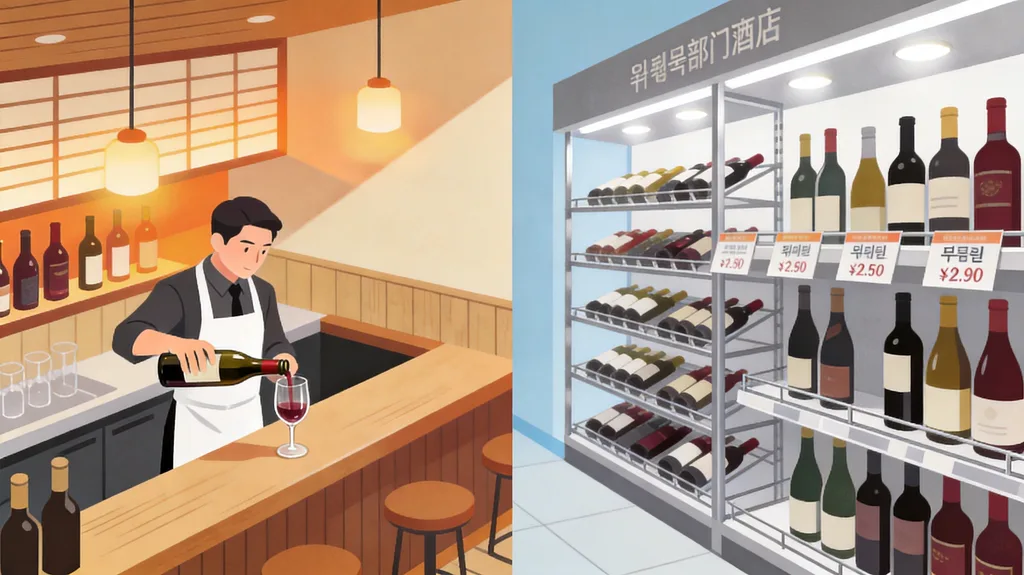
Korea: Higher Tax, Fewer Importers, Strong Wine Culture
South Korea is a growing wine market — but a harder one for a small winery to enter than Japan. This is the market where wine import Asia strategy most often stumbles on price points rather than regulation. The bottleneck is not consumer demand; it is the structure of the distribution sector and a tax regime that adds friction at every step.
Liquor tax (주세):
Korea applies a combined ad valorem + specific tax regime to wine under the Liquor Tax Act (주세법). The current structure levies a 30% ad valorem tax on the CIF (or customs value, whichever is higher) plus an education tax (교육세) of 30% of the liquor tax, plus VAT of 10% on the landed duty-paid value. For a bottle with CIF of EUR 4–6, the effective combined tax burden is typically 60–80% of CIF. For higher-end bottles (EUR 8–12 EXW), the ad valorem structure magnifies the tax take significantly, making retail price elasticity sharper than in Japan.
Registration:
Korea requires MFDS (Ministry of Food and Drug Safety, 식품의약품안전처) overseas food manufacturer registration for foreign food and beverage facilities, including wineries. This is a one-time registration per facility, free of charge, filed by the Korean importer through the MFDS portal. The registration requires basic facility information, product information,n and a manufacturing process description. HACCP certification is not universally required for wine, but the larger Korean importers (who control the premium department store and duty-free channels) will request HACCP, ISO 220,00 or an equivalent food safety certification as a commercial condition of taking on a new brand.
A liquor import licence (주류수입면허) issued by the regional tax office (국세청) is held by the Korean importer; you do not need one as the foreign producer.
Labelling:
Korean-language back labels are mandatory. The label must include: product name (product type "와인"), country of origin (원산지), importer name/address/phone (수입원), alcohol content (알코올분), net volume (내용량), allergen declaration (sulfites/아황산염 — mandatory for wine; other allergens per the 27-item Korean list if applicable), date information (제조연월/import date; most imported wine carries bottling date/vintage), storage instructions, and warning statements required by Korean law (pregnancy warning, no sale to minors).
Health warning labels (the Korean government-mandated pregnancy/driving warning box) must appear with the exact prescribed wording and minimum size. This is a common failure point for first-time exporters.
Why Korea is harder:
The Korean premium wine channel is controlled by a small number of large importers — companies such as Kumho, Lotte, Shinsegae, and a tier of mid-sized specialist importers who aggregate European and New World portfolios. Breaking in requires a clear point of difference: a strong region/appellation story, a notable critic score, a unique style (natural, orange, biodynamic, low-alcohol), or a competitive price position in the mid-premium segment (KRW 25,000–45,000 retail, roughly USD 18–33).
Smaller specialist importers exist and are more accessible to small wineries, but they move smaller volumes — typically 100–300 cases per brand per year. A small winery realistic about first-year volume should target these specialists rather than chasing the top-tier importers on the first visit.
Taiwan: Mature Market, Strong Private Cellar Channel, Due Diligence Required
Taiwan is one of the most mature and wine-literate markets in Asia, with a long history of French and New World wine consumption, a strong independent sommelier scene, and a well-developed premium retail and HORECA channel centered on Taipei and Taichung. For small wineries prioritising wine import opportunities in Asia, Taiwan is often the second or third market after Japan, but it is also where importer due diligence matters most.
Liquor tax (菸酒稅):
Under the Tobacco and Alcohol Administration Act (菸酒管理法), wine (fruit wine) is subject to a specific liquor tax of TWD 185 per litre for still wine (as of the 2026 schedule), with separate rates for sparkling wine and fortified categories. A 5% business tax (營業稅) applies on top of the duty-paid value. Import duty on wine from most favoured nation origins is 10% (with applicable free trade agreement reductions for certain origins — check your country's FTA status with Taiwan, which is not a WTO member in the conventional sense and applies reciprocal tariff arrangements).
For a 750 ml bottle of still wine, liquor tax alone is approximately TWD 139 (USD 4.20), which makes Taiwan's effective tax burden moderate — higher than Japan, lower than Korea and Singapore.
Registration and licensing:
The Taiwanese importer must hold a tobacco and alcohol import business permit (菸酒進口業許可執照) issued by the National Treasury Administration (財政部國庫署) and a food importer registration (食品輸入業者登録) with TFDA (Taiwan Food and Drug Administration, 衛生福利部食品藥物管理署). As a foreign winery, you do not register directly with TFDA; the importer is responsible for import declarations, label review, and any required inspection.
Foreign alcoholic beverage manufacturers may be requested to provide a Certificate of Free Sale (CFS) / Sanitary Certificate issued by the competent authority in the home country, a Certificate of Origin, and an analysis report.
Labelling:
Traditional Chinese-language labels are mandatory on all retail bottles. Required elements include: product name (wine type), country of origin (原產地), alcohol content (酒精濃度), net volume (容量), importer name/address/phone (進口商), date information (vintage year or import date), sulphite/allergen declaration, and the statutory health warning (未成年請勿飲酒 / "Do not drink if underage" — mandatory wording in prescribed size).
Channel risk — the private channel:
Taiwan has a well-documented parallel/private import channel (俗稱"私酒" or "水貨" in the local market) where bottles are brought in by non-licensed individuals or groups, sold through informal channels, group buys, social media, and some restaurants without the full tax and labelling compliance of the formal channel. These channels are illegal but persistent, especially for rare or allocation wines. As a foreign producer, it is critical to understand which channel your potential importer operates in. If a potential partner offers terms that seem too good to be true (no licence check, no TFDA registration discussion, cash terms only, no label compliance), they may be operating in the informal channel. If their business is later raided or audited, your brand can be associated with illegal imports even if you acted in good faith.
Due diligence questions to ask any prospective Taiwanese importer before signing:
- Request a copy of their 菸酒進口業許可執照 (tobacco and alcohol import permit).
- Ask which retail chains or restaurant groups they currently work with and visit them to confirm distribution.
- Ask for references from two other foreign wineries they represent.
- Confirm who is responsible for Chinese-language label compliance and TFDA declaration (it must be the importer or a licensed label compliance agent).
Singapore: Regional Hub, English Labels, Heavy Excise Duty
Singapore is both a national wine market and the regional distribution hub for Southeast Asia, and it plays a unique role in wine import Asia strategy as the gateway to ASEAN. It is the easiest of the four markets in which to operate administratively (English-language labels, low-friction registration, efficient customs), but it carries the heaviest tax burden of any major wine market in the world — which fundamentally changes the positioning you need to take.
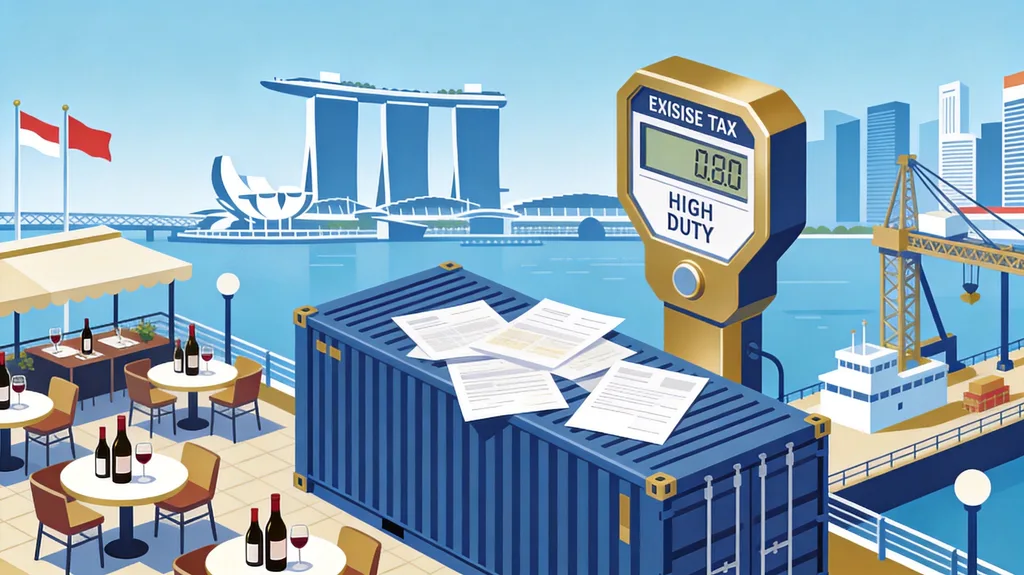
Liquor tax (excise duty):
As published by Singapore Customs, an excise duty of SGD 88 per litre of pure alcohol applies to wine and most other categories of beverage alcohol, plus a 9% GST (Goods and Services Tax, increased from 8% in 2024) on CIF + duty + excise. For a standard 750 ml bottle of still wine at 13% ABV, the pure alcohol content is 750 ml × 13% = 97.5 ml = 0.0975 litres. Excise duty alone is therefore approximately SGD 8.58 per bottle (0.0975 × 88), before duty, before GST, before any margin.
For context:
- A bottle with a CIF of SGD 10 (roughly EUR 7 landed) lands with excise of SGD 8.58 + duty + GST, at a duty-paid cost of roughly SGD 20–22 before importer margin.
- After the importer adds margin, distributor margin, and retail/restaurant markup, retail shelf price is typically SGD 35–50 per bottle, and restaurant prices are SGD 60–120+.
- This means a bottle that retails for EUR 8–10 in France becomes a SGD 40+ (USD 30) proposition in Singapore retail — and a SGD 80+ (USD 60) proposition on a restaurant wine list.
There is an additional high-end wine tier for wines retailed above SGD 80, where the excise duty becomes a smaller percentage of shelf price — but for most small winery EXW pricing (EUR 4.5–10), Singapore automatically places your wine in the "premium" or "super-premium" bracket regardless of how it is positioned in Europe.
Registration:
An importer must hold a liquor import licence from Singapore Customs and a food importer registration with SFA (Singapore Food Agency). SFA's food import regime is one of the most straightforward in Asia — there is no pre-market approval or overseas factory registration for most wine; import is per-shipment with supporting documents (CO, analysis, VI-1 for EU wine, labelling). SFA operates a "check-and-clear" system with relatively low inspection rates for established importers.
Labelling:
English-language labels are acceptable — no need for Chinese/Malay/Tamil translation on standard wine bottles for the Singapore market. This is the only one of the four markets covered here where a standard English-language European or New World back label is largely sufficient without re-labelling. (Importer contact details are not required to appear physically on the label in the same mandatory way as Japan/Korea/Taiwan, though they must be available to SFA on the import documentation.)
Why Singapore works (and does not):
Singapore is the regional hub — many of the larger importers cover Singapore plus Malaysia, Indonesia (duty-paid and bonded channels), Thailand, Vietnam and sometimes Hong Kong from a single warehouse. Securing one good importer in Singapore can give you regional Southeast Asian coverage without negotiating market-by-market. But you must accept that:
- Your wine is automatically positioned at the premium end, regardless of home-market positioning.
- Volume will be lower than the label price suggests. Singapore's on-trade (hotels, restaurants, bars) is the largest channel for imported wine, not retail — the dining culture is strong, and wine lists are extensive, but a single restaurant may move only 1–2 cases of a given SKU per month.
- Retailers such as Cold Storage, FairPrice Finest, and specialist wine retailers are important, but they operate on thinner margins and expect marketing support.
The Four Markets Compared
Before choosing where to start, this comparison summarises the key numbers that drive wine import Asia decisions for small producers:
| Japan | Korea | Taiwan | Singapore | |
|---|---|---|---|---|
| Liquor tax (still wine, per 750ml bottle) | JPY 60–100 (~USD 0.40–0.70) | ~60–80% of CIF (ad valorem) | TWD 139 (~USD 4.20) | SGD 8.58 excise + duty + 9% GST |
| Overseas factory registration | None | MFDS registration (importer-filed) | TFDA importer registration; foreign producer CFS required | None (SFA importer licence) |
| Label language | Japanese (JAS organic for organic claims) | Korean (health warning mandatory) | Traditional Chinese | English sufficient |
| Importer structure | Fragmented — many small premium specialists | Concentrated — a few large + tier of specialists | Mature; formal + informal channels — due diligence essential | Hub for SE Asia; mix of large distributors + small specialists |
| Dominant channel | HORECA + premium retail + department store | Department store + HORECA + duty-free | Independent HORECA + premium retail | On-trade (restaurants, hotels) + regional distribution |
| Positioning expectation | Premium / artisanal / appellation-driven | Mid-premium to premium; strong story required | Premium; Burgundy/Bordeaux/Champagne entrenched | Premium to super-premium (tax pushes all imports up) |
| Small winery friendliness | ★★★★★ | ★★★ | ★★★★ | ★★★★ (easy admin, hard price point) |
Small Winery Entry Strategy: One Market, One Importer, 2–3 SKUs
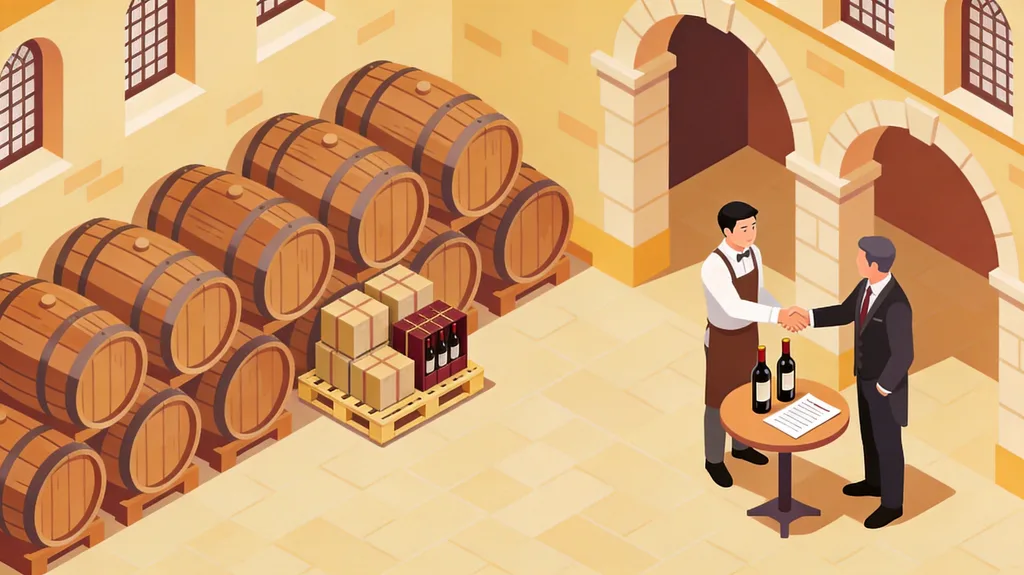
The single biggest mistake small wineries make with wine import in Asia is trying to enter four markets at once with the same trip, the same pricing, and the same sample case. It does not work. Each market requires a different pricing model, different label artwork, different channel expectations, and a different conversation with the importer.
1. Start with one market.
Pick the market where your product story fits best:
- Old World appellation wine with strong critic scores: Japan (most forgiving for small domaines with strong terroir stories) or Singapore (regional hub, English-speaking).
- Value-driven New World / mid-premium European with a clear price position: Korea (where the growing middle class is actively exploring imported wine) or Taiwan (where price-value in the TWD 600–1,200 retail range is underserved by the big importers).
- Natural/biodynamicc / low-intervention / orange: Japan (strong natural wine scene) or Singapore (regional bar and restaurant culture).
- Sparkling wine: Japan (stable market) and Korea (growing fast), with Singapore for premium Champagne.
Do not try to cover Japan/Korea/Taiwan/Singapore from the same week-long trip. One market, well done, is better than four markets with half-conversations. This is the single most common mistake we see in wine import Asia engagements — producers spread themselves too thin and sign no one.
2. Find one committed importer before you send a container.
An importer who takes your whole portfolio across four markets on your first meeting is rarely a good sign. In practice, the right partner is an importer who specialises in your country/region/style, has existing restaurant and retail placements you can verify, commits to a written 12-month distribution plan with minimum volume, and is willing to invest in in-market activation (tastings, sommelier outreach, wine fair presence).
Wine importer agreements should always cover: exclusivity scope (market exclusivity vs channel exclusivity), minimum annual volume, marketing co-funding, tasting and winemaker visit commitments, label and compliance responsibility, payment terms (L/C at sight or pro-forma against shipping documents for new relationships — avoid open account), and termination clauses.
3. Start with 2–3 SKUs, not your whole range.
A small winery with 8–15 SKUs does not need to launch all of them in Asia on day one. Pick 2–3 lead SKUs that tell a coherent story: typically an entry-level signature wine, a mid-tier core range, and one flagship/limited cuvee. This lets the importer build a price ladder, train their sales team, and focus on getting placements for wines that have the best chance of re-order — rather than carrying inventory on 10+ SKUs that sell 5 cases each.
4. Set realistic first-year volume expectations.
There is a persistent myth that "Asia is huge so we should ship a container." The reality for a small winery entering a first Asian market with a new importer is different.
A first-year volume of 1,200–2,400 bottles (roughly 100–200 cases, 1–2 LCL pallets) per market is a realistic baseline for an importer to take you seriously — enough to justify the label registration, inventory holding cost, sales team training and activation investment, and enough to give you a read on whether the market responds. Anything below 600 bottles (50 cases) is a tasting portfolio, not a partnership; the importer will not prioritise your brand when they have 20 other producers to push.
Full-container (FCL) shipments of 12,000+ bottles per market are realistic only after your brand is established and reordering consistently — usually years 2–3, not year 1. For the first shipment, LCL (less-than-container load) through a consolidator is standard practice; your freight forwarder or importer can handle this.
5. Brand over volume.
Do not chase volume in Asia. Volume comes when the brand is built, and brand building in premium wine markets takes time, presence, and consistency — winemaker visits, in-market tastings, sommelier education, good PR, consistent supply. A small winery that discounts to chase volume in year one will be stuck in the discount tier forever. The brands that succeed long-term in Asia are the ones that price consistently, protect their positioning, and invest in the brand even when volume is small.
For more on channel and distributor strategy, see our Asia food distributor agreement guide and our guide to shipping food and beverage samples to Asia.
The Bottom Line
Wine import Asia success for a small winery depends on treating Japan, Korea, Taiwan and Singapore as four separate businesses, not one "Asia trip." Each has its own tax math, its own labelling requirements, its own importer structure, and its own channel reality. Entering any of them well takes 6–12 months of work from first contact to first shipment.
The wineries that succeed do the basics right: they pick one market to start, find one committed specialist importer, launch 2–3 SKUs, support the brand with in-market activity, and set realistic volume expectations for year one. They treat the first market as a proof point, not as a volume play — and they let the second and third markets follow once the first one is working.
If you are a small-to-medium winery planning your first entry into Japan, Korea, Taiwan, or Singapore and want an independent review of your market selection, importer shortlist, label readiness, or pricing model, send your current export price list, product fact sheet, and any existing Asian market conversations to kevin@specitconsulting.com. We will provide a free 1-page Asia market readiness snapshot within 5 business days — flagging which market to lead with, what compliance steps remain, and whether your pricing is realistic for the importer channel.
Specit Consulting advises overseas food and beverage exporters on regulatory compliance and market entry across 13 Asian markets — China, Japan, Korea, Singapore, Thailand, Vietnam, Indonesia, Malaysia, the Philippines, Hong Kong, Macau, Taiwan, and India. We handle regulatory mapping and registration (GACC, MHLW, MFDS, Thai FDA, BPOM, SFA), labelling compliance, halal certification, health claims review, detention resolution, and distributor matching. We do not sell freight or act as importer of record; we work alongside your chosen logistics partners and importers.
Disclaimer: The information in this article is based on regulations and on-the-ground experience as of October 2026, and is provided for general guidance only. It does not constitute legal advice. Liquor tax rates, labelling requirements, and importer licensing rules are subject to change; always verify current rules with the relevant authority (National Tax Agency Japan, Korea Customs Service / MFDS, National Treasury Administration / TFDA Taiwan, Singapore Customs / SFA) or a qualified advisor before shipping. Specit Consulting accepts no liability for decisions made based on this article.
Further Reading
- Japan MHLW Food Import Rejected: 7 Reasons and What to Do
- Korea MFDS Registration for Overseas Food Manufacturers
- Exporting Olive Oil to Asia: Compliance for Japan, Korea and China
- Asia Food Distributor Agreements: Key Clauses to Negotiate
- Shipping Food and Beverage Samples to Asia: ATA Carnet and Temporary Import
- FHC Shanghai 2026: Complete Exhibitor Preparation Checklist
FAQ
These are the questions small wineries ask most often when planning wine import into Asia.
Do I need an overseas winery registration to export wine to Japan?
No. Unlike China (GACC/CIFER facility registration) and Korea (MFDS overseas factory registration), Japan does not require foreign wineries to register with a Japanese regulator before shipping wine. Your Japanese importer files the MHLW import notification and liquor tax declaration per shipment, supported by your standard export documents (certificate of origin, analysis certificate, VI-1 for EU wine).
Is EU organic certification sufficient for an "organic" wine label in Japan?
No. To label wine as 有機 (organic / yūki) in Japan, the wine must be certified under the JAS (Japanese Agricultural Standard) organic programme by a JAS-accredited certifying body. EU organic equivalence arrangements for food do not automatically extend to wine labelling in the Japanese market; you will either need JAS certification or drop the organic claim for the Japanese market.
What is the Korea MFDS overseas factory registration for wineries?
Wineries exporting to Korea must have their manufacturing facility registered with MFDS through the Korean importer. The registration requires basic facility information, product categories, a manufacturing flow chart, and a declaration of compliance with Korean food safety standards. It is free of charge, filed online by the importer, and is generally approved within 2–4 weeks for wine.
How much is Singapore wine excise duty in practice?
Singapore Customs levies SGD 88 per litre of pure alcohol as excise duty on wine. For a standard 750 ml bottle at 13% ABV, that is SGD 8.58 per bottle in excise alone. Combined with import duty, 9% GST, and importer/distributor/retail margins, the retail shelf price typically lands at 3–5× the CIF cost of the bottle. This means a wine that costs EUR 6 CIF will typically retail for SGD 35–50.
Can I use an English-language label in Taiwan?
No. Taiwan requires all imported wine sold through general retail channels to carry a Traditional Chinese-language back label with the required elements: product name, country of origin, alcohol content, net volume, importer details, date/vintage, allergen/sulphite statement, and the statutory underage warning. English-only labels are only permitted for bonded/duty-free channel sales in limited circumstances.
What first-year volume should I commit to an Asian importer?
For a small winery entering a first Asian market, a realistic first-year volume commitment that an importer will take seriously is 1,200–2,400 bottles (100–200 cases) — typically shipped as 1–2 LCL pallets rather than a full container. This is enough volume to justify the importer's investment in label compliance, inventory holding, sales training, and in-market activation, without over-committing to an unproven market. Full FCL shipments (12,000+ bottles per year per market) are realistic in years 2–3 once the brand is established and reordering.
How do I vet an importer in Taiwan to avoid the private/parallel channel?
Request the importer's tobacco and alcohol import licence (菸酒進口業許可執照), ask for two references from other foreign wineries they represent, verify their presence in retail and HORECA by visiting the stores and restaurants they claim to supply, confirm they are responsible for TFDA registration and Chinese labelling, and avoid importers who insist on cash-only terms or refuse to put minimum volume commitments and label compliance responsibility in writing.
Need help navigating your market entry?
We've helped food exporters across 10+ countries enter 13 Asian markets. Get a free initial assessment based on public data — delivered in 3 working days.
Get Your Free AssessmentContinue Reading
▶FOB CIF Pricing for Asian Food Importers: FOB, CIF or DDP?
▶5 Questions That Make Asian Importers Commit at Trade Shows
Questions about entering the Asian market?
Chat with us on WhatsApp →