


17 November 2026 | Shanghai, China
You walked the show. You collected cards. You tasted product, shook hands, and told sixty people you would be in touch. Now you are back at your desk, staring at a pile of business cards, and the food trade show follow up you send this week will decide whether those cards become purchase orders or dust collectors. The question is the same every November: what do you actually send?
Most exhibitors lose the deal before they even write the second email. Not because their product is wrong, but because their follow-up is late, generic, and asks for too much too soon. A food trade show follow-up that says "nice to meet you, here is our catalog" is not a follow-up. It is spam with a business card attached.
Here is the uncomfortable data: roughly 80% of trade show leads never receive any follow-up at all, per the Center for Exhibition Industry Research's lead response studies. Of those that do, the vast majority arrive during the buyer's post-show backlog window — when procurement teams are clearing operational work, not evaluating new suppliers. The first vendor to land something relevant wins the next conversation. Speed matters, but relevance matters more.
This guide gives you a tiered system, seven email structures, and a cadence that respects how Asian buyers actually work after a show. It is built for producers and exporters who leave ProWine Shanghai, Vinexpo Asia, or Foodex Japan with a stack of cards and no clear plan. If you want your post-show outreach to produce meetings instead of silence, read it before you send anything.

1. The 24-Hour Window: Why Most Show Follow-Ups Die
The conventional advice is "follow up within 48 hours." That is incomplete. The real rule is: follow up within 24 hours, but only if you have something specific to say.
Here is what happens after a major Asia show. A buyer returns to Seoul or Tokyo with three days of accumulated email, internal meetings, and operational fires. Your follow-up arrives in that pile. If it says "Great meeting you, here is our catalog," it gets archived without a reply. If it references the exact conversation you had at the booth — the price tier they asked about, the competitor they mentioned, the label issue that worried them — it gets flagged for later.
The data supports this. Personalized subject lines see open rates around 46%, 31% higher than generic ones, per Campaign Monitor's email marketing benchmarks. Emails that lead with a resource or answer, rather than a meeting request, see significantly higher reply rates. And one follow-up alone lifts reply rates by roughly 49% compared to no follow-up at all, according to Harvard Business Review's analysis of sales follow-up timing.
For Asian buyers specifically, there is an additional layer. Korean and Japanese importers often operate through consensus and internal review. Your first email is not read by one person deciding alone; it is forwarded to a team. That means your first touch must be forwardable — clear enough that the buyer can send it to a colleague with "this is worth a look" and not have to explain context.
The 24-hour window is not about being first in the inbox. It is about being the one email that still makes sense when the buyer finally has bandwidth to read it. A generic message that arrives on day three is competing with a hundred other things. One that arrives on day one, referencing a specific conversation, is competing with nothing.
2. Before You Send: Grade Every Card A/B/C
The single biggest mistake in a food trade show follow up is treating every card the same. You will not write 80 personalized emails. You will write three, maybe five, that matter. The rest get a different treatment.
Grade every contact the same evening after the show, while the conversations are still fresh. Do not wait until Monday. By Monday you will not remember whether the Riesling buyer was Korean retail or Japanese HoReCa, and your message will read like it was written for anyone — which means it was written for no one.
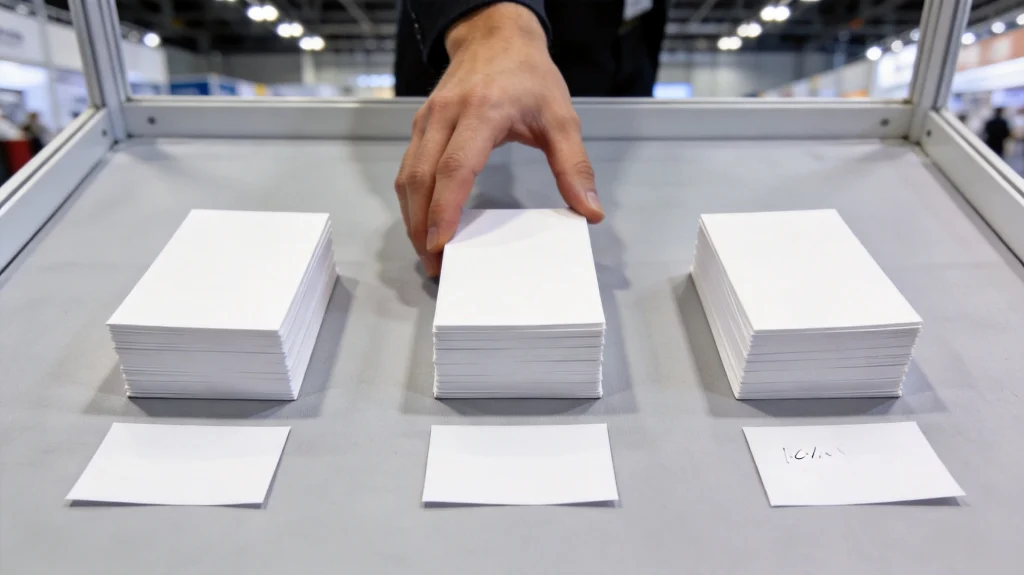
A-Grade (Assessment-Ready). You had a substantive conversation. They described a real problem, asked about pricing or regulatory process, mentioned a timeline, or named a competitor they are unhappy with. They gave you a business card and a reason to use it. These are the buyers who expect a personalized follow-up and will notice if they do not get one. Aim for a food trade show follow-up within 24 hours, ideally the same day.
B-Grade (Interested, Not Ready). They stopped, listened, asked a question or two, took your card or brochure, but no timeline or specific pain surfaced. They may have said "send me some information" without committing to anything. These contacts need value before they need a meeting. A one-page profile or a short market observation is more useful than a calendar link.
C-Grade (Card Exchange Only). A brief exchange, a badge scan, a polite hello. No real conversation. These contacts are not lost, but they are not sales-ready. Send one short thank-you, connect on LinkedIn if appropriate, and move them into a nurture list. Revisit in 90 days.
The grading system matters because your A-grade email and your C-grade email should not look like they came from the same company. One is a conversation continued; the other is a courtesy acknowledged. Confusing the two is how exhibitors train buyers to ignore them.

3. The A-Grade Follow-Up: Reference the Conversation, Ask for the Assessment
This is the most important email in your entire food trade show follow up sequence — and the only one that should ask for a meeting. It must prove you were paying attention.
Structure:
- Subject line: something specific from the conversation, not "ProWine follow-up"
- Opening: reference the exact thing they said or asked
- Body: one sentence connecting what you do to that thing
- CTA: a low-friction assessment call, not a "partnership discussion"
What it sounds like:
Hi [Name],
You mentioned at the booth that Korean retail buyers keep asking for site-specific Mosel Rieslings but the label registration timeline is the bottleneck.
That is exactly the pattern I see across importers in Seoul. I help producers pre-clear label requirements before the first shipment and get FOB and CIF pricing right so the buyer conversation does not stall after the PO.
Would a short assessment call next week make sense? I can walk you through the specific registration steps for Korea and what typically delays them.
Best,
[Name]
The key move here is naming the problem they named. If you cannot remember the problem, you did not capture enough at the booth. Voice memos immediately after each conversation work better than written notes — you speak three times faster than you type, and you will remember details you would otherwise lose.
For A-grade contacts in Asia, consider sending this within the same day or next morning. The buyer is still in show mode, and your email will land while the conversation is fresh rather than after the backlog has buried it. A food trade show follow-up that names a specific problem is forwardable. One that says "great meeting you" is not.
4. The B-Grade Follow-Up: Attach Something Useful, Ask for Nothing
The B-grade contact is interested but has no urgency. A meeting request will feel premature, and a generic food trade show follow up will get archived without a read. What they need is a reason to remember you when the urgency does appear.
Attach one of these:
- A one-page label checklist for their market (Korea, Japan, or China)
- A short market observation (300–500 words) on a category relevant to their portfolio
- A single case study: "How one importer cleared Korean label registration in six weeks"
What it sounds like:
Hi [Name],
Good to meet you at the booth last week. You mentioned you are looking at Korean retail for the first time.
Attached is a one-page checklist we use for Korean label registration. It covers the five items that most often cause delays — the ones that are easy to miss if you have not done it before.
No need to reply if it is useful. If a specific question comes up, I am happy to answer it.
Best,
[Name]
Notice the CTA: none. Or rather, the CTA is "use this." The email is designed to be forwarded to a colleague, filed for later, or replied to with a question. It does not ask for time.
For B-grade contacts, the right cadence is a first email within 2–3 days, then a single value-add follow-up around day 7–10 if there is no response. After that, move them into a quarterly nurture list. Do not keep emailing a B-grade contact weekly; you will burn the relationship before the urgency appears. A smart food trade show follow-up for a B-grade lead plants a seed; it does not demand a harvest.
5. The C-Grade Follow-Up: Short Thanks, LinkedIn, and Silence
The C-grade email is the one most exhibitors send to everyone. That is why it fails. For a card-exchange contact, the goal is not conversion. The goal is recognition — so that when they see your name in three months, they do not wonder who you are.
What it sounds like:
Hi [Name],
Thanks for stopping by the booth at ProWine. It was a brief hello, but I enjoyed it.
I will send a connection request on LinkedIn — no need to reply here. If German Riesling comes up in your sourcing conversations, I am happy to be a resource.
Best,
[Name]
This food trade show follow up has one job: be remembered. Do not attach anything. Do not ask for a meeting. Do not send a catalog. The C-grade contact did not ask for information, and sending a five-megabyte PDF confirms that you were not listening.
Send this within 3–5 days. Then stop. Connect on LinkedIn with a one-line note. Add them to a quarterly newsletter or market update list. Revisit at 90 days with a genuine reason to reach out — a new vintage release, a regulatory change in their market, a relevant article. If none of those exist, wait longer. A food trade show follow-up for a C-grade contact is a door left open, not a foot in the door.
6. The 3/7/14 Day Cadence: Three Touches, Then Stop
The cadence below is designed for A- and B-grade contacts only. C-grade follows the single-email rule above.
Day 0–1 (within 24 hours): First touch. A-grade: personalized email referencing the conversation + assessment call ask. B-grade: email with one attached resource + no ask.
Day 3–5: Second touch (same thread). A-grade only; if no reply: a brief follow-up adding one new piece of information — not "checking in." Example: "One thing I forgot to mention: the Korean registration change that takes effect in Q1 may affect your timeline. Happy to walk through it if useful." This gives them a reason to reply, not a reminder that they did not.
Day 7–10: Second touch for B-grade. One short email with a different angle: a case study, a market observation, or an answer to a question they hinted at. Still no meeting request.
Day 14: Break-up (A and B). The break-up email is not dramatic. It is a clean close that leaves the door open.
Hi [Name],
I have not heard back, so I will assume the timing is not right. No problem at all.
If the Korea or Japan question comes up later, I am easy to find. I will keep you on the quarterly market update list unless you would rather I did not.
Best,
[Name]
This email often gets a reply — not because it is clever, but because it removes the pressure. The buyer who was too busy to respond now has nothing to apologize for, and often writes back with "actually, let me ask you one thing."
After day 14, A-grade contacts with no reply get downgraded to B-grade nurture. B-grade contacts move to quarterly. Nobody gets a fifth email in three weeks. Your food trade show follow-up sequence ends when the sequence says it ends, not when you run out of patience.
7. What to Attach (and Never Attach)
Never attach in a first follow-up:
- A full catalog (PDF over 5MB)
- A price list
- A company presentation with 20 slides
- Anything that requires them to download and open a file to understand your value
Do attach:
- A one-page market-specific checklist (label registration, import documentation, retail channel map)
- A single case study, one page maximum
- A short market observation (300–500 words) relevant to their category
- Nothing at all, if the email works without it
The logic is simple. Asian buyers receive dozens of follow-ups after a show. A catalog says "I want you to buy something." A checklist says "I understand what you are dealing with" — the same logic applies when vetting distributors after a show. The second one gets forwarded to a colleague; the first one gets archived.
For A-grade contacts, the best "attachment" is often no attachment at all — just a specific reference to the conversation and a clear next step. The email itself is the value: it proves you were listening. Every food trade show follow-up you send should make the buyer's job easier, not harder.
Before You Send Any Food Trade Show Follow-Up — One Final Check
Before you hit send on your first batch, ask three questions. Did I grade this card? Am I sending something specific, not generic? Am I asking for the right next step given where this buyer actually is? If the answer to any of those is no, revise. The difference between a food trade show follow-up that converts and one that gets archived is rarely the quality of the writing. It is whether you did the grading before you wrote, the timing before you sent, and the thinking before you asked.
If you are preparing for an upcoming Asian food trade show — FHC Shanghai, ProWine Shanghai, Foodex Japan, or another regional exhibition — and want help structuring your approach before you arrive, we offer a 15-min Asia regulatory health-check to scope your market entry before you commit. Book a 15-min Asia regulatory health-check.
Disclaimer: The information provided in this article is for general informational purposes only and does not constitute legal, regulatory, or professional advice. Food import regulations, labeling requirements, and market access conditions change frequently and vary by product category, country of origin, and destination market. While we make every effort to ensure the accuracy of the information at the time of writing, we make no representations or warranties of any kind, express or implied, about the completeness, accuracy, reliability, or suitability of the information contained herein. Always consult with qualified regulatory professionals, legal advisors, or import specialists before making export decisions or taking action based on the information in this article. Specit Consulting accepts no liability for any loss or damage arising from reliance on the information provided or from any errors or omissions.
Further Reading
- How to Quote Asian Food Importers: FOB, CIF, MOQ and Pricing Structure — A post-show conversation often moves to pricing within a week. Here is how to structure your first quote the right way.
- Korea MFDS Food Import Checklist: 14 Steps Before Your First Shipment — Attach this as your B-grade value piece to Korean buyers who are new to the market.
- HoReCa vs Retail Food Asia: Choosing Your First Channel — Match the right channel to your product before you lock into an importer who only serves one.
- How to Convert Asian Trade Show Leads into Distribution Deals in 30 Days — The 30-day playbook for moving from booth conversation to first PO.
Frequently Asked Questions
When should I send my first food trade show follow-up email? Within 24 hours of the conversation, ideally the same evening or next morning before the buyer's inbox fills with other exhibitors' emails. If you met on day three of a three-day show, send before you fly home. Speed signals that the conversation mattered; a three-day gap signals it did not.
How long before I give up on a non-responder? For A-grade: after the day 14 break-up with no reply, downgrade to nurture. For B-grade: after the day 10 value email with no reply, move to quarterly. Do not delete them. Procurement timelines in Asia can be long, and a contact who was not ready in November may be ready in March. The mistake is emailing them every week in between.
WhatsApp or email? Email first, always. WhatsApp is appropriate only if the buyer explicitly gave you their number and suggested it. In Korea and Japan, unsolicited WhatsApp messages from a new business contact can feel intrusive. Use LinkedIn as the second channel if you want to stay visible — a connection request with a one-line note is lower pressure than a message.
They said, "send me information." What do I send? Send one thing, not everything. If they were specific ("send me your Korea label requirements"), send exactly that. If they were vague ("send me some information"), send a one-page profile and one relevant article, with a line that says: "I kept this short — if a specific question comes up, I am happy to go deeper." The vague request is often a polite exit. A focused food trade show follow-up is the only thing that might reopen it.
Multiple cards from the same company — who do I contact first? Contact the most senior person who actually had the conversation with you, not the most senior title on the cards. If a junior team member spoke with you for ten minutes and the VP walked by for thirty seconds, email the junior person and cc the VP only if the junior person explicitly suggested it. In Asian business culture, going over someone's head after a brief show interaction can backfire. Let the person who remembers you forward the email internally.
Need help navigating your market entry?
We've helped food exporters across 10+ countries enter 13 Asian markets. Get a free initial assessment based on public data — delivered in 3 working days.
Get Your Free AssessmentQuestions about entering the Asian market?
Chat with us on WhatsApp →