

28 September, 2026 | Shanghai, China
We have five active craft-distillery clients in our pipeline right now — a London dry gin distiller in Scotland, a Brazilian cachaça producer, an Italian grappa distiller, a Polish craft vodka distiller, and a Spanish brandy de Jerez bodega. Every one of them asked the same question at some point: "Can I just ship a container and figure out the paperwork once it lands?"
The short answer is no — not for alcohol. Beverages above 1.5% ABV sit at the intersection of food safety, spirits tax, and import licensing. Ship gin to China without a valid GACC registration number on the label, or to Japan without an importer holding a liquor sales licence, and you are looking at return or destruction. Roughly 70% of craft-distillery detentions are preventable with a one-hour pre-shipment document check. For a 5-person distillery, one detention ties up working capital for three months, costs you the importer relationship, and sets your Asian launch back 12–18 months.
This article covers China, Japan, and Korea for craft distillers worldwide. It answers three questions: can you enter, how, and where shipments most often fail. We also flag an early-entry window in Vietnam for distillers looking past the Big Three.
China Pathway: GACC Decree 280, CIFER, and Chinese Back Labels
Since 1 June 2026, GACC Decree No. 280 has replaced Decree No. 248 as the registration regime for overseas food manufacturers. For spirits producers, the headline is positive: alcohol is not on the 17-category list requiring official recommendation from your home-country authority. No government endorsement letter, no embassy coordination — you register your production facility through the CIFER portal (cifer.singlewindow.cn), submit the form, business licence, and compliance declaration, and GACC reviews.

Review for spirits (low-risk) takes 20–30 working days. Two practical details that cause avoidable delays:
- The GACC registration number must appear on the Chinese back label and must match the actual registered facility for that SKU. There is no such thing as "two GACC numbers for one bottle." The number printed must correspond to the facility registered in CIFER for that product. The most common mismatch: the original back label says "bottled at facility A" but the CIFER registration lists facility B (e.g., distillate made at the distillery, bottling done at a separate site). That discrepancy triggers customs rejection.
- Auto-renewal is not "set and forget." Spirits fall under Decree 280's five-year auto-renewal rule, but you must still file an amendment if you move facilities, change production process, or change product scope.
Chinese back labels must comply with GB 7718 and GB 2757 (distilled spirits). Required items: Chinese product name, ingredient list, alcohol content ("Alcoholic strength xx.x% vol"), net content, country of origin, Chinese importer name and address, bottling date, and the mandatory warning "Excessive drinking is harmful to health." Spirits above 10% ABV are exempt from shelf-life dating; sulphites and other allergens must be declared.
Registration and labelling are the entry tickets; once those are sorted, the practical question for most distillers is what it actually costs to land a bottle in China.
Duty on distilled spirits (HS 2208) is 10% MFN for gin, vodka, brandy, cachaça and liqueurs, with whiskies (2208.30) at a 5% interim rate effective 2 February 2026. VAT is 13%, consumption tax 20% plus RMB 0.912/L. Combined effective tax lands at roughly 49% of CIF for whisky, 56% for other spirits. FTA partners — Australia, New Zealand, Chile, South Korea, Switzerland, Georgia, certain ASEAN origins — pay reduced or zero duty; EU, UK, US and Brazilian-origin spirits (Scotch, craft gin, cachaça) currently pay full MFN/interim rates. Ask your importer for a written duty estimate on your specific HS subheading before you quote. For market testing, the CBEC route bypasses some onshore registration burdens — covered in our CBEC 2026 update.
For spirits brands not ready to commit to full general-trade entry, China's cross-border e-commerce (CBEC) channel offers a no-entity pathway with reduced tax burden and no physical Chinese label requirement, though platforms still require GACC registration as a listing condition. See our CBEC guide for craft alcohol and food brands.
Japan Pathway: Liquor Tax Act, Food Sanitation Act, and the Label Notification
Japan involves three authorities: the National Tax Agency (NTA) handles spirits classification, tax rates, and liquor sales licences; MHLW handles food safety and per-shipment import quarantine (食品等輸入届出); and the CAA handles labelling standards and allergen rules.
The single most important pre-shipment check: your Japanese importer must hold a liquor sales licence (酒類販売業免許) in the correct category. Without a wholesale liquor import licence (酒類輸出入業免許), goods cannot leave the bonded area. We ask for a copy before any production run. Initial consignments face a higher command-inspection rate; after several clean shipments, it drops to monitoring, then random inspection — so get the first shipments right.
The Japan-specific step most distillers miss is the labelling method notification (表示方法届出): before goods leave the bonded warehouse, the importer files the proposed Japanese label with customs for Liquor Tax Act compliance confirmation. Once confirmed, it is valid nationwide. Required label items: importer name/address, net content, liquor category (品目), alcohol content, country of origin, and "No drinking under 20" warning. Allergen labelling expanded to 28 mandatory items from April 2025 — botanical spirits containing nut derivatives must declare them in Japanese. For organic spirits, mutual-recognition arrangements (EU, US NOP, selected others) were extended to organic alcoholic beverages from October 2025, but the importer must hold JAS organic importer certification to use the JAS mark; an overseas organic certificate alone is not enough.
The 1 October 2026 tax window (timely): chūhai and canned highball RTD duty rises ¥28→¥35/350ml (+25%), while beer/happōshu/third-beer rates unify at ¥54.25. The price gap between cheap RTD and premium craft bottles narrows in percentage terms. If you are in active talks with a Japanese importer, lock pricing and SKU listings in the weeks after 1 October before the new price ladder settles.
Duty-wise, Japan is the most open of the three: distillers from FTA origins (EU, UK, CPTPP, Switzerland) generally pay 0% on HS 2208; non-FTA origins (US, most of Latin America outside Chile/Peru, much of Africa and the Middle East) face WTO rates up to 22.5% for some categories — cachaça, for example, sits at 22.5%. Check your HS subheading carefully. Spirits tax itself is paid by the importer at bonded withdrawal but shapes the retail price band you can realistically occupy.
Korea Pathway: Liquor Import Licence and MFDS Import Declaration
Korea is the highest-barrier market of the three, but the barrier works both ways — fewer competitors once you are in. The liquor import licence (주류 수입면허) is issued by the local tax office, requiring a trade-business registration, a ≥22 sqm warehouse (lowered from 66 sqm in 2025, opening the door to smaller specialty importers), and clean credit. The licence is category-specific: fruit wine does not cover distilled spirits; liqueur does not cover whisky. Verify the category matches your product before you ship.
Once licensed, every consignment requires an MFDS import declaration under the Imported Food Safety Control Act. Regulatory emphasis for spirits is on Liquor Tax Act classification rather than food-safety testing, though random sampling for heavy metals and methanol still applies. Korean-language back labelling is mandatory, with format rules prescribed in detail — translation is not compliance. Korea also uses a liquor tax stamp (주류납세병마개) applied by the importer after clearance. HACCP is not mandatory for alcohol itself but strengthens an importer's overall compliance posture, which matters because who you partner with in Korea matters more than in either China or Japan.
That partner matters most because of the duty profile: FTA origins (EU, UK, Chile, Australia, Canada, US, ASEAN, CPTPP) generally pay 0% or reduced duty on spirits; non-FTA origins face ~30% MFN on most HS 2208 categories — materially higher than China or Japan. A well-connected licensed importer can make that duty irrelevant to market access; a weak one cannot overcome it with pricing.
The Four Most Common Spirits Detentions
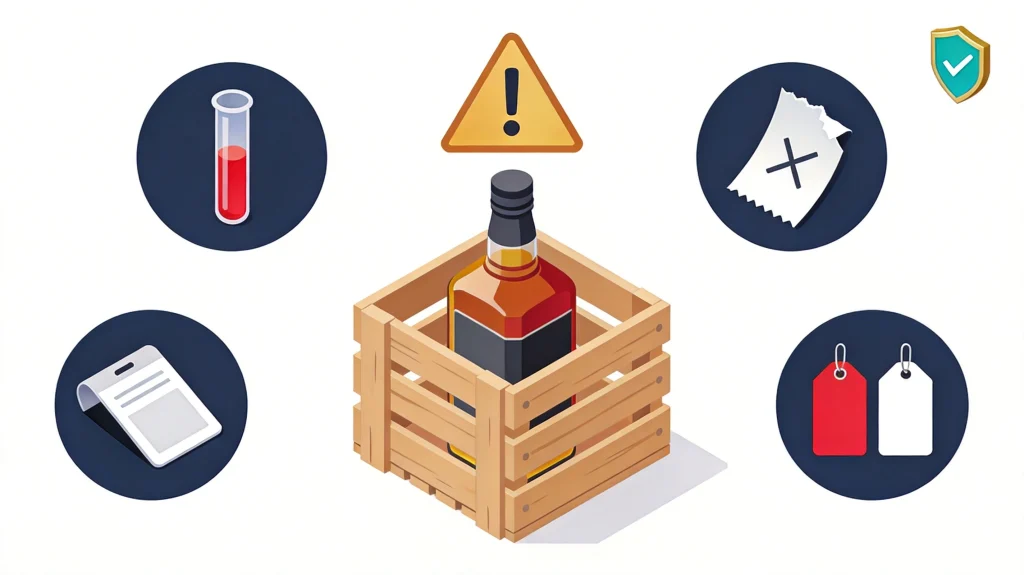
Working across roughly 25 active spirits clients in China, Japan and Korea, the same four causes repeat:
- Additives not on the positive list. Japan's designated-additives system (指定添加物) only allows explicitly listed substances. A preservative or colour routine in your home market can be a non-designated additive in Japan — we had a botanical liqueur held in Yokohama for six weeks because it carried natamycin, permitted in the distiller's home market but not on Japan's list. China (GB 2760) and Korea (Korean Food Additives Code) each have their own lists that do not align 1:1. Cross-check every ingredient against the target market's list before first shipment.
- Label errors or missing mandatory items. Wrong net-content units on the Chinese back label, missing Japanese importer address, wrong alcohol-content format on the Korean label, GACC registration number not matching the registered facility. Build labels against the local standard; do not translate your domestic back label.
- Importer qualifications not in order. A Japanese "importer" with only a retail licence; a Korean importer whose licence category does not cover distilled spirits; a Chinese importer without a food business licence. We have seen a 40-ft container of single malt held in Yokohama for 11 weeks because the listed importer held only a retail off-licence — storage JPY 2.3M, stock eventually sold at a 40% discount to a properly licensed wholesaler.
- Registration-number mismatch. Under GACC Announcement 27/2026, customs declarations must carry the correct registration number under licence category code 519 plus "Edible" (食用) in the commodity-use field. A label/registration mismatch for multi-site production is the single most common China clearance failure we see.
How to Choose Your First Asian Market
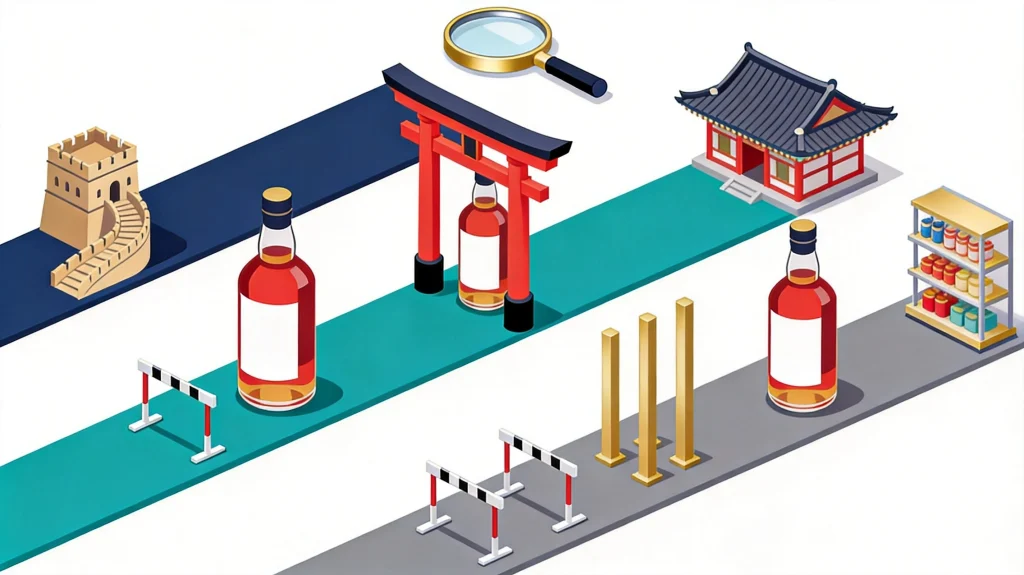
- China is the volume prize (imported spirits +18% in 2025). Barriers are GACC registration and Chinese back labelling — both now relatively transparent thanks to Decree 280's self-application route. Whisky benefits from the new 5% interim duty (the best China window for Scotch and craft whisky in a decade). Gin, brandy and craft liqueurs are the strongest categories. FTA-origin distillers should price the duty advantage in from day one. Suits producers with 6–9 months of patience for compliance prep.
- Japan is the premium market — best per-bottle margins of the three. On-trade (craft cocktail bars, hotel bars, specialty shops) actively seeks provenance stories. The October 2026 tax reset creates a credible listing window for bottles in the ¥3,000–¥6,000 retail band. 0% duty for FTA-origin distillers. Suits producers with a strong brand story, clean label (no additives outside Japan's designated list), and a Japanese importer already in conversation.
- Korea moves fastest for trendy, design-led spirits and RTD-adjacent categories (craft gin, flavoured spirits, premium liqueurs). The licence barrier (category-specific, ≥22 sqm) keeps weak competitors out once you land a good partner. Non-FTA distillers face ~30% MFN, which constrains pricing — partner quality matters most here.
- Vietnam (forward-looking): QCVN 30:2026/BCT takes effect 1 January 2027, replacing the 15-year-old standard with tighter methanol limits and a conformity-declaration requirement, with a 12-month grace period for existing products. Distributors are locking in portfolios now; Q4 2026 is the right window to engage a Vietnamese importer and prepare re-testing before the market re-prices.
None of the three Big Three is "easy." The right starting market is the one where your product's additives are clean, your label can realistically be built against the local standard, and you already have — or can realistically find — an importer with the correct liquor licence in hand. Most distillers we work with end up starting in whichever market brings them a credible inbound enquiry first, then using that reference importer to negotiate the others.
Before You Ship: The 20-Minute Compliance Snapshot
Before committing production to an Asian order, confirm three things:
- Additive compliance — every ingredient cross-checked against the target market's positive list; approval in your home market is not automatic approval in Asia.
- Label compliance — build target-market back labels from the local standard, not by translation.
- Importer licence verification — obtain a copy of the licence and confirm the category covers your product.
If you want a second pair of eyes on your registration status, back label or importer licence before committing production, book a free 20-minute compliance snapshot. In one call, we will tell you which of China, Japan or Korea is your most viable starting market, what documents you need, and where your most likely failure point sits.
Frequently Asked Questions
Do craft distillers need GACC Decree 280 registration to sell spirits in China?
Yes. Alcohol is not on China's 17-category recommended list, so every distillery (one SKU = one registered production facility) must self-register through CIFER. The registration number must appear on the Chinese back label. There is no group-registration shortcut; your Chinese importer cannot register on your behalf, though many will coordinate the paperwork.
Is GACC registration required for Japan and Korea too?
No. Japan does not require overseas distilleries to pre-register with a central authority; the gates are additive compliance against Japan's positive list and a valid liquor import licence held by your Japanese importer. Korea relies on MFDS consignment inspection plus a category-specific liquor import licence held by the Korean importer, not pre-registration of the overseas distillery.
How long does a compliant first spirits shipment take for each market?
Plan 6–12 months for China (GACC CIFER alone runs 3–4 months once the file is clean, plus label approval and booking). Japan runs 4–8 months, bottlenecked by additive-list review and an importer search. Korea is fastest at 3–6 months, assuming an importer with the correct licence category is already in place.
What is the most common reason spirits shipments get detained?
Additive mismatches, not paperwork errors. Products that pass home-market approval routinely hit detention because they contain preservatives, colours or fining agents not on the destination country's positive list. Japan is the strictest; we have seen a botanical liqueur held in Yokohama for six weeks over natamycin, permitted in the distiller's home market but not in Japan. Send your full ingredient list and processing aids to your importer for a written compliance check before printing labels.
Can one multilingual back label cover all three markets?
Not reliably. Each market requires its own language and different mandatory fields: China requires the GACC registration number, production date in YY/MM/DD or YYYY/MM/DD, and a shelf-life end date; Japan requires allergen declarations on a specific set of ingredients; Korea requires the importer's licence number and a local customer-service contact. Overprinting three languages tends to create font-size violations. Most distillers run a single base label and apply market-specific stickers at the warehouse.
Still deciding which Asian market to enter first with your spirits brand? China, Japan, and Korea each have distinct licence, tax, and channel requirements. Score them side-by-side using our market-prioritization framework for craft food and beverage brands.
Disclaimer: This article is for informational purposes and does not constitute professional compliance advice. Regulatory requirements change; always verify current rules against the latest official sources before shipment. For actual compliance, registration, or label work specific to your product and market, contact us at kevin@specitconsulting.com.
Related reading
- GACC Decree 280: What overseas food manufacturers must know before registering in 2026
- Two months of Decree 280 rejection data: what exporters must fix before shipping
- Japan food import: three surprises not in the official guide
Need help navigating your market entry?
We've helped food exporters across 10+ countries enter 13 Asian markets. Get a free initial assessment based on public data — delivered in 3 working days.
Get Your Free AssessmentContinue Reading
▶Exporting Food to Asia in 2026: A Market Prioritization Framework for Craft Food & Beverage Brands
▶Food Import Detentions in Asia: 7 Real Cases and How to Avoid Them (2026)
Questions about entering the Asian market?
Chat with us on WhatsApp →