

24 August 2026 | Shanghai, China
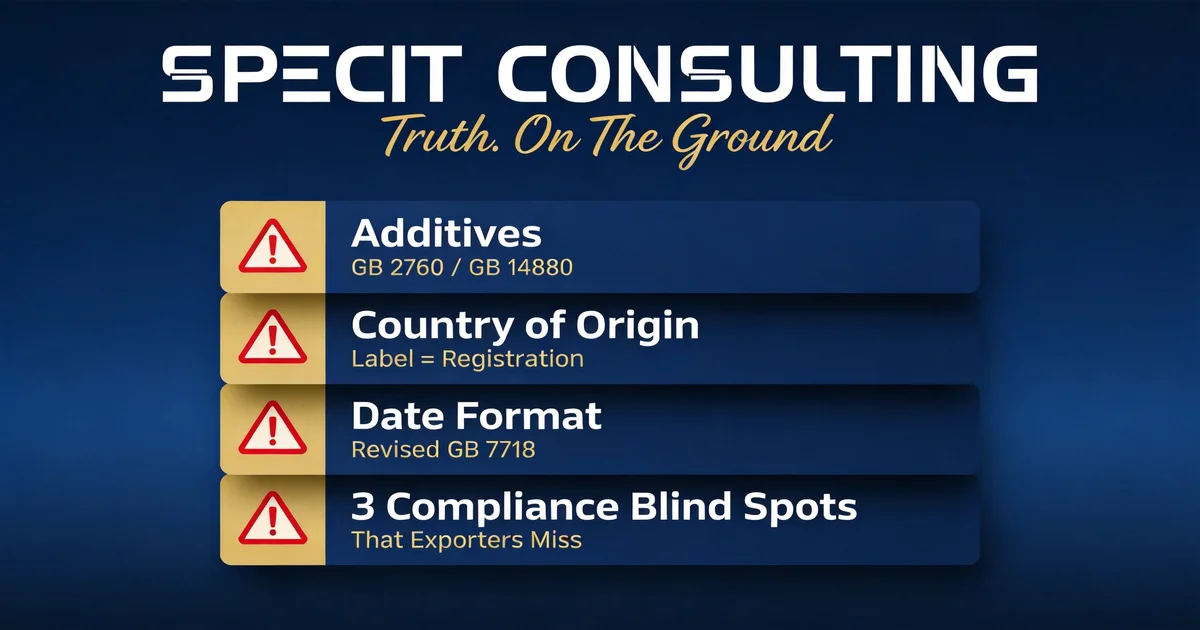
Most exporters preparing for China have a checklist. Formula? Check. Label? Check. Registration? Check. But in our pre-entry reports, we consistently find three things that almost no one thinks to check — until the container is already at the port.
What We Saw
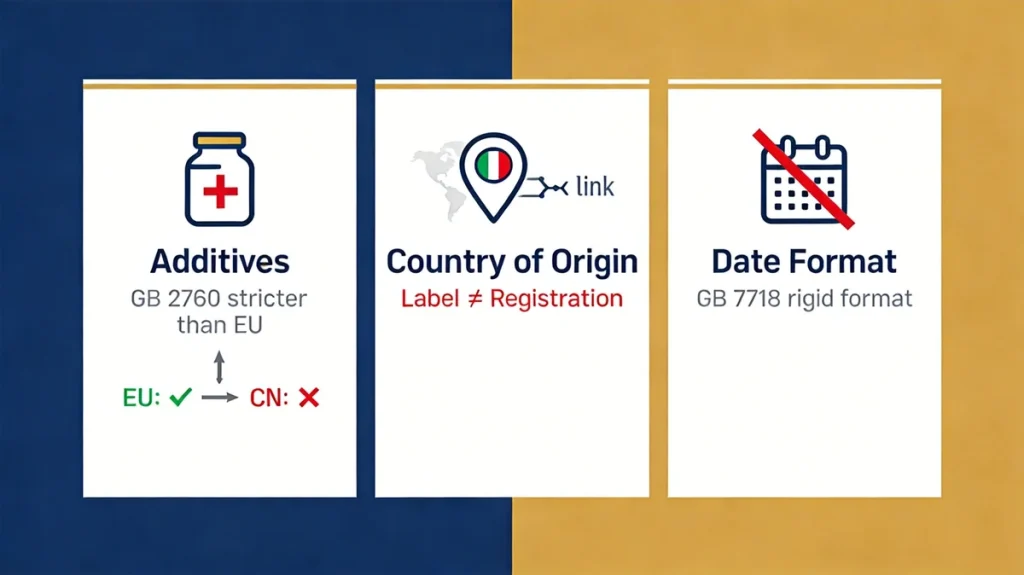
The first blind spot is additives. The assumption is simple and dangerous: “If it’s allowed in my country, it’s allowed in China.” It is not.
China’s food additive standard, GB 2760, is stricter than many international benchmarks. A preservative or colour that is compliant in the EU or US may exceed China’s permitted limits — sometimes by a factor of ten.
We saw a fruit juice manufacturer boost vitamin levels to support a “high in vitamins” claim. The formulation was perfectly legal in the original market. In China, the vitamin fortification levels exceeded GB 14880’s permitted amounts (GB 14880 is the standard for nutritional fortification substances, separate from the additive standard GB 2760), and the shipment was rejected at the border.
What makes this trap wider than it appears is the carry-over principle. Even if you do not add an additive directly to your final product, it may be present because it was used in an ingredient you sourced. That indirect presence can still be flagged as non-compliant if the additive is not permitted in the final product category. A recurring blind spot: exporters assume that because an ingredient is sold in EU or US health-food channels it has automatic access in Asia. Maca, chia, and lucuma Asia market entry paths diverge sharply — maca required NFRM approval in China, chia seeds underwent a multi-year positive-list amendment, and lucuma remains in regulatory grey zones for several markets.
The second blind spot is country of origin. The rule is simple: the country of origin declared on your Chinese label under GB 7718 must exactly match the country of the manufacturer registered with GACC. This is not a “similar” or “close enough” situation. A single character difference can trigger a label rejection.
A typical case: a chocolate bar is “manufactured” in Country A, but the chocolate is melted, mixed, and packaged in Country B. GACC will likely consider Country B the country of origin for import purposes. If your label says Country A, your documentation says Country B, and your registration is under Country B, you have a fatal inconsistency.
The third blind spot is date format. Under the revised GB 7718 standard, production and expiry dates must be in a specific, rigid format. Exporters often use familiar “Best Before” or “BBD” phrasing. China’s rules now require both the production date and the expiry date, in year-month-day order, using clear standardised wording.
“Best Before 24-08-2027” will not pass. “生产日期:2026-08-15 保质期至:2027-08-24” will.
Why This Matters for You
Each of these blind spots is preventable. That is what makes them so costly. A rejected shipment means the container is returned or destroyed — there is no relabel-and-resubmit option at Chinese ports. The exporter pays for shipping, customs fees, and demurrage. The importer misses stock. The launch date slips. The relationship strains.
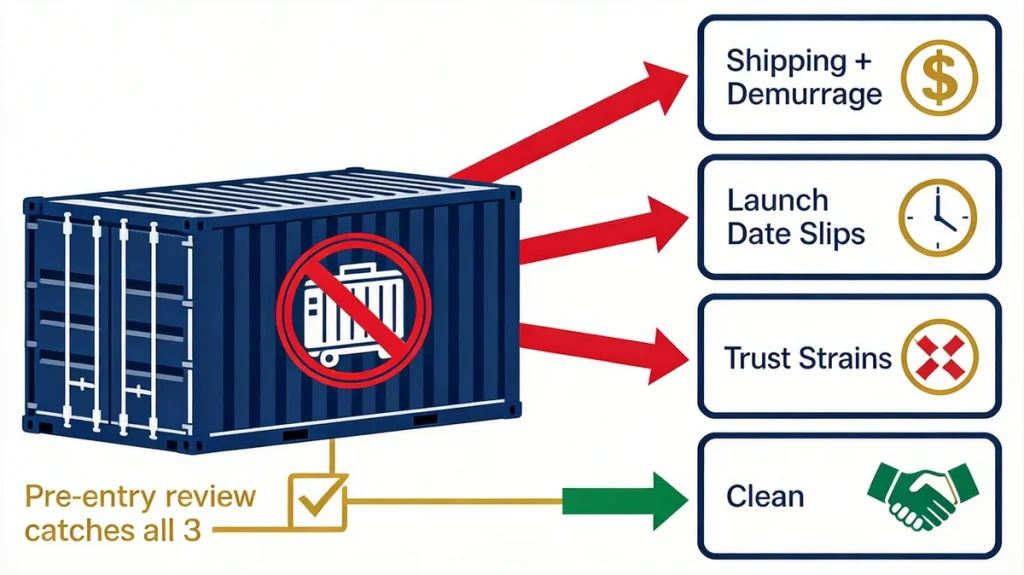
What makes these three issues particularly dangerous is that they sit outside most standard checklists. An exporter can have their formula reviewed, their registration confirmed, and their logistics arranged — and still lose the shipment on a vitamin level, a country-of-origin mismatch, or a date format. These are quiet risks. They tend to surface only when the container is already at the port, which is the worst possible moment to discover them.
A pre-entry review that checks additives against GB 2760, fortification against GB 14880, verifies the country-of-origin alignment across label, registration, and documentation, and confirms the date format against the revised GB 7718 will eliminate the vast majority of these failures. Skipping that review means betting the shipment on assumptions made thousands of kilometres from the border.
These three issues share one trait: they are invisible on standard checklists and irreversible once the container reaches the port.
Takeaway
Check every additive against GB 2760, including those carried over from source ingredients. For vitamins and mineral fortification, check against GB 14880.
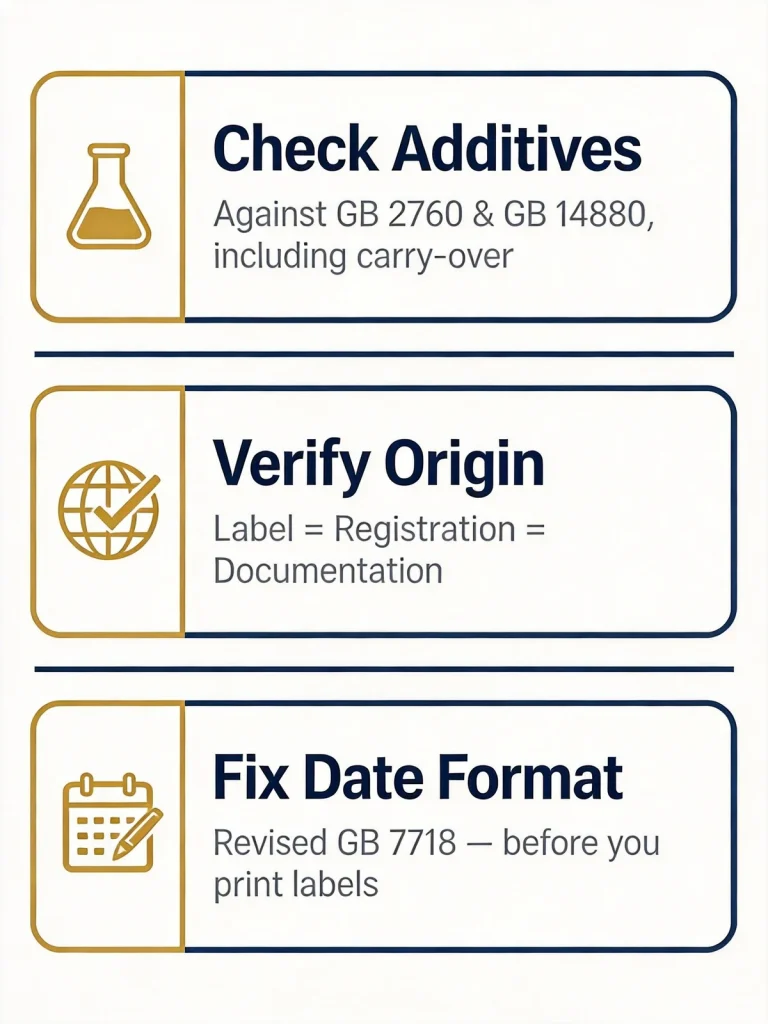
Verify that the country of origin on your Chinese label, your GACC manufacturing registration, and your export documentation all match perfectly.
Rewrite your date formats to the revised GB 7718 standard before you print labels — not after. Beyond the obvious label errors, one blind spot we flag repeatedly is organic certification mismatch: a producer carrying EU organic but lacking JAS organic, China Green Food, or Korea organic certification will see their product demoted to conventional status in each market — losing the premium price point the certification was meant to command.
These three blind spots are among the most common reasons for customs holds, and all of them are avoidable. A few hours of pre-entry review can save a container. Missing them almost certainly won’t.
Need help reviewing your product before it ships to China? Read our guide on GACC Decree 248 and what the rejection data tells us.
About Specit Consulting
We help food and beverage brands enter and grow in the Chinese and wider Asian markets through trade intelligence, importer identification, and market research.
✉ info@specitconsulting.com
Disclaimer
This article reflects general market observations and regulatory understanding as of August 2026. It does not constitute legal or regulatory advice. Always confirm current requirements with the relevant authority or a qualified regulatory consultant before shipping.
Need help navigating your market entry?
We've helped food exporters across 10+ countries enter 13 Asian markets. Get a free initial assessment based on public data — delivered in 3 working days.
Get Your Free AssessmentContinue Reading
▶Send Food Samples to Asia: Avoid These Customs Mistakes
▶Food Import Detentions in Asia: 7 Real Cases and How to Avoid Them (2026)
Questions about entering the Asian market?
Chat with us on WhatsApp →