

15 September 2026 | Shanghai, China
At Specit Consulting, we classify food products for Asian markets every week. HS codes are not just numbers to look up — they determine duty rates, inspection intensity, and whether your shipment clears or gets held. This guide breaks down China's 10-digit tariff structure, walks through the food chapters (01–21), and shows you how to identify the right code from a product description.
Every food product entering China requires an HS code on the customs declaration. Classify correctly, and your shipment clears; classify incorrectly, and you may face delays, duty shortfalls, additional inspection, or, in serious cases, seizure. Misclassification is a leading cause of customs holds and clearance delays for first-time exporters.
The 10-Digit Structure: From Chapter to Tariff Line
China's customs classification follows the international Harmonized System maintained by the World Customs Organization. The full code used for Chinese customs declarations is 10 digits, organised into five levels.
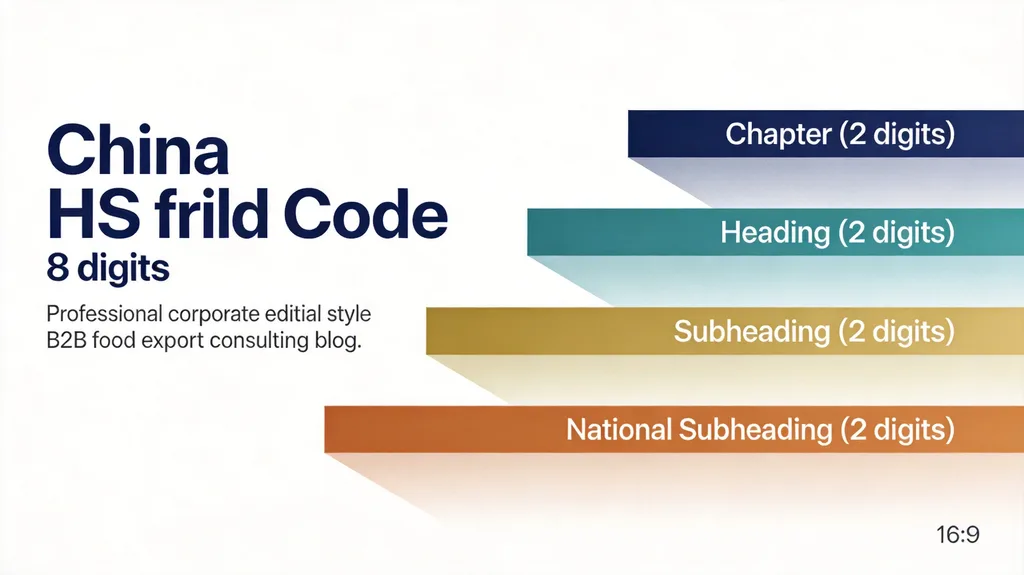
Digits 1–2: Chapter. The broadest category. The HS has 97 chapters, grouped into 21 sections. Chapters are organised by product type and processing stage. Live animals are Chapter 1; meat is Chapter 2; fish is Chapter 3. As a general principle, the more processed a product, the higher its chapter number.
Digits 3–4: Heading. Within a chapter, the heading narrows the product further by its basic character or use. For example, in Chapter 4 (dairy), heading 04.06 covers cheese and curd.
Digits 5–6: International Subheading. This is the six-digit level recognised globally. It is the standard reference for trade statistics and the code used when communicating with suppliers or customs authorities outside China.
Digits 7–8: National Subheading (本国子目). This is where China diverges from other countries. The 7th and 8th digits are set by Chinese tariff policy, reflecting domestic duty rates, export rebate rules, and regulatory requirements. Two countries may share the same first six digits but assign different 7th–8th digits.
Digits 9–10: Tariff Line. The final two digits subdivide the national subheading for China-specific duty application — distinguishing most-favoured-nation rates, provisional rates, conventional (FTA) rates, and special preferential rates. Some 9th–10th digit codes also map to specific import licence or quarantine requirements, but their primary function is duty differentiation.For EU exporters, this digit level also determines whether you can claim conventional and FTA tariff rates — and the expiry windows that apply through 2029
A practical convention: where a subheading ends in "9", it typically denotes "other" — goods not specifically named elsewhere in that heading. This convention is consistent across many national tariff schedules, including China's.
Food Chapters 01–21: A Chapter-by-Chapter Walkthrough
Most food and beverage products fall within Chapters 01–21. The following table summarises each chapter:
| Chapter | Category | Typical Products |
| 01 | Live animals | Breeding stock, live poultry |
| 02 | Meat and edible offal | Fresh, chilled, frozen meat |
| 03 | Fish and crustaceans | Fresh, frozen, dried seafood |
| 04 | Dairy, eggs, honey | Milk, cheese, butter, eggs, natural honey |
| 05 | Other animal products | Bones, horns, shells, sinews, ivory, animal products n.e.s. |
| 06 | Live plants and cut flowers | Bulbs, roots, cut flowers |
| 07 | Edible vegetables | Fresh, chilled, frozen vegetables |
| 08 | Edible fruits and nuts | Fresh, dried fruits, nuts, citrus fruit |
| 09 | Coffee, tea, spices | Roasted and unroasted coffee, all teas, pepper, spices |
| 10 | Cereals | Wheat, rice, barley, maize |
| 11 | Milling products | Flour, malt, starch, inulin, wheat gluten |
| 12 | Oil seeds and grains | Soybeans, peanuts, sunflower seeds, fodder |
| 13 | Gums and resins | Natural gums, resins, vegetable saps and extracts |
| 14 | Vegetable plaiting materials | Bamboo, rattan, other vegetable materials |
| 15 | Fats and oils | Animal and vegetable fats and oils, refined or unrefined |
| 16 | Prepared meat and fish | Sausages, canned meat, prepared seafood |
| 17 | Sugars and confectionery | Cane sugar, beet sugar, sugar confectionery, chewing gum |
| 18 | Cocoa and preparations | Cocoa beans, cocoa powder, chocolate |
| 19 | Cereal preparations | Pasta, pastry, biscuits, bread, bakery products |
| 20 | Prepared vegetables and fruits | Jams, fruit juices, canned vegetables, prepared nuts |
| 21 | Miscellaneous edible preparations | Sauces, soups, yeast, coffee and tea extracts, compound seasonings |
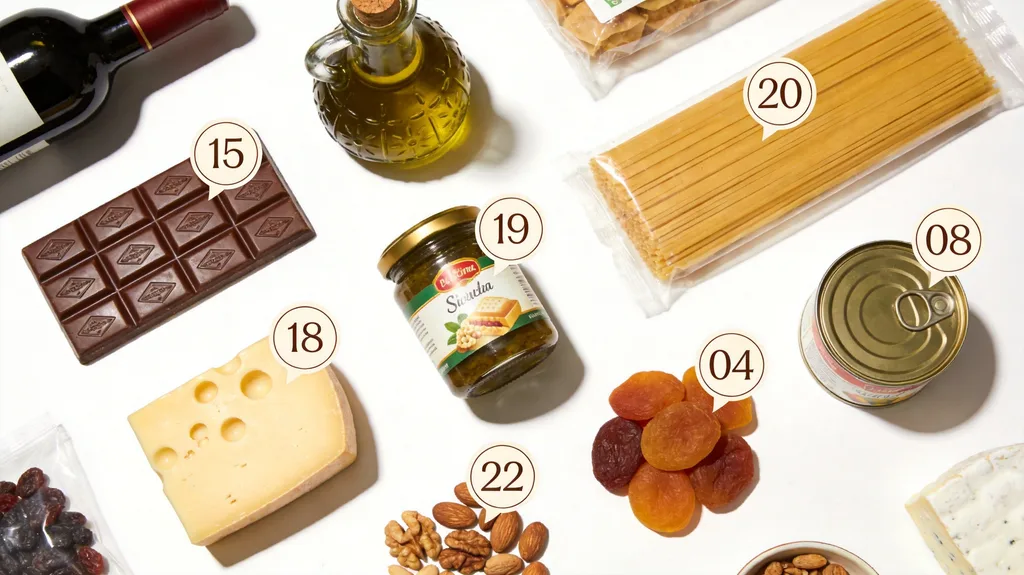
The organising principle of the HS is the processing stage. A raw tomato falls under Chapter 07; tomato paste under Chapter 20; tomato ketchup under Chapter 21. Each shift moves the product into a new chapter with different tariff and regulatory requirements.
Three Practical Methods to Find the Right Code
Method 1: Start from the Chapter and Work Down. Identify the product's essential character — animal product, vegetable product, or prepared food — to determine the chapter. Then narrow within the chapter by heading and subheading. For example, a dried fruit snack: Chapter 08 (edible fruits and nuts) → heading for dried fruit → subheading for the specific fruit type. Fruit importers should note that correct HS classification alone is not sufficient — fresh fruit also requires GACC orchard registration and cold-treatment records to clear Chinese customs. See our fresh fruit import guide for the full compliance checklist.
Method 2: Use China's Official Tariff Query System. The General Administration of Customs of China provides an online search tool through the "Internet+Customs" portal. Select "Import/Export Tariff Query" and enter your product name. The system returns candidate codes with duty rates and regulatory conditions. The same portal also links to GACC registration requirements for imported food. Always verify the full 10-digit code, not just the six-digit international code.
Method 3: Cross-Reference with Classification Databases. Use a customs classification reference tool or the GACC classification inquiry function to search by product description and specification. Enter keywords from your product formulation and processing method, then cross-check the returned code against the chapter notes and heading text to confirm the fit. Chapter notes and section notes are legally binding for classification purposes — if your product does not meet the note criteria, it belongs elsewhere.
Common Misclassification Cases
Case 1: Same product name, different processing method. "Potato chips" can fall under two different headings depending on how they are made. Extruded chips — where potato is processed into flour or dough, shaped, and fried or baked — are classified under heading 19.05 (bakers' wares and cereal preparations). Traditional sliced-and-fried chips are classified under heading 20.05 (prepared or preserved vegetables, not frozen). The processing method, not the end product name, determines the code.
Case 2: Overlooking chapter notes. Two products may appear similar but belong in different chapters based on composition thresholds defined in the chapter notes. For example, a roasted coffee substitute containing no coffee falls under heading 2101.30; if it contains any coffee, it moves to heading 0901.21. The chapter notes set these boundaries explicitly and always take precedence over product marketing descriptions.
Case 3: Ignoring processing state. Fresh, chilled, and frozen forms of the same product can fall under different subheadings, even within the same heading. Dried versus fresh fruit, concentrated versus single-strength juice, and whole versus ground spices all carry different codes. Physical state and degree of processing are core classification criteria.
Misclassification is one of the most frequent causes of customs holds for first-time exporters. Under Chinese customs regulations, an incorrect declaration can lead to administrative penalties, recovery of duty shortfalls with surcharges, and in serious cases, seizure. Repeated errors may also affect the importer's customs credit rating, increasing inspection frequency on future shipments.
The combined MFN tariff + full VAT burden applies to general-trade imports. Goods sold through China's cross-border e-commerce (CBEC) channel enjoy a 30% VAT reduction and zero tariff within transaction limits, substantially lowering the effective duty burden — see our CBEC entry pathway breakdown.
Frequently Asked Questions
What is the difference between the 6-digit and 10-digit HS code?
The 6-digit code is the international standard, used globally for trade statistics and cross-border communication. The 10-digit code is China-specific, used for Chinese customs declaration, and determines the exact duty rate, regulatory conditions, and inspection requirements. You must declare the full 10-digit code for imports into China.
How often does China's HS code list change?
The international HS is revised on a roughly five-year cycle by the World Customs Organization (HS 2002, 2007, 2012, 2017, 2022). China's national subheadings (digits 7–10) are reviewed annually, with changes typically effective from 1 January. Exporters should verify codes against the current year's tariff schedule before each shipment.
What happens if I declare the wrong HS code?
If the error is unintentional and does not result in duty underpayment, customs may issue a correction notice and administrative warning. Where the incorrect code leads to underpaid duty, the importer must pay the difference plus a late-payment surcharge. In serious or repeated cases — particularly where misclassification appears deliberate — customs may treat the matter as a regulatory violation, which can affect the importer's customs credit rating and result in higher inspection rates for subsequent shipments.
Need help verifying your HS classification before your next shipment to China? We provide a pre-entry classification review that checks your product against the current China tariff schedule, identifies the correct 10-digit code, and flags any regulatory requirements tied to that code. We can also cross-check label compliance and HS classification together, since label errors and misclassification often surface at the same inspection. Contact Specit Consulting to discuss your product.
About Specit Consulting
We help food and beverage brands enter and grow in the Chinese and wider Asian markets through trade intelligence, tariff analysis, labelling compliance, importer identification, and market research.
✉ info@specitconsulting.com
Need help navigating your market entry?
We've helped food exporters across 10+ countries enter 13 Asian markets. Get a free initial assessment based on public data — delivered in 3 working days.
Get Your Free AssessmentContinue Reading
▶EU Food Exports to China: Understanding Tariff Risks (2026–2029)
▶How Free Trade Agreements Reduce Food Import Tariffs in Asia
▶HS Code Misclassification: When Our Report Predicted a Tariff Shock
Questions about entering the Asian market?
Chat with us on WhatsApp →