

11 September 2026, Shanghai, China
The EU–China tariff dispute began with electric vehicles, but food and agriculture have become the primary retaliation vector — agricultural tariffs create targeted political pressure on specific member states. This article outlines measures in force, the pattern of target selection, practical risks for pre-packaged food exporters, and steps businesses can take now.
The EV Dispute That Set the Pattern
In October 2023, the European Commission launched an ex officio anti-subsidy investigation into Chinese battery electric vehicles (BEVs). Definitive countervailing duties were imposed on 29 October 2024 under Implementing Regulation (EU) 2024/2754 for five years, after a member-state vote split 10–5–12 (Germany and Hungary among those opposed). Rates applied on top of the standard 10% auto duty range from 7.8% (Tesla Shanghai) to 35.3% (non-cooperating producers), for combined duties of 17.8%–45.3%, and apply to all China-built vehicles regardless of brand.
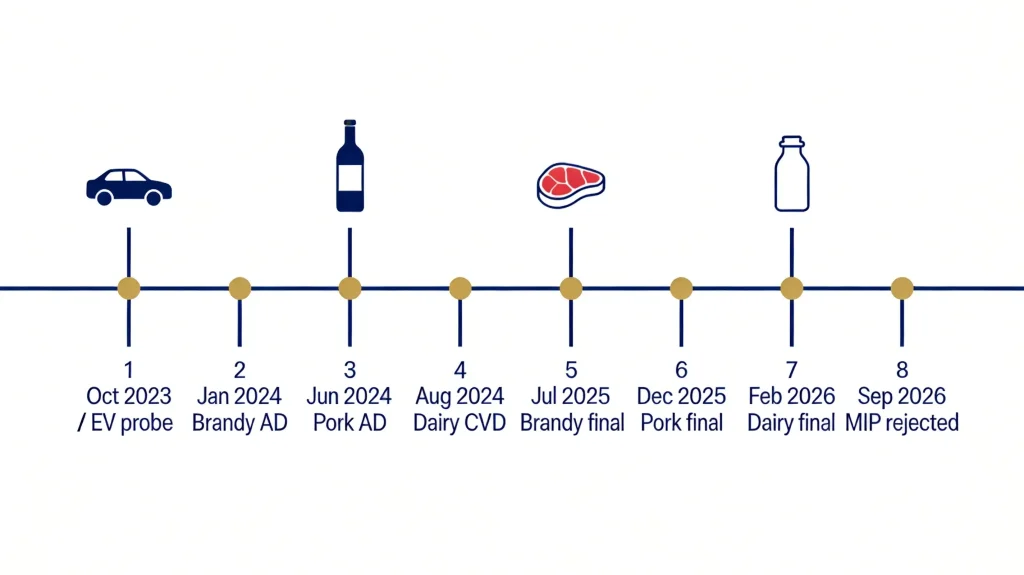
China responded by filing a WTO dispute and opening trade remedy investigations into EU agricultural products concentrated in member states that supported the tariffs. On 10 September 2026, the Commission rejected China’s minimum-price undertaking offers; member states vote on 25 September on maintaining the five-year regime.
Tariff Measures in Force on EU Food Products
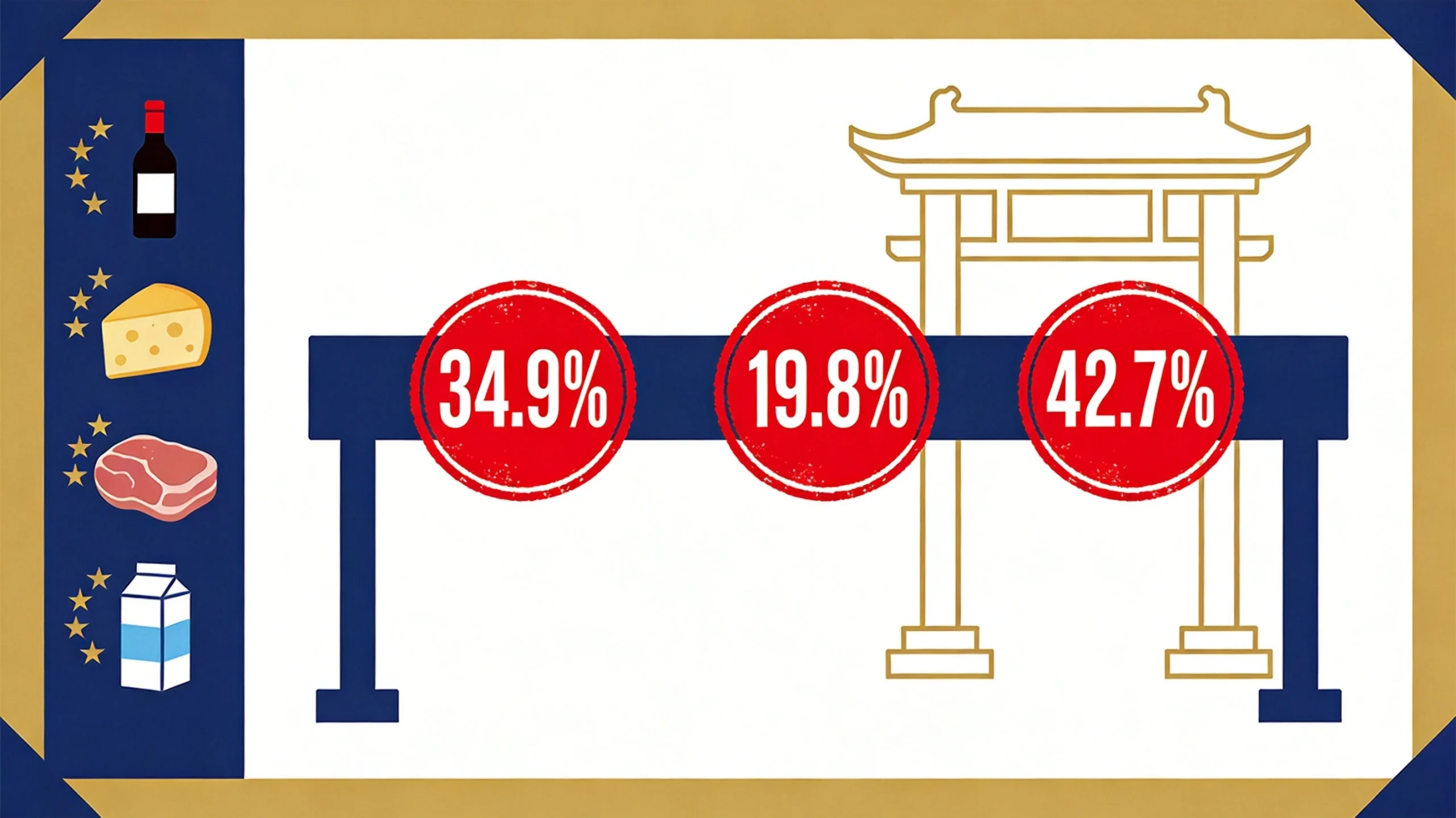
Brandy and Cognac — up to 34.9%
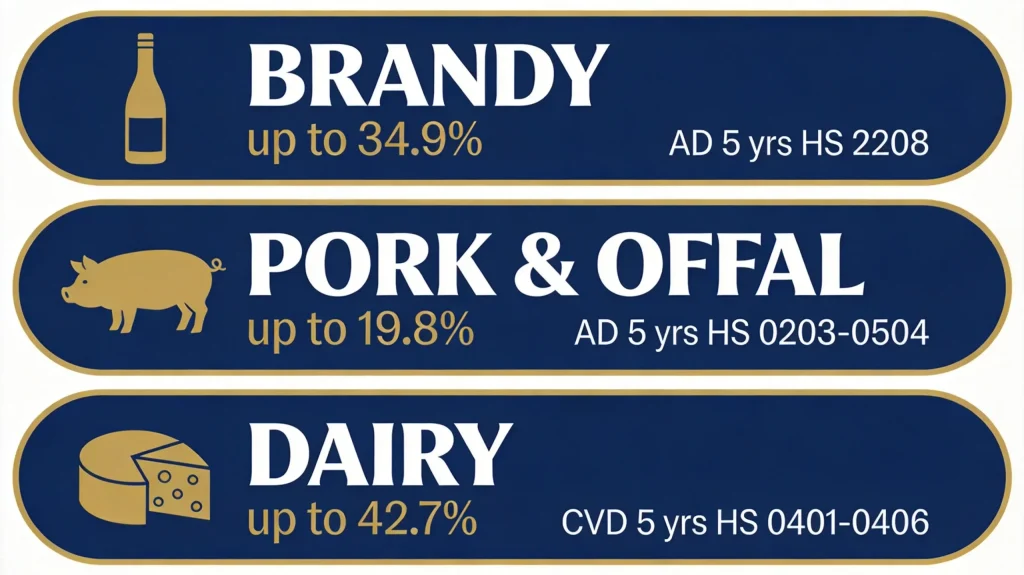
MOFCOM launched an anti-dumping (AD) investigation into EU brandy (HS 22082000) on 5 January 2024, imposed provisional measures on 29 August 2024, and published final determinations on 4 July 2025 (Announcement No. 30, 2025). Definitive AD duties of 27.7%–34.9% apply for five years. Three major cognac houses have been granted exemption through price undertakings; all other EU brandy exports, particularly from France’s Charente region, face the duties.
Pork and Pork By-Products — up to 19.8%
MOFCOM launched an AD investigation into EU pork and pig by-products (HS 0203, 0206, 0209, 0504) on 17 June 2024, applied provisional duties on 17 June 2025, and issued final determinations on 11 December 2025 (Announcement No. 41, 2025) with duties of 4.9%–19.8% for five years. The measures affect Spain, Denmark, the Netherlands and other member states, covering fresh and frozen pork, offal, fat and casings.
Dairy Products — up to 42.7%
MOFCOM opened a countervailing duty (anti-subsidy) investigation into EU dairy on 21 August 2024, applied provisional duties on 21 April 2025, and published final determinations on 12 February 2026 (Announcement No. 9, 2026). Definitive CVD duties took effect on 13 February 2026 for five years, with rates up to 42.7% for non-cooperating producers. The measures cover certain milk, cream, whey, butter, cheese and curd products (HS 0401, 0406), affecting Ireland, France, Germany and the Netherlands.
Summary of Current Measures
| Product | Type | Max Rate | Effective | Primary Targets |
| Brandy / Cognac (HS 22082000) | Anti-Dumping | 34.9% | 4 Jul 2025 (5 yrs) | France (Charente) |
| Pork & By-Products (HS 0203/0206/0209/0504) | Anti-Dumping | 19.8% | 11 Dec 2025 (5 yrs) | Spain, Denmark, Netherlands |
| Dairy (HS 0401/0406) | Countervailing | 42.7% | 13 Feb 2026 (5 yrs) | Ireland, France, Germany, NL |
How Targets Are Selected — An Observed Pattern
Based on the three cases to date, targets share common characteristics: high geographic concentration in 1–3 member states, established import volumes into China, links to states that supported the EV tariffs, and agricultural products with political weight through rural constituencies and CAP-supported farming lobbies.
Important: This describes an observed pattern; it does not predict future targets. As of 11 September 2026, no formal investigation has been announced on EU wine, olive oil, chocolate, confectionery, bakery products, honey or craft spirits. No official source has confirmed these investigations are retaliatory.
What This Means for Pre-Packaged Food Exporters
Even for non-targeted categories, trade tension creates four practical risks:
- Importer uncertainty: Chinese buyers may delay contracts or shift to non-EU origins during active friction.
- Tighter origin checks: Customs may scrutinise Certificates of Origin more closely. Ensure CO and traceability documentation are complete.
- Non-tariff friction: GACC registration, CIQ inspection, GB-standard labelling and document review may see slower processing or stricter enforcement.
- Contractual exposure: Add tariff escalation clauses specifying which party bears the cost of new duties imposed after signing.
Steps Exporters Can Take Now
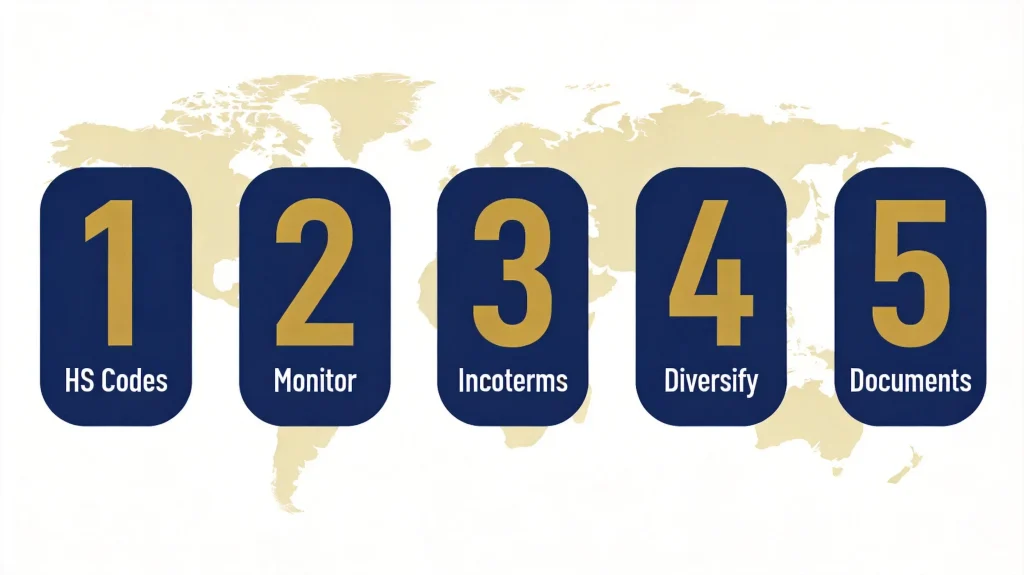
- Confirm your precise HS code at the 8–10 digit level and cross-check against any MOFCOM investigation notice — misclassification can cause unexpected duty liability or detention at port.
- Monitor MOFCOM announcements and European Commission DG TRADE updates, or retain a customs broker who tracks trade remedy actions; MOFCOM publishes new investigations in Chinese and English on its website.
- Review Incoterms and add a tariff-change clause to new contracts specifying how additional duties imposed after signing will be allocated between buyer and seller.
- Diversify across Asia where feasible: Japan, South Korea and Southeast Asia offer large pre-packaged food markets with established import frameworks independent of China–EU tensions.
- Maintain complete production and subsidy records (including any CAP payments or member-state grants) and ensure Certificates of Origin, traceability documentation and export health certificates are accurate and ready for enhanced customs scrutiny — these become relevant if a CVD investigation is initiated, regardless of whether your category is currently targeted.
Fresh fruit is a category where non-tariff barriers — GACC orchard registration and cold-chain quarantine records — reject more shipments than tariffs ever will. See Fresh Fruit to China: Why Orchard Registration Kills More Shipments Than Tariffs.
Frequently Asked Questions
Are all EU food exports to China subject to new tariffs?
No. Additional duties are product-specific and currently apply only to brandy, certain pork products and certain dairy products as listed above. All other food categories enter China under standard MFN rates, subject to existing GACC registration and labelling requirements.
What is the difference between anti-dumping and countervailing duties?
Anti-dumping duties address imports sold below normal value; countervailing duties offset government subsidies conferred on producers. Both require a formal investigation, injury determination, and public notice.
My product is not targeted — do I still need to act?
Confirm your HS classification, review contract terms for tariff escalation, and keep documentation (CO, traceability, subsidy records) in good order so you can respond quickly if the landscape changes.
Outlook
Key dates: the 25 September 2026 EV tariff vote, Commissioner Šefčovič’s early-October Beijing visit, and the 2029 expiry of the five-year EV duties. Trade negotiations can de-escalate as quickly as they escalate; no outcome is predetermined.
Get Support with Your Tariff and Market-Entry Positioning
Specit Consulting helps European food and beverage exporters classify products, assess duty exposure, and prepare compliance packages for China and other Asian markets. For an initial tariff and compliance assessment, see our import duties service. For broader context, see our FTA guide and Japan import guide.
About Specit Consulting
We help food and beverage brands enter and grow in the Chinese and wider Asian markets through trade intelligence, importer identification, and market research. See our importer sourcing and qualification service, the Japan food import guide, and the Indonesia food import regulations guide for other Asian markets where we work.
✉ info@specitconsulting.com
Disclaimer
This article is based on publicly available information as of 11 September 2026. It does not constitute legal, customs, or trade advice. Tariff measures, investigation timelines, and trade policies can change rapidly. Exporters should consult official sources — including MOFCOM, the European Commission Directorate-General for Trade, and China Customs (GACC) — as well as qualified professional advisors before making business decisions. Any discussion of patterns in China's choice of targets reflects the authors' observation of prior cases and does not predict future actions or attribute official intent.
Need help navigating your market entry?
We've helped food exporters across 10+ countries enter 13 Asian markets. Get a free initial assessment based on public data — delivered in 3 working days.
Get Your Free AssessmentContinue Reading
▶How to Read China HS Tariff Code (Chapter-by-Chapter)
▶How Free Trade Agreements Reduce Food Import Tariffs in Asia
▶HS Code Misclassification: When Our Report Predicted a Tariff Shock
Questions about entering the Asian market?
Chat with us on WhatsApp →