

25 September 2026 | Shanghai, China
At Specit Consulting, we work with functional food and ingredient exporters targeting Asian markets on a weekly basis. One pattern repeats across categories: the products that get detained are rarely the ones you would expect. They are not the ones with pesticide residues or heavy metal violations. They are the products where the exporter assumed that "natural" meant "automatically legal" — and shipped an ingredient that has no regulatory status in the destination market.
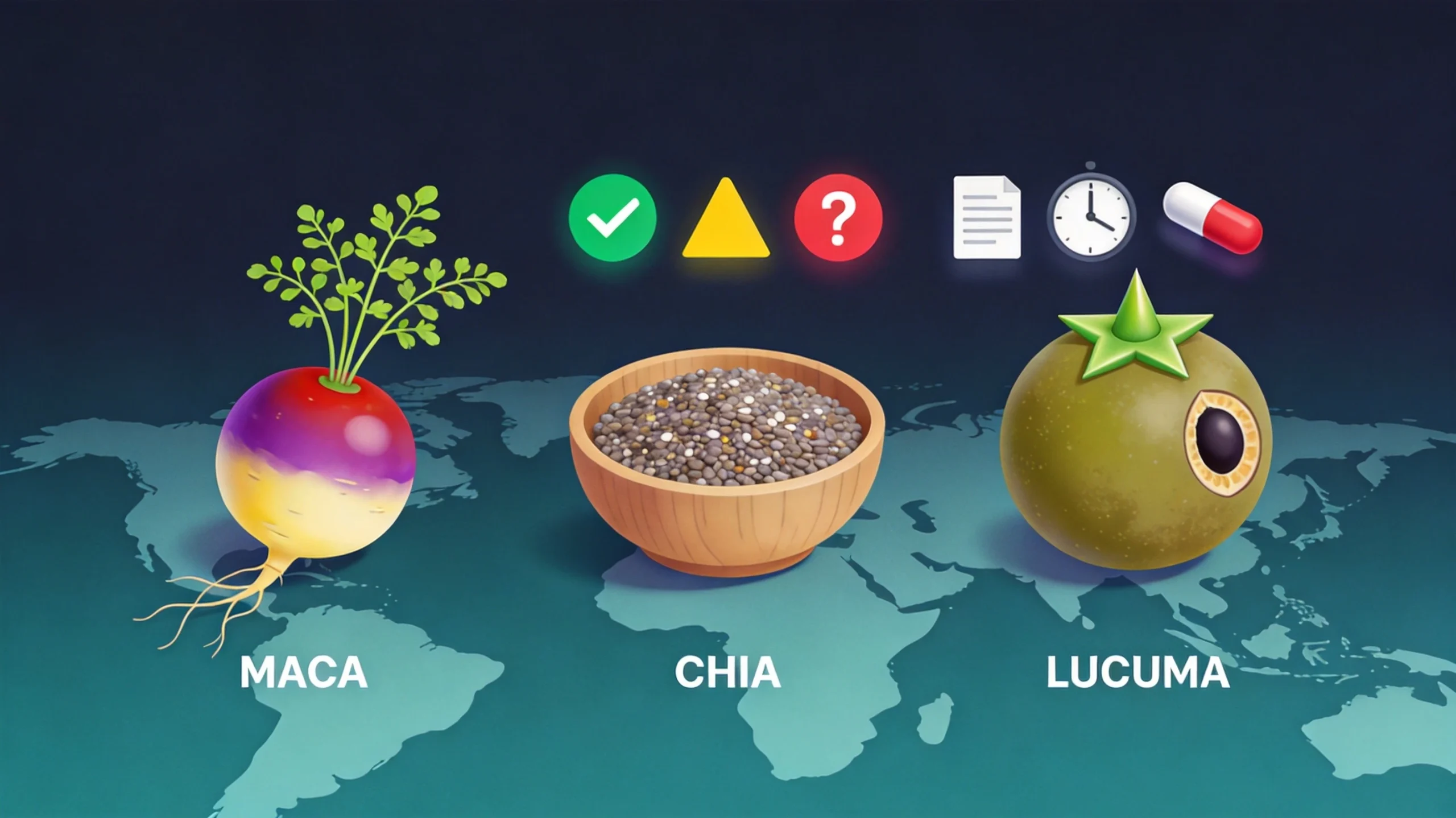
The global superfood boom has driven surging demand for ingredients like maca, chia, and lucuma across China, Japan, Korea, and Southeast Asia. But there is a critical gap between consumer interest and regulatory approval. A product that sells freely in Germany, the Netherlands, the United States, or Peru may be classified as an unapproved novel food ingredient in one or more Asian markets — requiring a separate, lengthy approval process before it can legally be imported, labelled, or sold.
This is not a theoretical risk. Shipments are detained, returned, or destroyed at Chinese, Korean, and Japanese ports every month because the exporter did not verify ingredient approval status before shipping. This guide breaks down what maca, chia, and lucuma exporters need to know across the three major North Asian markets — China, Japan, and South Korea — and how the approval landscape changes when you add Southeast Asia to the mix.
The Asian Superfood Market: Growing Demand, Fragmented Approval
Consumer demand for functional and "superfood" ingredients is rising across every major Asian market, but each market routes that demand through a very different regulatory framework.
- China's functional food sector has expanded rapidly over the past decade, with health food, functional food, and "new food raw material" categories all growing in double digits. Consumer segments for energy, immunity, sports nutrition, gut health, and beauty-from-within products have expanded beyond the middle-aged demographic to include consumers in their 20s and 30s.
- Japan's functional food market is mature and operates through the world's most-developed functional claim notification system. The Foods with Function Claims (FFC, 機能性表示食品) system, introduced in 2015, provides a pathway for products to make science-based health claims without the lengthy individual approval required for FOSHU (Foods for Specified Health Uses, 特定保健用食品). As of April 2025, FFC products account for the majority of new functional food launches in Japan.[1]
- South Korea's Health Functional Food (HFF, 건강기능식품) market was valued at KRW 5.96 trillion (approximately USD 4.4 billion) in 2025 according to the Korea Health Functional Food Association, recovering modestly from 2024.[2] Imports account for a significant share of the market, with vitamins, minerals, red ginseng, probiotics, omega-3, and body-fat-reduction categories leading sales. The consumer base has expanded from the traditional 50+ demographic to adults in their 20s–40s and children.
The challenge is not demand. It is regulatory fragmentation. Each market maintains its own list of approved ingredients, its own classification boundary between general food and functional food, and its own enforcement style. A single ingredient can be:
- A fully approved general food ingredient in one market
- Approved only as a functional ingredient with a specific notification pathway in a second market
- An unapproved novel food ingredient requiring a multi-year approval in a third market
This is the gap that this article addresses.
China: The "Three New Foods" Pathway
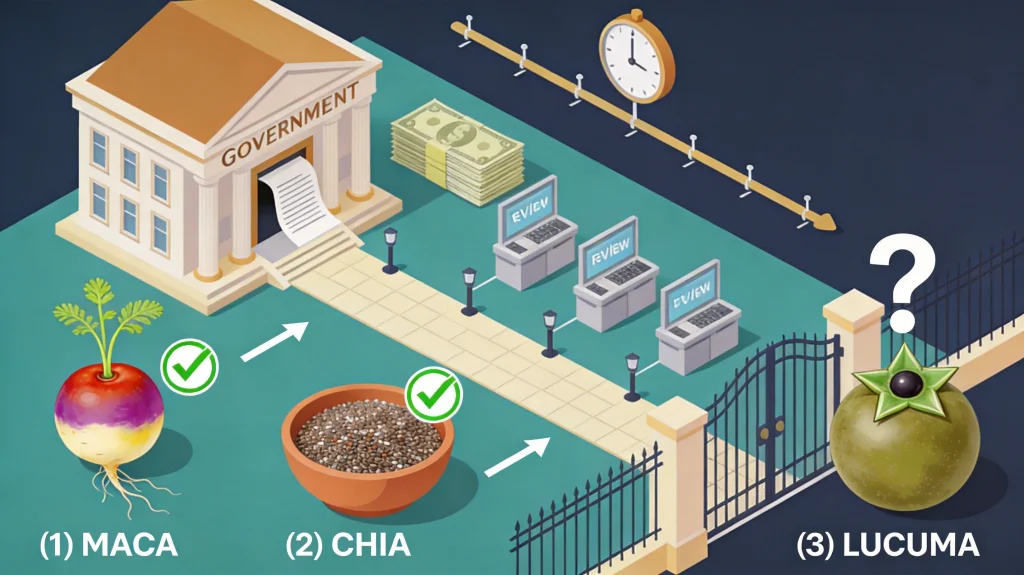
China regulates novel food ingredients through its "Three New Foods" (三新食品) framework, administered by the National Health Commission (NHC, 国家卫生健康委员会), with the China National Center for Food Safety Risk Assessment (CFSA, 国家食品安全风险评估中心) conducting technical reviews.[3] The three categories are:
- New food raw materials (新食品原料) — ingredients without a history of traditional consumption in China, or ingredients produced using new processes.
- New food additives (食品添加剂新品种) — additives not included in GB 2760 or used outside existing permitted scope.
- New food-related products (食品相关产品新品种) — packaging materials, processing aids, and other food-contact items.
Any ingredient without established consumption history in China must go through the new food raw material approval process before it can be used in food products sold or imported into China. The process involves dossier preparation, formal acceptance by NHC, technical review by CFSA expert committees, requests for supplementary data, public consultation, and final approval by public announcement.
Approval status of maca, chia, and lucuma in China
| Ingredient | China status | Basis | Key restrictions |
|---|---|---|---|
| Maca powder (玛咖粉) | Approved as a new food raw material | NHC Announcement No. 13 of 2011[4] | Cultivated maca (Lepidium meyenii) only; must be used in accordance with the announcement; label must state "not suitable for infants, young children, and pregnant/lactating women" in some product categories |
| Chia seed (奇亚籽) | Approved as a new food raw material | NHC Announcement No. 10 of 2014[5] | Initially restricted to specific food categories (beverages, dairy products, baked goods); label must state unsuitability for infants and young children; daily intake guidance applies per the announcement |
| Lucuma (蛋黄果/卢库马果) | Not approved as a new food raw material as of September 2026 | Not listed in any NHC "Three New Foods" announcement[6] | Cannot be imported or sold as a food ingredient in mainland China; requires a full new food raw material application before import |
Key takeaway: Maca powder and chia seed can legally be used in food products in China — but only within the scope of their approval (specified food categories, labelling restrictions, and any consumption limits). Lucuma is not approved and cannot be sold as a food ingredient in mainland China without prior NHC approval.
The approval timeline is important. NHC's published procedure states that expert technical review should be organised within 60 working days of acceptance, but the actual end-to-end timeline — from dossier preparation through testing, supplementary data requests, technical review, public consultation, and final announcement — averages approximately 18 months from acceptance for plant-based ingredients with established safety dossiers; complex, animal-derived, or higher-risk ingredients can take considerably longer, with total timelines of 2–4 years from initial application to approval not uncommon for novel ingredients without international precedent.[3] NHC does not charge an administrative approval fee, but the costs of dossier preparation, toxicological testing, notarisation, authentication, and translation are substantial, typically ranging from RMB 300,000 to over RMB 1 million depending on ingredient complexity and required testing.
Exporters who discover at the port that their ingredient is unapproved face immediate detention. There is no "provisional approval" or port-side remedy for an unapproved new food raw material. The shipment must be returned or destroyed.
Japan: The Foods with Function Claims (FFC) Pathway
Japan's approach to functional ingredients differs fundamentally from China's. Rather than maintaining a single pre-approval list for ingredients, Japan operates three regulatory categories for health-related foods, each with different requirements and permissible claims.
Japan's three functional food categories
- Foods with Function Claims (FFC, 機能性表示食品): Introduced in 2015 and now the most common pathway for new functional product launches. Under the FFC system, businesses submit a notification to the Consumer Affairs Agency (CAA, 消費者庁) to make science-based functional claims based on published clinical or systematic review evidence, without undergoing the individual government approval required for FOSHU.[7] The business operator bears full responsibility for safety and scientific substantiation. As of September 2025, all FFC products must also comply with GMP (Good Manufacturing Practice) requirements — a two-year grace period that ended on 1 September 2025, now fully enforced.[1]
- Foods for Specified Health Uses (FOSHU, 特定保健用食品): Requires individual approval from the CAA based on clinical trials demonstrating the health effect. This is the most stringent category and is typically used for products making disease-risk-reduction claims or specific physiological-effect claims (e.g., postprandial blood glucose, gastrointestinal health, cholesterol).
- General Health Foods (一般健康食品): Products without specific functional claims fall into the general food category and are not subject to FFC or FOSHU notification/approval requirements, but remain subject to general Food Sanitation Act requirements, food labelling standards, and any applicable ingredient restrictions.
How maca, chia, and lucuma fit
For maca, chia, and lucuma, the first question in Japan is not "is the ingredient approved" (the Chinese-style pre-approval question) but rather "what claims are being made and under which category" :
- Sold as a general food ingredient without health claims: Maca powder, chia seed, and lucuma powder can generally be sold as ordinary food ingredients in Japan, subject to standard Food Sanitation Act requirements, pesticide residue compliance, and general labelling rules. This applies when the product is positioned as a food ingredient (e.g., in smoothies, baked goods, snack bars) without functional or health claims.
- Sold with functional claims as an FFC product: This requires FFC notification. The CAA maintains a database of functional ingredients and published scientific evidence; if your ingredient and the specific functional claim (e.g., "helps reduce fatigue," "supports energy metabolism") are supported by published clinical studies meeting CAA evidence standards, you can submit an FFC notification. If the ingredient or claim is not already in the database, you must compile and submit your own scientific substantiation dossier.
- Sold as FOSHU: Requires individual CAA approval with full clinical trial data; this is the most demanding pathway and is rarely used for imported botanical ingredients.
The critical distinction for exporters is between "can I sell this as an ingredient" and "can I make a functional claim about it." The former is usually straightforward for established food ingredients with international consumption history; the latter triggers the full FFC notification system, including GMP manufacturing compliance, Japanese-language labelling, and science-based claim substantiation that meets CAA standards.
A common operational mistake is for exporters or their Japanese importers to ship a product that makes functional claims (on the label, in marketing material, or on the Japanese-language packaging) without having submitted an FFC notification. CAA enforcement actions against unnotified FFC claims have increased since GMP enforcement began in 2025, with products subject to recall orders, removal from retail, and public announcement of non-compliance.
South Korea: Health Functional Food vs. General Food — A Classification That Determines Everything
Korea draws the sharpest regulatory line between functional food and general food of any market in Asia. How your product is classified — and crucially, whether your packaging, dosage form, and claims push it into the Health Functional Food category — determines the entire market entry pathway, licensing requirements, and labelling rules.
Korea's three food categories relevant to superfoods
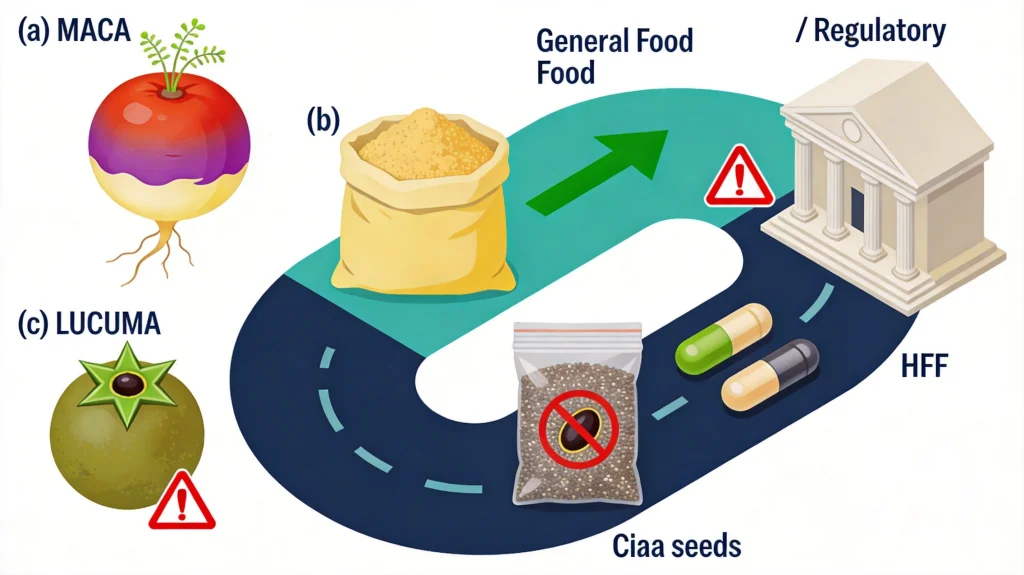
- Health Functional Food (HFF, 건강기능식품): Products in this category must be manufactured in specified forms (capsules, tablets, pills, liquids, powders in unit-dose packaging, or other forms recognised by MFDS) and must contain functional ingredients recognised on the MFDS-published Functional Ingredient List. Products making specific functional claims (e.g., immunity support, fatigue recovery, joint health, body fat reduction) must be classified as HFF, manufactured in an MFDS-licensed HFF facility, and imported by a Korean importer holding a separate HFF import business licence.[8] The HFF market was KRW 5.96 trillion in 2025, with vitamins/minerals, red ginseng, probiotics, omega-3 EPA/DHA, and body-fat-reduction categories as the top five segments.[2]
- Functional Display Food (FDF, 기능성표시식품): A category introduced to allow general food products to display the presence and content of functional ingredients, without being fully classified as HFF.[9] To qualify, products must use scientifically verified ingredients (ingredients recognised by MFDS for functional display), be manufactured in HACCP-certified facilities, and meet labelling requirements. This is the middle pathway that avoids HFF licensing but still permits limited functional ingredient content display.
- General Food (일반식품): Products without functional claims, in conventional food forms (powders sold in bulk, snacks, beverages, bakery products, meal components). Subject to general Food Sanitation Act requirements, food additive standards under the Food Code, Korean labelling requirements, and standard import inspection — but no HFF-specific licensing.
How maca, chia, and lucuma are classified in Korea
Maca: Maca root powder (Lepidium meyenii) is treated as a food ingredient rather than an HFF-notified functional ingredient in Korea. This means:
- Sold as a bulk powder, blended into smoothies, snacks, confectionery, or beverages without functional claims → general food pathway, standard import inspection, standard Korean labelling.
- Sold in capsule/tablet/pill form with functional claims (e.g., energy, stamina, male vitality) → classified as HFF, requiring MFDS HFF import licensing, HFF-grade manufacturing, and either use of MFDS-recognised functional ingredients or a full individual HFF ingredient recognition application.
Chia seed: Chia seed is a permitted food ingredient in Korea (it has a food ingredient code in the Korea Food Code) and can be used in general food products without HFF classification. Functional claims about omega-3 ALA content may trigger HFF or FDF classification depending on claim wording.
Lucuma: Lucuma powder, as a relatively uncommon ingredient in the Korean market, is not on the HFF functional ingredient list. It can be imported as a general food ingredient if it has a recognised food ingredient classification and meets Food Code specifications. Products positioning lucuma for blood sugar, antioxidant, or other functional claims will trigger HFF classification.
The most common rejection scenario we see with superfood ingredients in Korea is misclassification: an exporter ships maca in capsule form, labels it in English as a "dietary supplement" or "herbal supplement," and does not engage a Korean HFF-licensed importer. Korean customs and MFDS classify the product as HFF based on dosage form and claims; the importer does not hold the required HFF import licence, and the shipment is refused.
Southeast Asia: Fragmented Requirements, Tighter Labelling Scrutiny
Southeast Asian markets take a more varied approach to novel ingredients. The regulatory picture differs by country, and there is no ASEAN-wide mutual recognition for novel food ingredients.
- Singapore operates one of the most rigorous novel food frameworks in the region. The Singapore Food Agency (SFA) requires novel food applications for ingredients without an established history of consumption, with full safety dossiers. Singapore is also the only Asian market with a formal regulatory framework for cultivated meat and alternative proteins, and novel food review timelines can extend 12–18 months for unfamiliar ingredients.
- Thailand maintains a controlled food ingredient list under FDA Thailand. Ingredients not on the Thai FDA-approved list require pre-market approval; functional claims trigger food supplement classification.
- Indonesia requires BPOM (National Agency of Drug and Food Control) registration for all imported food products, with additional Halal certification mandatory under Law No. 33 of 2014 (effective from October 2024, with transition periods for existing products). The Halal requirement adds a distinct compliance layer for superfood ingredients, as Halal certification requires ingredient traceability and production process certification.
- Vietnam operates through the Ministry of Health and the Department of Food Safety, with food product registration required for imported functional foods and health supplements.
- Malaysia requires novel ingredient approval from the Food Safety and Quality Division (FSQD) under MOH, and Halal certification from JAKIM for products targeting the Malay consumer segment.
- Philippines operates through FDA Philippines, with food supplement registration for products making health claims.
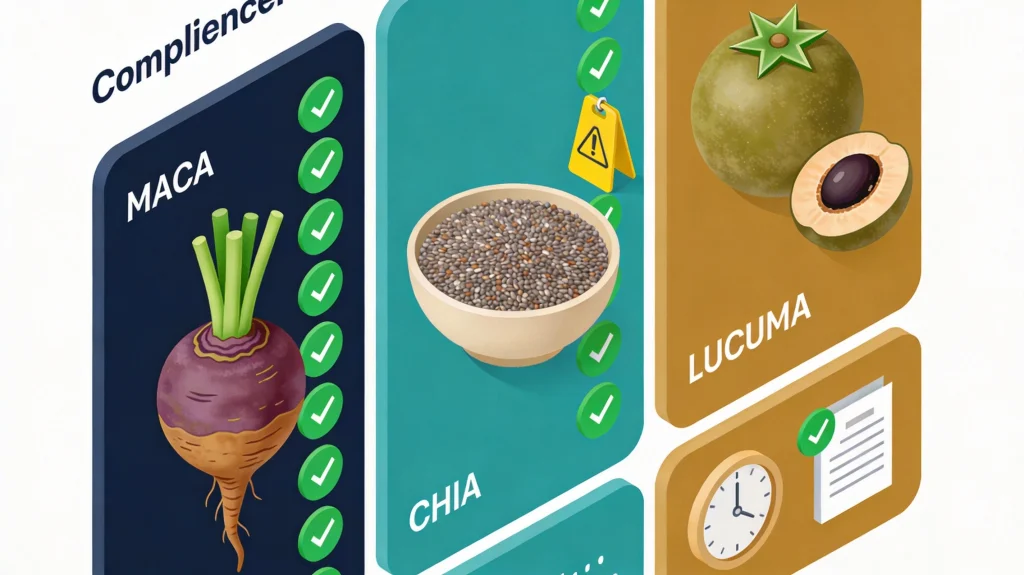
The common thread across Southeast Asia is labelling compliance. Even in markets where ingredient approval for established superfoods is less onerous than China's "Three New Foods" system, labels must meet local language requirements, allergen declarations, nutrition panel formats, and claim restrictions. An EU-compliant label will not pass retail inspection in Indonesia, Thailand, or Vietnam. For more on labelling variation across the region, see our Asia food labelling requirements overview.
The "Natural = Sellable" Myth: Three Detention Cases
The fastest way to lose a shipment is to assume that because an ingredient is "natural" or "traditional" in its country of origin, it can be sold as food in an Asian market. Here are three cases based on the types of detentions we see regularly:
Case 1: Lucuma powder detained in China for unapproved novel ingredient
An exporter shipped lucuma powder to a Chinese distributor under the HS code for "other dried fruit powders," assuming that because lucuma is a traditional Peruvian fruit with a long consumption history in South America, it could be sold as a food ingredient in China. Chinese customs identified the product during routine inspection, checked the NHC-approved new food raw material list, confirmed that lucuma is not approved as a new food raw material in China, and detained the shipment under Article 37 of the Food Safety Law (imported food must comply with Chinese national food safety standards and be composed of approved ingredients). The shipment was returned to origin at the exporter's cost. The distributor lost the sales window; the exporter lost freight, insurance, and the product itself.
The critical lesson is that consumption history in South America does not constitute consumption history in China. NHC makes its own determination of traditional consumption history based on documented evidence of consumption within China.
Case 2: Maca capsules rejected in Korea for HFF classification
A Peruvian maca exporter shipped maca capsules to a Korean importer who held a general food import licence but not an HFF import licence. The product was labelled as a "dietary supplement for energy support" in English, with capsules in blister packs. Korean MFDS classified the product as a Health Functional Food based on its dosage form (capsule) and functional claim (energy support). The importer did not hold the required HFF business licence, the product did not use an MFDS-notified functional ingredient, and the shipment was refused entry. The exporter was informed that re-import would require either (a) reformulating as a general food product (e.g., bulk maca powder with no functional claims and no capsule/tablet form) or (b) engaging an HFF-licensed importer and pursuing HFF ingredient recognition — a process requiring 12–18 months and a full technical dossier.
Case 3: Chia-based functional food held in Japan for missing FFC notification
A European chia-powder brand entered Japan through a distributor who listed the product on Amazon Japan with Japanese-language copy stating "supports omega-3 intake for daily health" and "helps maintain energy levels" — claims that constitute functional claims under Japanese FFC regulations. No FFC notification had been submitted. CAA identified the product through marketplace monitoring and required the Japanese distributor to either (a) remove all functional claims and relabel the product as general food, or (b) complete the FFC notification process before continuing sales. The shipment was held at the distributor's warehouse for six weeks during relabeling and notification preparation, with lost sales and relabeling costs borne by the exporter and distributor.
What Public Databases Won't Tell You
As with other Asian regulatory categories, the official approval lists and ingredient databases describe the formal requirements but do not tell you where routine failures occur. In our work with superfood and botanical ingredient exporters targeting Asia, four issues consistently cause preventable problems:
- "Approved" in China does not mean unrestricted. Both maca (2011 announcement) and chia seed (2014 announcement) were approved with specific scope restrictions: permitted food categories, labelling requirements (especially the "not suitable for infants and young children" warning), and in some cases daily intake guidance. Exporters who ship maca in a food category not listed in the 2011 announcement (for example, infant formula, children's snacks, or certain beverage categories) face detention even though the ingredient itself is approved. Scope matters as much as approval status.
- Dosage form, not just claims, triggers Korea's HFF classification. MFDS looks at the combination of form + claim + packaging. A powder in a 200 g stand-up pouch sold as a baking ingredient with no functional claims is general food. The same powder in 5 g unit-dose stick packs labelled "take one per day for energy" is HFF. Capsules and tablets are almost always classified as HFF regardless of claim wording. Exporters who ship in supplement-style packaging without understanding this classification boundary face automatic refusal.
- Japan's FFC notification must be filed by a Japanese entity — typically the Japanese importer or a Japanese marketing authorisation holder. Foreign exporters cannot file an FFC notification directly. If your Japanese distributor is unwilling or unable to take on FFC notification responsibility (and the associated post-marketing vigilance obligations, including adverse event reporting), your functional product cannot be legally sold with claims in Japan.
- Combination products are assessed against their least-approved ingredient. A blend containing chia (approved in China) and lucuma (not approved in China) is treated as an unapproved product for Chinese import purposes, regardless of how small the lucuma component is. The same principle applies in Korea and Japan for functional claims: a blend of a notified FFC ingredient and a non-notified ingredient cannot carry the functional claim for the notified ingredient if the product formulation does not meet FFC requirements.
These are not exotic edge cases. They are the standard mistakes made by exporters who verify headline approval status but do not work through category scope, dosage form, claim language, and entity responsibility for each target market.
Three Signals You Need a Multi-Market Compliance Assessment Before Shipping
Superfood exporters should seek professional multi-market compliance review before their first shipment to Asia if any of the following applies:
- You are unsure whether your ingredient appears on the approved or positive list in each target market — and specifically whether it is approved for the food category and dosage form you are shipping. Headline approval status is not enough; you need to confirm scope, permitted categories, and any labelling or consumption-limit conditions.
- Your product makes health or functional claims anywhere on the packaging, website, or marketing material, and you have not verified the notification or approval pathway for those claims in each target market. A "supports energy" claim that is permitted on a general food in the EU can trigger HFF classification in Korea, FFC notification in Japan, and health food registration/blue-hat requirements in China depending on wording and product form.
- You are selling the same SKU across multiple Asian markets using a single label or formulation. There is no "Asia-approved" superfood ingredient; each market requires its own approval check, and labels must be market-specific (local language, local allergen declarations, local nutrition panel formats, local claim restrictions).
The cost of a multi-market compliance review is small relative to a single detained or returned shipment, and it prevents the far larger cost of a regulatory rejection after the product has been marketed and sold.
Frequently Asked Questions
Can I sell a product in Asia if it is already approved in the EU or US?
No. Approval in one market does not transfer to another. Each Asian market maintains its own approved ingredient lists, classification systems, and regulatory pathways. Maca and chia seed are approved new food raw materials in China (with scope restrictions); lucuma is not. A product that is a compliant dietary supplement in the US or a food supplement in the EU may be classified as an HFF requiring a separate import licence in Korea, require an FFC notification in Japan, or be an unapproved novel food in China. Regulatory status must be verified market by market.
Do small-scale trial or sample shipments require ingredient approval?
Yes, if the product is imported for commercial sale — even in small quantities, even as "samples" intended for distributor presentations or trade show use. There is no general "trial shipment" exemption for novel food ingredients. Samples not for sale (laboratory testing, regulatory consultation samples, trade show displays not for distribution) may fall under separate procedures depending on the market, but any product imported for commercial distribution must comply with local ingredient regulations. For more on the distinction between samples and commercial shipments, see our guide to first shipments to China.
What is the boundary between general food and HFF in Korea?
The boundary is determined by a combination of three factors: product form (capsules, tablets, pills, liquids in ampoule form, and unit-dose powders are strongly associated with HFF classification), claims (any health maintenance, physiological function, or disease-risk-reduction claim triggers HFF), and packaging (unit-dose packaging with dosage instructions is treated as HFF). Powders in bulk packaging, conventional food forms, and products without functional claims may qualify as general food or Functional Display Food. The form, the claim, and the packaging together determine the pathway — not any single factor.
How long does new food raw material approval take in China?
NHC's published procedure specifies expert technical review within 60 working days of formal acceptance, but the end-to-end timeline from initial dossier preparation to final NHC public announcement approval averages approximately 18 months from acceptance for plant-based ingredients with well-established safety dossiers; complex, animal-derived, or novel ingredients without international precedent can take 2–4 years. The process involves dossier preparation, toxicological testing, NHC formality review, CFSA expert technical review (often with supplementary data requests), public consultation, and final NHC approval by announcement.[3] NHC does not charge an administrative fee, but dossier preparation, testing, and advisory costs can be substantial.
What if my product contains both an approved and a non-approved ingredient?
In all three major North Asian markets, the product's compliance is determined by the least-approved or most-restricted component. A blend containing chia seed (approved in China) and lucuma (not approved in China) cannot be legally sold as a food ingredient in China until lucuma is approved. In Japan, a product containing an FFC-notified ingredient and a non-notified ingredient cannot carry the FFC functional claim for the notified ingredient unless the entire product meets FFC requirements (including GMP manufacturing and scientific substantiation for all functional claims). In Korea, a product containing one HFF functional ingredient and one general ingredient, in capsule form with functional claims, is classified as HFF.
Do I need separate certifications for each Asian market?
For ingredient approval and product registration, yes — each market has its own approval status, classification rules, labelling requirements, and regulatory pathway. For private certifications (organic, Halal, non-GMO, etc.), some certifications are recognised across multiple markets (for example, EU organic is recognised in Japan under the EU-Japan mutual recognition arrangement for specific categories, as detailed in our Asia organic certification guide; Halal certification from a recognised body is accepted across most Muslim-majority Southeast Asian markets), but regulatory market access approval is not transferable.
Need a multi-market approval assessment for your superfood or novel ingredient product? We offer a compliance snapshot covering ingredient approval status, classification (general food vs. functional food vs. novel ingredient), labelling requirements, and the regulatory pathway for maca, chia, lucuma, and other botanical or functional ingredients across China, Japan, Korea, and Southeast Asian markets. Send us your product specification, ingredient list, intended claims, and target markets through our contact page for a market-by-market status assessment within 7 working days.
About Specit Consulting
We help food and beverage brands enter and grow in the Chinese and wider Asian markets through trade intelligence, tariff analysis, labelling compliance, ingredient and novel food approval support, functional food classification, importer identification, and market research.
✉ info@specitconsulting.com
[1]: NutraIngredients, "Major nutra regulatory developments across APAC in 2026," 5 January 2026: Japan GMP requirement for FFC fully enforced from 1 September 2025 (two-year grace period from September 2024 introduction); FFC system applies to all product formats including conventional foods.
[2]: Korea Health Functional Food Association (건강기능식품협회), "2025년 건강기능식품 시장 5조 9,626억 원," 20 November 2025: KRW 5.96 trillion in 2025, +0.2% YoY recovery from 2024; vitamins/minerals, red ginseng, probiotics, EPA/DHA omega-3, and body fat reduction as top five categories.
[3]: REACH24H and CIRS Group, "China's 'Three New Foods': Regulatory Framework & Approvals" and "Review of China's New Food Raw Materials in H1 2026," 2026: NHC is the approval authority, CFSA conducts technical reviews; NHC organises expert review within 60 working days of acceptance; end-to-end timelines average ~18 months from acceptance for standard plant-based ingredients, 2–4 years for complex/novel ingredients; NHC approved 12 new food raw materials in H1 2026 across Announcements No. 1 and No. 5 of 2026.
[4]: Ministry of Health (now NHC), Announcement No. 13 of 2011, "Approval of Maca Powder as a New Resource Food": approval of cultivated maca (Lepidium meyenii Walp.) powder as a new resource food, with usage and labelling requirements.
[5]: National Health and Family Planning Commission (now NHC), Announcement No. 10 of 2014, "Approval of Chia Seed as a New Food Raw Material": approval of chia seed (Salvia hispanica L.) as a new food raw material, with specified permitted categories, consumption limits, and labelling requirements including "not suitable for infants and young children" warnings.
[6]: NHC "Three New Foods" approval announcements (latest searchable through NHC and CFSA public databases): as of September 2026, lucuma (Pouteria lucuma) has not appeared in any NHC new food raw material approval announcement; confirmed absent from the Announcements issued through mid-2026 (No. 1 and No. 5 of 2026, and all prior 2024–2025 announcements).
[7]: Japan Consumer Affairs Agency (CAA, 消費者庁), Foods with Function Claims system overview, and FFC notification database: businesses submit notifications with scientific evidence (systematic reviews or clinical trials) supporting specified functional claims; CAA does not individually approve FFC products but publishes submitted notifications and monitors compliance.
[8]: MFDS, Health Functional Foods Act (건강기능식품에 관한 법률) and enforcement decrees; MFDS, "Standards and Specifications for Health Functional Foods" (건강기능식품의 기준 및 규격), most recently revised by Public Notice No. 2026-43 of 11 June 2026: HFF import business licence requirement, MFDS-recognised functional ingredient list, HACCP/GMP requirements for HFF manufacturing.
[9]: Korea government, "Functional Display Food vs. Health Functional Food" (기능성표시식품 vs 건강기능식품), Korea.kr visual news, 21 July 2026; MFDS functional display food regulations: FDF permits general food products to display the presence/content of functional ingredients using scientifically verified ingredients, manufactured in HACCP-certified facilities, without full HFF licensing.
Need help navigating your market entry?
We've helped food exporters across 10+ countries enter 13 Asian markets. Get a free initial assessment based on public data — delivered in 3 working days.
Get Your Free AssessmentContinue Reading
▶Food Import Detentions in Asia: 7 Real Cases and How to Avoid Them (2026)
▶Japan Food Import Requirements: A 6-Step Compliance Guide for EU Exporters (2026)
Questions about entering the Asian market?
Chat with us on WhatsApp →