

Canned food in Asia is not one market. It is several — and the reception differs sharply by country. A Portuguese sardine in olive oil, a French duck confit, a Spanish tuna belly, an Italian tomato passata — each carries a different meaning depending on where it lands. European canned and preserved food sells unevenly across the region, and exporters who treat it as a single category end up in the wrong aisles.
In Tokyo, tinned seafood is a growing premium category. In Seoul, it competes with a deeply established domestic canning industry. In Shanghai, "canned" still signals low quality for many consumers. This is the reality of canned food in Asia: one product category, five completely different reception patterns. Here is where each product actually sells, and what it takes to get there.
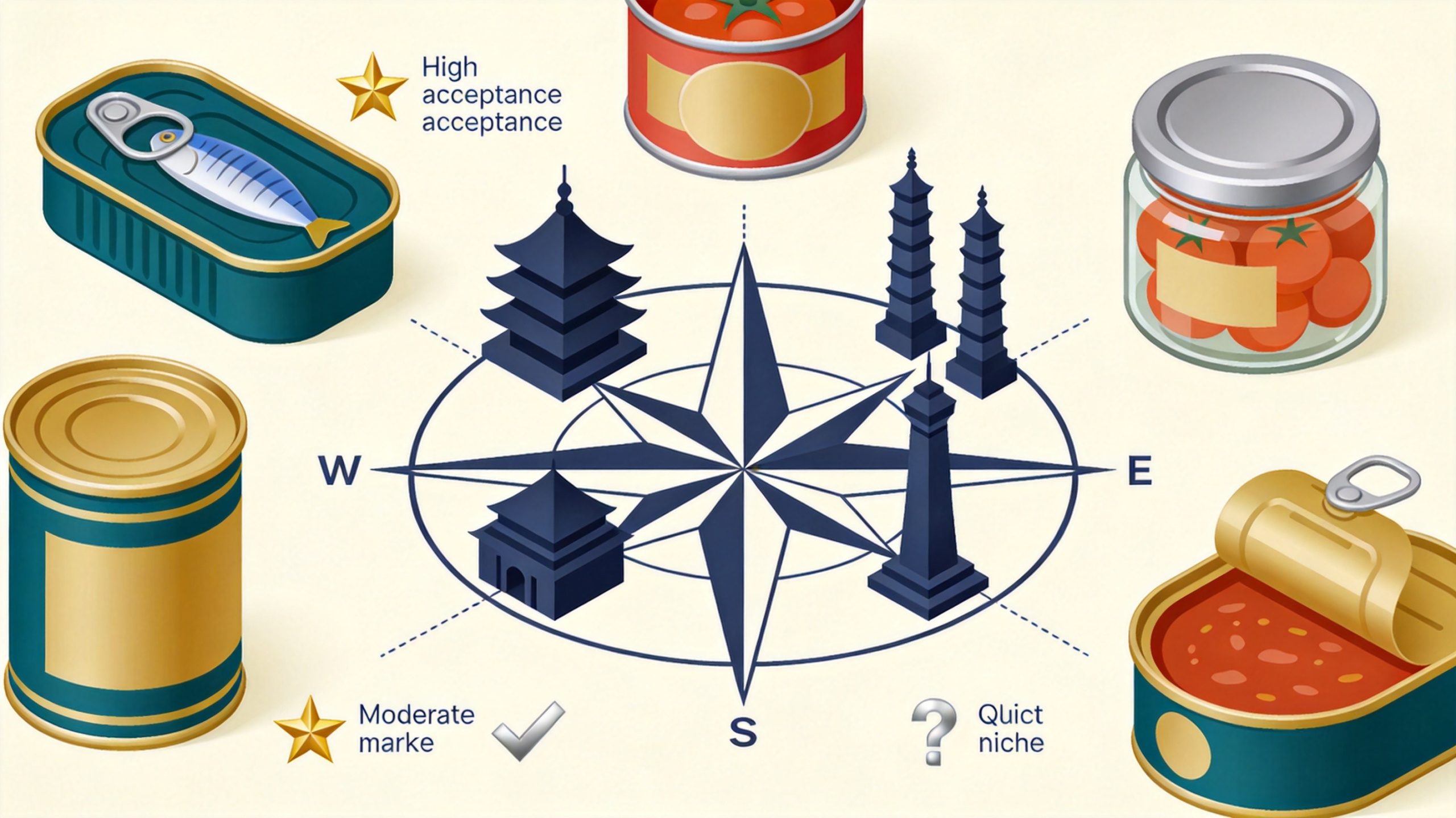
Market Acceptance Map

🇯🇵 Japan — Most Mature, Most Receptive
Canned food in Japan is not a compromise. It is a category.
Tinned mackerel (saba-kan), grilled chicken skewers in a can, corned beef — these are household staples. The disaster preparedness culture reinforces demand: the Cabinet Office's 2024 white paper recommends households keep seven days of shelf-stable protein on hand. That recommendation alone creates structural demand that does not depend on economic cycles.
The premium segment is where European brands can genuinely compete. Department store food halls (depachika) carry wagyu in a can and premium saba-kan lines at prices that would look absurd in a European supermarket, and consumers pay them. Price premiums are achievable if the product justifies them — provenance, olive oil quality, species specificity.
The numbers support this. Japan's canned meat market is valued at approximately USD 836 million in 2026, growing at a 4.5% CAGR. That is just meat. Add canned seafood, legumes, fruit, and ready meals, and the total canned food market exceeds USD 3 billion.
European tinned fish has an established audience. Portuguese sardines and Spanish mackerel in olive oil sell in premium supermarkets (Seijo Ishii, Meidi-Ya, National Azabu), and the customer understands the difference between oil-packed and water-packed, between a €2 can and an €8 can. This is not a market where you need to educate the consumer about why canned fish is good — they already know.
Verdict: Tier 1. Both volume and premium segments exist. Japan is the most receptive market for canned food in Asia — start here.
🇭🇰 Hong Kong & Macau — Western Food Gateway, High Acceptance
Colonial history, a large expat population, and no mandatory Chinese labelling requirement for most food categories — English labels are sufficient for retail — make Hong Kong the easiest entry point in Asia.
The retail infrastructure supports this. Waitrose, Market Place by Jasons, Taste, City'super and Great Food Hall all carry European canned goods in meaningful volume. Oil-packed sardines, tuna in olive oil, anchovies, pâté, duck confit, and French terrine all have mature consumers who repurchase. Pricing runs 30–50% higher than mainland China for comparable products, which supports better margins for distributors and exporters alike.
Hong Kong's strategic value goes beyond its 7.4 million consumers. It functions as a test market for Southeast Asia: one distributor can often cover Hong Kong, Macau, and cross-border movement into southern China through parallel trade or licensed importers in the Greater Bay Area. Zero import duty on most food categories keeps landed costs down and makes pilot shipments financially realistic.
Verdict: Tier 1. Low barrier, established demand, English labelling. The fastest way to get your cans onto Asian shelves, and the lowest-risk entry point for canned food in Asia.
🇰🇷 South Korea — Polarised
Korea has a large domestic canned food market — tinned tuna (Dongwon) and luncheon meat (CJ Spam, Lotte) are worth an estimated USD 2.3 billion combined. Spam is not a joke product here; it is a Chuseok gift set item, sold in gold-trimmed boxes. Budae-jjigae (army base stew) is a national dish.
But acceptance of European canned products is limited, and the reasons are culinary, not regulatory. Korean consumers prefer domestic flavours: ganjang-marinated mackerel, gochujang-braised fish, canned kimchi. European oil-packed sardines taste wrong to a palate raised on soy-chilli preservation. A French terrine is a foreign object in a Korean home kitchen.
What does work is canned fruit for baking and dessert applications. Mandarin oranges, peaches, cherries in syrup — these sell as ingredients for home baking and café patisserie, growing at roughly 5% CAGR. This is ingredient-driven demand, not ready-to-eat consumption, and it competes on quality and origin rather than flavour profile.
There is also a niche opportunity for premium oil-packed fish in high-end department store channels (Hyundai Department Store, SSG Food Market, Lotte Avenuel). It is small, and it will never be mass market, but it exists for brands with strong provenance stories.
Verdict: Tier 2. Fruit and dessert cans are viable and stable; meat and fish are difficult outside the premium niche. Canned food in Asia does not get more polarised than this.
🇨🇳 Mainland China — Low Acceptance, But Entry Points Exist
In the Chinese consumer mindset, "canned" (罐头) signals low-end, not fresh, and preservative-heavy. The COVID stockpiling wave of 2020–2022 created a temporary surge, but that has largely receded as fresh e-commerce and instant delivery restored normal buying patterns. Domestic brands — Meilin, Gulong, and regional canneries in Fujian and Shandong — dominate the low-price segment, and many Chinese consumers can cite the belief that "canned food contains lots of preservatives" even though commercially canned food relies on heat sterilisation, not chemical preservation.
Per-capita canned food consumption in China is roughly 1 kg per year, compared with roughly 90 kg in the United States, 50 kg in Western Europe, and 23 kg in Japan. The gap is not a market opportunity by itself — it reflects a genuine cultural preference for fresh, wok-cooked food.
That said, three entry points exist for European producers:
- Premium imported supermarkets. Ole', City'super, Hema Premium, and Costco carry European tinned seafood and oil-packed fish at price points that make quality positioning viable. The shopper in these stores is self-selecting for imported goods and is less influenced by the "canned = low quality" stereotype.
- Baking and ingredient use. Canned fruit, condensed milk, and coconut milk sell as raw materials for home baking and café supply chains. This is B2B demand, more stable than consumer-facing canned food, and less subject to the quality prejudice because the product is an input, not a finished meal.
- Cross-border e-commerce. Younger consumers, particularly in Tier 1 cities, are curious about imported brands and food trends. CBEC platforms (Tmall Global, JD Worldwide) allow market testing without full GACC factory registration, though you should be aware that the CBEC compliance framework is tightening under the Food Safety Law revision.
Verdict: Tier 3 for consumer-facing cans. Ingredient and CBEC channels are more viable than trying to build a mass-market canned food brand in mainland China. Canned food in Asia has no tougher consumer market than the mainland — the product category carries a quality stigma that takes years and premium positioning to overcome.
🇸🇬🇹🇭🇻🇳 Southeast Asia — Mid-Tier Acceptance, Halal Is the Gate
Thailand and Singapore have established canned food consumption cultures. Singapore's English-language environment, transparent regulatory system, and developed retail infrastructure (Cold Storage, FairPrice Finest, RedMart) make it accessible for European brands — though the market is small at 5.9 million people.
Indonesia and Malaysia present a binary gate. Canned meat and fish require halal certification — BPOM registration plus halal for Indonesia, JAKIM halal for products containing animal-derived ingredients for Malaysia. From 17 October 2026, halal certification becomes mandatory for almost all food and beverage sold at retail in Indonesia. European pork products and any cans containing alcohol (wine-based sauces, liqueur-preserved fruit) cannot enter these markets through normal retail channels. This is not a labelling issue; it is a market access exclusion.
Thailand has a developed canned food industry of its own (tuna, pineapple, seafood) but imports European canned goods in premium supermarket channels. Vietnam, under its current self-declaration regime, is relatively permissive, though consumer purchasing power for premium imported canned food is limited outside Hanoi and Ho Chi Minh City.
Verdict: Tier 2 for Singapore and Thailand. Indonesia and Malaysia require halal compliance — or deliberate exclusion from your target list. This halal gate is the single biggest constraint on canned food in Asia for European producers, many of whom use pork, wine,e or animal-derived ingredients that disqualify them from two of the region's largest consumer markets. For the full Southeast Asian market picture, see our six-country ASEAN compliance roadmap.
Compliance Snapshot by Market
Consumer acceptance determines whether canned food in Asia will sell; compliance determines whether it will be allowed in at all. Here is what the regulations say in the markets that matter.

China (GB 2760): Preservative minefield. Sodium benzoate is prohibited in meat, fish, sh and cheese. Sodium dehydroacetate is permitted only in canned meat at 0.5 g/kg. Nitrite in canned products is capped at 50 mg/kg — more lenient than other meat categories but still easy to exceed. Carry-over additives from ingredients (e .g., preservatives in olive oil used as a filling medium) must be declared on the label. Labelling must be in Chinese, with a Chinese-labelled sticker applied before sale unless the product enters through CBEC.
Japan: Positive list system for additives (ポジティブリスト). Any additive not on the list is prohibited. Canned products must also comply with container and packaging recycling regulations, including identification marks for steel vs aluminium cans. BPA and BPS internal coating restrictions have been progressively tightened; verify your can manufacturer's compliance before shipping. Japanese-language labelling is required for retail, with the importer typically applying compliant stickers on arrival.
Korea: KFDA additive standards apply. Bisphenol limits for metal can linings are stricter than EU standards in certain categories. Korean-language labelling is mandatory, including full ingredient lists in Korean. Canned meat and fish products require additional quarantine inspection at import.
Southeast Asia: Indonesia requires BPOM registration (6–12 months) plus halal certification (mandatory from 17 October 2026). Thailand requires Thai FDA label approval with Thai-language labelling. Vietnam operates a self-declaration system under the current transitional framework. Malaysia requires JAKIM halal certification for products containing animal-derived ingredients. Singapore accepts English labelling and has the fastest registration process (1–2 weeks).
Market Priority for European Canned and Preserved Exporters
Based on consumer acceptance, regulatory barriers, and margin potential, here is how to prioritise canned food in Asia for a European producer.
Tier 1
- Japan — mature canning culture, premiumisation, established consumer understanding of European tinned fish
- Hong Kong — low barrier, English labelling, zero duty, proven test market
Tier 2
- Singapore — English language, halal and non-halal channels clearly separated, regional hub
- Korea — fruit and dessert cans viable; meat and fish difficult outside the premium niche
Tier 3
- Mainland China — premium retail and CBEC only; do not attempt mass market
- Thailand / Vietnam — mid-tier acceptance, price-sensitive, limited premium shelf space
Requires halal or avoid entirely: Indonesia, Malaysia — pork and alcohol-containing products cannot enter retail channels. If your entire product range is pork-based or uses alcohol in preservation, these markets are not a realistic target.
Product Category Guidance
Not every European canned product has the same market fit. The following table summarises where each category of canned food in Asia is most likely to find consumers.
| Category | Best Markets |
|---|---|
| Oil-packed fish (sardines, tuna, anchovies, mackerel) | Japan, Hong Kong, Korea (niche), Singapore |
| Premium tomato products (passata, San Marzano, peeled tomatoes) | Japan, Hong Kong, Singapore |
| Canned fruit and dessert ingredients | China (B2B baking), Korea |
| Confit, terrine, pâté, rillettes | Hong Kong, Singapore (expat and premium channels) |
| Pork-based and alcohol-containing preserves | Avoid Indonesia, Malaysia, Brunei; focus on Japan, Hong Kong, Singapore, Korea |
Next Step
The right market for your canned product depends as much on consumer preference as on compliance. A sardine in olive oil is a different product in Tokyo than it is in Seoul. There is no single answer for canned food in Asia because there is no single Asian canned food consumer. Tell me your canned product category and target price point, and I will assess which markets have genuine consumer demand, which compliance hurdles apply, and what labelling adjustments your packaging needs. Contact Specit Consulting for a market-specific entry assessment for canned and preserved foods.
Disclaimer: This article is provided for general informational purposes only and does not constitute professional legal or compliance advice. Regulations, additive standards, halal requirements,s and labelling rules change frequently; specific products may be treated differently depending on HS classification, ingredient composition, processing method, od and port of entry. Market size figures are drawn from industry analyst reports (FMI, Decisions Advisors, KREI, China Canned Food Industry Association) current as of October 2026 and should be treated as directional estimates. Halal recognition lists and BPJPH-accredited foreign certifiers should be verified directly before initiating registration. For practical compliance support specific to your product category and target market, contact us at kevin@specitconsulting.com.
About Specit Consulting
Specit Consulting advises overseas food and beverage exporters on regulatory compliance and market entry across 13 Asian markets — China, Japan, Korea, Singapore, Thailand, Vietnam, Indonesia, Malaysia, the Philippines, Hong Kong, Macau, Taiwan, and India. We handle regulatory mapping and registration (including GACC Decree 280, Japan MHLW positive list, Korea MFDS, Thai FDA, BPOM Indonesia and SFA Singapore), labelling compliance including additive and preservative reviews against GB 2760 and national positive lists, halal certification navigation for Southeast Asian markets, detention resolution, and distributor due diligence. We do not sell freight or act as importer of record; we work alongside your chosen logistics partners and distributors to get products to market compliantly.
Further reading
- How to Export Food to China in 2026
- Export Food to Southeast Asia: A 6-Country Compliance Roadmap
- Selling Imported Food via China Cross-Border E-Commerce in 2026
- How FTAs Affect Food Import Tariffs in Asia
- Asia Food Export Market Priority: A Decision Framework
- Food Distributor Agreements in Asia: Eight Clauses Exporters Must Negotiate
FAQ
Do canned foods really contain no preservatives?
Most commercially canned food relies on retort sterilisation (high-temperature pressure cooking in a sealed container) rather than chemical preservatives for shelf stability. However, many European preserved foods — particularly semi-preserved products like anchovies in salt, certain pâtés, or alcohol-preserved fruits — do use preservatives or curing agents (salt, nitrite, sugar, alcohol). These must comply with the additive rules of each destination market.
Is Chinese-language labelling mandatory for canned food sold in Hong Kong?
No. English-language labelling is sufficient for most pre-packaged food in Hong Kong. Bilingual English-Chinese labelling is common but not legally required for imported products in premium channels. Traditional Chinese labelling is required for Macau for certain categories.
Can I sell pork-based canned products in Indonesia or Malaysia?
Not through normal retail channels. Both markets require halal certification for meat products, and pork is haram under Islamic dietary law. Non-halal sections exist in some supermarkets in Malaysia (particularly in non-Muslim majority areas like Penang), but the regulatory environment is tightening with Indonesia's mandatory halal law from October 2026. It is more realistic to focus your pork and alcohol-containing ranges on Japan, Hong Kong, Singapore, Korea, and the Philippines.
How strict is Japan's positive list for additives in canned food?
Very strict. Any additive not on the positive list is prohibited, regardless of whether it is approved in the EU. This is a common issue for European canned products that use preservatives or processing aids common in EU production but not approved in Japan — certain antioxidants, firming agents,s and colour retention agents fall into this category. An additive review against Japan's positive list should be your first compliance step.
What is the minimum order quantity to test Hong Kong or Singapore?
Both markets can accept relatively small pilot shipments, often pallet-level quantities rather than full containers, because of their developed import infrastructure and English-language environments. Hong Kong distributors frequently start with a pallet (approximately 500–1,000 cans depending on size) to test sell-through before committing to container volumes.
Need help navigating your market entry?
We've helped food exporters across 10+ countries enter 13 Asian markets. Get a free initial assessment based on public data — delivered in 3 working days.
Get Your Free AssessmentContinue Reading
▶Email Asian Food Importers: 5 Mistakes to Avoid
▶Exporting Food to Southeast Asia: A 6-Country Compliance Roadmap
▶Exporting Olive Oil to Asia in 2026: A Compliance Comparison for China, Japan and Korea
Questions about entering the Asian market?
Chat with us on WhatsApp →