

23 September 2026 | Shanghai, China
At Specit Consulting, we help food and agricultural exporters navigate market access across 13 Asian markets. Fresh fruit is one of the categories where we see the widest gap between exporter confidence and actual border readiness. Most fruit exporters planning China entry focus on tariffs, Incoterms, and pricing — but the shipments that get stopped at the port rarely fail because of duties.
They fail because of registration gaps, cold-treatment documentation errors, and incomplete phytosanitary paperwork. These are the issues that cause detention, re-export, or destruction — often after the fruit has already travelled thousands of kilometres in a temperature-controlled reefer, with the clock running on shelf life.
China imported 9.03 million tonnes of fresh fruit worth USD 18.94 billion in 2025, a 17.5% increase in volume and 6.7% in value year-on-year.[1] Durian alone accounted for USD 7.49 billion of that, with 1.87 million tonnes imported.[2] The market is large and growing. It is also one of the most strictly regulated fresh-produce import regimes in the world, and the difference between a profitable shipment and a total write-off often comes down to three or four documents.
China's Fresh Fruit Import Landscape
China's fresh fruit supply is structurally dependent on imports, but access is granted on a strictly bilateral basis. The General Administration of Customs of China (GACC) maintains a regularly updated list of approved fresh fruit varieties and source countries; fruit cannot be imported from a country or in a variety that has not been formally opened through a bilateral phytosanitary protocol.
As of mid-2026, the approved list includes (among others) mango, pineapple, banana, papaya, coconut, avocado, durian, table grape, cherry, melon, peach, apricot, longan, mangosteen, lychee, rambutan, jackfruit, passion fruit, and various citrus varieties, each tied to specific approved origins.[3] European stone fruit, citrus, kiwifruit, apples, and pears have partial access under specific bilateral protocols, but the list is narrower than many European exporters assume; for example, not all EU member states have access for all fruit categories, and several categories remain in protocol negotiation.
Southeast Asian suppliers dominate volume: in the first eight months of 2026, Yunnan province alone imported 910,000 tonnes of ASEAN fruit through land-border ports, a 31.2% year-on-year increase. Fresh durian accounted for 483,000 tonnes of that volume, valued at RMB 13.52 billion.[4] Through the Tianbao land port, daily durian imports reach approximately 200 tonnes, with peak days exceeding 400 tonnes.[4] This land-border trade moves on very short cycles (3–5 days from orchard to Chinese wholesale market) and operates under different cold-chain and inspection protocols than maritime reefer trade from Europe or the Southern Hemisphere.
The key point for non-ASEAN exporters is that country-level access approval is only the first gate. Every individual orchard and packing house that supplies fruit to China must also be registered with GACC, and the registration must be traceable through the entire supply chain. This is where the majority of preventable shipment failures occur.
Orchard and Packing House Registration: The Non-Negotiable First Step
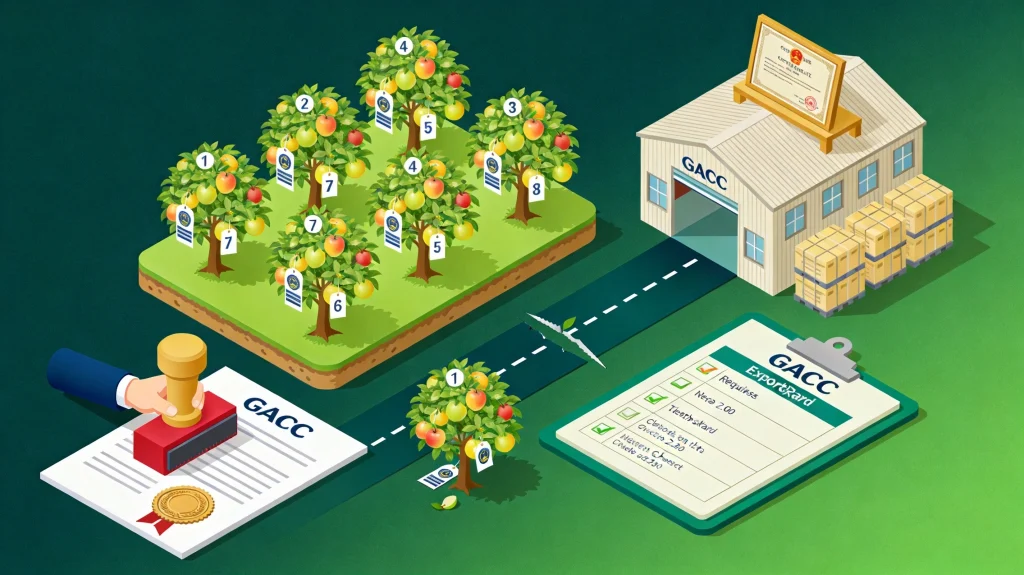
Under China's phytosanitary protocols and GACC's imported food overseas production enterprise registration system (most recently revised under GACC Decree No. 280, effective 1 June 2026), fresh fruit can only be exported from orchards and packing houses that have been reviewed, registered, and formally approved by GACC.[5] Shipments from unregistered orchards or packing houses are refused entry outright. There is no port-side procedure to "fix" a registration gap.
How registration works
Registration operates through the bilateral phytosanitary protocol for each fruit-country combination. The exporting country's national plant protection organisation (NPPO) — USDA APHIS for the United States, DG SANTE and member-state competent authorities for the EU, ICA for Colombia, DoA for Thailand and Sri Lanka, DAFF for Australia, and so on — is responsible for auditing and registering candidate orchards and packing houses, then submitting consolidated lists to GACC for review and final approval. GACC publishes the approved lists on its website, and Chinese port customs cross-check every shipment against these lists on arrival.
The 2026 revision of GACC Decree No. 280 introduced a classification-based registration system and streamlined some administrative procedures, but the core requirement remains unchanged: fruit must originate from a registered orchard and be processed and packed in a registered packing house.[5] The revision did not relax the traceability requirements or the mandatory registration for fresh produce.
Traceability is the operating requirement, not the form
Packing houses must establish traceability systems that allow any exported carton to be traced back to the specific supplying orchard. Required records include processing and packing dates, source orchard names or registration numbers, quantity, export date, destination, container number, and seal number. These records are subject to review by both the exporting country's NPPO and GACC inspectors, and must be retained for a minimum period specified in each bilateral protocol (typically two years).[6]
Registration is not a one-time formality. Lists of registered orchards and packing houses must be updated regularly — for example, Sri Lanka is required to provide GACC with updated lists every six months, and Thailand submits season-specific registration lists for durian. If an orchard changes its pest-management practices, loses its export certification in the home country, or is associated with a non-compliance finding, it can be removed from the GACC list. Exporters who rely on registration lists from a previous season without verifying current status risk shipping from deregistered sites.
How orchard registration fails in practice
The most common registration failure is not that the orchard was never registered. It is that the orchard's registration has lapsed, been suspended, or been superseded by an updated list, and the exporter did not verify current-season status before harvest. A secondary failure mode is consolidation: exporters sometimes aggregate fruit from multiple small orchards through a central packing house and assume the packing house's registration covers all supplying orchards. It does not — every supplying orchard must be individually registered and traceable on the phytosanitary certificate.
Cold Treatment and Temperature Records: Where Reefer Shipments Actually Fail
For many fruit varieties originating from countries or regions with quarantine pest risks — most notably Mediterranean fruit fly (Ceratitis capitata), Queensland fruit fly (Bactrocera tryoni), Oriental fruit fly (B. dorsalis), and various species of fruit borer — cold treatment is a mandatory phytosanitary measure. The specific temperature and duration requirements are set product-by-product in each bilateral protocol, and they are non-negotiable.
Cold treatment schedules are protocol-specific
Cold treatment schedules vary significantly by fruit type, pest risk, and origin. They are specified in the bilateral protocol, not in a single universal GACC table. To illustrate the range:
- Iranian kiwifruit to China: fruit pulp temperature at or below 1.11°C for 14 consecutive days, or 1.67°C for 16 days, or 2.22°C for 18 days.[7]
- South African citrus to China (GACC Announcement No. 47 of 2026): fruit pulp at or below –0.2°C for 16 continuous days, or at or below 1.0°C for 19 days.[8]
- Peruvian pomegranate to China (GACC Announcement No. 229 of 2025): fruit pulp at or below 1.11°C for 15 days, or 1.67°C for 17 days.[9]
- Australian apricots, table grapes, and citrus (non-Western Australia): fruit pulp at or below 3°C for 18 days; Western Australian production 2.1°C for 21 days; WA citrus additionally 1°C for 16 days.[10]
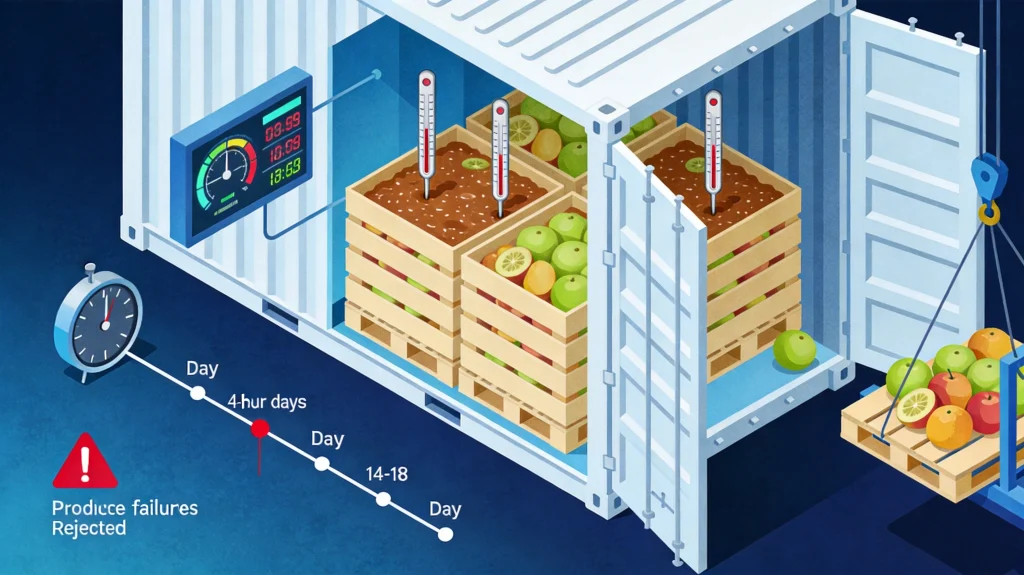
The critical distinction is that temperature is measured at fruit pulp level, not at ambient reefer air temperature. Air temperature can fluctuate during door openings or at loading while fruit pulp temperature remains within the required range — but customs checks pulp probe records specifically, not reefer unit air-temperature logs.
Probe and recorder requirements
The temperature recording equipment and probe placement must meet the specifications set out in the relevant protocol. Requirements vary, but common elements include:
- Recorder operating range covering at least –3.0°C to +3.0°C with accuracy of ±0.15°C or better.
- Recording interval of at least once per hour (some protocols require more frequent intervals).
- At least three to four pulp probes inserted into fruit at specified positions, including one probe at the geometric centre of the cargo (the warmest point, where cold treatment is slowest to take effect) and one near the return-air inlet.
- Probes must be calibrated before and after each treatment voyage, with calibration records available for inspection.
- Data must be downloadable and retained until verified by Chinese customs officials on arrival.[7]
If any probe fails for more than four continuous hours (the threshold varies slightly by protocol), the entire cold treatment is considered invalid. This is the single most common technical cold-treatment failure for long-haul reefer shipments: a single probe dislodges during a rough ocean crossing, its data stream drops out for six hours, and the entire 16- or 18-day treatment is voided even if all other probes maintained correct temperatures.
In-transit vs. onshore cold treatment
For some origins (including the United States, South Africa, Australia, Chile, and Peru), cold treatment can be conducted either onshore before export or in transit during the sea voyage. If conducted in transit, the phytosanitary certificate must state "Cold treatment in transit" and include the treatment temperature, duration, container number, and seal number.[11] If the cold treatment is conducted onshore before export, the treatment facility must be approved by both the exporting NPPO and GACC, and treatment records must accompany the shipment.
In-transit cold treatment is the more common option for Southern Hemisphere fruit to China (the voyage from South America or South Africa to China is long enough to accommodate the 14–21 day treatment requirement), but it transfers execution risk to the carrier and the exporter's logistics provider. If the reefer unit experiences a technical fault, if probes are not correctly placed at loading, or if temperature deviations occur during the voyage, the treatment is invalidated on arrival, and there is no opportunity to restart it.
Phytosanitary Certificates: The Paperwork That Has to Match
Every consignment of fresh fruit imported into China must be accompanied by an official phytosanitary certificate issued by the exporting country's NPPO. The certificate is not a generic document; each bilateral protocol specifies additional declarations that must appear in the "additional declaration" field, and minor discrepancies are sufficient for detention.
Three certificate issues cause the majority of fresh-fruit detentions:
1. Missing or incorrect orchard/packing house registration numbers. The certificate must include the name or GACC registration number of every orchard and packing house that supplied the consignment. GACC officials verify these numbers against the current approved list on arrival.[6] For Thai durian in the 2026 season, for example, certificates must indicate the latest orchard registration number issued for the current season; certificates carrying previous-season numbers or missing the registration number result in direct detention of the goods.[12]
2. Incorrect additional declaration text. Each bilateral protocol specifies exact wording that must appear in the additional declaration field. For Colombian Tahiti limes, the certificate must state: "This consignment complies with the requirements specified in the Protocol of Phytosanitary Requirements for Export of Fresh Tahiti Lime Fruits from Colombia to China, and is free from quarantine pests of concern to China."[13] Paraphrasing, abbreviating, or omitting required wording is a basis for refusal.
3. Mismatch between certificate details and shipping documents. Container numbers, seal numbers, consignee names, and product descriptions on the phytosanitary certificate must match the bill of lading, commercial invoice, and packing list exactly. Discrepancies — even minor typographical ones — can trigger document holds while corrections are requested, and perishable fruit loses shelf life every day it sits under inspection hold (for context on how shelf-life and date-marking rules shape retail window calculations across China, Japan, and Korea, see our date-marking guide).
Three Reasons Fresh Fruit Shipments Get Rejected
Across markets and origins, three issues account for the majority of preventable fresh-fruit import failures into China.
1. Fruit from an unregistered or suspended orchard/packing house
If the fruit originates from an orchard or packing house that is not on GACC's current approved list, the entire consignment is refused entry. There is no port-side registration remedy. The shipment must be returned or destroyed. This issue most often arises not from deliberate circumvention but from supply-chain changes: a grower adds a new orchard block to the programme, a packing house subcontracts overflow to another facility, or a consolidation centre sources from a co-operative whose registration lapsed between seasons. In all cases, the exporter bears the loss.
2. Cold treatment records with gaps, probe failures, or deviations
Temperature records must be continuous, complete, and within the specified pulp-temperature band for the required duration. Recorder failure, probe displacement exceeding the four-hour threshold, incomplete calibration documentation, or pulp temperature excursions outside the protocol range invalidate the treatment. The consequences depend on the pest risk and the port of entry: in some cases the shipment may be offered on-arrival cold treatment at a designated facility (adding 2–3 weeks and fees, with the fruit continuing to age); in most cases the options are return or destruction.
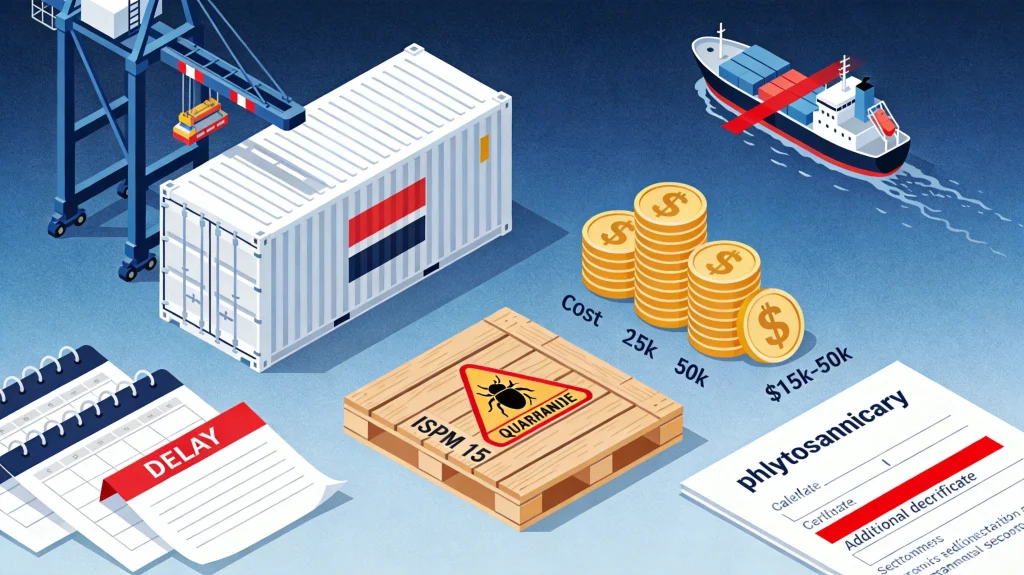
The commercial impact is severe. A 40-foot reefer of premium Southern Hemisphere stone fruit or berries can carry USD 30,000–80,000 in product value; return freight to origin runs USD 5,000–15,000; reefer storage at Chinese ports during inspection holds costs USD 150–400 per day in electricity and storage charges; and demurrage/detention on the reefer container accumulates at USD 150–350 per day after free time.[14] A single cold-treatment failure on a high-value perishable can cost the exporter the full FOB value of the shipment plus logistics charges.
3. Phytosanitary certificate errors — numbers, wording, or mismatches
Certificates with outdated registration numbers, missing or paraphrased additional declaration text, or data mismatches with shipping documents cause detention while corrections are sought. For perishable fruit, a 3–7 day document hold is itself a commercial failure even if the certificate is eventually corrected, because wholesale distributors will not accept fruit with reduced remaining shelf life. (We outline how to profile and qualify Asian importers with the cold-chain and category experience your fruit needs in our importer sourcing guide.) This is an especially acute problem for air-freighted berries, cherries, and other short-shelf-life items where a document hold of even two or three days destroys retail value.
Wood Packaging: The ISPM 15 Requirement
If your shipment uses solid wood packaging — wooden crates, pallets, dunnage, or blocking — the wood must be treated and marked in accordance with ISPM 15 (the International Plant Protection Convention standard for wood packaging material in international trade). The IPPC (International Plant Protection Convention) mark must be visible, legible, and compliant with current ISPM 15 specifications.
Shipments with wood packaging that lacks a valid IPPC mark, or where the mark is illegible or does not meet requirements, are not eligible for normal entry. Chinese customs may order mandatory treatment (methyl bromide fumigation or heat treatment at the importer's cost), destruction, or return of the non-compliant packaging — which typically requires unloading and re-palletising the entire shipment at the port, adding days and cost to a perishable cargo.[15]
Exceptions exist for processed wood materials such as plywood, particle board, oriented strand board, or veneer (materials that have undergone sufficient manufacturing processing — heat, pressure, and glue — to eliminate pest risk). Plastic pallets and cardboard packaging are not affected. But if any solid wood component is present in the packaging assembly, the IPPC mark requirement applies to all solid wood pieces in the shipment.
Frozen Fruit (IQF): A Different Regulatory Pathway
The compliance pathway for frozen fruit differs fundamentally from fresh fruit. Frozen fruit falls under different HS codes (Chapter 08, various frozen-product codes rather than the fresh-produce codes) and is inspected under GACC's imported food safety regime rather than the fresh-produce phytosanitary regime. For example, frozen avocados from Kenya entering China are subject to pesticide-residue testing, heavy-metal screening, and microbial pathogen testing — a food-safety inspection focus rather than a fresh-produce phytosanitary focus.[16]
The operational differences are important:
- No mandatory cold treatment for pest control. The freezing process itself is the phytosanitary treatment for most pests of concern, so the strict cold-treatment schedules and probe requirements described in Section 4 do not apply to IQF fruit.
- Overseas production enterprise registration is still required. Frozen fruit manufacturing facilities must be registered with GACC under the Decree No. 280 system (Category: processed fruit/vegetable products), just like other food production facilities.
- Traceability and food-safety documentation apply. Frozen fruit must comply with Chinese food safety standards (GB 2762 for contaminants, GB 2763 for pesticide residues, GB standards for microbiological limits), and testing against these standards may be required at import inspection.
- Different shelf-life and cold-chain expectations. Reefer temperature for frozen fruit is maintained at –18°C rather than the positive temperatures used for fresh produce cold treatment; the documentation expectations are for cold-chain integrity during transport, not for phytosanitary pest disinfestation.
Fresh fruit exporters should not assume that registration or supply-chain compliance for fresh produce automatically covers frozen products, or vice versa. The regulatory pathways, competent authorities, and inspection regimes are separate. For more on the food-safety and registration framework that applies to processed and frozen food imports, see our guide to exporting processed food to China.
What Public Checklists Won't Tell You
As with other areas of Asian market access, the published protocols describe the requirements but not where operational failures routinely occur. In our work with fresh-fruit exporters targeting China, four issues cause problems that no public checklist explicitly warns about:
- Approved-list status changes by season, not just by year. GACC and the exporting NPPO update orchard and packing house lists at different frequencies for different countries. Thai durian lists are updated annually before the season; Southern Hemisphere stone fruit lists are audited before each export season; some countries' lists are audited on rolling schedules. Assuming that last season's registration is still valid for the current season is dangerous. Verify against the current published GACC list immediately before each shipment.
- Cold-treatment probe placement is the carrier's responsibility only if you contract it that way. Many exporters assume the shipping line or reefer operator will place probes correctly. In practice, probe placement is often done at the packing house or by the freight forwarder's loading team, and reefer crew will not reposition probes once the container is sealed. If your packing house has not been trained in GACC probe placement protocol, the risk of probe failure or misplacement is high.
- Additional-declaration wording varies not just by country but by protocol revision. GACC periodically updates the required additional declaration text (for example, when pest lists change or new pest risks are identified). The wording that worked for a shipment six months ago may no longer be the exact text required for the current protocol. Exporters who rely on template phytosanitary certificates from their freight forwarder without checking against the latest bilateral protocol risk certificate rejection.
- Land-border and maritime arrivals follow different inspection rhythms. ASEAN fruit arriving overland through Guangxi or Yunnan land ports moves through dedicated fast-track inspection channels, with same-day or next-day clearance for compliant shipments. Maritime reefer arrivals at Shanghai, Dalian, Tianjin, or Shenzhen go through standard port inspection queues, and inspection-order categories or random sampling can add 3–7 days. Planning shelf life and sales-channel timing requires knowing which inspection regime your port of entry operates under.
These are not exotic failures. They are routine consequences of operating a perishable supply chain across multiple regulatory jurisdictions without product-specific China-market experience.
Three Signals You Need a Compliance Review Before Your First Shipment
Fresh fruit exporters who contact us after a detention or rejection usually understand the basics — bilateral access, registration, cold treatment, phytosanitary certificates. The question is whether your specific product, origin, and supply chain are actually ready. You should seek professional review before your first shipment if any of the following applies:
- You cannot confirm that every supplying orchard and packing house is on the current GACC published list for the current season. If you are aggregating from multiple small growers, using a new packing house, or entering China for the first time, have your supply chain verified against the official list by someone who reads Chinese and can navigate the GACC registration database.
- Your cold-treatment protocol has not been validated end-to-end for China. If your team, packing house, or freight forwarder has not previously executed China-specific cold treatment with calibrated pulp probes at the required positions, with Chinese-acceptable documentation, and with in-transit monitoring procedures, you are at high risk of a probe failure or temperature-deviation rejection on your first voyage.
- Your phytosanitary certificate additional declaration wording has not been checked against the latest bilateral protocol for your specific fruit and origin. Forwarder templates and previous-season certificates are not reliable; protocols are revised when pest risks change.
For high-value perishable cargo, a pre-shipment compliance review costs a tiny fraction of a single rejected reefer container.
Frequently Asked Questions
How long does GACC orchard and packing house registration take?
The registration process is conducted through the exporting country's NPPO, which audits and approves orchards before submitting consolidated lists to GACC for final approval. Timelines vary significantly by country and fruit type. For countries with established protocols, seasonal list updates may take 2–4 months from NPPO audit to GACC publication. For new fruit-country combinations still in bilateral protocol negotiation, the entire market-access process can take years. GACC may also conduct virtual or on-site inspections of orchards and packing houses in the exporting country before granting initial approval, particularly for higher-risk categories.
Can a rejected shipment be salvaged?
For unregistered-orchard rejections, no — the consignment is refused entry and the options are return or destruction. For cold-treatment failures, on-arrival cold treatment may be offered in some cases at designated facilities (if capacity is available and the fruit has sufficient remaining shelf life), but this is not guaranteed, adds 2–3 weeks of treatment time, and is rarely commercially viable for anything other than the longest-shelf-life categories. For certificate errors, corrections may be possible through the NPPO, but each day in detention consumes remaining shelf life on a perishable product. There is no straightforward port-side "fix" for a rejected fresh fruit shipment.
Is it safe to use a third-party agent for registration?
Using an agent does not change GACC's technical requirements. The orchard and packing house must still meet the pest-management, traceability, and facility standards in the protocol, and registration must correspond to the actual production site. If an agent facilitates registration without the orchard genuinely meeting protocol requirements — for example, by registering a facility that does not actually handle the exported fruit — the registration can be suspended or cancelled when discovered, and future shipments from that exporter may face elevated inspection.
Does European GlobalGAP or other private certification substitute for GACC registration?
No. Private food-safety certifications (GlobalGAP, BRCGS, etc.) are valuable for buyer relationships and may support your NPPO's audit of your facility, but they are not a substitute for GACC registration and do not create any presumption of compliance with Chinese phytosanitary requirements.
Need a compliance snapshot for your fresh fruit export to China? We offer a free initial assessment covering GACC bilateral access status, current orchard and packing house registration verification, cold-treatment protocol validation, and phytosanitary certificate compliance for your specific fruit variety, origin, and port of entry. Send us your product specification, supply chain summary, and intended port of entry through our contact page for a turnaround within 7 working days.
About Specit Consulting
We help food and beverage brands enter and grow in the Chinese and wider Asian markets through trade intelligence, tariff analysis, labelling compliance, registration support, importer identification, and market research.
✉ info@specitconsulting.com
[1]: Produce Report, "China's 2025 Fruit Import Statistics Released," 11 February 2026, citing Chinese customs data: total fruit imports USD 18.94 billion, 9.032 million tonnes, +6.7% in value and +17.5% in volume YoY.
[2]: China Daily, "Exporters of Durians Taste Sweet Success," 15 August 2026, citing Chinese customs data: 1.87 million tonnes of fresh durians imported in 2025, import value USD 7.49 billion.
[3]: GACC, List of Fresh Fruits Admissible for Import into China and Approved Origins, updated periodically. As of mid-2026, the list covers tropical, subtropical, temperate, and stone fruit varieties tied to specific approved country origins.
[4]: Yunnan provincial customs data as reported by Chinese agricultural trade media, January–August 2026: 910,000 tonnes of ASEAN fruit through Yunnan land ports, +31.2% YoY; durian 483,000 tonnes, RMB 13.52 billion; Tianbao port daily durian throughput approximately 200 tonnes, peaks above 400 tonnes.
[5]: GACC Decree No. 280 (revised), Regulations of the People's Republic of China on Registration Administration of Overseas Production Enterprises of Imported Foods, issued April 2026, effective 1 June 2026; accompanied by GACC Announcement No. 27 of 2026 (implementation announcement).
[6]: Bilateral phytosanitary protocol provisions (standard across China's fresh fruit protocols): registered orchard and packing house numbers must appear on the phytosanitary certificate; GACC cross-checks against current published approved lists at the port of entry.
[7]: Iranian kiwifruit cold treatment schedule as cited in industry cold-treatment protocol references; three temperature-duration options.
[8]: GACC Announcement No. 47 of 2026, Supplementary Phytosanitary Requirements for the Import of Fresh Citrus Fruits from South Africa, 7 May 2026: two cold treatment options (–0.2°C/16 days or 1.0°C/19 days pulp temperature).
[9]: GACC Announcement No. 229 of 2025, Phytosanitary Requirements for the Import of Fresh Pomegranates from Peru, 17 December 2025: two cold treatment options (1.11°C/15 days or 1.67°C/17 days pulp temperature), onshore pre-export or in-transit.
[10]: Australian Department of Agriculture, Fisheries and Forestry (DAFF), China export protocols: Apricots, Table Grapes, Citrus, updated 2026: cold treatment schedules by state of origin (Mediterranean fruit fly-free areas vs. WA vs. other states).
[11]: USDA APHIS and DAFF export programme manuals: in-transit cold treatment procedures for fresh fruit exports to China, including required phytosanitary certificate notation "Cold treatment in transit" with temperature, duration, container number, and seal number.
[12]: Thai durian phytosanitary certificate requirements for 2026 season: certificates must indicate the latest orchard registration number for the current season; outdated or missing numbers result in direct detention.
[13]: Colombian Tahiti lime protocol, Protocol of Phytosanitary Requirements for Export of Fresh Tahiti Lime Fruits from Colombia to China: exact required additional declaration text as cited.
[14]: Perishable logistics cost references: Greenwich Mercantile, "My Perishable Shipment Is Stuck at the Port" (2026): reefer holds USD 15,000–50,000 per container including reefer storage USD 150–400/day, demurrage USD 150–350/day, power USD 50–150/day; Gerudo Logistics, "Demurrage and Detention Fees for Reefer Containers" (2026); industry reefer freight rates for 40-foot reefer containers China–South America/South Africa/Europe return lanes.
[15]: ISPM 15 (FAO International Plant Protection Convention), Regulation of Wood Packaging Material in International Trade, current revision; Chinese customs implementation: solid wood packaging without valid IPPC mark may be treated, destroyed, or returned at importer's cost.
[16]: Kenyan frozen avocado China market access protocol: pesticide residue, heavy metal, and microbial pathogen testing requirements (food-safety regime) rather than fresh-produce phytosanitary cold treatment.
Need help navigating your market entry?
We've helped food exporters across 10+ countries enter 13 Asian markets. Get a free initial assessment based on public data — delivered in 3 working days.
Get Your Free AssessmentContinue Reading
▶Exporting Food to Asia in 2026: A Market Prioritization Framework for Craft Food & Beverage Brands
▶Food Import Detentions in Asia: 7 Real Cases and How to Avoid Them (2026)
Questions about entering the Asian market?
Chat with us on WhatsApp →