

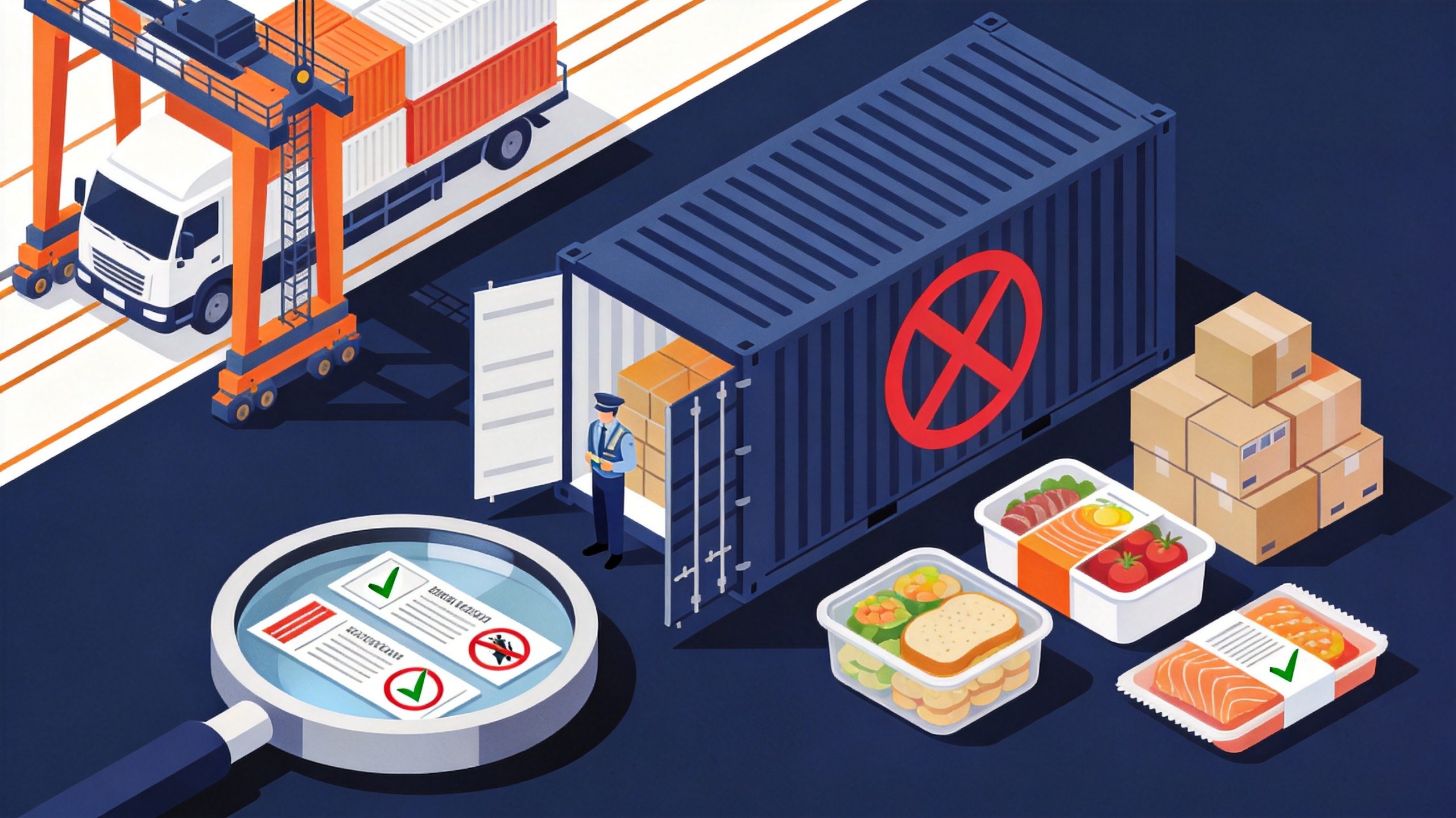
Asia food label rejection is consistently the single largest cause of food import refusal across the region. In China, label non-compliance alone accounted for 159 out of 617 rejected food batches in August 2025 — roughly 25% of all refusals, according to GACC's public rejected-food data. By January 2026, that figure had risen to 191 out of 629 batches, over 30%.
The pattern is not unique to China.
In Japan, roughly one in five import notifications flagged for document review by MHLW Quarantine Stations involves label issues. In Korea, MFDS label review is a standard checkpoint on every foreign-manufactured food product filing, and label errors are the most common cause of supplementary data requests during import clearance.
Labels fail more often than additive violations, more often than missing certificates, more often than contamination issues. And they fail for reasons that are entirely preventable before the container leaves the factory.
This is the category of import rejection where there is no excuse. Labels are not held up by a surprise regulatory change, or a contaminated ingredient, or a geopolitical dispute. Labels fail because someone in the supply chain assumed the US or EU label would be accepted, or ran the Chinese/Korean/Japanese translation through a generic translator without checking against local rules, or did not know that the three major East Asian markets each run entirely different label systems with no mutual recognition.
Here are the six reasons Asia food label rejection happens, in order of frequency from our case files, and exactly how to fix each one before you ship.
1. Incomplete or Incorrect Allergen Declarations

Allergen declarations are the number one label rejection cause across all three major Northeast Asian markets. The problem is not just that allergens are mandatory — it is that Japan, Korea, and China each maintain different mandatory allergen lists, and no two are the same.
A product label that is fully compliant in one market can fail in the next. A US FDA-compliant "Contains: Milk, Wheat, Soy" label is not compliant in any Asian market without localisation.
Here is how the three frameworks differ, as of October 2026:
| Market | Mandatory allergens | Recommended/voluntary | Format requirement |
|---|---|---|---|
| Japan (Food Labelling Act / 食品表示法) | 8 items (egg, milk, wheat, buckwheat/soba, peanut, shrimp/prawn, crab, walnut/kurumi — walnut added April 2023) | 20 items (abalone, squid, salmon roe, orange, kiwifruit, beef, walnut, salmon, mackerel, soybean, chicken, banana, pork, matsutake, peach, yam, apple, gelatin, cashew, sesame — note: almond added to recommended 2025) | Specific emphasis required: allergens must appear in brackets after the ingredient name (e.g., "乳化剤(大豆由来)"), in a dedicated allergen box (原材料に含まれるアレルギー物質), or in the ingredient name itself. They cannot simply be listed inline without emphasis. |
| Korea (Food Code / 식품공전) | 27 items (expanded from earlier lists; includes egg, milk, buckwheat, peanut, soybean, wheat, mackerel, crab, pork, peach, tomato, sulfite, walnut, chicken, beef, squid, shellfish/oyster, pine nut, and additional items added in 2024–2025 rounds) | — All 27 are mandatory | Allergen must be declared in Korean, in the ingredient list or a dedicated box, with the Korean names of the allergenic substances. Note: Korea applies a 10 ppm threshold for allergen cross-contamination disclosure. |
| China (GB 7718-2025, mandatory 16 March 2027) | 8 categories (cereals containing gluten, crustaceans, fish, eggs, peanuts, soybeans, milk/dairy, tree nuts) — note: GB 7718-2025 expanded tree nuts to include cashew, pistachio and other nuts beyond the earlier subset, and introduced stricter emphasis requirements | — | Allergenic ingredients must be emphasised in the ingredient list by bold, contrasting colour, or underline. A separate allergen box is not required but is recommended. The standard Chinese names for each allergenic ingredient must be used. |
What goes wrong in practice:
- A European chocolate label declares "nuts" as an allergen. Japan and Korea require the specific nut to be named (almond, cashew, walnut, hazelnut are all individually listed), and Korea requires disclosure even where the nut is a carry-over from shared equipment at ≥10 ppm.
- A US frozen meal declares "spices" generically. Japan requires individual allergen disclosure; if the spice blend contains mustard or celery (both EU-mandatory but neither Japan-mandatory; conversely, buckwheat and yam are Japan-mandatory but not EU-mandatory), the label may miss items.
- A Japanese label uses the box format (アレルゲン一覧). China does not accept this on its own — the allergen must be emphasised inline in the ingredient list under GB 7718.
- Korean labels in particular fail on cross-contamination statements. An EU-style "may contain traces of nuts" advisory statement is not recognised in Korea in the same form; if a product contains a mandatory allergen even at trace levels from shared equipment, the Korean label must indicate it using the Korean standard phrasing.
How to fix: Run the full finished-product ingredient list, including carry-over from compound ingredients and processing aids, against the allergen list of each target market before commissioning label artwork. Do not assume that because your EU or US allergen box is complete, it is sufficient for any Asian market. A single missing mandatory allergen is an automatic detention.
2. Date Marking Formats That Do Not Match Local Rules
Date marking is the second most common driver of Asia food label rejection, and it is often the most avoidable. Each market has strict rules about how dates must be expressed, and simply translating a US "Best By: 03/07/27" or EU "07.03.2027" will not work.
Japan:
Japan requires a consumption-by date (消費期限) for perishable foods (including most chilled and many frozen ready meals with short shelf life) or a best-before date (賞味期限) for shelf-stable and frozen foods. Dates must be in the Japanese calendar year or Western calendar year, in year-month-day order, in Japanese characters or Arabic numerals, clearly indicated. The date format must not be ambiguous — "12/03/2027" is not acceptable because MHLW interprets Japanese date order as year/month/day, but a label printed with US-style month/day/year format will be misread.
Korea:
Korea uses year-month-day format (yyyy.mm.dd or yyyy-mm-dd) for both manufacture date (제조연월일) and shelf-life expiry date (유통기한 or 소비기한, depending on food category — note: Korea transitioned most foods from 유통기한/sell-by to 소비기한/use-by in 2023). For frozen foods, the date must be printed in indelible ink, not on a removable sticker. The date must appear on the primary display panel or in a location specified by Korean Food Code rules for that category.
China (GB 7718-2025):
China is the strictest of the three. A label that states "shelf life: 12 months" without printing both a specific production date (生产日期) and a specific shelf-life expiry date (保质期至) is automatically non-compliant under GB 7718-2025. Both dates must appear in year-month-day order (YYYY MM DD or YYYY/MM/DD or YYYY.MM.DD), in Chinese characters on the primary panel, with the shelf-life expiry date calculated from the production date. "Best before 12 months from production" is not acceptable. The production date must be a real date printed by the manufacturer, not a sticker applied after import (with narrow exceptions for bulk importer repackaging).
The common mistakes:
- US "MM/DD/YYYY" or EU "DD/MM/YYYY" format labels used directly for Japan/Korea/China without reformatting.
- "Shelf life: 18 months" without a printed expiry date for China.
- Manufacture date printed on the outer carton but not on individual consumer packs (a common failure in Korea and China).
- Date stickers applied on top of the original date by the importer — both Japan and China prohibit over-stickering of production dates; in China, if the importer applies a Chinese back label, the original production date must remain visible, and the Chinese label must accurately reflect it.
How to fix: Commission a separate date marking layer in your artwork file for each market, and print the correct format at the factory. Do not rely on importer-applied date stickers for the production date. For frozen foods going to multiple markets, consider printing both YYYY.MM.DD format (works for Korea, China, and Japan when the Western calendar is used) on the primary panel and include the Japanese 賞味期限 / 消費期限 and Korean 제조연월일 / 소비기한 text as required.
3. Additive Names Not in the Local Standard Language
Additive naming is the third leading cause of Asia food label rejection. This issue overlaps with additive compliance — but even when all your additives are permitted, you can still fail on how they are named on the label.
E-numbers (E202, E330, E415), INS numbers, and English common additive names are not recognised as valid label declarations in Japan, Korea, or China. Each market requires the additive to be listed by its local standard name:
- Japan: additive names must use Japanese designated names (指定添加物名称) per the MHLW Food Labelling Act, written in hiragana, katakana, or kanji as specified in the Food Labelling Act tables. "Potassium sorbate" is not acceptable; the label must read ソルビン酸カリウム.
- Korea: Korean standard names per the MFDS Korean Food Code additive nomenclature must be used. E-numbers are not accepted in lieu of the Korean name.
- China (GB 2760): Chinese standard names from GB 2760-2024 and the GB 2760 additive list must be used, written in simplified Chinese characters (简体中文). E-numbers may appear alongside the Chinese name but cannot substitute for it. For example, "potassium sorbate" must appear as 山梨酸钾; E202 alone is not acceptable.
A related failure: additives listed by category class name without specific identification (e.g., "emulsifier", "preservative", "antioxidant" with no further detail). Japan and Korea generally require the specific additive to be named; China permits category names for some additive classes but requires specific names for others. When in doubt, list the specific name.
How to fix: When preparing additive information for your label translation, do not simply hand the translator your US or EU ingredient list. Provide CAS numbers and additive functional classes, and have the translator (or compliance consultant) map each additive to the local standard name in the target market's official additive list. This is a job for someone who knows the local GB 2760 / Food Labelling Act / Food Code lists — not for a general translator.
For a deeper look at how additive approvals differ across markets, see our article on Japan frozen food additive approvals and the China GB 2760 pre-shipment additive check.
4. Country of Origin Missing, Misplaced, or Vague
Each Northeast Asian market has specific rules about where and how country of origin must appear on a label, and these rules differ from EU "origin marking" and US "country of origin" labelling.
China (GB 7718-2025):
The country of origin (原产国) must appear on the same display panel as the product name, clearly visible to the consumer, in Chinese characters (e.g., 原产国:意大利 / 原产国:西班牙). It cannot be on a side panel, cannot be in English only, and cannot use vague descriptions such as "Product of EU" or "European produce" — the specific country must be named. For products where a raw material origin is highlighted (e.g., "French olive oil"), the origin of the raw material must not mislead the consumer about the country of manufacture.
Japan (Food Labelling Act):
Japan requires country of origin (原産国名) for imported processed foods, labelled in Japanese katakana or kanji (e.g., 原産国名:フランス / イタリア). Additionally, Japan maintains raw material origin declaration requirements (原料原産地表示) for certain processed food categories where the main ingredient's origin is considered material — for example, some meat products, rice products, seafood products, and confectionery categories may require the origin of the main ingredient to be declared even when the product is manufactured domestically. For imports, check whether your category triggers raw material origin disclosure.
Korea (Food Code / Foreign Food Labelling Standards):
Korea requires country of origin (원산지) in Korean, on the primary display panel or in a location readily visible to consumers. Korea also has agricultural and fishery product origin labelling rules that extend to processed foods containing certain proportions of beef, pork, chicken, rice, kimchi cabbage,e and other specified ingredients — if the product contains more than a threshold quantity (e.g., meat products where beef/pork constitutes a certain proportion), the individual meat origin may also need to be declared.
Common failures:
- "Made in the EU" or "European product" — China and Korea require specific country naming.
- Country of origin printed on the back panel but product name on the front — China requires both on the same display panel.
- "Produced for [Brand], [EU city]" without explicitly stating the country — insufficient in all three markets.
- "Product of France" for a product bottled or packed in a different country — origin must reflect the country of substantial processing or manufacture, not the brand home country.
- Products where raw material origin is marketed on the front of pack (e.g., Italian-flag imagery with "Italian recipe" or "Tuscany" branding) but the actual manufacturing country is not named — Japan and China both flag this as misleading.
How to fix: Put the country of origin in Chinese/Japanese/Korean on the same panel as the product name, naming the specific country, before the label goes to print. If the product uses origin-themed branding (flags, maps, regional names, "Mediterranean", "Provence"), cross-check whether the branding implies a specific origin that must be substantiated on the label.
5. Nutrition Panel Formatted for the Wrong Market

A nutrition information panel (NIP) designed for one Asian market will not pass in another. The required nutrients, units, reference values, es and formats are all different.
China (GB 28050-2025, effective alongside GB 7718):
China requires the "1+4" core nutrients declared on every pre-packaged food label: energy (能量, in kJ per 100g/100mL), protein (蛋白质), fat (脂肪), and carbohydrates (碳水化合物), plus sodium (钠). Additional nutrients are optional or conditionally required depending on claims. Values must be expressed per 100 g or per 100 mL, and must include NRV% (营养素参考值百分比) — the percentage of the Chinese Nutrient Reference Value, calculated from GB 28050's NRV table (which differs from Codex, US Daily Values and EU Reference Intakes).
Saturated fat, trans fat, sugars and dietary fibre are conditionally required if making a claim about them, or mandatory in certain food categories.
Korea (Food Code / Food Labelling Standards):
Korea requires a nutrition panel with energy (kcal, per serving and per 100g), plus the standard "Big 9" set including carbohydrates, sugars, protein, fat, saturated fat, trans fat, cholesterol, sodium, and other nutrients as applicable. Korea uses daily value percentage (1일 영양성분 기준치에 대한 비율,%), which is not the same as Chinese NRV% or US DV — the reference values differ.
Japan (Food Labelling Act nutrition labelling):
Japan requires a standard nutrition panel (栄養成分表示) showing energy (kcal), protein, fat, carbohydrates, and salt equivalent (食塩相当量, in grams — note: Japan uses salt-equivalent rather than sodium, which is a structural difference from China and the US). Saturated fat and dietary fibre are required for most products as of the current labelling standards. Japan does not use NRV% as a mandatory column, though reference values may be voluntarily included.
Why this matters:
- An EU-style "per 100g + per portion" panel with E% (energy percent) and no sodium in the correct format will fail in China.
- A US panel with "Sodium 460mg 20% DV" uses US Daily Values, not Chinese NRV% or Korean daily %.
- A panel that lists sodium (Na) instead of salt equivalent for Japan requires a conversion (salt = Na × 2.54).
- A panel that omits trans fat (required in Korea for most foods, conditionally in China) will be rejected in Korea.
- Per-serving values without per-100g values are not acceptable as the sole format in China or Japan.
How to fix: Build separate nutrition panel tables for each market, calculated using that market's reference values and format rules. Do not attempt to use a single "Asia" nutrition panel. The arithmetic conversion from one format to another is straightforward (kJ = kcal × 4.184; salt = Na × 2.54; NRV% uses China's specific NRV numbers per GB 28050, not Codex), but it must be done correctly,y or the panel will be rejected.
6. Importer / Local Responsible Party Information Missing

Every food label sold in Japan, Korea, or China must include the name and address of a local in-country responsible party on the label. This is not optional — a product without local contact information is a leading cause of Asia food label rejection, considered a "white label" smuggling risk,k and refused at the border.
The local entity differs by market:
Japan:
Japan requires the name and address of the Japanese importer of record (輸入者), plus their contact information (phone number is standard practice). This must be a legal entity with a physical address in Japan — a PO box is not sufficient, and a foreign manufacturer's address does not substitute. For direct-to-consumer e-commerce imports (cross-border), different rules apply, but for standard retail/foodservice imports the Japanese importer must appear. The importer is also the entity filing the MHLW import notification (輸入届出), so the name on the label must match the name on the notification.
Korea:
Korea requires the name and address of the Korean importer (수입원 or 수입판매원), who holds the food import business registration (수입식품등 수입판매업 등록) under MFDS. The importer's Korean address and telephone number must appear in Korean on the label, typically on the back panel alongside the foreign manufacturer information.
China (GB 7718-2025):
China requires the name, address, and contact information of the Chinese distributor/importer (国内经销商/进口商) registered in mainland China, in Chinese characters. The distributor's address must be a valid China mainland address; a Hong Kong or Macau address does not satisfy this requirement for domestic-sold products. For products imported through general trade (not CBEC cross-border), the Chinese distributor must be identified on the label alongside the country of origin and the foreign manufacturer. For cross-border e-commerce (Tmall Global, JD Worldwide, etc.) stored in bonded zones, different rules apply and simplified Chinese labelling may be on the product detail page rather than physically on-pack — but that is a separate regulatory channel.
The most common failures:
- Foreign manufacturer's address only, with no Japanese/Korean/Chinese importer.
- Importer name but no physical address (just a website or email).
- Outdated importer information from a previous distributor relationship that is no longer active.
- For China: a Hong Kong address presented as the domestic distributor — this is non-compliant for general trade.
- For Japan: an English-only importer name without Japanese katakana rendering.
How to fix: Confirm your local in-market partner (importer/distributor) well before the label goes to print, and leave a blank or template section in your artwork for their name, address, and contact details. The importer should review and sign off on the final label proof before printing — they are legally responsible for the label's accuracy at the port of entry.
The Pre-Shipment Label Checklist
Asia food label rejection is almost always preventable when the artwork is checked against market-specific rules before print. Before any food shipment departs for Japan, Korea, or China, the label should clear all six of these checkpoints:
- Allergens: Each allergen in the finished product (including carry-over from compound ingredients and cross-contamination at relevant thresholds) is declared using the local market's standard name, format, and emphasis rules.
- Date marking: Production date and shelf-life expiry date are printed in the correct local format (YYYY.MM.DD, specific dates in Chinese for China, shoumi-kigen/shohi-kigen for Japan, jei-gi-han/so-bi-gi-han for Korea), on the correct panel, in indelible print.
- Additive names: Every additive is listed using the local standard name in the local language — not E-numbers, INS codes, or English common names — and matches the approved additive list for that market.
- Country of origin: The specific country of manufacture/substantial processing is named in the local language, on the same panel as the product name, with no misleading origin branding.
- Nutrition panel: Formatted for that market specifically — Chinese NRV% with per-100g values and the GB 28050 nutrient set; Korean daily values with the Korean nutrient set; Japanese format with salt equivalent rather than sodium.
- Local importer information: A valid in-country importer or distributor with a physical local address is named in the local language, matching the entity filing the import notification with that market's regulator.
If you can check all six boxes, your label is very unlikely to be detained on labelling grounds. If any one box is unchecked, fix it before the container sails — relabelling a container at the port costs between USD 3,000 and USD 15,000 depending on market and product category, and adds 2–6 weeks to your time to shelf.
If you are preparing your first label for Japan, Korea, rea or China and want an independent review before you go to print, send your current label artwork and ingredient specification to kevin@specitconsulting.com. We will provide a free 1-page label gap review within 5 business days, flagging the items most likely to be refused at the border — before you incur printing or relabelling costs.
Specit Consulting advises overseas food and beverage exporters on regulatory compliance and market entry across 13 Asian markets — China, Japan, Korea, Singapore, Thailand, Vietnam, Indonesia, Malaysia, the Philippines, Hong Kong, Macau, Taiwan, and India. We handle regulatory mapping and registration (GACC, MHLW, MFDS, Thai FDA, BPOM, SFA), labelling compliance, additive approval, halal certification, health claims review, detention resolution, and distributor matching. We do not sell freight or act as importer of record; we work alongside your chosen logistics partners and distributors.
Disclaimer: The information in this article is based on regulations and on-the-ground experience as of October 2026, and is provided for general guidance only. It does not constitute legal advice. GB 7718-2025 and GB 28050-2025 enter mandatory enforcement on 16 March 2027; Japan and Korea periodically update mandatory allergen lists and nutrient reference values. Always verify current rules with the relevant authority or a qualified advisor before shipping. Specit Consulting accepts no liability for decisions made based on this article.
Further Reading
- China GB 2760 Additive Check: The Pre-Shipment Review Every Brand Must Run
- Japan MHLW Food Import Rejected: 7 Reasons and What to Do
- Korea MFDS Registration for Overseas Food Manufacturers
- Japan Frozen Food Additives: Why US & EU Brands Get Held at MHLW
- FHC Shanghai 2026: 5 Pre-Show Actions to Complete Two Weeks Before
- Wine & Spirits Import in Japan, Korea, Taiwan & Singapore: A Small Winery Guide
FAQ
Are food labels for Japan, Korea and China mutually recognised?
No. There is no mutual recognition of food labels among Japan, Korea and China. Each market has its own labelling standards, mandatory ingredient/allergen/nutrient disclosures, language requirements, and format rules. A label compliant in one is very unlikely to be compliant in another without localisation. Even within Greater China, mainland China (GB standards), Hong Kong (FEHD/CFS rules), and Taiwan (TFDA rules) each operate separate labelling regimes.
Is it true that China requires simplified Chinese on the label for general trade imports?
Yes. All pre-packaged food imported into mainland China through general trade must carry a label in simplified Chinese characters meeting GB 7718-2025 requirements. Traditional Chinese used in Hong Kong/Taiwan does not satisfy the requirement. English-only labels are not acceptable. The Chinese label may be a pre-printed part of the packaging or a supplementary sticker applied under supervision before sale, but the sticker must cover all mandatory elements and cannot obscure the production date.
Does Japan require Japanese-language labels on all imported food?
Yes. All pre-packaged food sold to consumers in Japan must carry a label in Japanese (hiragana/katakana/kanji) meeting Food Labelling Act requirements, including ingredient list, allergens, nutrition, importer information, and date marking. Foreign-language-only products may be sold only through licensed bonded warehouses, duty-free shops under specific conditions, or direct cross-border e-commerce to Japanese consumers (which operates under a different customs regime).
What is the difference between China's NRV% and US Daily Values?
China's Nutrient Reference Values (NRV) per GB 28050 are different from US FDA Daily Values and EU Reference Intakes. For example, the sodium NRV is 2000 mg in China, versus 2300 mg in the US (2400 mg for older DV); energy NRV is 8400 kJ (2000 kcal) in China. Using US DV% numbers on a Chinese label will be rejected even if the absolute nutrient values are correct.
Can I use E-numbers or INS codes on Asian food labels?
No. E-numbers and INS codes are EU/Codex nomenclature and are not accepted as the primary additive identification in Japan, Korea, or China. Each additive must be listed by its local standard name in the local language. E-numbers may appear alongside the local name on a Chinese label but cannot substitute for the Chinese GB 2760 name. In Japan and Korea, E-numbers are not generally used on consumer-facing labels at all.
If I have to relabel at the port, how much does it cost and how long does it take?
Port relabelling (applying compliant Chinese/Korean/Japanese stickered labels to non-compliant stock under customs/importer supervision) typically costs USD 3,000–15,000 per container depending on product category, number of SKUs, and port location, and adds 2–6 weeks to clearance time. In Japan, relabelling must occur at a bonded warehouse; in China, relabelling must be done at a supervised facility before customs release; in Korea, MFDS-supervised relabelling is possible but adds cost and delay. Prevention at the artwork stage is dramatically cheaper and faster.
Do I need to print different labels for each market, or can one Asian-market label work?
For consumer-facing pre-packaged food, you should expect to print separate labels for Japan, Korea, and mainland China for general trade. The language, allergen list, nutrition panel format, date marking format, and local importer information are all different enough that a single "Asia label" will fail in at least two of the three markets. Singapore and Hong Kong accept English-language labels with minimal additions, and English labels may be usable there with adjustments, but they are separate regulatory regimes from the three major East Asian markets.
Label mockup issues are also one of the top five GACC registration rejection patterns—the same clarity standards that fail labels at port also cause filings to be sent back.
Need help navigating your market entry?
We've helped food exporters across 10+ countries enter 13 Asian markets. Get a free initial assessment based on public data — delivered in 3 working days.
Get Your Free AssessmentContinue Reading
▶Wine & Spirits Import in Japan, Korea, Taiwan & Singapore: A Small Winery Guide
▶Japan Frozen Food Additives: Why US & EU Brands Get Held at MHLW
▶FHC Shanghai 2026: 5 Pre-Show Actions Food Brands Must Finish 2 Weeks Out
Questions about entering the Asian market?
Chat with us on WhatsApp →