

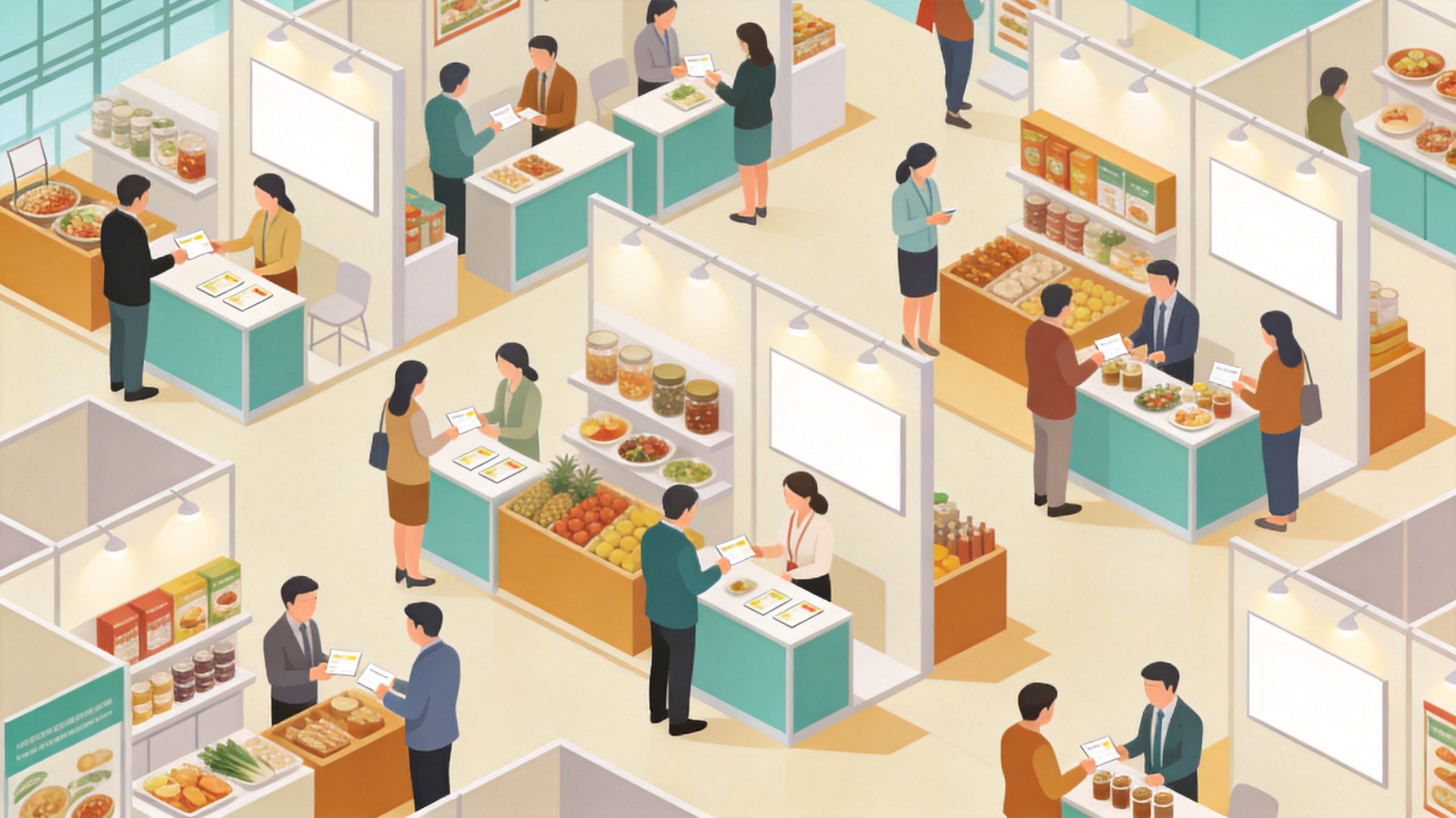
FHC Shanghai alone draws over 3,000 exhibitors and an expected 180,000 professional buyers across three days. ProWine Shanghai runs alongside it. In that environment, you might speak to 50 people. You will hand out samples. You will collect business cards.
And 80% of the people you meet will never place an order. The on-booth behaviour patterns that drive this 80% drop-off — from giving samples too freely to skipping qualification — are part of a wider set of mistakes that non-Asian brands repeat at food trade shows across the region.
Not because your product is wrong — because you did not qualify Asian food distributors at trade shows before you invested samples and follow-up time in them.
Most exhibitors arrive at Asian trade shows with a simple strategy: talk to as many people as possible and hand out samples freely. That is a volume play. But when you qualify Asian food distributors at trade shows, you invest your limited samples and shelf life only in buyers who can actually move your product. The difference is five to fifteen real partnerships instead of fifty dead business cards.
Every sample you give away has a real cost: international freight, shelf life consumed, allocation that could have gone to a committed buyer. Handing samples to someone who is collecting catalogues is not networking. It is waste. If you learn one thing before your next Asian trade show, learn how to qualify Asian food distributors at trade shows in under five minutes.
Why Qualifying at the Show Matters More Than After
Asian trade culture rewards face-to-face judgment. Ten minutes in person tells you more about a distributor's real intent than three rounds of email follow-up. This is exactly why learning to qualify Asian food distributors at trade shows — on the floor, in real time — produces better partners than any amount of post-show email outreach. But the signals are not always direct.
In many North and Southeast Asian markets, business relationships prioritize harmony and face-saving. A polite nod, a warm smile, or a sample acceptance does not always signal purchase intent. The contact may simply be being courteous. Southeast Asian distributors also vary enormously in scale — one distributor may handle a single city, another may cover five countries. A single question about volume reveals which one you are talking to.
Industry data across B2B food trade shows consistently shows that pre-booked meetings convert at a far higher rate than walk-up badge scans. On-site qualified conversations — where you have asked screening questions and received specific answers — land in a middle tier. Conversations where you never qualify Asian food distributors at trade shows and simply hand over samples convert at the lowest rate. The difference between a productive show and an expensive one is the quality of the conversations you invest in.
8 Questions to Qualify Asian Food Distributors at Trade Shows
Use these eight questions as a structured filter when you qualify Asian food distributors at trade shows. You do not need to ask all eight in every conversation — pick the most relevant based on what you already know. Before you walk a show floor like FHC or ProWine, commit three or four of these to memory so you can use them naturally in conversation.

1. "Which Asian markets are you currently active in, and how many SKUs do you handle in our category?"
This tests real import experience. A distributor who handles five SKUs in your category across three markets is a specialist. A distributor who handles "all food" across "all Asia" is not a distributor — they are an agent with a wide net and no depth.
Green flag: Specific countries, specific SKU count in your category.
Red flag: Vague geography, "we do everything."
2. "What's your typical MOQ for a new imported brand, and what's your sell-through timeline?"
This measures their scale and purchasing rhythm. A distributor who expects 500 units as a first order and sells through in six months is a different partner from one who expects a container and turns it in eight weeks. The answer shapes everything that follows in the quotation — Incoterms, MOQ tiers, and CIF port specificity all flow from an accurate picture of how the buyer actually orders. We unpack how to structure MOQ and pricing when you quote Asian food importers for the first time in our guide to FOB, CIF and first-order pricing.
Green flag: A specific MOQ and a realistic sell-through estimate.
Red flag: "We'll see how it goes."
3. "Do you handle label compliance and registration in-house, or through a third party?"
This tests their compliance capability. If they do not understand Korean labelling requirements or the Japanese import notification process, they will push that work back to you. That means cost and risk on your side.
Green flag: In-house regulatory knowledge or a trusted, named third-party partner.
Red flag: "You handle the label, we just sell."
4. "Which imported brands do you currently represent that are similar to ours?"
This tests their portfolio and potential conflicts. If they already carry your direct competitor, you will be second fiddle. Their sales team has existing relationships and existing margin structures to protect.
Green flag: Complementary brands, no direct conflict.
Red flag: A portfolio that looks exactly like your target shelf.
5. "What's your primary channel — retail, HoReCa, e-commerce, or on-trade?"
This tests channel fit. A retail specialist will not open restaurant doors for you. A HoReCa distributor will not get you onto supermarket shelves.
Green flag: A clear primary channel that matches your positioning.
Red flag: "We do all channels."
6. "How many containers do you bring in per year for a typical new brand in year one?"
This directly measures purchasing scale. A distributor who brings in one container per year for a new brand is testing. A distributor who brings in five is investing.
Green flag: A realistic number that matches their stated MOQ.
Red flag: "It depends." (Everything depends — but they should have a baseline.)
7. "Who makes the final buying decision, and what's your evaluation timeline?"
This tests the decision chain and time expectation. If the person you are speaking to is not the decision-maker, you need to know who is and when they will review your brand.
Green flag: A clear decision-maker and a defined timeline.
Red flag: "I'll need to check with my team." (That is fine — but ask who and when.)
8. "Are you attending as a buyer, or also exhibiting or representing other brands?"
This distinguishes real buyers from sample collectors and competitors. At every trade show, a significant portion of badge holders are other exhibitors, agents scouting for their own portfolio, or people collecting samples for resale or benchmarking.
Green flag: They are attending to source, and they are clear about it.
Red flag: They are an exhibitor or an agent for a competing brand, collecting intelligence.
3 Non-Verbal Signals
You do not need to ask everything when you qualify Asian food distributors at trade shows. Some things you can see in the first two minutes. You do not need a script to spot a gatekeeper, a sample collector, or a genuinely interested buyer — but you do need to pay attention.
Gatekeeper flag: A business card with no specific title, or an email address that is only info@. You are likely speaking to a gatekeeper, not a buyer. Ask politely who handles new imported brand partnerships.
Sample collector: Within five minutes, they ask for "your catalogue and price list" without asking a single question about the product itself. They are building a file, not evaluating a partnership. Offer a digital link instead of a physical sample.
Genuine interest: They take you to their booth, introduce you to a colleague, or ask a follow-up question about your production capacity or minimum run sizes. That is a signal of real intent — invest more time.
After the Meeting: 3 Actions to Lock In a Qualified Lead
The work does not end when the conversation does. These three steps separate leads that convert from business cards that collect dust. The three steps on the booth floor are just the beginning; converting those qualified conversations into signed agreements requires a structured 30-day sequence, which we detail in our full guide to turning trade show leads into distribution deals with Asian importers.
1. Book the next touchpoint on the spot. "I'll send the spec sheet on Thursday — can we do a quick call next week?" A specific next step separates a real conversation from a polite exchange.
2. Write one personal detail on the back of the card. Not about the product — about the person. What they mentioned drinking on a recent trip, which city they are flying in from, whether they mentioned a family connection to your region. This is what makes the follow-up feel human instead of templated.
3. Follow up within 24 hours. Not a pitch. A short note referencing the conversation and confirming the next step. Follow-ups sent within 48 hours of a trade show meeting convert at meaningfully higher rates than those sent a week later, when the conversation has faded.
FAQ
Should I give samples to everyone who visits my booth?
No. Ask two or three of the qualifying questions above first. If the answers are vague or reveal a poor fit, offer a catalogue or a digital link instead of a physical sample. A sample is a commitment of inventory and freight; a link costs you nothing.
How many qualified leads should I expect from a three-day food trade show in Asia?
For a small to mid-sized producer, five to fifteen genuinely qualified conversations — where you have asked screening questions and identified a potential fit — is a realistic and productive outcome from a well-prepared show. The rest are contacts, not leads.
What if an importer asks for exclusive distribution rights at the first meeting?
Say you are open to discussing exclusivity once there is a demonstrated track record — typically after the first two or three orders and a joint review of sell-through. Exclusivity without a minimum purchase commitment is a red flag. Do not agree to it in the first meeting.
Disclaimer: This article is provided for general informational purposes only and does not constitute legal, regulatory, or commercial advice. Trade show conversion rates, distributor behaviour patterns, and market entry outcomes vary significantly by product category, market, and individual circumstances. Always conduct your own due diligence and seek professional advice before entering into distribution agreements or making commercial commitments based on information in this article. Specit Consulting does not guarantee any specific business outcome from following the practices described herein.
Want us to vet a distributor you are already talking to before FHC? Contact Specit Consulting for a 15-minute importer-fit assessment at kevin@specitconsulting.com.
Related Reading
- FHC Shanghai 2026 Pre-Show Checklist
- How to Vet an Asian Food Importer: 10 Red Flags
- Japan Food Import Requirements: 6-Step Guide
Need help navigating your market entry?
We've helped food exporters across 10+ countries enter 13 Asian markets. Get a free initial assessment based on public data — delivered in 3 working days.
Get Your Free AssessmentContinue Reading
▶Japan Food Distribution: HORECA vs Retail vs Online Channel Strategy
▶GACC Registration: 5 Mistakes That Get Your China Filing Rejected
Questions about entering the Asian market?
Chat with us on WhatsApp →