


You collected 47 business cards at FHC, SIAL, or Anuga. Six weeks later, zero deals. Here is why: You collected 47 business cards at FHC, SIAL, or Anuga. Six weeks later, zero deals. Here is why: roughly 80% of trade show leads never receive any follow-up at all, and of those that do, most arrive after the buyer has already mentally closed the file. The cards are not the problem. The absence of a system is.
This guide is that system: thirty days, four weeks, one goal—convert trade show leads into at least one distribution conversation actually moving toward a deal. It assumes you are selling into Japan, Korea, or Greater China, where relationship logic and decision cycles differ from what most Western exhibitors expect. If you want to convert trade show leads in Asia rather than just collect business cards, this is the framework to follow.
The 30-Day Window: Why Asian Leads Go Cold Faster
The standard advice says follow up within 48 hours. In Asia, the window is tighter.
First, speed-to-lead bites harder in relationship markets. Buyers at Asian shows meet dozens of suppliers in three days. By day three, your booth is a blur. The first email referencing the actual conversation—not the product category—wins the mental slot. Studies on trade show follow-up consistently show that personalized subject lines and conversation-specific openings lift reply rates significantly, while generic blasts hover around 5%. The ability to convert trade show leads depends almost entirely on whether that first email lands before the blur sets in.
Second, the decision cycle in Japan and Korea is not a sprint, but entry to that cycle is. Japanese decisions are consensus-driven and can take months; Korean buyers move faster and dislike delay. The 30-day window is not about closing a deal—it is about earning the right to enter their evaluation process before someone else does.
Third, festival seasons create hard stops. Japan effectively shuts down from December 29 into the first week of January. Korea's Lunar New Year and Greater China's Mid-Autumn pause decision-making for one to two weeks. A slow follow-up from a November show lands in the dead zone.
Week 1: Triage and First Touch (Days 1–7)

Sort every card A/B/C the night of the show
Do not wait until Monday. Grade while conversations are still fresh.
A-grade (Assessment-ready): You discussed a specific problem, timeline, or competitor. They asked about pricing, regulatory process, or sampling. These get a personalized email within 24 hours.
B-grade (Interested, not ready): They stopped, listened, asked a general question, and took your card. These get a value-first email within 2–3 days with no meeting request.
C-grade (Card exchange only): A brief hello. One short thank-you within 3–5 days, then LinkedIn connection, then silence.
Mark cards physically: dot for A, line for B, circle for C. If you cannot grade a card in three seconds, it is C-grade by default. This is how you convert trade show leads before opening your laptop.
The 24h email vs. 48h template vs. 7-day light touch
24 hours (A-grade): Reference the exact thing they said. Not "great meeting you at SIAL." Something like: "You mentioned your Korean retail buyers keep asking for organic-certified suppliers, but the label conversion timeline is the bottleneck." That sentence proves you listened and gets forwarded internally in consensus-driven Asian buying committees. We cover the three-touch cadence in our trade show follow-up guide.
48 hours (B-grade): Attach one useful thing—a label checklist, a one-page market snapshot, a short case study. No meeting request. This email is designed to be filed or forwarded, not replied to immediately.
7 days (C-grade): Short thanks. No attachment. LinkedIn connection with a one-line note. Revisit in 90 days with a genuine reason.
Channel choice: WhatsApp, email, or LinkedIn
Email is the default for all tiers—it is forwardable, searchable, and expected. WhatsApp only for A-grade contacts who explicitly offered their number; unsolicited messaging feels intrusive in Japan and Korea, where business communication norms skew formal in early-stage contact (Harvard Business Review on cross-cultural B2B communication). LinkedIn is the second channel, not the first.
What NOT to send
"Great meeting you at [show]. Here is our catalog." Delete-on-arrival. The buyer has forty of these. A catalog says "I want you to buy something"; a specific reference to their problem says "I was listening." Our piece on Asian trade show booth mistakes covers the habits that tank response rates before the first email is sent.
Week 2: Qualify Deep (Days 8–14)
Five questions that separate buyers from browsers
By week two, you need to know whether the contact has real purchasing intent:
- "What does your current supplier setup look like for this category?"
- "Which channel is the priority this year—retail, food service, or online?"
- "What has stopped you from bringing in a new supplier so far?"
- "Who else is involved in the decision on your side?"
- "If we found the right fit, what would the timeline look like?"
A buyer answers three or more with specifics; a browser redirects to "send me information." A fuller diagnostic set is in our guide to qualifying Asian food distributors.
Send a market snapshot: the value-first move
For B-grade contacts and A-grades who have gone quiet, attach a one-page market snapshot—not a catalog, not a price list. Frame it like this:
"You mentioned you were looking at Korea. Attached is a one-page summary of what organic certification requires for Korean retail entry, and the two steps that most often delay the first shipment. No need to reply—just useful if the timing comes up."
This proves you understand their market, gives them something forwardable, and asks for nothing. In relationship-first markets, asking for nothing is often what earns the next conversation—and what begins to convert trade show leads without you having to chase. This is also the moment when the system you built in Week 1 starts to convert trade show leads that a generic follow-up would have lost.
How to handle "we already have an importer"
This is not a rejection; it is a status update. Respond:
"Understood—that makes sense. Most importers I work with started with a second or third supplier before consolidating. If the current arrangement ever needs a backup or complementary range, I am happy to be a resource."
You are not competing; you are positioning as the backup option when the current arrangement has a gap. If exclusivity concerns surface, cross-reference our guide to vetting an Asian food importer.
Week 3: Advance to Proposal (Days 15–21)
From interest to commitment: the three-document sequence
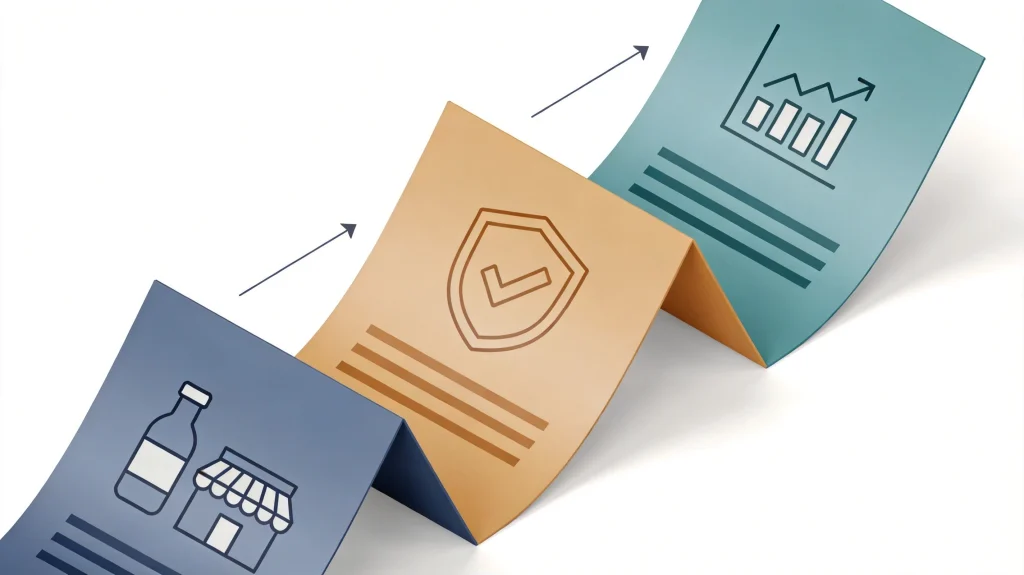
Do not send a proposal. Send a sequence.
Document 1: The fit summary (one page). Your product, their channel, why it matches what they told you.
Document 2: The compliance and logistics overview (one page). Label requirements, import documentation, lead times, MOQ. This is where most Western suppliers lose credibility. For Korea, reference the MFDS checklist for small producers so they know you are not guessing.
Document 3: The commercial framework (one page). Pricing tiers, MOQ, exclusivity terms, payment terms. Do not quote in the first email or the second—but by week three, engaged buyers need numbers to move internally.
Fit first because nothing else matters if the product does not match the channel; compliance second because an interested buyer who discovers you have not mapped the regulatory path will disengage; commercial framework third because pricing only becomes productive after fit and credibility are established. Sending a price sheet before the compliance document is the fastest way to anchor conversation on cost before trust exists, and one of the most common reasons brands fail to convert trade show leads that were genuinely interested at the booth.
Pricing conversations without quoting
Quote the range, not the unit price: "For the volume you described, the landed cost in Korea would fall in a standard range depending on mix and shipment size. I can put together a specific quote once we confirm SKUs and first order volume." This keeps the conversation on fit rather than haggling.
When to schedule a call vs. keep async
Schedule a call when they ask a question you cannot answer in two paragraphs, or introduce a colleague to the thread. Keep it async while they are still in information-gathering mode—a call too early feels pushy in relationship-first markets. For Japanese buyers, a call is a relationship step, not a decision meeting; expect to learn the next internal step, not get a yes.
Week 4: Close or Nurture (Days 22–30)
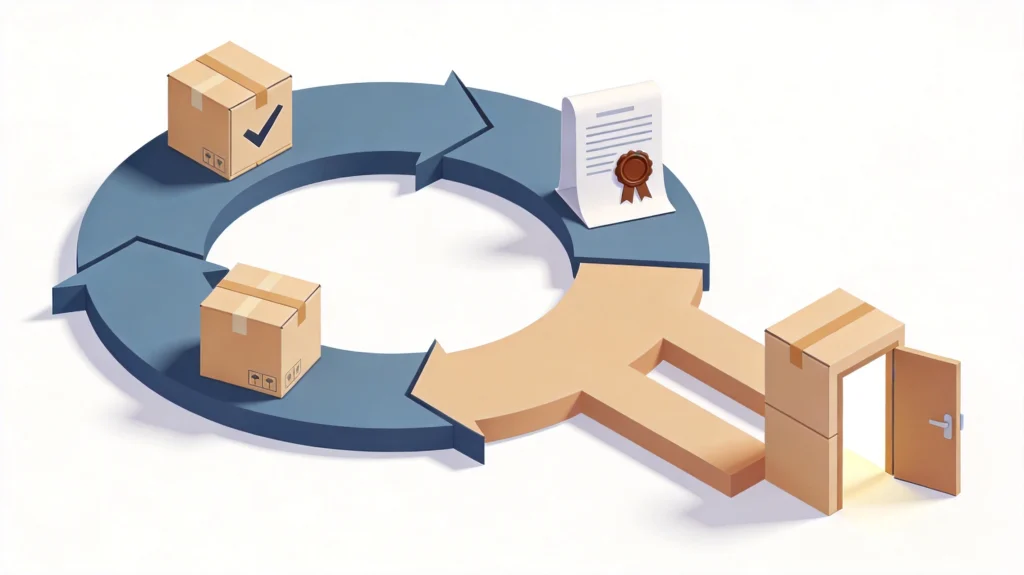
The soft close: trial order framework
The 30-day goal is not a signed distribution contract; it is a trial order—a small first shipment that proves logistics, compliance, and commercial fit without requiring a full program commitment.
Frame it as a test, not a discount:
"Rather than a full first order, would it make sense to start with a small trial shipment—enough to test label registration and see how the range performs in two or three accounts? If it works, we can talk about a larger program. If not, you have lost very little."
This works in Korea, rea where buyers value momentum, and in Japan,apan where small, reliable steps build the track record larger commitments require. For a realistic timeline from trial to repeat order, see our first food shipment Asia timeline.
When to walk away—and how
If by day 30 the contact has not engaged beyond the first reply, send a clean close:
"I have not heard back, so I will assume the timing is not right. No problem at all. If the Korea or Japan question comes up later, I am easy to find. I will keep you on the quarterly market update list unless you would rather I did not."
This often gets a reply because it removes pressure to apologize for silence. If it does not, you have preserved the relationship for the next cycle.
Long-term nurture
A contact not ready in November may be ready in March. Move them to a quarterly cadence: a market update, a regulatory change, a new vintage. One touch every 90 days with a genuine reason. No "checking in." No "just following up." If you have nothing useful to say, say nothing.
The System, Not the Script
The difference between 47 cards and zero deals is not better copywriting. It is grading, timing, and relevance. Grade every card the night of the show. Write three personalized emails, not forty. Attach something useful, not something impressive. Ask for a trial order, not a distribution contract. And stop after three touches—the buyer who is not ready in 30 days will not be ready in 31. Most exhibitors who fail to convert trade show leads do not lose to a competitor; they lose to silence and a generic follow-up.
Converting trade show leads into Asian distribution requires a system, not guesswork. If you want to pressure-test how you convert trade show leads against the market you are targeting, book a free 15-minute call. For the exact email templates and day-by-day cadence, see the companion piece on food trade show follow up emails. Bring your card stack and current email template—we will find where the leads are leaking.
Disclaimer: Specit Consulting provides general informational content about international food trade, regulatory compliance, and route-to-market strategy in Asian markets. This article is based on general professional experience across multiple trade shows and Asian markets and is intended for general informational purposes only. It does not constitute legal, regulatory, tax, or professional business advice. Follow-up cadences, response-rate observations, and conversion patterns vary significantly by market, product category, price segment, channel, and the specific relationships involved, and the framework described reflects general patterns drawn from the authors' professional experience rather than definitive rules or guaranteed predictors of individual outcomes. Always verify specific commercial terms, regulatory requirements, import procedures, label compliance, shelf-life rules, additive approvals, and contractual obligations with qualified legal, regulatory, and tax advisors in the relevant market before entering into any distribution agreement, making binding export commitments, or shipping product. Examples and timing recommendations reflect the authors' professional tracking across multiple trade shows and are not guarantees of individual outcomes. Specit Consulting does not warrant the accuracy, completeness, or timeliness of the information contained in this article, and accepts no liability for commercial decisions made based on this content.
Frequently Asked Questions
How quickly should I follow up after an Asian trade show to convert trade show leads?
Send the first email to A-grade leads within 24 hours of the conversation—ideally before you leave the show city. B-grade leads get a value-first food distributor follow-up email within 48 hours, with a useful attachment and no meeting request. C-grade leads get one short thank-you at the five-to-seven-day mark and then move to a quarterly nurture cadence. Sending a generic blast to every card on day seven is the most common reason Asian food import lead conversion stalls, and you fail to convert trade show leads that were genuinely warm at the booth.
What is the single biggest mistake in post-trade show strategyin Asia?
Sending a catalog as the first follow-up. A catalog tells the buyer you want them to buy something; a conversation-specific email tells them you were listening. The first email must reference a concrete detail from the booth conversation—a specific buyer problem, a channel they named, a regulatory question they raised. Without that anchor, the email reads as a template and gets archived with the other forty in their inbox.
How many of the cards I collect at FHC or SIAL should realistically convert into deals?
For a first-time exhibitor targeting Japan, Korea, or Greater China, expect roughly five to fifteen genuinely qualified conversations out of 40–60 cards, and one to three of those to move into active distribution discussions within the 30-day window. Trade show ROI for food brands is not measured in cards collected; it is measured in how many A-grade leads you can move to a trial order. The rest are contacts, not pipeline, and expecting every card to convert trade show leads into revenue is how exhibitors burn out chasing tire-kickers.
Should I use WhatsApp, LINE, or KakaoTalk to follow up with Asian buyers?
Only if the buyer offered the handle or explicitly invited you to message them there. Unsolicited messaging on personal chat apps is read as intrusive in Japan and Korea. Email remains the default first channel because it is forwardable, searchable, and appropriate for consensus-driven buying committees. Messaging apps are a second touch, not a first touch, when you want to convert trade show leads professionally.
What do I do with leads that go silent after the first email?
Send one more value-touch at day 14—the market snapshot described in Week 2—then a clean close at day 30. After that, move them to a 90-day nurture cycle with a genuine reason each quarter. Do not "check in." Do not send gentle reminders. Silence in relationship-first markets usually means timing, not a no, and the same buyer who went quiet in November can become an active conversation in March when their category review cycle opens.
Need help navigating your market entry?
We've helped food exporters across 10+ countries enter 13 Asian markets. Get a free initial assessment based on public data — delivered in 3 working days.
Get Your Free AssessmentContinue Reading
▶Japan Food Distribution: HORECA vs Retail vs Online Channel Strategy
▶GACC Registration: 5 Mistakes That Get Your China Filing Rejected
Questions about entering the Asian market?
Chat with us on WhatsApp →