

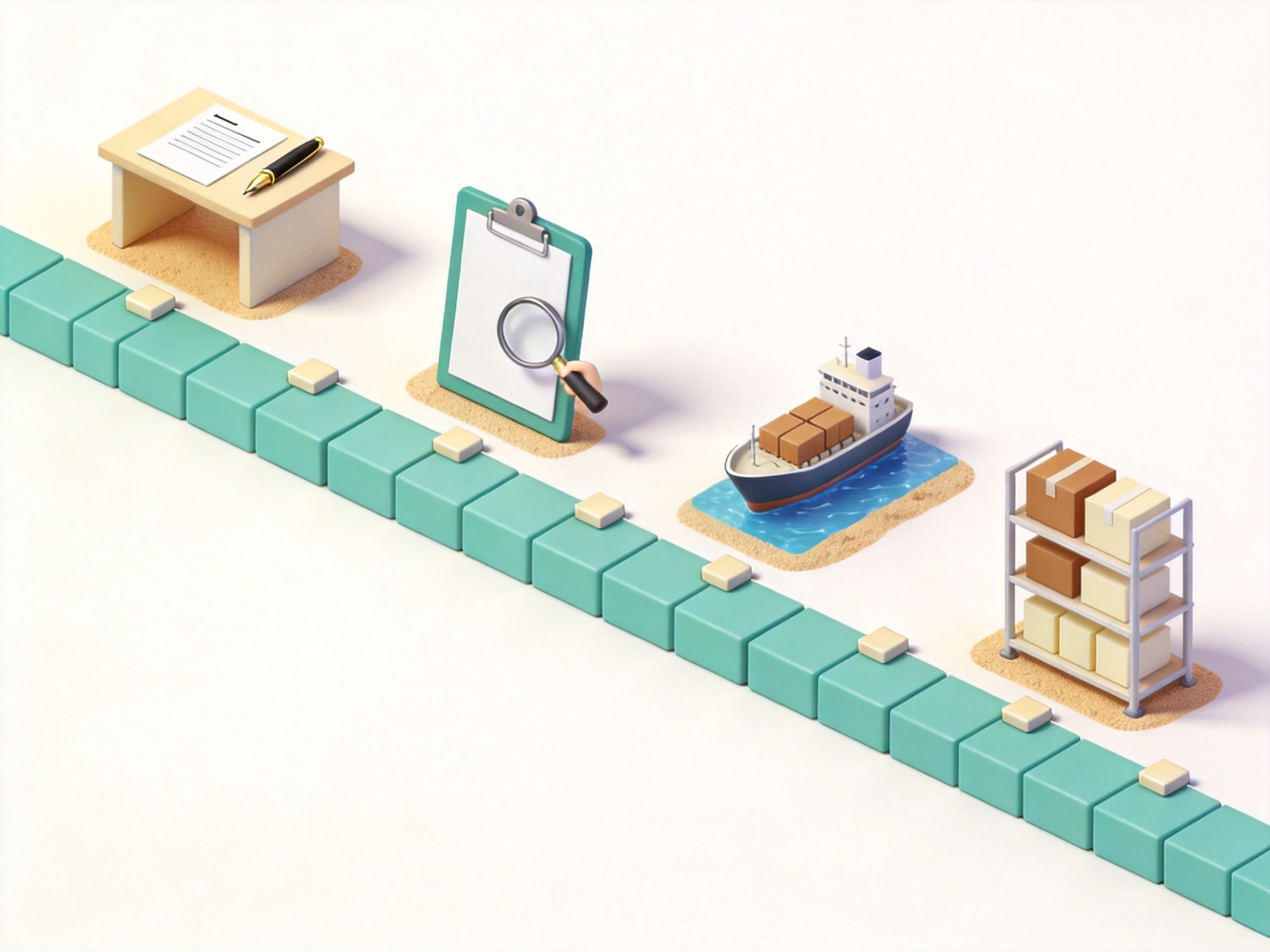
The question every new exporter asks is: "We signed the importer — how long until we are on shelf?"
The answer is not six weeks. It is not six months either. For most processed food and beverage products, the realistic first food shipment Asia timeline is four to nine months from signed contract to retail shelf. For meat, poultry, dairy and health foods, it can stretch to nine to twelve months.
This is not because Asian regulators are slow. It is because each step — factory registration, label design and review, documentation, ocean freight, port inspection and in-market distribution — has a real minimum lead time, and several steps run sequentially. If you plan against a six-week assumption you will miss your launch window, disappoint your importer and pay demurrage and storage charges you did not budget for. The International Trade Centre's guide to export operations sets out similar lead-time expectations for new-to-market shipments across emerging Asian markets. Here is the phase-by-phase breakdown of a realistic first food shipment Asia timeline.
Why It Takes 4–9 Months, Not 30 Days
The first food shipment Asia timeline is driven by three hard realities: registration approvals take as long as they take and cannot be rushed; ocean freight from Europe or the Americas is measured in weeks, not days; and your first container to a new market almost always triggers a higher inspection rate at the port of entry. You can compress individual steps by being organised with documentation, but you cannot skip phases. If you have never shipped samples to Asia before, add time to send pre-production samples for laboratory and label review — we cover that process in our guide to sending food samples to Asia.
Phase 1: Contract & Documentation — Weeks 0–6
Contract signed. This is the starting line. By the time the ink is dry, you should already be pulling together the export documentation package your importer will need for registration: health certificate / free sale certificate from your home authority, certificate of origin, certificate of analysis for each SKU (nutritional values, microbiological, heavy metals, residual solvents as relevant), full allergen matrix, HACCP or GFSI certificate (BRC, IFS, FSSC 22000 or SQF are all accepted), production flow diagram and factory layout.
The purchase order is issued and a production slot is booked with your factory. For many small producers this is the first real bottleneck on a first food shipment Asia timeline — if your co-packer has a six-week lead time, that is six weeks on the clock before product is even made.
Tip: get the allergen matrix and COA from your supplier at the moment you receive the PO, not when production finishes. Label work can start before the product is physically made.
Phase 2: Label Design & Compliance Review — Weeks 4–12
This phase overlaps with Phase 1 — documentation and label work run in parallel. Label approval is usually the longest single item on the critical path of a first food shipment Asia timeline.
Japan (MHLW / Food Labeling Act). The Japanese back label must satisfy the Food Labeling Act checklist: product name, ingredient list with QUID percentage for characterising ingredients, full nutrition table (per 100 g, the five-plus-one mandatory items: energy, protein, fat, carbohydrate, salt equivalent, plus saturated fat where applicable), allergen declarations (recommended and mandatory items — note cashew became a recommended mandatory item from April 2026), net content, best-before date, storage method, importer name and address, country of origin, and the JAS organic mark if organic is claimed. Label artwork is designed in Japanese, reviewed internally by your importer and often run through a pre-submission consultation with the quarantine station. One to two rounds of revisions are normal.
Korea (MFDS). The Korean back label requires Korean-language text, ingredient list with country of origin and percentage for every ingredient, dual-column nutrition (per 100 g and per serving), 28-allergen declaration, storage, use-by date (소비기한), importer block in Korean, consumer hotline 1399 and the customer service / return address. The overseas manufacturing facility must be registered (해외제조업소등록) before import declaration is filed — this is a common hidden wait on a first food shipment Asia timeline. Some categories (dairy, meat, health-functional foods) require health certificate pre-approval before shipment.
Taiwan (TFDA). Traditional Chinese back label, eleven mandatory allergens, expiry date in ROC-era or Gregorian format, storage temperature, importer registration number (食品業者登錄字號), product liability insurance confirmation and a Chinese-language customer service line.
Plan for one to two rounds of label revisions per market, at one to two weeks per round. If you are launching into all three markets simultaneously, label work on three separate versions dominates this phase.
Phase 3: Registration & Pre-Shipment Approval — Weeks 8–16

Japan. First-time imports go through 事前相談 (ji-zen sōdan, pre-consultation) with the port quarantine station. The importer or their customs house submits the full documentation package including the label artwork, formulation and health certificate. For processed foods this is typically a document review only. For meat, dairy and aquatic products the review is substantially longer because the producing facility must be listed on Japan's approved-establishment register. The Japanese Ministry of Health, Labour and Welfare (MHLW) publishes import procedures in English for reference.
Korea. Overseas manufacturing facility registration (해외제조업소등록) must be completed before the import declaration is accepted. The Korean importer of record files the registration on behalf of the overseas factory, supported by HACCP/ISO/FSMA certificates, the production flow and factory layout. For standard processed foods, registration takes two to four weeks with complete documents. For animal-origin products, the QIA (Animal and Plant Quarantine Agency) review adds months. Label pre-confirmation (한글표시사전확인) is optional but recommended for first-time importers to avoid port-of-entry rejection. MFDS provides the overseas manufacturer registration portal guidance in English.
Taiwan. Import food inspection registration (輸入食品查驗登錄) is filed at port of entry, but pre-shipment document preparation follows the same pattern. The first shipment is almost always selected for document review and possibly physical inspection.
Animal-origin products (meat, poultry, dairy, egg, aquatic). For products of animal origin, add three to six months on top of the plant-product timeline. The producing facility must appear on the approved-establishment list maintained by the importing authority, veterinary health certificates are negotiated between governments rather than issued by the exporter alone, and port inspection is mandatory and more rigorous. If your product contains dairy (including milk chocolate, butter biscuits, cream-filled products) the rules apply to the dairy component.
For a deep dive into what happens when port inspection fails, see our guide to Japanese port rejections.
Phase 4: Production & Container Shipping — Weeks 10–18
Production is completed. Labels are applied — either at origin (preferred when you are confident the label has passed review) or at a bonded warehouse in the destination market (more flexible but adds cost and time). The container is booked: dry for shelf-stable products, reefer for temperature-sensitive categories (chocolate, cheese, frozen, fresh). Which Incoterm you agree with the importer at this stage — FOB or CIF for most first shipments — shapes who controls freight and where landed cost settles; we cover the trade-offs in FOB, CIF and DDP pricing for Asian food imports. ATA Carnet or commercial sample shipments will usually have been sent and approved by this point — if you are still negotiating samples, push the production slot out.
Transit times vary by route: approximately two to three weeks from the US West Coast to Japan or Korea, four to five weeks from Northern Europe to North Asia, and roughly two weeks from Australia or New Zealand. Add one week for vessel connections, trans-shipment delays and port cut-offs. Always build a one-week buffer into your sailing plan on a first food shipment Asia timeline; a missed vessel means a seven-day delay before the next one. For details on how to use ATA Carnet for samples before committing to a full container, see our ATA Carnet guide.
Phase 5: Port Arrival & Customs Clearance — Weeks 18–20

The container arrives. Document review begins: the customs broker files import declaration, submits the health certificate, label dossier and commercial documents, and pays duty and VAT. On a first shipment, expect one or more of the following: physical inspection (container opened and goods examined), sampling for laboratory testing (microbiological, additive residues, heavy metals, agricultural chemicals depending on category), and label spot-check. Laboratory testing adds two to four weeks. If a problem is found — most commonly an allergen omission, an additive that is not approved, or a discrepancy between the submitted label and the physical product — the shipment may be held for re-labelling, returned, or destroyed. Once everything is in order, duty is paid and the container is released to the importer.
Phase 6: In-Country DC to Retail Shelf — Weeks 20–26
The container is drayed from port to the importer's distribution centre. The DC receives, temperature-verifies (mandatory for cold-chain), and allocates stock to sub-distributors, retail accounts and HoReCa. For retail launches the next steps are the retail DC receiving, allocation to individual stores, shelf set and in-store promotional sampling. For HoReCa launches the product moves faster — chef introductions, menu placement and first orders can happen within two weeks of DC arrival, but menu turnover means your product is only as secure as the next seasonal menu change.
Expect a total of six to eight weeks from port arrival to seeing your product on a physical retail shelf for the first time. For large chains (Aeon, Lotte, Costco, Carrefour, PX Mart) the retail listing process itself can add months if you have not already secured a listing commitment before the container ships.
Fast-Track vs Standard vs Slow Lane

Not every category moves at the same speed. The first food shipment Asia timeline varies by category risk and approval complexity. As a rough planning tool:
Fast lane — approximately four months. Dry, plant-based, shelf-stable processed foods with no animal-origin ingredients and no novel additives: pasta, dry biscuits without dairy, plant-based snacks, olive oil, vinegar, coffee, tea, single-ingredient dried goods. The importer already has experience in the category, the label passes review on the first round, and the port selects the shipment for document review only.
Standard lane — six to seven months. Frozen and chilled plant products, extra-virgin olive oil with existing organoleptic certification, cheese and dairy from approved facilities, chocolate and confectionery, wine and spirits, most processed foods with EU-recognised additives. One round of label revisions is normal, a routine physical inspection at port is possible. This is the most common first food shipment Asia timeline we see across our client base.
Slow lane — nine to twelve months (or longer). Meat, poultry and processed meat products; raw-milk dairy from facilities not yet on the approved list; health-functional foods, infant formula and products for children; novel ingredients and products making functional or health claims. Quarantine registration, facility approval and health-certificate negotiations drive the extended timeline.
If your category falls in the slow lane, you need to start the process before you sign an importer — not after.
What You Can Do in Parallel
The months between contract and shelf are not dead time on a first food shipment Asia timeline. While your importer and their compliance team are working on registration and label review, you should be working in parallel on:
- Marketing collateral translated into the local language (sell sheets, brand story, serving suggestions, chef recipes)
- A sample programme with key chefs, baristas, sommeliers and retail buyers before the container lands
- Buyer meetings at trade shows — FHC Shanghai, ProWine Shanghai, Foodex Japan, Seoul Food & Hotel — timed so that relationships are warm by the time product arrives
- LinkedIn and industry content in English so that inbound leads are already coming in by launch
- A reorder forecast so your factory can hold production capacity for the second and third containers
For a broader channel-strategy view of how to choose between HoReCa and retail as your first Asia channel, see our companion guide on choosing your first Asia channel.
FAQ
Can I compress the first food shipment Asia timeline to catch a specific season? For Valentine's Day in Japan or Chinese New Year in Greater China, you need product on water by late October or early November at the latest. If you sign a contract in October for a Valentine's launch the same year, you have already missed the window. Plan one season ahead.
Should labels be printed at origin or applied in-market? For the first container, applying local-language labels at a bonded warehouse in the destination market is safer — it avoids scrapping a full print run if the label is rejected at review. Once the label is approved and stable, origin printing reduces unit cost.
What happens if the shipment is selected for laboratory testing? The laboratory tests for whatever category risk the port authority is focusing on: microbiological counts, additive residues, heavy metals, pesticide residues, mycotoxins, radioactivity for certain origins. Results take two to four weeks. The container sits at port (you pay demurrage and storage after the free time expires). If the product fails you have three options: recondition (re-label, rework if possible), export back, or destroy.
Can I ship before factory registration is complete? No — in Korea the import declaration will not be accepted without a valid overseas manufacturer registration number; in Japan pre-consultation must be completed for first-time imports. Shipping before paperwork is in place guarantees delay and storage charges at port, and it is the most common way exporters blow up their own first food shipment Asia timeline.
What is a realistic first-order volume? For premium specialty food, one to two pallets is a legitimate first order for HoReCa entry; for retail a 20-foot container (approximately ten to twelve pallets) is the usual minimum. If your importer is asking for multiple containers for the first shipment, that is a red flag — verify their channel commitments before committing production. Getting to that first order, however, depends on what you do in the weeks after the trade show — graded triage, fit-first sequencing and a trial-order close, not a generic blast email. Our 30-day guide to converting trade show leads walks through the cadence that gets a buyer from a booth conversation to a first purchase order.
If you are planning your first food or beverage shipment to Japan, Korea or Greater China and want a realistic first food shipment Asia timeline review against your specific SKU and category, send us your product specification sheet and target market. We will turn around a written timeline assessment — including the critical-path items that can delay your launch — within 48 hours.
Specit Consulting helps global non-Asian food and beverage brands navigate regulation, Chinese-Asian language labelling, product registration and importer introductions across Japan, Korea and Greater China. Based in Shanghai, active across the region since 2007.
Disclaimer: This article is provided for general informational purposes only and does not constitute legal advice, regulatory guidance or a professional recommendation on any specific shipment, product or distribution arrangement. Food import regulations, facility registration requirements, port inspection protocols and transit times change frequently across Japan, Korea, Taiwan and mainland China, and they vary significantly by product category, HS classification, origin and importer of record. The third-party resources linked in this article (ITC, MHLW Japan, MFDS Korea) are provided for reference only and do not constitute endorsement. Always engage qualified local legal and compliance counsel and confirm current requirements with your importer and customs broker before booking a shipment. Specit Consulting accepts no liability for decisions made on the basis of this article. For advice specific to your brand and category, contact us directly.
Further Reading
- How to Send Food Samples to Asia Without Wasting Time and Money
- ATA Carnet for Food Samples to Asia: When It Works and When It Does Not
- Why Japanese Ports Reject Food Imports (and How to Avoid It)
- 7 Reasons Asian Ports Reject Food Labels
- HoReCa vs Retail: Choosing Your First Asia Channel
- Vetting an Asian Food Importer: 10 Red Flags Before You Sign
Need help navigating your market entry?
We've helped food exporters across 10+ countries enter 13 Asian markets. Get a free initial assessment based on public data — delivered in 3 working days.
Get Your Free AssessmentContinue Reading
▶Japan Food Distribution: HORECA vs Retail vs Online Channel Strategy
▶GACC Registration: 5 Mistakes That Get Your China Filing Rejected
Questions about entering the Asian market?
Chat with us on WhatsApp →