


Chocolate is both an opportunity and a trap in North Asia. Japan's gift culture, Korea's premium growth, and Greater China's specialty retail expansion create real demand. But chocolate is temperature-sensitive, additive-heavy, and subject to some of the strictest labeling rules in the region. A product that sells well in one market will not automatically clear customs in Tokyo or Seoul. This guide walks through the practical realities of chocolate import Asia labeling, shelf-life coding and summer shipping, so you can plan your first container with realistic expectations. The biggest mistakes we see in chocolate import Asia labeling are not regulatory ignorance but underestimating how different the three markets are from each other.
Market Opportunity by Territory
Japan. Japan is one of the largest and most sophisticated chocolate markets in Asia, with retail chocolate sales running at a multi-billion-dollar annual level according to both the All Japan Confectionery Association and leading market research firms — and with a distinctive seasonal gifting rhythm that no other market replicates. Valentine's Day and White Day drive the single biggest seasonal peak: Japanese confectionery manufacturers typically generate a disproportionate share of annual chocolate revenue between mid-January and mid-March. Within that peak, jibun-choco (self-reward chocolate bought for oneself) has overtaken the traditional giri-choco (obligation chocolate for colleagues) as the largest spending category, with premium department-store surveys reporting that self-purchase budgets now match or exceed spending on romantic gifts. Premium and gifting segments continue to outperform mass-market tablets. Department store food halls (Meidi-ya, Isetan, Seibu) and duty-free remain the strongest premium channels; convenience stores dominate everyday consumption.
Korea. Premium and artisanal chocolate is expanding faster than the broader confectionery market. European dark chocolate and single-origin products have strong appeal among urban professionals, particularly through SSG Food Market, Hyundai Department Store and Coupang's premium grocery vertical. The Korean dessert café culture also pulls compound chocolate and couverture for B2B use.
Greater China. Specialty retail, HoReCa and cross-border e-commerce are the entry points. Gift boxes perform better than mass-market bars, especially around Mid-Autumn Festival, Chinese New Year and Valentine's Day. The HoReCa channel — five-star hotels, independent cafés and western restaurants — offers lower-MOQ entry before committing to retail listings.
Labeling Changes Required

Every market requires a local-language back label. Chocolate is a processed food with multiple allergen and additive declarations, so chocolate import Asia labeling is more complex than for olive oil or wine. Chocolate import Asia labeling errors are one of the top three reasons for port rejection in our experience, alongside cold-chain failures and incomplete health certification. If you are new to the region, start with our overview of common label rejection reasons.
Japan (MHLW / Food Labeling Act). Mandatory elements include product name, ingredient list with QUID percentage for characterising ingredients, allergens, net content, best-before date (賞味期限), storage method, and importer name and address. Notable points for chocolate: milk, soy, wheat, almond and walnut are commonly declared allergens; cashew nuts became a mandatory recommended allergen from April 2026 with a transition period to March 2028. Cocoa content and cacao mass claims are regulated — "high cacao" cannot appear without a stated percentage. Organic chocolate requires JAS certification or cannot make the organic claim. The Japanese Consumer Affairs Agency's Food Labeling section publishes the full current standard in English.
Korea (MFDS). A Korean-language back label is mandatory. The allergen list covers 28 items (2025 list), including egg, milk, buckwheat, peanut, soy, wheat, mackerel, crab, pork, peach, tomato, sulphites, walnut, chicken, beef, squid, shellfish and pine nut — note that tomato, peach and pork are not mandatory in the EU and are frequently missed by European producers. Nutrition facts must appear in dual-column format: per 100 g and per serving (1회 제공량). The consumer hotline 1399 (부정·불량식품신고) must appear on every label. Each ingredient must show its country of origin with percentage. The import block carries the Korean importer's name and address in Korean. The MFDS English portal publishes the current Food Code and labeling standards.
Taiwan (TFDA). A Traditional Chinese label is required. Eleven mandatory allergens include crustaceans, mango, peanut, milk, egg, nuts, sesame, gluten-containing grains, soy, fish and sulphites. Best-before date (有效日期), storage temperature for chilled or frozen product, and importer registration number (食品業者登錄字號) must appear. Product liability insurance is required for all food sold at retail, and the policy number or a contact line for claims must be on the label.
For all three markets, a neutral mother-bag with local-language sticker applied in-market is the most common small-producer approach to chocolate import Asia labeling — this is how Costco's Kirkland and many international premium brands appear on shelf. A single print run with all three languages on-pack is possible but carries higher obsolescence risk if the formula or importer changes.
Additives That Trigger Extra Review
Chocolate formulation routinely uses additives that are routine in Europe but attract scrutiny in Asia. PGPR (E476, polyglycerol polyricinoleate), vanillin, soya lecithin and natural vanilla flavour are common. Japan operates a positive-list system for food additives — every additive used must appear on Japan's designated list or receive individual approval, and this is a frequent point of delay for craft chocolate makers using novel emulsifiers. This is one of the most commonly overlooked items in chocolate import Asia labeling reviews.
Cocoa butter equivalents (CBE), cocoa butter substitutes (CBS) and cocoa butter replacers (CBR) require specific percentage declarations in Japan and Korea; "chocolate" naming is restricted by cocoa solids and cocoa butter content in each market. Colourants used in decorative or filled chocolates (E102, E129 and similar azo dyes) face tighter restrictions in Korea and require warning statements in Japan. If your product includes inclusions — fruit pieces, nuts, alcohol, gold leaf, edible flowers — each one adds a layer of documentation and potential quarantine review.
Shelf Life & Date Coding
Each market uses a different date format and a different legal concept:
- Japan distinguishes between 賞味期限 (shōmi-kigen, best-before / quality) and 消費期限 (shōhi-kigen, use-by / safety). Chocolate, being a shelf-stable low-moisture product, uses 賞味期限, typically 9-12 months from production.
- Korea uses 소비기한 (sobi-gihan, use-by) for all foods from 2023. Even stable chocolate prints a use-by date, which conservative retailers treat as a hard cut-off.
- Taiwan uses 有效日期 (effective date / expiry), printed as YYYY/MM/DD or YYYY.MM.DD.
Chocolate shelf life is typically 9-12 months under controlled temperature — long enough for a single ocean container cycle if chocolate import Asia labeling artwork is locked before production starts. Fat bloom (a whitish-grey coating caused by cocoa butter recrystallisation) and sugar bloom (from moisture condensing on the surface) are not safety issues, but both cause retail rejection — premium retailers will refuse a bloomed bar even if it is technically within date. Date coding can be printed on-pack at origin or applied with the local-language sticker in-market; in-market coding offers more flexibility for sea-freight transit time.
Cold-Chain & Summer Logistics
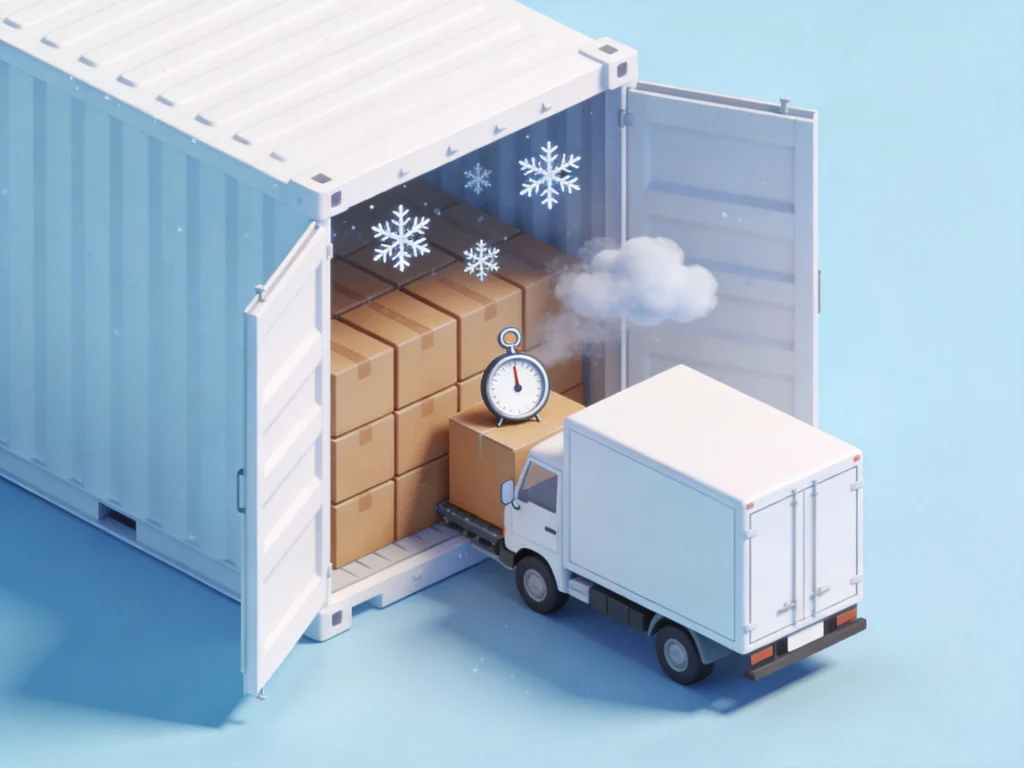
Shipping chocolate to North Asia is not like shipping wine or olive oil. Temperature control is not optional if you want the product to arrive in sellable condition — and cold-chain failure will undo every hour spent on chocolate import Asia labeling work.
The summer shipping window. Shipping chocolate to Japan, Korea or Shanghai in June–September at ambient container temperature is high risk. Container interiors on deck can reach 50–60 °C in the Pacific summer. The practical reefer window for premium brands is October to April; brands with mature logistics continue year-round with strict reefer protocols. Many small producers pause shipments from June to September rather than absorb reefer costs and bloom risk.
Reefer container settings. Dark chocolate travels at 12–18 °C at 60–65% relative humidity; milk and white chocolate travel cooler at 8–12 °C. This is controlled temperature, not frozen — freezing chocolate causes sugar bloom when it thaws. Set the reefer unit to continuous run (not cycle-sentry) and place a data logger inside the container door and one in the middle of the pallet stack.
Last-mile delivery. Port-to-warehouse and warehouse-to-retail require insulated trucks or refrigerated vans in all three markets. A product that survives the ocean crossing can be destroyed in three hours on a Shanghai or Tokyo tarmac in August. Insist that your importer provide temperature-log records from port to DC.
Bloom management. If bloom occurs despite all precautions, the product is safe to eat but cannot be sold as premium. Some HoReCa and discount channels accept bloomed chocolate at 30–50% discount for pastry use, but this damages brand positioning. It is better to delay a shipment than to relaunch with compromised product.
Tariff & Tax Snapshot
Tariff treatment for chocolate depends on cocoa content, filling type, sugar content and whether the product is classified under HS 1704 (sugar confectionery / white chocolate) or HS 1806 (chocolate and cocoa preparations). As a rough planning guide:
Japan. MFN tariffs on chocolate and confectionery generally fall in the 0–10% range depending on cocoa content and fillings. EPA / FTA preferential rates may apply for EU, UK, Australian, New Zealand and certain other origins under Japan's existing trade agreements.
Korea. The basic customs duty on most chocolate is approximately 8% with 10% VAT applied on the duty-inclusive landed value, giving a combined duty and VAT uplift in the high-teens before insurance, port handling, inland freight and inspection fees. EU-Korea FTA and UK-Korea FTA preferential rates can reduce or eliminate the duty for qualifying origin products with valid origin documentation.
Greater China. Cross-border e-commerce rates differ from general trade rates. General-trade chocolate tariffs are typically in the 8–10% range plus 13% VAT, with consumption tax applicable to certain filled, alcohol-containing or premium-priced products. China's FTA network (including with New Zealand, Australia, Switzerland and ASEAN) offers preferential rates for qualifying origins. You can look up applied MFN and FTA rates on the WTO Tariff Download Facility or ITC Market Access Map.
For a full landed-cost model including inspection fees, bonded-warehouse storage, distribution and importer margin, request a quotation specific to your HS code and incoterms — and build four to six weeks of lead time for chocolate import Asia labeling review into that timeline.
Importer Profiles by Market

The right importer for chocolate is often not the largest general-line food distributor — chocolate import Asia labeling experience matters more than the size of the importer's portfolio. In Japan, look for a specialist confectionery or premium food importer with existing department store food hall relationships rather than a general trader. In Korea, importers with both duty-free and premium retail access (Lotte, Shinsegae, Hyundai) tend to do best with European chocolate, alongside online specialists serving Coupang Rocket Delivery. In Greater China, importers serving both HoReCa and premium retail (City'Super, Ole', Hema) offer the most flexible entry path; avoid mass-market hypermarket distributors unless you have a six-figure marketing budget. For a framework on what to ask a potential partner, see our food distributor agreement guide and our trade show question checklist.
FAQ
Is white chocolate harder to import than dark?
White chocolate contains no cocoa solids, so it falls under a different HS classification in some markets (typically 1704 rather than 1806), which changes the tariff rate and may trigger different additive rules. It is also more temperature-sensitive than dark chocolate due to higher milk-fat content, so cold-chain planning matters even more for white chocolate import Asia labeling and shipping.
Can I ship in summer?
Technically yes, with a reefer container, insulated last-mile and temperature loggers end-to-end. But reefer capacity adds a meaningful premium over dry containers on North Asia routes — rates vary sharply by carrier, season and fuel surcharge — and bloom risk remains even with correct settings. Most small to mid-sized European brands pause summer shipments and build inventory ahead of the October launch window for Valentine's Day, so chocolate import Asia labeling work can be completed in the quiet summer months.
Can bloomed chocolate be sold?
Not as premium product. Premium retailers and department stores reject bloomed bars on sight. Some HoReCa and discount channels will accept it at 30–50% discount for pastry or repacking, but this undermines your brand positioning and is not a strategy for a new entry.
Do small-batch bean-to-bar producers face extra hurdles?
Yes, in two areas: additive documentation (craft makers often use minimal ingredients but may use unrefined cocoa butter, alternative sweeteners or natural flavours that are not on Japan's positive list) and factory registration (Korea requires overseas manufacturer registration for every production facility, including small ateliers). Budget 4–8 extra weeks for documentation in your chocolate import Asia labeling timeline.
Should I launch with gift boxes or with tablets/bars?
Gift boxes (assorted truffles, pralines, seasonal packaging) perform best for a premium entry in Japan and Greater China because they align with gifting culture and support a higher price point per kg. Tablets and single-origin bars are better for Korea, where the everyday premium chocolate segment is developing fastest. Many brands start with a small gift-box SKU for gifting seasons and add tablets once the brand is established.
If you are preparing your first chocolate or confectionery shipment to Japan, Korea or Greater China, we can help with a single-market label gap review — we review your existing pack against local regulations, flag additive and allergen issues in your chocolate import Asia labeling, and give you a clear go/no-go before you book a container. Send us your product specification and current label, and we will turn around the review within 48 hours.
Specit Consulting helps global non-Asian food and beverage brands navigate regulation, Chinese-Asian language labelling, product registration and importer introductions across Japan, Korea and Greater China. Based in Shanghai, active across the region since 2007.
Disclaimer: This article is provided for general informational purposes only and does not constitute legal advice, regulatory guidance or a professional recommendation on any specific product, shipment or distribution arrangement. Chocolate and confectionery import regulations, additive lists, tariff classifications, allergen labelling requirements and cold-chain best practice change frequently across Japan, Korea, Taiwan and mainland China. The third-party resources linked in this article (CAA Japan, MFDS Korea, WTO, ITC) are provided for reference only and do not constitute endorsement. Always engage qualified local legal and compliance counsel and verify the current HS classification, additive status and labelling rules for your specific formulation and target market before booking a shipment. Specit Consulting accepts no liability for decisions made on the basis of this article. For advice specific to your brand and product, contact us directly.
Further Reading
- 7 Reasons Asian Ports Reject Food Labels (and How to Avoid Them)
- How to Send Food Samples to Asia Without Wasting Time and Money
- Food Distributor Agreements in Asia: Key Clauses to Negotiate
- Vetting an Asian Food Importer: 10 Red Flags Before You Sign
Need help navigating your market entry?
We've helped food exporters across 10+ countries enter 13 Asian markets. Get a free initial assessment based on public data — delivered in 3 working days.
Get Your Free AssessmentContinue Reading
▶Japan Food Distribution: HORECA vs Retail vs Online Channel Strategy
▶GACC Registration: 5 Mistakes That Get Your China Filing Rejected
Questions about entering the Asian market?
Chat with us on WhatsApp →