

FHC Shanghai Day 1 is over. N1–N5 and W1–W5 have gone quiet for the evening. You collected 40 business cards, had a dozen conversations that felt promising, drank too much coffee, and somewhere between the hotel lift and the lobby bar you realised you cannot tell which three buyers are worth chasing next week and which 37 were just being polite.
After five years walking these aisles in Shanghai, Tokyo, Seoul, and Hong Kong, we can tell you this: Asian food buyer signals read differently in Japan, Korea, and Greater China than they do in Cologne or Barcelona. Serious buyers do not always say the things European producers are trained to listen for. The most enthusiastic visitor at your booth is often the one who will never reply to your email. The quiet buyer who asks one sharp question about lead time and walks away after ten minutes can turn into your largest account two years later.
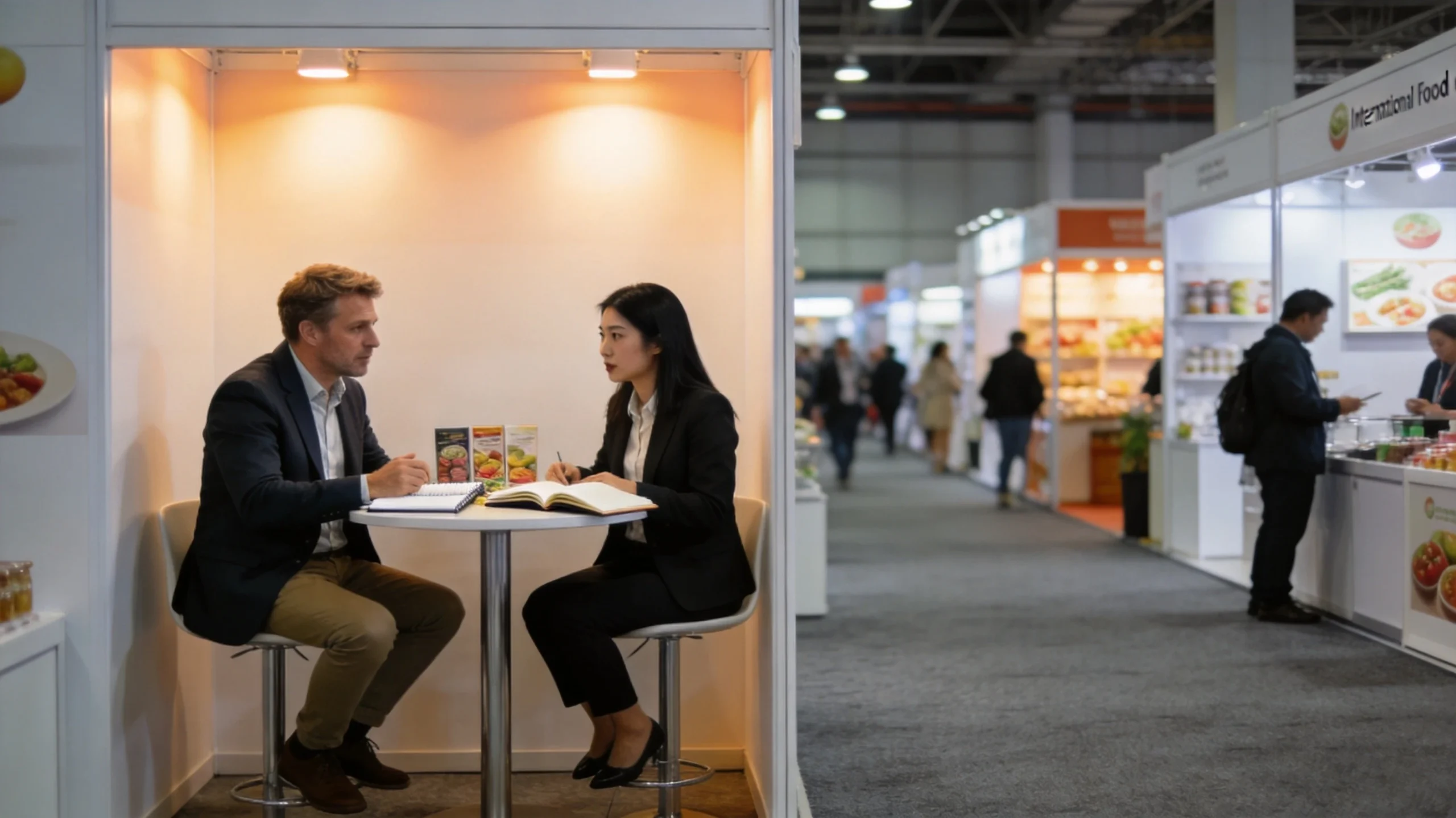
These are the seven Asian food buyer signals we have learned to weight most heavily on the floor, and the three red flags that say walk away politely before you waste another sample. Reading these Asian food buyer signals correctly on Day 1 determines whether your Day 2 conversations actually move toward orders or just fill your notebook with polite contacts.
7 Asian Food Buyer Signals That Say “This One Is Real”
1. They ask about MOQ and lead time within the first five minutes
Tire-kickers talk about terroir, awards, and the story behind your brand for fifteen minutes without touching a single commercial question. Serious buyers lead with logistics. If their second or third question is about minimum order quantity, production slots, container loading, or how many weeks from PO to shipment, they are not being difficult — they are slotting you mentally into their assortment plan and testing whether your production cadence matches their replenishment cycle.
This is especially true for Japanese buyers. A Japanese supermarket or specialty importer plans buying cycles three to six months ahead, often tied to seasonal catalogues and chain-level reset dates. If they ask about MOQ in the first five minutes, they are checking whether your operational scale is even compatible with their buying rhythm before they invest further time.
Korean buyers tend to frame the same question differently — they ask about price breaks at volume, or what happens if they start with a mixed pallet rather than a full container. The substance is the same: they are doing a supply-chain fit check.
If someone spends twenty minutes tasting and admiring your packaging and never asks what it takes to place an order, they are not a prospect. They are a visitor.
When they do ask about price, how you quote matters as much as the number itself. FOB, CIF, and DDP each signal something different to an Asian buyer, and quoting the wrong Incoterm on that first conversation can deprioritise you before they even look at the unit price. We break down the framework in FOB, CIF or DDP? Pricing Asian Food Importers Right.
2. They bring a colleague or photograph your price sheet for internal review
A buyer who calls over a colleague — a category manager, a procurement lead, an on-trade buyer, or even a junior associate carrying their sample bag — and walks them through your range is doing something most exhibitors miss: they are selling your product internally, on your behalf, while still standing at your booth.
This is one of the highest-conversion Asian food buyer signals at any regional show. It means they have seen enough to advocate. When a buyer photographs your price sheet, your MOQ tier card, or your product specification sheet to share with someone who is not at the show, they are preparing an internal conversation that will happen within the next 48 hours, not next quarter.
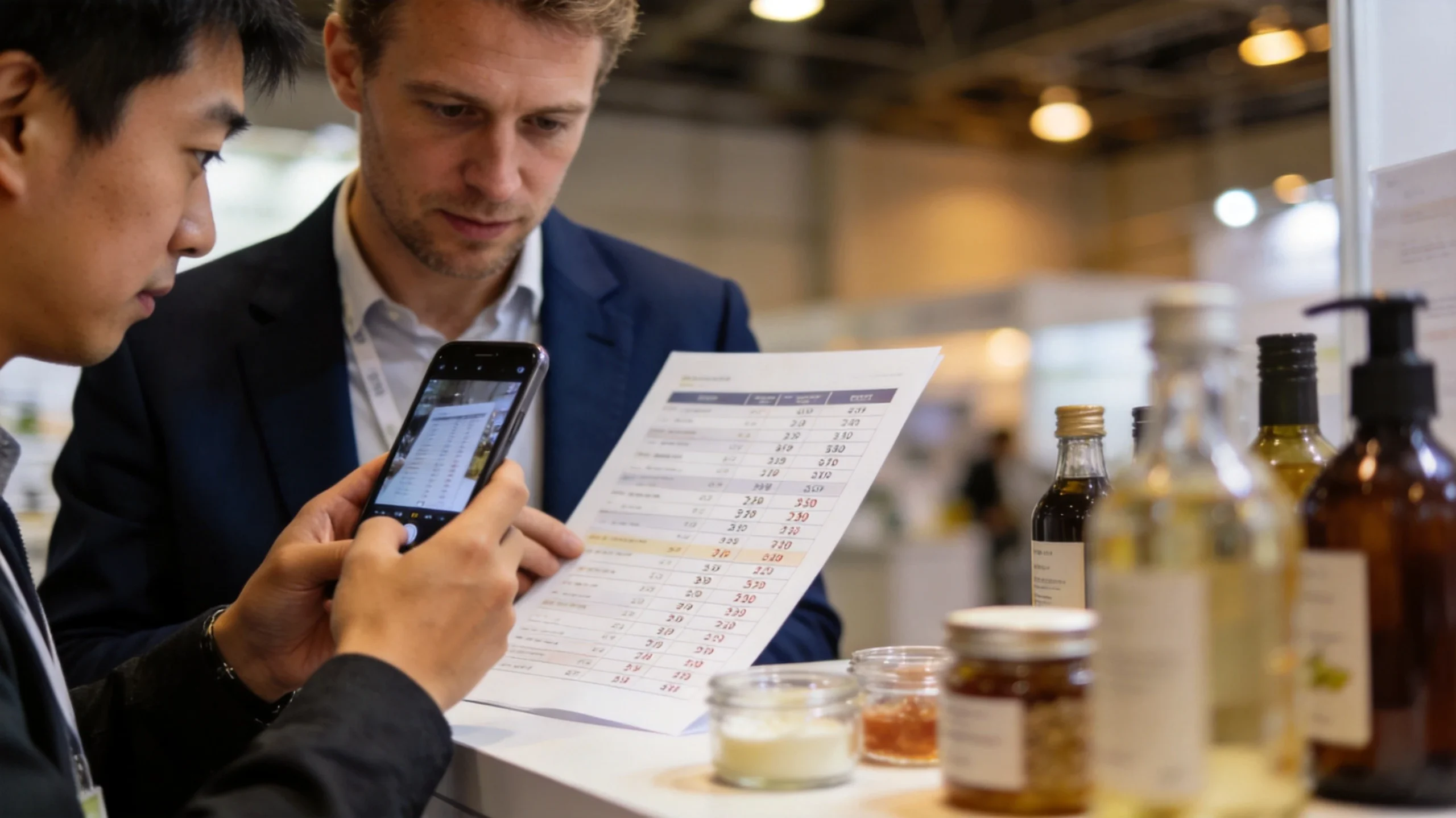
The opposite signal is also reliable: a solo visitor who takes a brochure, tastes one sample, says “very interesting,” and moves on without involving anyone else is roughly 80% less likely to follow up after the show, based on our tracking across FHC, ProWine, Food Japan, and Seoul Food across multiple years. We have watched the same pattern repeat in every market. Reading those signals is only half the job — what you do in the thirty days after the booth closes determines whether the serious ones actually move. Our 30-day framework for converting trade show leads covers the A/B/C triage, the three-document sequence, and the day-30 soft close that separates pipeline from business-card tourism.
If you see the internal-sell behaviour happening, stop your pitch and make it easy for them. Hand them a clean copy of the price sheet. Offer to email it before they leave the booth so they have a digital version for their group chat. Ask who else is on their team who should see the information.
3. They ask which other Asian markets you are already selling into
This question sounds like casual conversation. It is due diligence, and it is one of the most revealing questions an Asian buyer can ask.
What they are really checking is three things: whether you already have distribution that might create channel conflict in their market, whether your packaging and documentation are already adapted for Asian regulatory requirements, and whether you are genuinely new to exporting or simply new to their specific country.
A Japanese importer who asks “are you in Korea already?” is not making small talk. They are assessing whether they need to move fast to secure the market before a Korean competitor does, or conversely whether you have already been picked up by someone they know and the opportunity is gone. A Korean buyer asking the same question about China is often checking whether you have survived a China registration process, which they read as a proxy for how documentation-ready you are.
If they ask this question, it means they are evaluating you as a potential line for their portfolio rather than browsing for curiosities. It is the kind of question an Asian food importer asks when they have moved past “this looks interesting” and into “does this fit what we are building in this category right now.” The answer matters less than the fact that they asked.
4. They name a specific channel — retail, HoReCa, or e-commerce
A buyer who says “this would work for our high-end supermarket programme” or “our on-trade sommeliers would programme this by the glass” has done something most browsers never do: they have placed your product into a specific mental shelf.
Generic language — “this is interesting,” “great product,” “I love your story” — means nothing. It is the social default at a trade show and it costs the speaker nothing to say it. Channel-specific language means they have a path to revenue in mind.
Listen for channel granularity. A Korean buyer who says this would fit their department-store gourmet floor, not just “retail,” is further along in their thinking than someone who says it might work for stores. A Japanese buyer who talks about convenience-store formats versus natural-foods specialty chains is already at SKU-selection level, not awareness level. A Greater China buyer who specifies whether they are thinking about Tmall Global versus offline supermarket versus HoReCa is giving you a routing blueprint.
When you hear channel-specific language, match it immediately. Do not continue your generic pitch. Ask which of their existing brands are in that channel, what their typical margin structure looks like for that channel, and what volume they do per SKU in that segment. The conversation moves from awareness to qualification the moment you meet their channel language with channel-specific questions.
5. They give you a direct mobile or WhatsApp instead of only a generic company card
This signal is underrated by first-time exhibitors, and it operates differently across the three major North Asian markets.
In Japan, business-card exchange (meishi) is ritualised and a card alone tells you almost nothing about intent. What matters is whether, after the card exchange, they add you on LINE or offer a direct mobile number. A Japanese buyer who shares a personal LINE ID is making a meaningful escalation because LINE is their primary business messaging layer for relationships that matter. Generic email addresses on company cards go to a shared inbox that is checked by an assistant, if at all.
In Korea, the equivalent signal is a KakaoTalk ID or a direct mobile. Korean procurement teams move fast and they prefer messaging over email for active conversations; if you leave a Korean booth meeting with only an info@ address and no KakaoTalk, treat that lead as cold.
In Greater China, WeChat is the default, and most buyers will offer it freely, so the signal is weaker. What matters more on the mainland is whether they invite you to visit their office or warehouse after the show — that is the real escalation in a market where in-person relationship building still drives distribution decisions.
Across all three markets, the principle holds: a generic card is a wall, not a door. A direct messaging contact is an opening worth following up within 24 hours.
6. They ask about label compliance, ingredient certification, or registration requirements
If they raise labelling, food-additive approvals, JAS certification, organic equivalency, halal, shelf-life testing, cold-chain requirements, or factory registration within the first ten minutes, they are not a browser. They are running a regulatory screen on you in real time.
This is the difference between an import professional and someone who likes your product. Someone who has been importing food into Asia for more than two years has been burned by a compliance delay — a rejected container at Kobe port, an MFDS ingredient rejection in Busan, a CIQ registration holdup in Shanghai — and they will qualify you on those dimensions early because they do not want to repeat the experience.
We have written in more detail about how long these registration and compliance steps really take, and why they routinely consume more of the timeline than buyers expect, in our piece on the first food shipment Asia timeline from contract to shelf. If a buyer is already asking these questions at your booth, they have lived that timeline before. Treat them accordingly.
The opposite is also telling: a visitor who never asks about compliance, certification, labelling, or shelf life is almost certainly not going to be the person doing the importing. They might be a broker, a media contact, a student, or a competitor doing market research, but they are not going to be signing a purchase order. When we do importer sourcing projects for clients, this early compliance screen is the fastest way to separate real buying intent from polite curiosity.
7. They name a concrete next step before they walk away
“Send me the price list by Friday.” “Come to our office when you are in Seoul next month.” “We are doing Q1 catalogue reviews in December — get the samples to us by mid-November.” Any next step that includes both an action and a timeframe is a buy signal.
The classic fake close at Asian food trade shows is “let’s stay in touch” or “send me an email after the show.” That is not a next step. It is a polite exit with no commitment attached. It means the conversation is over.
A serious buyer will tie their next step to their own internal calendar — a catalogue review deadline, a buying committee meeting, a seasonal reset window, a trade-show follow-up schedule. They name a date because their own internal process has dates, and they are placing you somewhere inside it.
When you hear a concrete next step, write it on the back of their business card immediately while they are still standing there. Confirm it back to them: “So I’ll send the spec sheet and MOQ tier to you by this Friday, is that right?” Get them to nod or say yes. That verbal confirmation, however small, increases follow-up response rates significantly because you have turned a vague intention into a tiny commitment.
3 Red Flags — Walk Away Politely
Not every business card is worth following up on. After enough shows, you learn to spot the patterns that cost you samples, time, and emotional energy with zero commercial outcome. These are the three we treat as automatic deprioritisations.
1. They ask only for free samples and never touch commercial terms
Sample collectors exist at every food show in every market, and they are disproportionately visible at Asian shows because many exhibitors over-sample in an effort to be hospitable. If a visitor tastes three products, asks for four samples to take away, and at no point asks about price, MOQ, lead time, or distribution, you are a free tasting station, not a prospect.
This is not to say you should never give samples. Samples are part of doing business at a food show. But offer them after a commercial conversation has happened, not before. If someone reaches for a sample before they ask what you do or who you work with, that is the wrong order. Politely offer a taste, then redirect with “are you looking for a specific category for your portfolio right now?” If there is no commercial answer, do not give them six SKUs to take home.
We have spoken to European exhibitors after shows who shipped 40 kilograms of samples out of their booth on Day 1 and received zero follow-up emails from any of those recipients. That is not bad luck; that is no qualification at the booth.
2. They claim to cover “all of Asia” with no channel specifics
No single company covers Japan, Korea, Greater China, Southeast Asia, and India with one team, one warehouse, one import licence, and one channel model. Anyone who tells you they do is either a broker with no infrastructure of their own or a trading company planning to shop your product to every contact they have without committing to anything.
A credible distributor or importer names countries. They name channels. They can tell you which competing brands they carry, which retailers they ship to, and roughly how many cases per month they move in a given category. If the answer to “which markets do you cover?” is “all of Asia” followed by no specifics, you are not talking to someone who is going to place an order. You are talking to someone who is going to send your price sheet to fifteen of their contacts and hope something sticks. That is not representation; that is lead routing with no accountability.
This is not to dismiss genuine pan-Asian groups — they exist, particularly in the wine and spirits category — but even the legitimate ones will tell you which countries they handle directly, which they handle through partners, and where they are weakest. Blanket claims are a warning sign.
3. They badmouth their current suppliers or demand exclusivity on the spot
A buyer who spends five minutes telling you how terrible their current supplier is — late shipments, quality problems, communication issues, terrible service — before they have even seen your full range will say exactly the same things about you twelve months later. Blaming suppliers is a habit, not a one-off judgement, and it tells you more about how that buyer manages relationships than it tells you about their current partner.
The second half of this red flag is more dangerous: demanding exclusive distribution before they have seen pricing, compliance documentation, MOQ, SKU range, or your export track record. Exclusivity is a concession that is earned through volume, not granted as an opening gesture. A buyer who demands territory exclusivity at a first booth meeting, with no purchase commitment attached, is almost always trying to lock up the rights to your brand so they can control the process without investing anything.
We have written a more detailed checklist for this stage in our guide to vetting an Asian food importer before you sign, including ten specific red flags beyond the three covered here. Exclusivity-without-commitment is in our top three.
What to Do on Day 2 Before the Floor Opens

If you are reading this on the morning of 11 November, coffee in hand, before the doors open, here is what to do in the next 30 minutes.
First, sort every Day 1 card into A, B, C piles before Day 2 conversations start blurring the signal. Use the seven signals above as your checklist. Three or more signals = A grade. One or two = B grade, worth a polite post-show email. None = C, do not chase.
Second, the A-grade cards get a WhatsApp or LINE message today, not next week. A short message while you are both still physically at the show — “good meeting you yesterday, as discussed I’ll send the spec sheet Friday, have a good Day 2” — converts at meaningfully higher rates than a post-show email seven days later, when the buyer has already had 40 similar conversations and your face has blurred into the crowd.
Third, bring yesterday’s price sheet and MOQ tier card to every Day 2 meeting, physically printed, not just on your laptop. The serious buyers you met on Day 1 may come back today with a colleague; they will ask for a copy again. The buyers who did not ask about pricing yesterday may ask today after they have walked your competitors and are ready to compare.
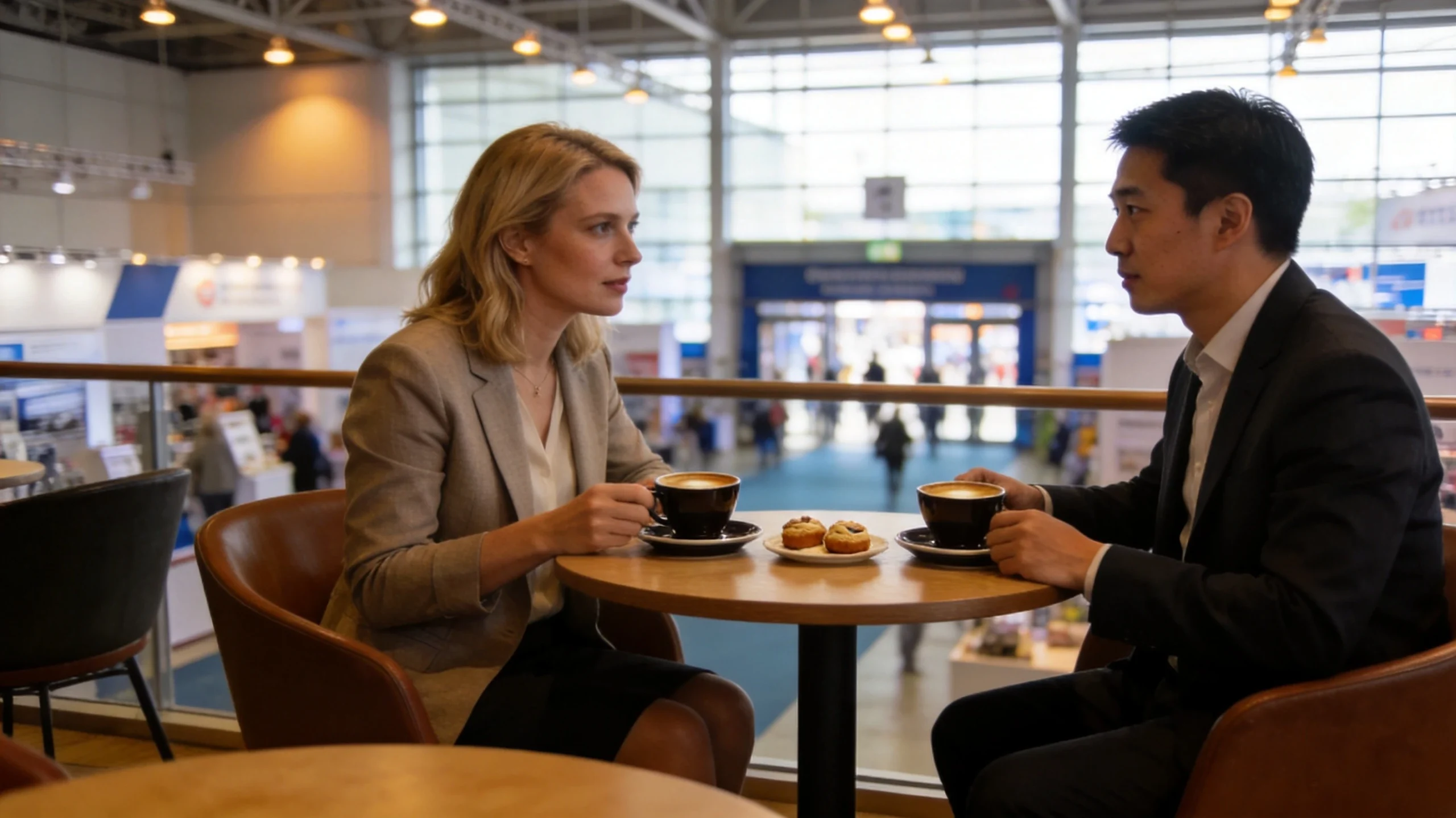
Fourth, if a Day 2 conversation produces four or more of the seven signals above, do not keep it standing at the booth. Offer a 15-minute sit-down at a nearby café or the booth-area seating. Moving from a standing conversation to a seated one changes the psychological frame — it turns a booth encounter into a meeting — and in our observation roughly doubles follow-up rates.
If you want more structure around the booth conversation itself, our earlier piece on how to qualify Asian food distributors before handing over samples has eight specific questions to ask before you give away anything. And for the nine most expensive Asian food trade show booth mistakes to avoid while you are still on the floor, see our FHC Day 1 piece on common Asian food trade show mistakes.
Want a Second Opinion on a Day 1 Lead?
If you are walking FHC this week and want a quick second opinion on whether a specific conversation is worth pursuing, you can find me on-site all three days, 10–12 November. Reach me on WeChat (ID: specitkevin) or WhatsApp (+86 150 2128 9465) during the show, or leave a note at the overseas exhibitor information desk and I will swing by your booth. I can read Asian food buyer signals in real time and tell you in two minutes whether to prioritise or deprioritise.
After the show, I have set aside six 30-minute lead-sort calls for 13–15 November. Bring your business cards, your notes, and your gut feeling about which conversations were real and which were just polite. In 30 minutes I will tell you which leads are worth your follow-up energy over the next two weeks, which ones to deprioritise, and what the first email to each A-grade prospect should say. Book a slot by emailing kevin@specitconsulting.com with “FHC lead sort” in the subject line — I will respond within 48 hours with available times.
Disclaimer: Specit Consulting provides general informational content about international food trade, regulatory compliance, and route-to-market strategy in Asian markets. This article is based on general trade show observation across multiple markets and is intended for general informational purposes only. It does not constitute legal, regulatory, tax, or professional business advice. Buyer behaviour varies significantly by market, product category, price segment, and channel, and the signals described in this article are general patterns drawn from the authors’ professional experience rather than definitive rules or guaranteed predictors of importer behaviour. Always verify specific commercial terms, regulatory requirements, import procedures, label compliance, shelf-life rules, additive approvals, and contractual obligations with qualified legal, regulatory, and tax advisors in the relevant market before entering into any distribution agreement, making binding export commitments, or shipping product. Examples and conversion-rate observations reflect the authors’ professional tracking across multiple trade shows and are not guarantees of individual outcomes. Specit Consulting does not warrant the accuracy, completeness, or timeliness of the information contained in this article, and accepts no liability for commercial decisions made based on this content.
Frequently Asked Questions
How many qualified leads should I expect from my first Asian food trade show?
For a small non-Asian food producer doing their first major Asian show, five to fifteen genuinely qualified conversations over a three-day event is a realistic and healthy outcome. The other 30–50 cards you collect are contacts, not leads. A qualified conversation, in our definition, is one where the buyer asked commercial questions (MOQ, pricing, lead time, channel), named a specific market or channel, and proposed or agreed to a concrete next step. If you leave the show with five A-grade leads, that is a successful show. Anything above ten is exceptional for a first-time exhibitor.
Should I give exclusive distribution to the first Asian food importer who offers?
No. Exclusivity without a minimum purchase commitment, a defined territory, a performance clause, and a fixed term is one of the most expensive mistakes new-to-Asia producers make. Granting exclusivity at a first booth meeting — before you have seen pricing, compliance documentation, references, or their existing portfolio — effectively removes your leverage and gives the distributor control of your brand in that market with no obligation to perform. Offer territory exclusivity only after a track record of orders is established, typically after two to three successful reorders over a 6–12 month period, and always tie it to a documented performance threshold: annual volume, SKU count, marketing investment, or retail-listing commitments.
How soon after an Asian food trade show should I follow up with A-grade leads?
Within 24 hours for A-grade leads, ideally before the show even ends. Our tracking across multiple Asian food trade shows puts the 48-hour follow-up window at roughly double the response rate of an email sent seven days after the show. After one week, most professional buyers have already processed their show follow-ups internally, had their category review meetings, and moved on to their normal Q4 workload; your email joins a pile of 200 similar follow-ups and gets deprioritised. For A-grade leads from Japan, a short LINE or WhatsApp message during the show itself, followed by a formal email with the promised documents within 24 hours, is the highest-conversion sequence we have tested. Reading the Asian food buyer signals early means you can move fast on the right ones before your competitors do.
Need help navigating your market entry?
We've helped food exporters across 10+ countries enter 13 Asian markets. Get a free initial assessment based on public data — delivered in 3 working days.
Get Your Free AssessmentContinue Reading
▶Japan Food Distribution: HORECA vs Retail vs Online Channel Strategy
▶GACC Registration: 5 Mistakes That Get Your China Filing Rejected
Questions about entering the Asian market?
Chat with us on WhatsApp →