

18 August 2026 | Shanghai, China
Understanding China tariffs on imported food is the first step to accurate landed-cost estimation. Exporters often make a costly assumption: they look up the Most-Favoured-Nation tariff rate and think that’s what they’ll pay. It’s not. By the time customs adds value-added tax and other charges, the bill is significantly higher.
What We Saw
When food products enter China, they face three separate charges, not one. The MFN tariff is the base duty rate, determined by the product’s HS code. Value-Added Tax (VAT) sits on top — 9% for most food products, 13% for certain categories. And for specific goods like alcoholic beverages, consumption tax applies as well.
Many exporters stop at the MFN rate and build their margins around that number. Then the first shipment clears, the landed cost comes in higher than expected, and the pricing that looked competitive on paper no longer works. The importer absorbs the surprise, or passes it back, and trust suffers from day one.
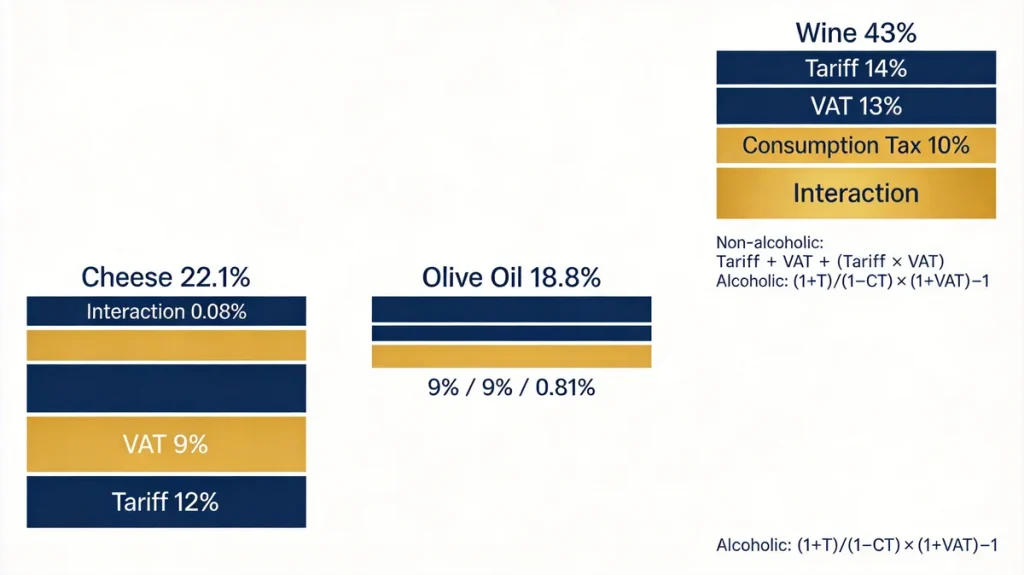
The actual calculation is not complicated once you know it, but the formula differs depending on whether consumption tax applies.
Non-alcoholic products:
Comprehensive Rate = Tariff + VAT + (Tariff × VAT)
Fresh cheese at 12% tariff and 9% VAT lands around 22.1%. Virgin olive oil, with a 9% tariff and 9% VAT, comes to approximately 18.8%. Filled chocolate at an 8% tariff and 13% VAT comes to about 22%. Frozen shrimp is lighter, at 5% tariff and 9% VAT, giving around 14.5%.
Alcoholic beverages (consumption tax compounds):
Comprehensive Rate = (1 + Tariff) / (1 − CT) × (1 + VAT) − 1
Still wine at 14% MFN tariff, 13% VAT, and 10% consumption tax: the effective rate climbs to approximately 43% — more than triple the MFN rate alone. This is the category where the gap between what exporters expect and what they actually pay is widest.
Two other traps show up repeatedly on the ground.
The first is classification drift. A small change in processing — roasted versus unroasted coffee beans, preserved versus fresh product — can shift the HS code and change the tariff meaningfully. Many exporters use the HS code that feels right based on their home market classification, without confirming how Chinese customs will treat the same product (see HS Code Misclassification in Asia). For official tariff rates, see the WTO I-TIP database.
The second is documentation. Free Trade Agreement tariff reductions do not apply automatically. A valid Certificate of Origin or Registered Exporter (REX) certification in the EU must be in place and issued before the shipment leaves. Without it, the full MFN rate applies, regardless of what a trade agreement says on paper.
Why This Matters for You
The comprehensive tax rate is the number that affects your landed cost, your importer’s margin, and your final shelf price. The MFN rate is only the starting point. In Vietnam, Vietnam entry costs vs China follow a different structure — no single comprehensive formula applies. Exporters who price on the wrong number either lose margin quietly or arrive in the market with a price that cannot compete. Japan's additives positive list is another system that catches exporters off guard.
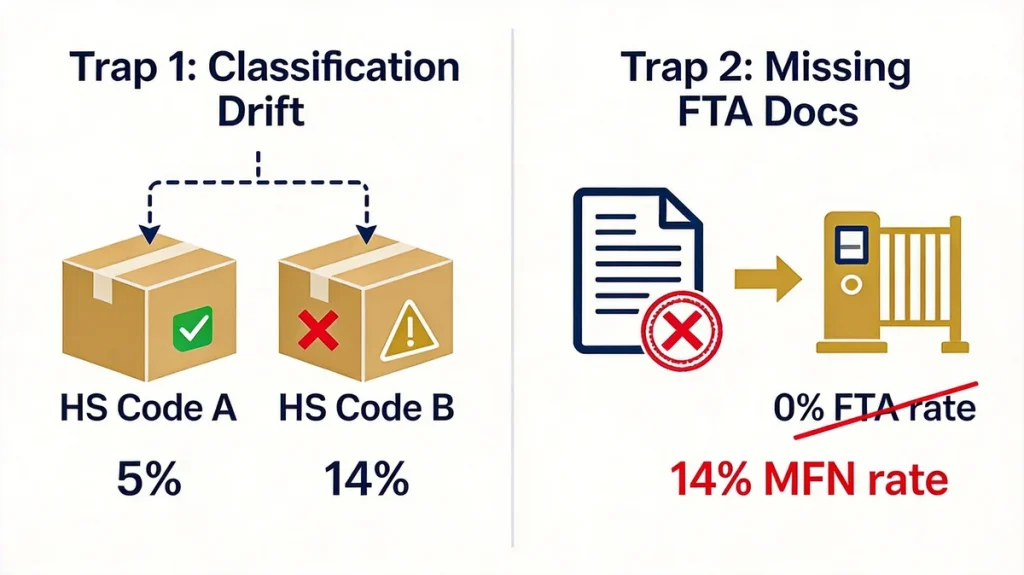
The classification issue deserves particular attention. A product classified one level down or one category across can face a tariff difference of several points — and that difference repeats on every shipment. The FTA issue is equally costly, and even more avoidable. The certification needs to be arranged before the goods move. Sorting it out after the fact is usually impossible. The exporter who discovers they could have paid 0% instead of 14% on the first container rarely makes that mistake again — but the margin on that first shipment is already gone.
Takeaway
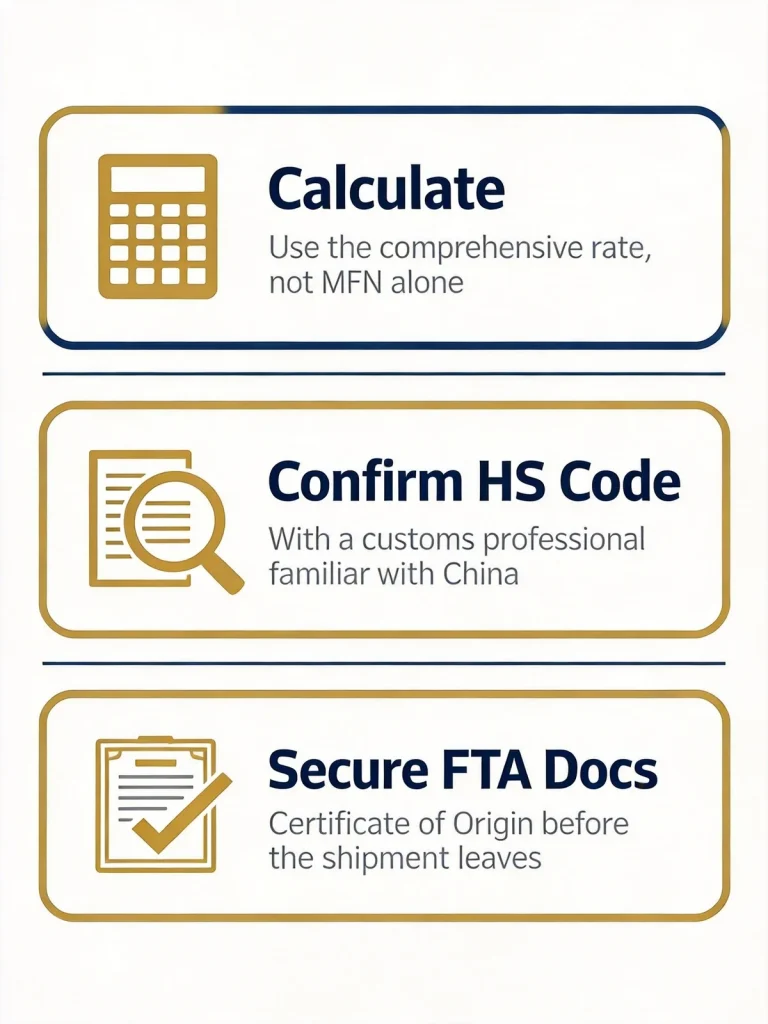
Calculate before you commit. The number that matters is the comprehensive tax rate — tariff plus VAT plus the interaction — not the MFN rate alone. Confirm your HS code with a customs professional familiar with Chinese classification practice, and do not assume your home market code will carry over unchanged. If you are eligible for FTA tariff reductions, secure the Certificate of Origin or REX registration before the shipment leaves, not after. Get any of these wrong, and the importer’s first shipment becomes a conversation about numbers neither of you expected.
Need help calculating the real landed cost for your product in China? Read our guide on GACC Decree 248 and how compliance affects your shipment timeline. Or contact us directly for a product-specific landed cost estimate.
Need to understand your landed cost in Asia? See our Import Duties & Tariffs service
About Specit Consulting
We help food and beverage brands enter and grow in the Chinese and wider Asian markets through trade intelligence, importer identification, and market research.
✉ info@specitconsulting.com
Disclaimer
This article reflects general market observations and regulatory understanding as of August 2026. Tariff and tax rates are indicative and may vary based on specific product characteristics and applicable trade agreements. Always confirm current rates with a customs professional or the relevant authority before shipping.
Need help navigating your market entry?
We've helped food exporters across 10+ countries enter 13 Asian markets. Get a free initial assessment based on public data — delivered in 3 working days.
Get Your Free AssessmentContinue Reading
▶What CIIE Exhibitors Learn After Their First Year in China
Questions about entering the Asian market?
Chat with us on WhatsApp →