

28 August 2026 | Shanghai, China
Most exporters approach Japan with a simple assumption: fill in the forms, pass the tests, and you're in. The official guide makes it look that straightforward. It's not.
Three hidden traps routinely catch exporters off guard — and each one can hold a shipment at the port, not because the product fails, but because the process has its own rhythm.
What We Saw
The first surprise is timing. Importers must register with Japan's Ministry of Health, Labour and Welfare (MHLW) before bringing in food products. Under Article 27 of the Food Sanitation Act, every shipment requires an import notification (届出) filed with the quarantine station. The official guidance says the notification is processed within two to five business days. That part is accurate — once your documentation is complete.
The delay comes from everything that must happen before that notification can be filed. The importer must hold a valid food sales business licence under Article 30 of the Food Sanitation Act. For certain product categories, ingredient reviews, specification checks, and first-shipment inspections add weeks or months. MHLW processes these prerequisites by product category, and your place in the queue depends entirely on your category's current schedule. We have seen exporters budget two months for the full process and end up waiting five — by which point the product's shelf life had already started to run down.
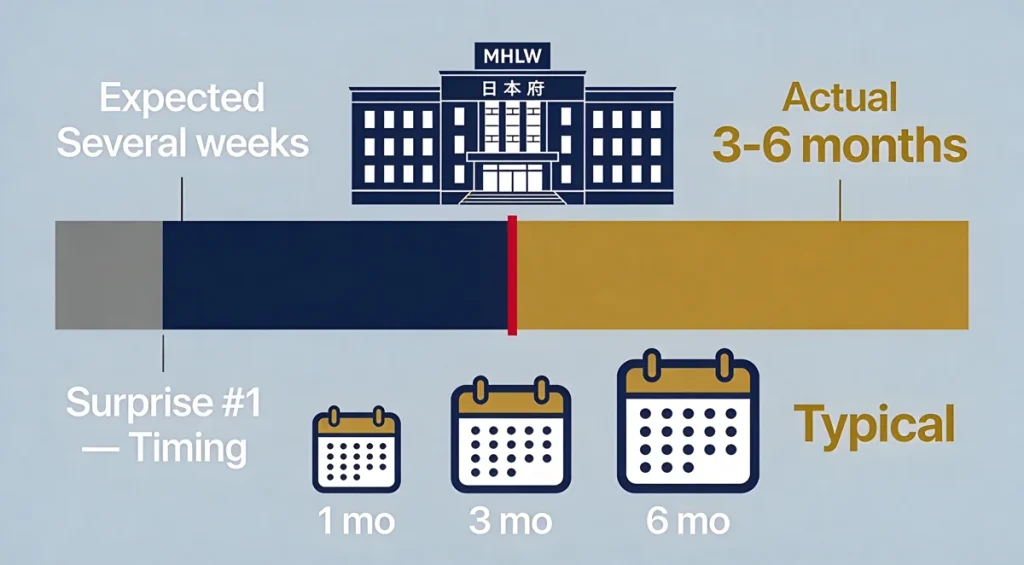
The regulation states a timeline for the notification itself. It does not set a timeline for everything you must complete before you can file. That distinction is where exporters lose time.
The second surprise is the additives system. Japan's Food Sanitation Act operates on a positive list. If an additive is not explicitly listed, it is not allowed. An additive permitted in Europe may not be permitted in Japan, and the permitted limits vary even for additives both systems allow.
This principle extends to packaging materials. Since June 2020, Japan has enforced a positive list for synthetic resins used in food contact materials — utensils, containers, and packaging. The five-year transition period ended on 31 May 2025; as of that date, all synthetic resins in food contact applications must comply with the positive list, with no further grace period. Base polymers and additives retained in the final material are both subject to the list. Exporters who assumed their EU-compliant packaging would automatically pass in Japan are now discovering that it does not.
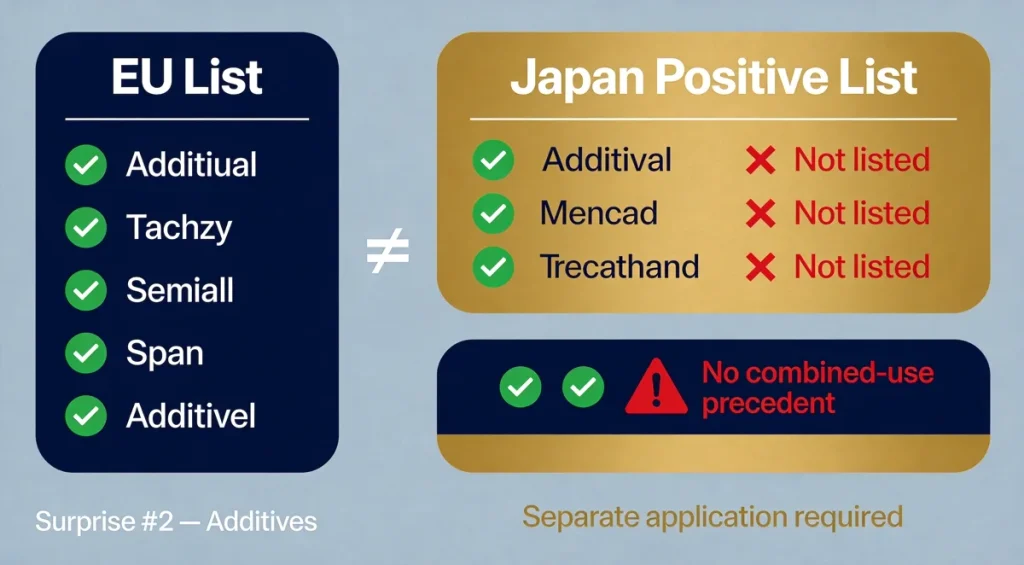
The real trap is combinations: two additives that are individually permitted may have no approved precedent for combined use. That triggers a separate application process, which adds time and cost to a product that was ready to ship.
The third surprise is labelling. Japan's labelling requirements are governed by the JAS Law and the Food Labelling Act (administered by the Consumer Affairs Agency). The label must be in Japanese and include product name, ingredients, allergen information, preservation method, manufacturer or importer name, and country of origin.
In April 2026, the Food Labelling Standards were amended. Cashew nuts were added to the list of mandatory allergen declarations (特定原材料), and pistachio was added to the recommended list. At the same time, decades-old individual labelling rules for specific food categories are being unified into a single standard — which means some product types that previously had their own naming and display rules now follow different requirements. Any label created before April 2026 should be reviewed against the amended standard.
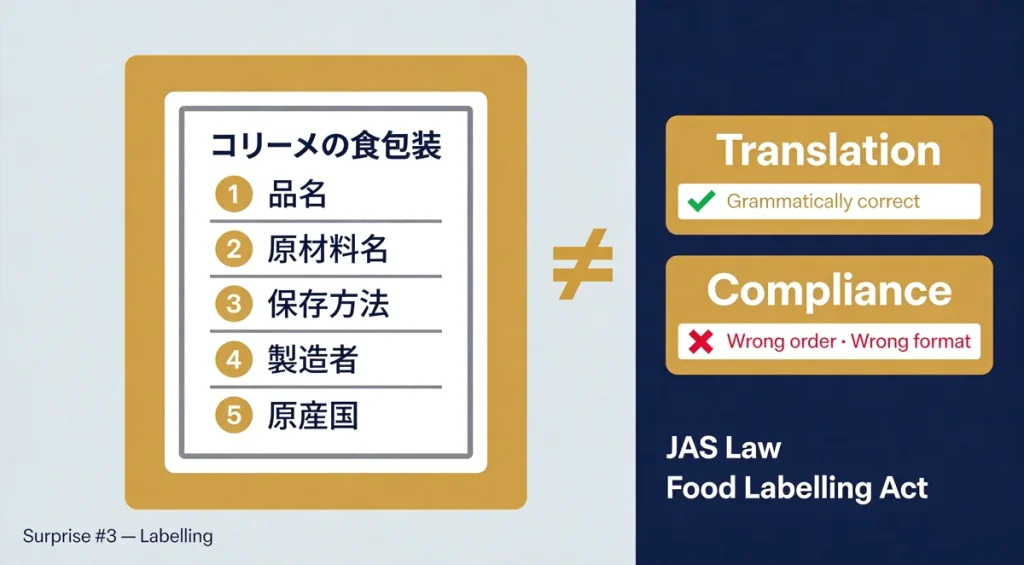
The deeper problem is that translation and compliance are not the same thing. A label can be grammatically correct but still fail because the information is in the wrong order, the font size does not meet requirements, or the nutritional format differs from EU standards. Japan's nutritional labelling requires sodium to be expressed as salt equivalent (食塩相当量), calculated as sodium (mg) × 2.54 / 1000 — not used in the EU or US — China has its own nutrition format too. Translation agencies are not equipped to handle this; they know the language but not the regulation.
Why This Matters for You
Japan is Asia's second-largest food import market after China, with agricultural and food imports reaching a record ¥13.8 trillion in 2025. The opportunity is real, but the friction is underestimated.
These three surprises are not theoretical risks. We have seen each one cause actual financial losses: containers sitting at the port, orders cancelled, and trust eroded between exporter and importer.
What makes these traps particularly dangerous is that none of them appear in the official guide. The guide describes a process. It does not describe the rhythm of that process. The exporter who reads the regulation and assumes the stated timelines are accurate is already behind. The exporter who assumes their EU-compliant additive profile will pass in Japan is betting on a different system. The exporter who treats labelling as a translation task is delegating a legal document to someone without legal responsibility.
The pattern is consistent: the exporters who struggle in Japan are not the ones with bad products. They are the ones who underestimated the system. Japan rewards precision, patience, and early verification. It punishes assumptions.
Takeaway
Before committing to Japan:
• Research the current processing timeline for your specific product category. Don't rely on the regulation's stated notification timeline—ask someone who has gone through the full process recently.
• Run an additive compliance check before finalising your formulation, including packaging materials and combined-use scenarios. The food contact materials positive list is now fully enforced with no transition period.
• Have your label reviewed by someone who understands the Food Labelling Act and the April 2026 amendments, not just a Japanese translator. Make it a compliance task, not a translation task.
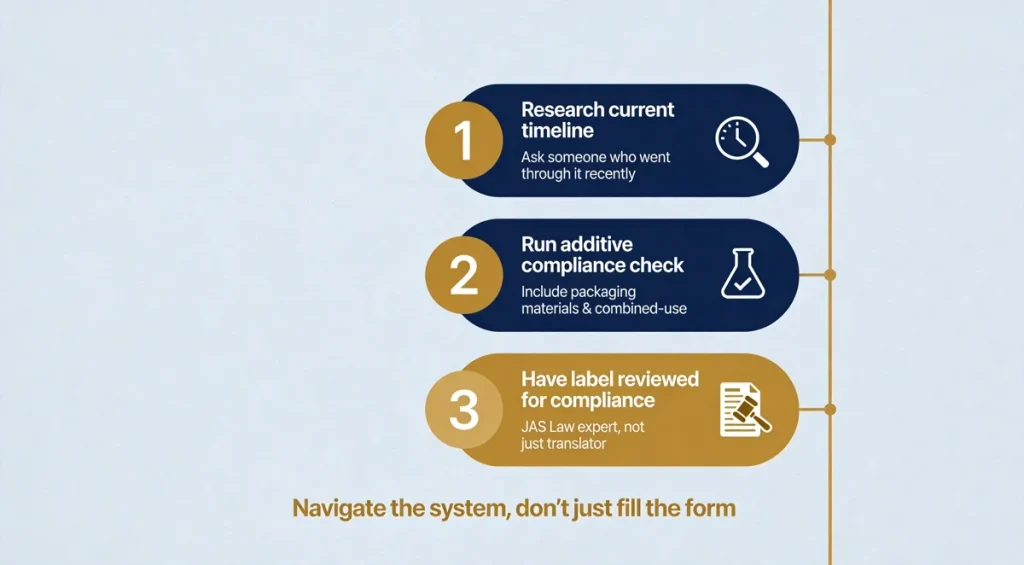
The exporters who treat Japan as a system to be navigated — not a form to be filled — are the ones who clear the port on schedule.
Need help preparing your product for Japan? Contact Specit Consulting for a pre-entry compliance review before you commit.
About Specit Consulting
We help food and beverage brands enter and grow in the Chinese, Japanese, and Korean markets and the wider Asian region through trade intelligence, importer identification, and market research.
✉ info@specitconsulting.com
Disclaimer: This article reflects general market observations and regulatory understanding as of August 2026. It does not constitute legal or regulatory advice. Always confirm current requirements with the relevant authority or a qualified regulatory consultant.
Need help navigating your market entry?
We've helped food exporters across 10+ countries enter 13 Asian markets. Get a free initial assessment based on public data — delivered in 3 working days.
Get Your Free AssessmentContinue Reading
▶What CIIE Exhibitors Learn After Their First Year in China
Questions about entering the Asian market?
Chat with us on WhatsApp →