

1 September 2026 | Shanghai, China
Indonesia is Southeast Asia’s largest market with 275 million people — but most exporters underestimate the compliance barriers that await at the border. BPOM registration and mandatory Halal certification are the two gates that stop more shipments than tariffs ever will.
What We Saw on the Ground
Every imported food product must obtain a BPOM Foreign Food Registration Number before it can be legally sold in Indonesia. The National Agency of Drug and Food Control issues the registration, and an Indonesian legal entity must hold it— typically a PT company with a valid Importer Identification Number and Business Identification Number.
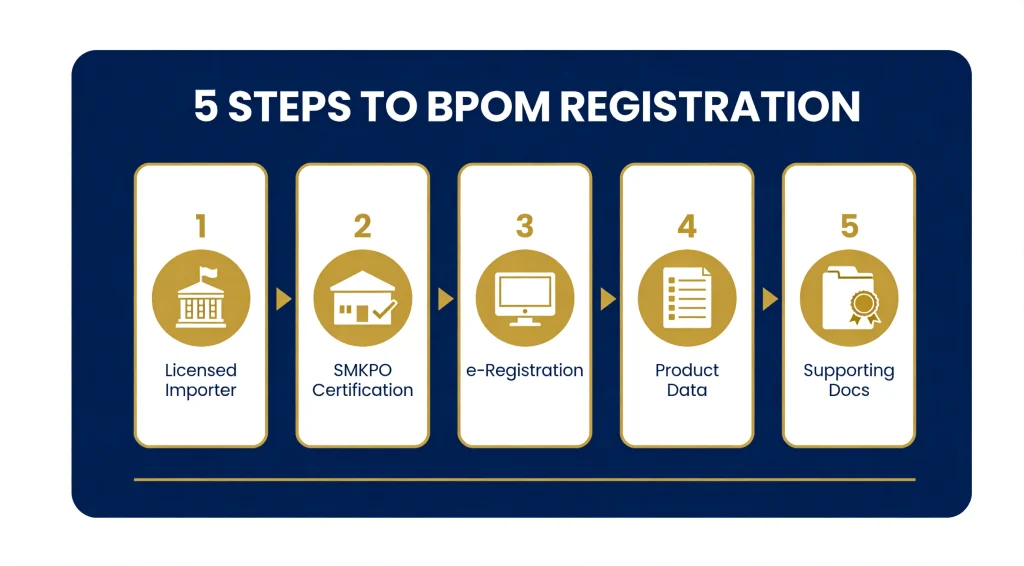
The process has more steps than most exporters expect.
First, establish a licensed Indonesian importer with a tax number, trading license, and NIB carrying the correct KBLI classification for food distribution.
Second, complete SMKPO certification before any product registration can begin — this verifies the importer’s warehouse storage standards, pest control, and traceability systems. SMKPO is mandatory for first-time food importers registering with BPOM, and the certificate is valid for five years. Without SMKPO, BPOM will not accept product registration applications.
Third, create an account in BPOM’s e-Registration portal and upload company documents.
Fourth, submit product data: ingredient lists, manufacturing flowcharts, shelf-life studies, and Indonesian-language label designs.
Fifth, upload supporting documentation including Certificate of Free Sale, Health Certificate, Certificate of Analysis, GMP/HACCP certificates, and product specifications.
Officially, BPOM has 30 working days to evaluate a complete application. In practice, expect two to twelve months depending on product risk classification. High-risk products like infant formula take significantly longer than low-risk items.
Halal Certification: The Second Gate
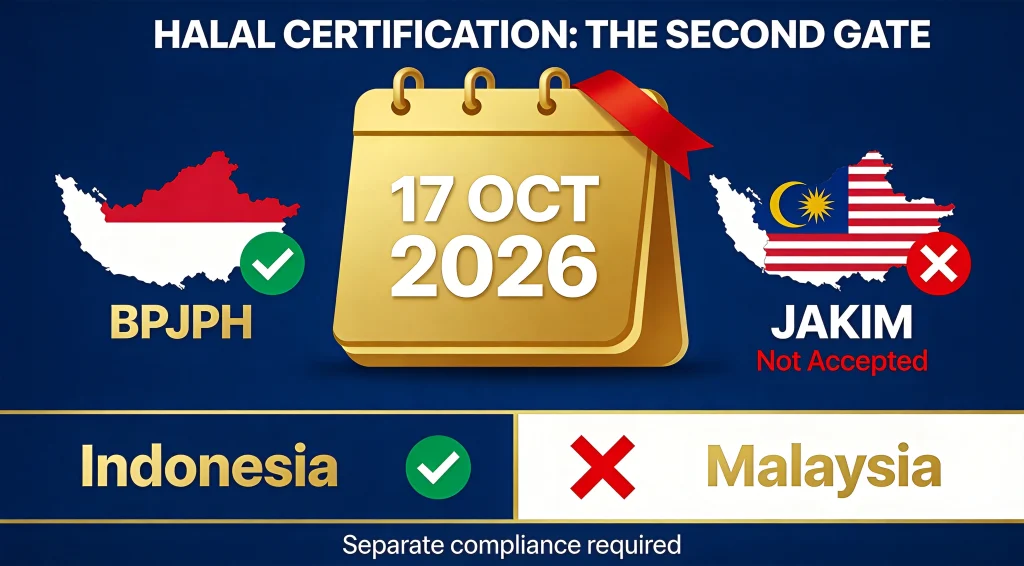
Halal certification becomes mandatory on 17 October 2026 for all packaged food and beverages under the Halal Product Assurance Law (Law No. 33/2014). Primary-sector goods like fresh vegetables and fruit are exempt, but seafood and processed or flavoured foods require certification.
Existing foreign Halal certificates from institutions recognised by BPJPH can be registered through the SHLN pathway. Uncertified brands must start the BPJPH audit process immediately — certification takes several months, and certifier slots will become scarce as the deadline approaches.
A common misconception is that Halal certification from Malaysia’s JAKIM is accepted in Indonesia. It is not. The two systems operate independently. Indonesia’s BPJPH requires its own registration process, even for products already certified by JAKIM. As of September 2025, 89 foreign halal institutions held mutual recognition agreements with BPJPH, with 29 more pending — but recognition earned in one market does not transfer to Indonesia by default. Exporters serving both markets need separate compliance strategies.
Labelling, Licensing, and the Import Certificate
Labels must be in Bahasa Indonesia and include product name, ingredient list in descending order, nutrition facts, allergen information, production and expiry dates, importer details, and Halal information once mandatory.
The Nomor Izin Edar (NIE) is the product-level import permit — each SKU requires its own NIE. Every shipment also requires an Import Certificate (SKI). For processed food, SKI can be fulfilled after customs release within the regulated timeframe, but it must be in place before distribution. For drugs, cosmetics, and health supplements, SKI must be completed before customs clearance (SKI Border).
Why This Matters for You
The realistic timeline from decision to first cleared shipment is six to nine months.
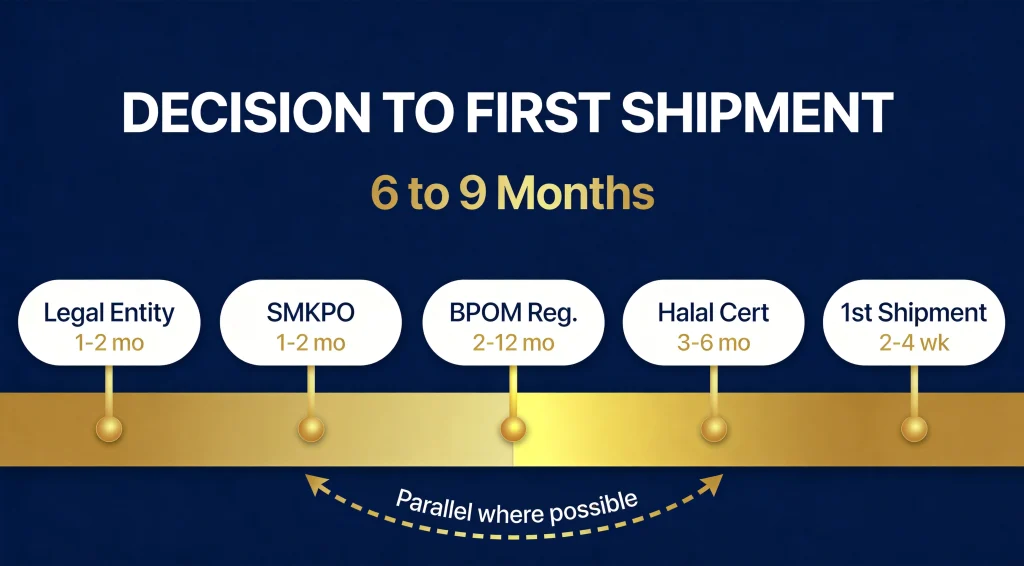
Establishing the legal entity and NIB takes one to two months.
SMKPO warehouse certification takes one to two months.
BPOM registration per SKU takes two to twelve months.
Halal certification, if not already held, takes three to six months.
First shipment customs clearance adds two to four weeks.
The sequencing matters. SMKPO must come before BPOM registration. BPOM registration must come before the NIE can be issued. The NIE and SKI must both be in place before the container clears distribution. Exporters who start in the wrong order lose months. Exporters who start everything at once, in parallel where possible, can meaningfully compress the timeline.
The Halal deadline adds urgency. The 17 October 2026 mandate is not a soft target, and certifier capacity will tighten as the date approaches. Brands that already hold recognised foreign Halal certification have a genuine advantage — their SHLN registration is faster than a full local audit. Brands without certification should not wait.
Takeaway
Appoint your Indonesian importer first, and verify they can obtain SMKPO certification before you commit.
Start BPOM registration as early as possible, because the timeline runs two to twelve months and every month of delay pushes back your first shipment.
If you need Halal certification, begin the process now — the deadline is fixed, the certifier slots are finite.
Treat Malaysia and Indonesia as separate compliance markets, because their Halal systems are not mutually recognised.
Do not ship until the NIE and SKI are both confirmed.
The exporters who plan for six to nine months from day one are the ones who reach the shelf on schedule.
Need Help?
Need help navigating Indonesia’s BPOM and Halal requirements? Contact Specit Consulting for an initial assessment based on public data — before you ship.
About Specit Consulting
We help food and beverage brands enter and grow in the Chinese and wider Asian markets through trade intelligence, importer identification, and market research.
✉ info@specitconsulting.com
Related Services
• China GACC Food Registration
• Import Duties & Tariffs — Asia
• Labelling & Regulatory Requirements — Asia
• Importer Sourcing & Profile — Asia
Related Reading
• China Tariffs on Imported Food: What Exporters Actually Pay
• Labelling Compliance in China for Imported Food
• Exporting Wine to Thailand: Zero Tariff, Real Compliance Costs
Disclaimer: This article reflects general market observations and regulatory understanding as of September 2026. It does not constitute legal or regulatory advice. Always confirm current requirements with the relevant authority or a qualified regulatory consultant.
Sources
• Halal Product Assurance Law (Law No. 33/2014), Government Regulation No. 42/2024
• BPOM Peraturan No. 23/2023 on Processed Food Registration
• Tilleke & Gibbins, “Indonesia Halal Certification” (September 2025 analysis)
• U.S. Commercial Service Indonesia, Halal market-intelligence note (February 2025)
• Cekindo, “New Import Rules on BPOM-Regulated Goods” (August 2026)
• Insightof.id, “Food and Beverage Registration in Indonesia (BPOM).”
Need help navigating your market entry?
We've helped food exporters across 10+ countries enter 13 Asian markets. Get a free initial assessment based on public data — delivered in 3 working days.
Get Your Free AssessmentContinue Reading
▶What CIIE Exhibitors Learn After Their First Year in China
▶3 Trade Shows Where Asia Food Buyers Show Up
▶Exporting Wine to Thailand: Zero Import Tariff, Real Compliance Costs
Questions about entering the Asian market?
Chat with us on WhatsApp →